1996 CHEVROLET S10 four wheel drive
[x] Cancel search: four wheel drivePage 240 of 375
Downloaded from www.Manualslib.com manuals search engine Remote Oil Filter (Four-wheel Drive)
The access door for the remote oil filter is in the steering
linkage shield assembly located under the radiator
support. Twist the screw to unlock or lock the door.
What to Do with Used Oil
Did you know that used engine oil contains certain
elements that may be unhealthy for your skin and could
even cause cancer? Don’t let used oil stay
on your skin
for very long. Clean your skin and nails with soap and
water, or a good hand cleaner. Wash or properly throw
away clothing or rags containing used engine oil. (See
the manufacturer’s warnings about the use and disposal
of oil products.)
Used oil can be a real threat
to the environment. If you
change your own oil, be sure
to drain all free-flowing oil
from the filter before disposal. Don’t ever dispose
of oil
by putting it in the trash, pouring it on the ground, into
sewers, or into streams
or bodies of water. Instead,
recycle it by taking it to a place that collects used
oil. If
you have a problem properly disposing
of your used oil,
ask your dealer, a service station or a local recycling
center for help.
Air Cleaner
“VORTEC” 4300 Engine
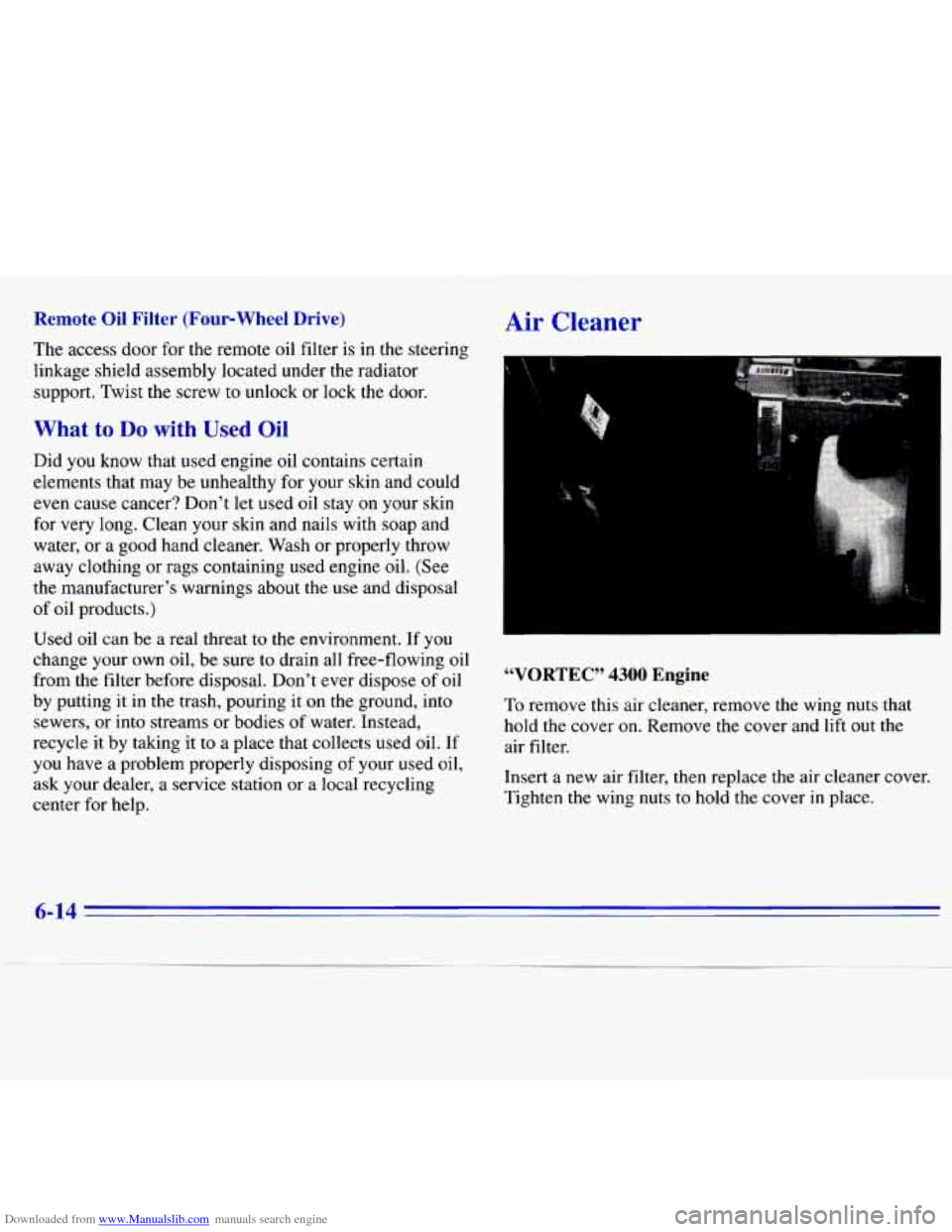
To remove this air cleaner, remove the wing nuts that
hold the cover
on. Remove the cover and lift out the
air filter.
Insert a new air filter, then replace the air cleaner cover.
Tighten the wing nuts to hold the cover
in place.
6-14
Page 248 of 375
Downloaded from www.Manualslib.com manuals search engine How to Check Lubricant
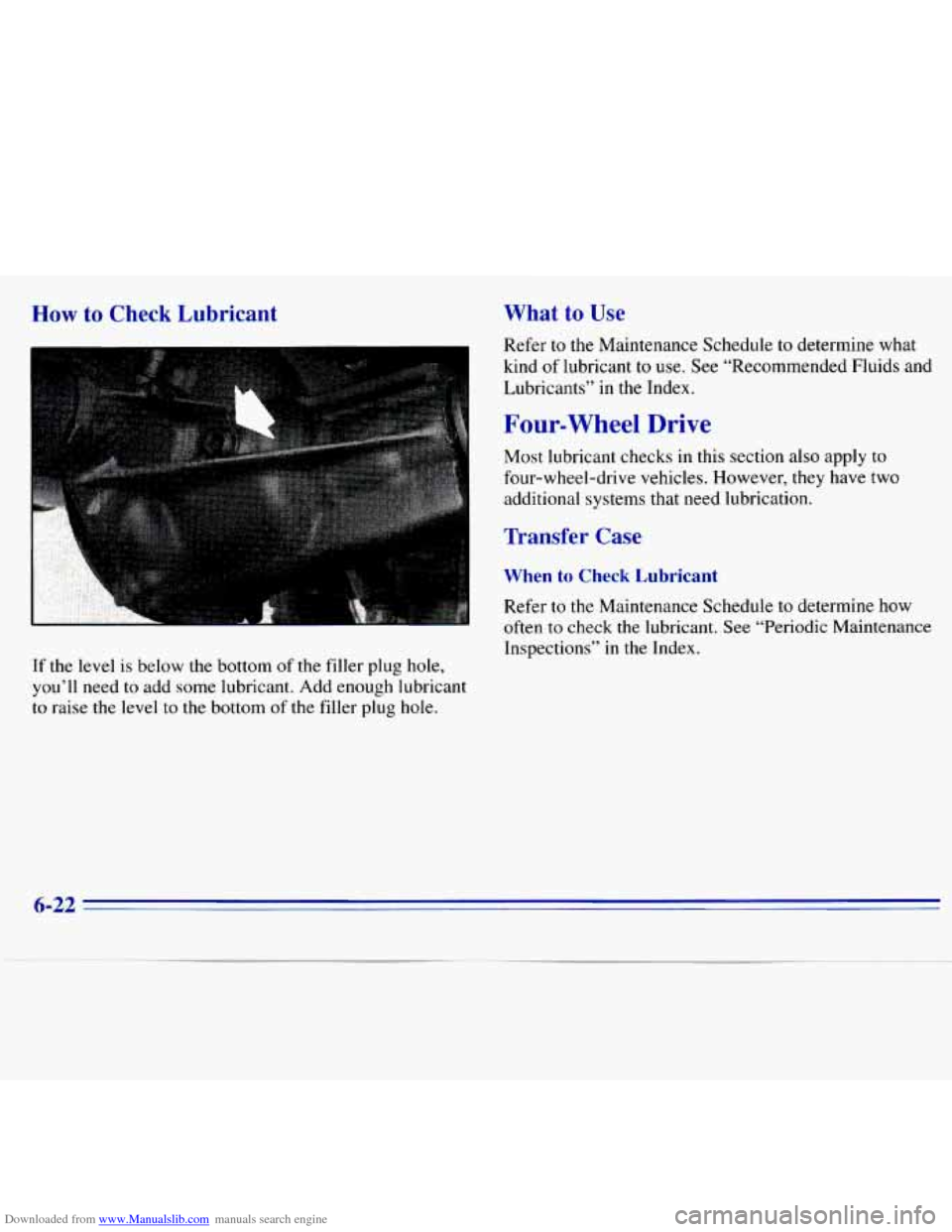
If the level is below the bottom of the filler plug hole,
you’ll need to add some lubricant. Add enough lubricant
to raise the level to the bottom of the filler plug hole.
What to Use
Refer to the Maintenance Schedule to determine what
kind
of lubricant to use. See “Recommended Fluids and
Lubricants” in the Index.
Four-wheel Drive
Most lubricant checks in this section also apply to
four-wheel-drive vehicles. However, they have two
additional systems that need lubrication.
Transfer Case
When to Check Lubricant
Refer to the Maintenance Schedule to determine how
often
to check the lubricant. See “Periodic Maintenance
Inspections”
in the Index.
6-22
Page 278 of 375
Downloaded from www.Manualslib.com manuals search engine Tire Chains
NOTICE:
If your vehicle has P235/75R15, P23970R15,
P235/55R16 or 3lxlO.5OR15LT/C size tires, don’t
use tire chains. They can damage your vehicle.
If you have other size tires, use tire chains only
where legal and only when you must. Use only
SAE Class “S” type chains that are the proper
size for your tires. Install them on the drive axle
tires (four-wheel-drive vehicles can use chains on
both axles) and tighten them as tightly as possible
with the ends securely fastened. Drive slowly and
follow the chain manufacturer’s instructions.
If
you can hear the chains contacting your vehicle,
stop and retighten them.
If the contact continues,
slow down until it stops. Driving too fast or
spinning the wheels with chains on will damage
your vehicle.
Appearance Care
Remember, cleaning products can be hazardous. Some
are toxic. Others can burst into flame if you strike a
match or get them
on a hot part of the vehicle. Some are
dangerous if you breathe their fumes in a closed space.
When
you use anything from a container to clean your
vehicle, be sure to follow the manufacturer’s warnings
and instructions. And always open your doors or
windows when you’re cleaning the inside.
Never use these to clean your vehicle:
0 Gasoline
0 Benzene
0 Naphtha
0 Carbon Tetrachloride
0 Acetone
0 Paint Thinner
0 Turpentine
0 Lacquer Thinner
0 Nail Polish Remover
They can all be hazardous
-- some more than
others
-- and they can all damage your vehicle, too.
I
‘ 6-52
Page 290 of 375

Downloaded from www.Manualslib.com manuals search engine FuseKircuit Usage Breaker
A
B
1
Power Door Locks, Power Seat, Power
Seat Lumbar, Remote Keyless Entry
Power Windows
Stoplamps, Hazard Lamps, Chime,
Center High-Mounted Stoplamp Relay,
Center High-Mounted Stoplamp
3
4
5
6
FuseKircuit Usage
Breaker
2 Dome Lamps, Visor Vanity Mirror,
Cigarette Lighter, Inside Rearview
Mirror Lamp, Overhead Console
Lamps, Glove
Box Lamp, Horns, Horn
Relay, IP Courtesy Lamps, Power
Outside Rearview Mirror, Illuminated
Entry Module
Parking Lamps, License Plate Lamps,
Electric Shift Transfer Case Module,
Underhood Lamp, Ashtray Lamp,
Door Switch Lamp
Alternator Field, A/C Compressor
Relay, Cluster Chime Module, DRL
Relay Coil, Four-Wheel-Drive
Indicator Lamp, DRL Module,
Transfer Case Control Module Ignition, SIR Redundant Ignition,
RKE Ignition
Oxygen Sensor Heater, Exhaust Gas
Recirculation, Cam Sensor, CANN.
Purge, MAS
Blower Motor, Temperature Door
Motor,
HI Blower Relay Coil
6-64
Page 291 of 375

Downloaded from www.Manualslib.com manuals search engine Fuse/Circuit Usage Breaker
7 Power Auxiliary Outlets, Assembly
Line Diagnostic Link
8
9
10
11
12
13
14
15
Not Used
PCMNCM Battery,
ABS Battery, Fuel
Pump (LN2)
PCM/VCM Ignition, Injectors, Crank
Sensor, Coil Driver Module
Radio, Inside Rearview Mirror
Map Lamp
DRAC, Anti-Lock Braking System,
Clock, Radio, Battery,
CD Player
VCM
IGN-3
A/C Compressor Battery Feed
Daytime Running Lamps,
Fog Lamps,
Fog Lamp Relay
Fuse/Circuit Usage Breaker
16
17
19
20 21
22
24 Turn
Signals and Back-up
Lamps, Brake-Transmission
Shift Interlock Solenoid
Windshield Washer, Windshield Wiper Motor
Electric Shift Transfer Case
Crank Signal, Air Bag System
Cluster Illumination,
Radio Illumination, Heater
Lamp, Four- Wheel-Drive
Illumination, Chime Module,
Fog Lamp Illumination
Air Bag System
PRNDL Power, 4L60E Automatic
Transmission
6-65
Page 299 of 375
Downloaded from www.Manualslib.com manuals search engine Part A: Scheduled Maintenance
Services
Using Your Maintenance Schedule
We at General Motors want to help you keep your
vehicle in good working condition. But we don’t know
exactly how you’ll drive it. You may drive very short
distances only a
few times a week. Or you may drive
long distances all the time
in very hot, dusty weather.
You may use your vehicle
in making deliveries. Or
you may drive
it to work, to do errands or in many
other ways.
Because of all the different ways people use their GM
vehicles, maintenance needs vary. You may even need
more frequent checks and replacements than you’ll find
in the schedules in this section.
So please read this
section and note
how you drive. If you have any
questions
on how to keep your vehicle in good
condition, see your GM dealer.
This part tells you the maintenance services you should
have done and when you should schedule them. If you
go to your dealer for your service needs, you’ll know
that GM-trained and supported service people will
perform the work using genuine GM parts. The
proper fluids and lubricants to use
are listed in
Part
D. Make sure whoever services your vehicle
uses these. All parts should be replaced and all
necessary repairs done before you or anyone else
drives the vehicle.
These schedules are for vehicles that:
0
carry passengers and cargo within recommended
limits. You will find these limits on your vehicle’s
Certification/Tire label. See “Loading Your Vehicle”
in the Index.
are driven on reasonable road surfaces within legal
driving limits.
are driven off-road in
the recommended manner. See
“Off-Road Driving With Your Four-Wheel-Drive
Vehicle’’ in the Index.
use the recommended fuel. See “Fuel” in the Index.
Selecting the Right Schedule
First you’ll need to decide which of the two schedules is
right for your vehicle. Here’s how to decide which
schedule to follow:
7-3
Page 348 of 375
Downloaded from www.Manualslib.com manuals search engine Drive Axle Service
Check readfront axle fluid level and add as needed.
Check constant velocity joints and axle seals for leaking.
Transfer Case (Four- Wheel Drive)
Inspection
Every 12 months or at oil change intervals, check front
axle and transfer case and add lubricant when necessary.
Check vent hose at transfer case for kinks and proper
installation. More frequent lubrication may be required
on off-road use.
Brake System Inspection
Inspect the complete system. Inspect brake lines and
hoses for proper hook-up, binding, leaks, cracks,
chafing, etc. Inspect disc brake pads for wear and rotors
for surface condition. Also inspect
drum brake linings
for wear and cracks. Inspect other brake parts, including
drums, wheel cylinders, calipers, parking brake, etc.
Check parking brake adjustment. You may need to have
your brakes inspected more often if your driving habits
or conditions result in frequent braking.
7-52
Page 368 of 375
Downloaded from www.Manualslib.com manuals search engine Engine Fan Noise ................................ 5-2 1
Engineoil .................................... 6-10
Change Intervals ............................. 6- 13
Checking ................................... 6- 10
Kind to Use
.................................. 6- 12
Pressure Gage ................................ 2-60
Used ....................................... 6-14
Engine, Running While Parked .................... 2-30
Engine, Starting ................................ 2- 10
Exhaust, Engine ................................ 2-30
Express-Down Window .......................... 2-32
Exterior Metal Parts, Protecting .................... 6-58
Adding ....................................... 6-11
Additives ................ .I ................... 6- 13
Extender, Safety Belt ............................. 1-38
Fabric cleaning ................................. -6-53
Fifth GeBr. Manual Transmission .................... 2-18
Filling Your Tank ................................ 6-5
Filter
Air
.................................... 6-14, 6-67
Remote Oil .................................. 6-14
........................ 6-57
........................ 6-59
....................... 2-17
........................ 2-18
.......................... 5-1
........................ 5-22
................... 6-68, 7-53
Fog Lamp Switch ................................ 2-41
Foreign Countries. Fuel ........................... 6-4
Fourth Gear. Manual Transmission ................. 2-18
Four-wheel Drive ......................... 2-20. 6-22
French LanguageManual 11
Front Axle ...................................... 6-23
Front Map Lamps ............................... 2-42
Front Sidemarker Lamp Bulb Replacement ........... 6-39
Front Storage Area ............................... 2-45
.. ...........................
FrontTowing ................................... 5-9
Front Turn Signal Lamp Bulb Replacement .......... 6-38
Fuel .......................................... 6-3
Filling Your Tank ................................ 6-5
Foreign Countries .............................. 6-4
Gage ......................................... 2-62
Fuel Tank Capacity ............................. 6-68
Fuses and Circuit Breakers ....................... 6-63
Gages
Engine Coolant Temperature
.................... 2-57
Engine Oil Pressure ........................... 2-60
Fuel ....................................... 2-62
GasCap ....................................... 6-5
GAWR ....................................... 4-42
Gear Positions .................................. 2-14
GloveBox .................................... 2-44
Gross Axle Weight Rating ........................ 4-42
Gross Vehicle Weight Rating ...................... 4-42
Guide en Frangais 11
GVWR ....................................... 4-42
.. .................................
I
9-4