Page 199 of 376

Downloaded from www.Manualslib.com manuals search engine I A CAUTION:
I I To help avoid injury to you or others:
0 Never let passengers ride in a vehicle that is
Never tow faster than safe or posted speeds.
0 Never tow with damaged parts not
0 Never get under your vehicle after it has
Always use separate safety chains on each
being
towed.
fully secured.
been lifted by the tow truck.
side when towing
a vehicle.
When your vehicle is being towed, have the ignition
key
off. The steering wheel should be clamped in a
straight-ahead position, with
a clamping device
designed for towing service.
Do not use the vehicle’s
steering column lock for this. The transmission should
be in NEUTRAL
(N) and the parking brake should
be released.
A CAUTION:
I
A vehicle can fall from a car carrier if it isn’t
adequately secured. This can cause
a collision,
serious personal injury and vehicle damage. The
vehicle should be tightly secured with chains or
steel cables before
it is transported.
Don’t use substitutes (ropes, leather straps,
canvas webbing, etc.) that can be cut by sharp
edges underneath the towed vehicle.
5-7
Page 200 of 376
Downloaded from www.Manualslib.com manuals search engine Front Towing
A towing dolly must be used under the drive wheels
when towing from the
front.
Tow Limits -- 35 mph (56 km/h), 50 miles (80 km)
NOTICE:
Do not tow with sling-type equipment or the
front bumper system will be damaged. Use
wheel-lift or car-carrier equipment. Additional
ramping may be required for car-carrier
equipment. Use safety chains and wheel straps.
Towing a vehicle over rough surfaces could
damage
a vehicle or wheel-lift equipment.
To help avoid damage, install
a towing dolly
a,nd raise the vehicle until adequate clearance
is obtained between the ground and/or
wheel-lift equipment.
Page 201 of 376
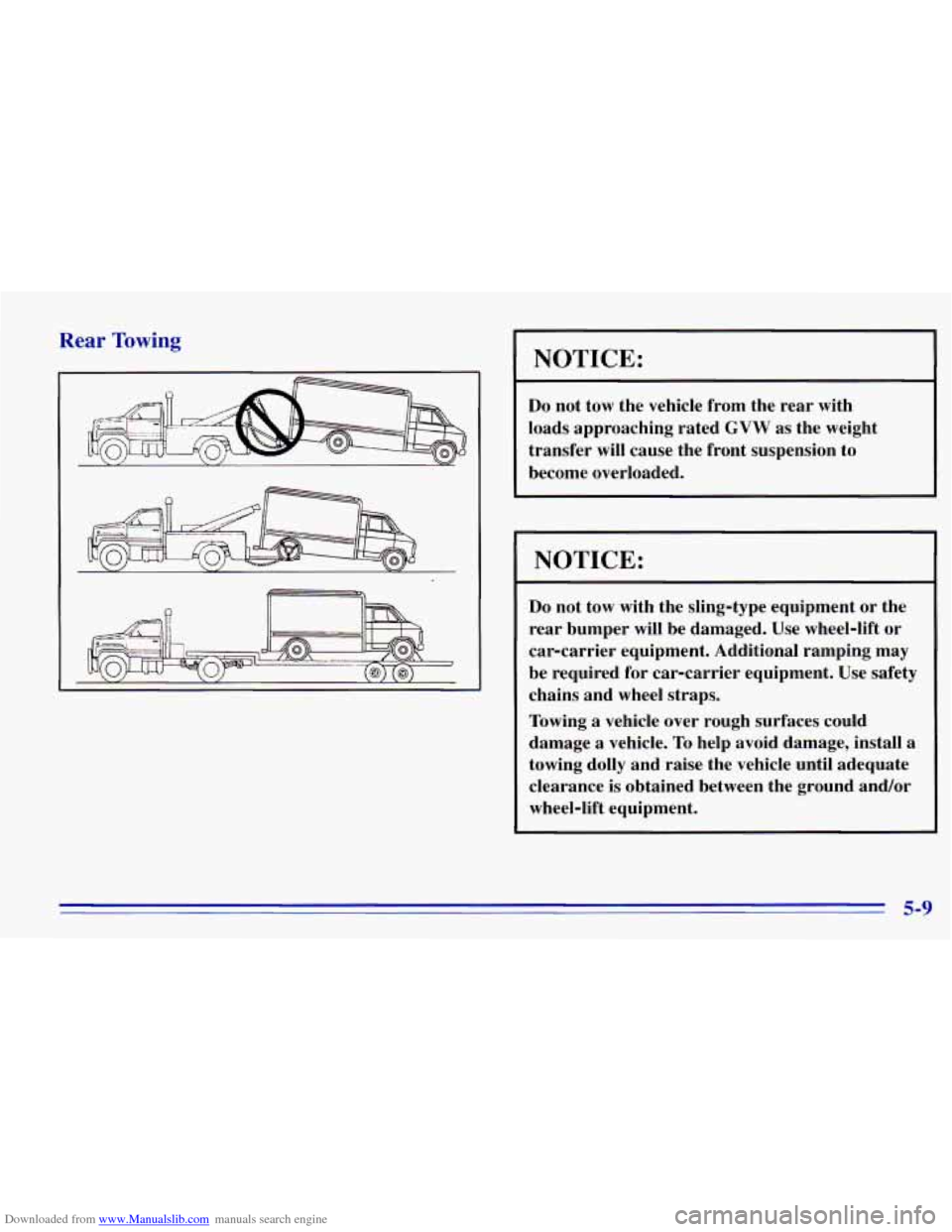
Downloaded from www.Manualslib.com manuals search engine Rear Towing
NOTICE:
Do not tow the vehicle from the rear with
loads approaching rated
GVW as the weight
transfer will cause the front suspension to
become overloaded.
NOTICE:
Do not tow with the sling-type equipment or the
rear bumper will be damaged. Use wheel-lift
or
car-carrier equipment. Additional ramping may
be required for car-carrier equipment. Use safety
chains and wheel straps.
Towing a vehicle over rough surfaces could
damage
a vehicle. To help avoid damage, install a
towing dolly and raise the vehicle until adequate
clearance is obtained between the ground and/or
wheel-lift equipment.
5-9
Page 203 of 376

Downloaded from www.Manualslib.com manuals search engine If No Steam Is Coming From Your Engine
If you get the overheat warning but see or hear no
steam, the problem may
not be too serious. Sometimes
the engine can get a little too hot when you:
0 Climb a long hill on a hot day.
0 Stop after high-speed driving.
0 Idle for long periods in traffic.
0 Tow a trailer. See “Driving on Grades” in the Index.
If
you get the overheat warning with no sign of steam,
try this for a
minute or so:
1. If you have an air conditioner, turn it off.
2. Turn on your heater to full hot at the highest fan
speed and open the window as necessary.
3. If you’re in a traffic jam, shift to NEUTRAL (N);
otherwise, shift
to the highest gear while
driving
-- DRIVE (D).
If you no longer have the overheat warning, you can
drive. Just to be safe, drive slower for about
10 minutes.
If the warning doesn’t come back on,
you can
drive normally.
If the warning continues, pull over, stop, and park your
vehicle right away.
If there’s still no sign of steam, you can idle the engine
for two or three minutes while you’re parked,
to push
the accelerator until the engine speed is about twice as
fast as normal idle speed. Bring
the engine speed back to
normal idle speed after two or three minutes. Now see
if
the warning stops. But then, if you still have the
warning,
turn ofthe engine and get everyone out qf the
vehicle
until it cools down.
You may decide not to lift the hood but to get service
help right away.
5-11
Page 211 of 376

Downloaded from www.Manualslib.com manuals search engine 8. Then replace the pressure cap. At any time during
this procedure
if coolant begins to flow out of the
filler neck, reinstall the pressure cap. Be sure the
arrows
on the pressure cap line up like this.
Engine Fan Noise
Your vehicle has a clutched engine cooling fan. When the
clutch is engaged,
the fan spins faster to provide more air
to cool the engine. In most every day driving conditions,
the fan
is spinning slower and clutch is not fully engaged.
This improves fuel economy and reduces fan noise.
Under heavy vehicle loading, trailer towing and/or high
outside temperatures, the fan speed increases
as the clutch
more
fully engages. So you may hear an increase in fan
noise. This
is normal and should not be mistaken as the
transmission slipping
or making extra shifts. It is merely
the cooling system functioning properly. The fan will
slow down when additional cooling is not required and
the clutch partially disengages.
You may also hear this Fan noise when you start
the engine. It will go away as the fan clutch
partially disengages.
5-19
Page 212 of 376

Downloaded from www.Manualslib.com manuals search engine If a Tire Goes Flat
It’s unusual for a tire to “blow out” while you’re driving,
especially if you maintain your tires properly. If air goes
out of a tire, it’s much more likely to leak out slowly.
But
if you should ever have a “blowout,” here are a few
tips about what
to expect and what to do:
If a front tire fails, the flat tire will create a drag that
pulls the vehicle toward that side. Take your foot off the
accelerator pedal and grip the steering wheel firmly.
Steer to maintain lane position, and then gently brake to
a stop well out of the traffic lane.
A rear blowout, particularly on a curve, acts much like a
skid and may require the same correction you’d use in a
skid. In any rear blowout, remove your foot from
the
accelerator pedal. Get the vehicle under control by
steering the way
you want the vehicle to go. It may be
very bumpy and noisy, but you can still steer. Gently
brake
to a stop -- well off the road if possible.
If a tire goes flat, the next part shows how to use your
jacking equipment
to change a flat tire safely.
Changing a Flat Tire
If a tire goes flat, avoid further tire and wheel damage
by driving slowly to a level place. Turn
on your hazard
warning flashers.
I
Changing a tire can cause an injury. The vehicle
can slip
off the jack and roll over you or other
people. You and they could be badly injured.
Find a level place to change your tire.
To help
prevent the vehicle from moving:
1. Set the parking brake firmly.
2. Put the shift lever in PARK (P).
3. ”urn off the engine.
To be even more certain the vehicle won’t move,
you can put blocks at the front and rear
of the
tire farthest away from the one being changed.
That would be the tire on the other side of the
vehicle, at the opposite end.
5-20
Page 214 of 376

Downloaded from www.Manualslib.com manuals search engine NOTICE:
Never remove or restore a tire frondto a stowage
position under the vehicle while the vehicle
is
supported by a jack. Always tighten the tire
fully against the underside of the vehicle when restowing
A flat rear tire reduces clearance to remove the spare
tire. If there is less than
12 inches (30.48 cm) between
the ground and the rear bumper or any trailer hitch, jack
up the vehicle
until the flat tire is off the ground.
(See “Removing
the Flat Tire” and “Installing the
Spare Tire,’’ Steps
4 through 8, in this section.)
Unless your vehicle has a flat rear tire, do not remove
or
restore a tire from/to a stowage position under the
vehicle while the vehicle is supported by a jack. Always
tighten the tire
fully against the underside of the vehicle
when restowing.
If you have a vehicle which was completed from a cab
and chassis, refer to the information from the body
suppliedinstaller.
The spare tire
is a full size tire, like the other tires on
your vehicle.
For cargo vans, the jack
is secured
in the rear
Remove the retaining wing bolt and lift
it off the
mounting bracket. Set the jack and jacking equipment
near the
flat tire.
5-22
Page 222 of 376
Downloaded from www.Manualslib.com manuals search engine 6. Remove all the wheel
nuts,
and take off the
flat tire.
7. Remove any rust or dirt
from the
wheel bolts,
mounting surfaces and
spare wheel.
A CAUTION:
Rust or dirt on the wheel, or on the parts to
which
it is fastened, can make the wheel nuts
become loose after a time. The wheel could come
off and cause an accident. When you change a
wheel, remove any rust or dirt from the places
where the wheel attaches to the vehicle. In an
emergency, you can use a cloth
or a paper towel
to do this; but be
sure to use a scraper or wire
brush later,
if you need to, to get all the rust or
dirt off.
I A CAUTION:
Never use oil or grease on studs or nuts. If you
do, the nuts might come loose. Your wheel could
fall off, causing
a serious accident.
I I
5-30