Page 60 of 386
Downloaded from www.Manualslib.com manuals search engine Key Release Button
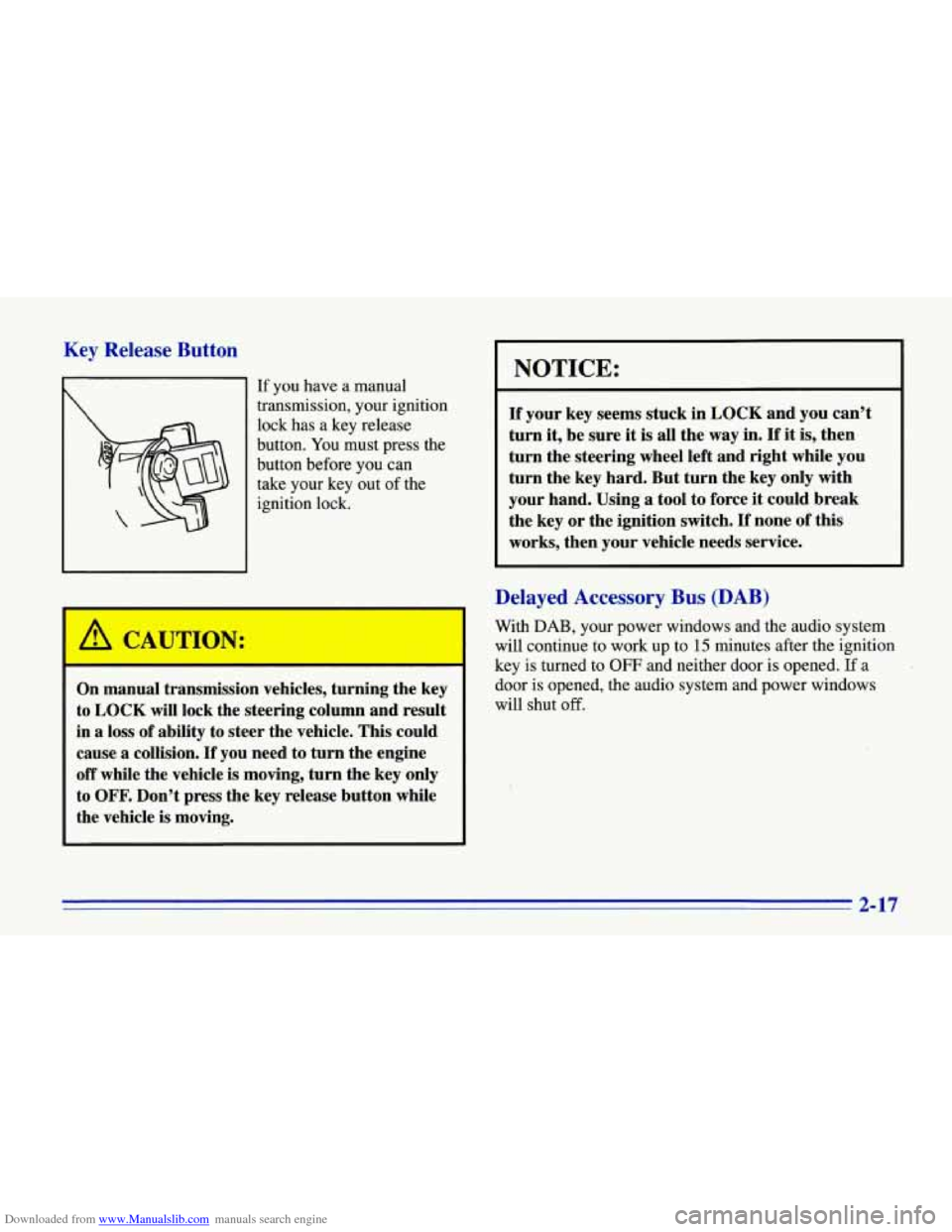
If you have a manual
transmission, your ignition
lock has a key release
button. You must press the
button before you can
take your key out
of the
ignition lock.
CAUTION:
On manual transmission vehicles, turning the key
to LOCK will lock the steering column and result
in a loss of ability to steer the vehicle. This could
cause a colIision.
If you need to turn the engine
off while the vehicle is moving, turn the key only
to
OFF. Don’t press the key release button while
the vehicle
is moving.
I NOTICE:
If your key seems stuck in LOCK and you can’t
turn
it, be sure it is all the way in. If it is, then
turn the steering wheel left and right while you
turn the key hard. But turn the key only with
your hand. Using
a tool to force it could break
the key or the ignition switch.
If none of this
works, then your vehicle needs service.
Delayed Accessory Bus (DAB)
With DAB, your power windows and the audio system
will continue to work up to
15 minutes after the ignition
key is turned to
OFF and neither door is opened. If a
door is opened, the audio system and power windows
will shut
off.
Y
2-17
Page 61 of 386
Downloaded from www.Manualslib.com manuals search engine Starting Your Engine
Automatic Transmission
Move your shift lever to PARK (P) or NEUTRAL (N).
Your engine won’t start in any other position
-- that’s a
safety feature. To restart when you’re already moving,
use NEUTRAL (N) only.
NOTICE:
Don’t try to shift to PARK (P) if your Corvette is
moving. If you do, you could damage the
transmission. Shift to PARK
(P) only when your
vehicle is stopped.
Manual Transmission
The gear selector should be in NEUTRAL. (N). Hold the
clutch pedal to
the floor and start the engine. Your
vehicle won’t start if the clutch pedal is not all the way
down
-- that’s a safety feature.
Starting Your Engine
1. Without pushing the accelerator pedal, turn the
ignition key to START. When the engine starts, let
go of the key. The idle speed will go down as your
engine gets warm.
NOTICE:
Holding your key in START for longer than
15 seconds at a time will cause your battery to be
drained much sooner. And the excessive heat can
damage your starter motor.
2. If it doesn’t start within 10 seconds, push the
accelerator pedal all the way to the floor, while you
hold the ignition key in START. When the engine
starts, let
go of the key and let up on the accelerator
pedal. Wait about
15 seconds between each try to
help avoid draining your battery.
When starting your engine in very cold weather (below
0°F or -18”C), do this:
1. With your foot
off the accelerator pedal, turn the
ignition key to START and hold it there. When the
engine starts, let
go of the key. Use the accelerator
pedal to maintain engine speed, if you have to, until
your engine has run for a while.
stops), it could be flooded with too much gasoline.
Try pushing your accelerator pedal all the way to the
floor and holding it there as you hold the key in
2. If your engine still won’t start (or starts but then
2-18
Page 64 of 386
Downloaded from www.Manualslib.com manuals search engine Automatic Transmission Operation
a
R
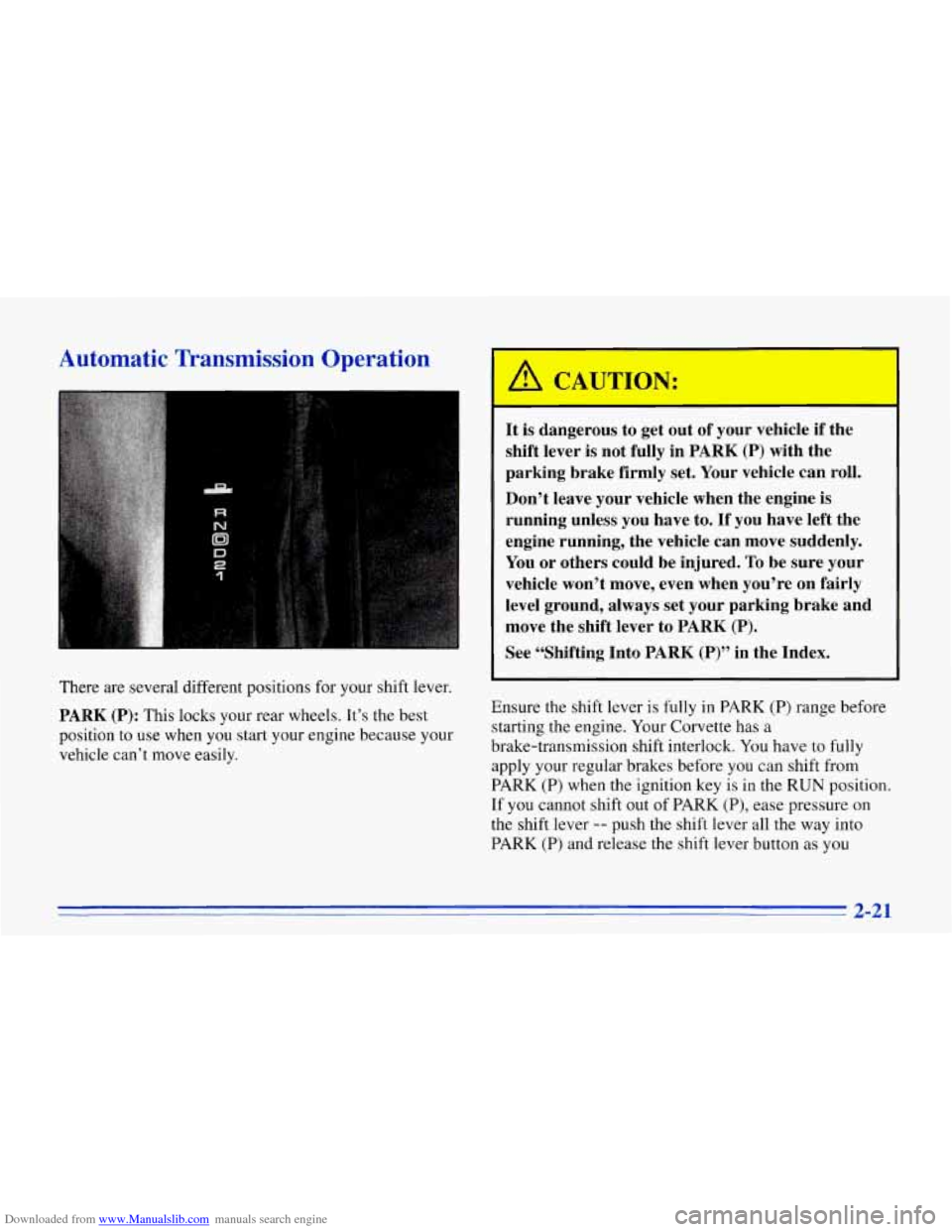
There are several different positions for your shift lever.
PARK (P): This locks your rear wheels. It’s the best
position to use when you start your engine because your
vehicle can’t move easily.
It is dangerous to get out of your vehicle if the
shift lever is not fully in
PARK (P) with the
parking brake firmly set. Your vehicle can roll.
Don’t leave your vehicle when the engine is
running unless you have to.
If you have left the
engine running, the vehicle can move suddenly.
You
or others could be injured. To be sure your
vehicle won’t move, even when you’re on fairly
level ground, always set your parking brake and
move the shift lever to
PARK (P).
See “Shifting Into PARK (P)” in the Index.
Ensure the shift lever is fully in PARK (P) range before
starting the engine. Your Corvette has
a
brake-transmission shift interlock. You have to fully
apply your regular brakes before you can shift from
PARK (P) when the ignition key is in the RUN position.
If you cannot shift out of PARK (P), ease pressure on
the shift lever -- push the shift lever all the way into
PARK (P) and release the shift lever button as you
2-21
Page 73 of 386
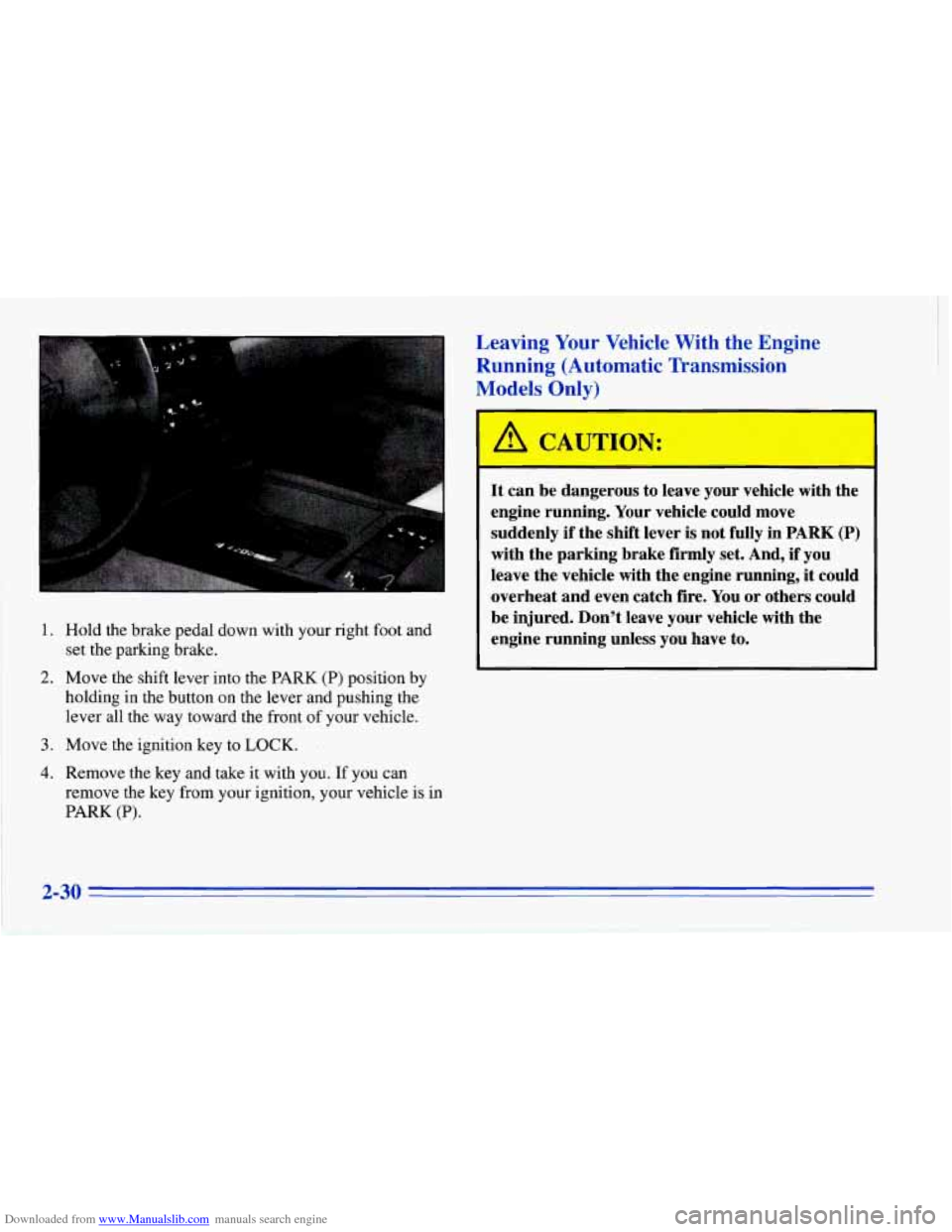
Downloaded from www.Manualslib.com manuals search engine 1. Hold the brake pedal down with your right foot and
set the parking brake.
2. Move the shift lever into the PARK (P) position by
holding in the button on the lever and pushing the
lever all the way toward the front
of your vehicle.
3. Move the ignition key to LOCK.
4. Remove the key and take it with you. If you can
remove the key from your ignition, your vehicle is in
PARK
(P).
Leaving Your Vehicle With the Engine
Running (Automatic Transmission
Models Only)
It can be dangerous to leave your vehicle with the
engine running. Your vehicle could move
suddenly
if the shift lever is not fully in PARK (P)
with the parking brake firmly set. And, if you
leave the vehicle with the engine running, it could
overheat and even catch fire. You
or others could
be injured. Don’t leave your vehicle with the
engine running unless you have to.
2-30
Page 74 of 386
Downloaded from www.Manualslib.com manuals search engine Torque Lock (Automatic Transmission)
If you are parking on a hill and you don’t shift your
transmission into PARK (P) properly, the weight of the
vehicle may put too much force on the parking pawl in
the transmission. You may find it difficult to pull the
shift lever out of PARK (P). This is called “torque lock.”
To prevent torque lock, set the parking brake and then
shift into PARK (P) properly before you leave the
driver’s seat. To find out how, see “Shifting Into
PARK
(P)” in the Index.
When you
are ready to drive, move the shift lever out of
PARK (P) before you release the parking brake.
If torque lock does occur, you may need to have another
vehicle push yours a little uphill to take some of the
pressure from the transmission,
so you can pull the shift
lever out of PARK (P).
Shifting Out of PARK (P)
(Automatic Transmission)
Your Corvette has a brake-transmission shift interlock.
You have to fully apply your regular brake before you
can shift from PARK (P) when the ignition is in the
RUN position. See “Automatic Transmission Operation”
in the Index. If you
cannot shift out of PARK (P), ease pressure on
the shift lever
-- push the shift lever all the way into
PARK (P) and release the shift lever button as you
maintain brake application. Then press the shift lever
button and move the shift lever into the gear you wish.
If
you ever hold the brake pedal down but still can’t
shift out of PARK (P), try this:
1. Turn the key to the
OFF position.
2. Apply and hold the brake until the end of Step 4.
3. Shift to NEUTRAL (N).
4. Start the engine and then shift to the drive gear
you want.
5. Have the vehicle fixed as soon as you can.
Parking Your Vehicle
(Manual Transmission)
Before you get out of your vehicle, put your manual
transmission in
REVERSE (R) and firmly apply the
parking brake.
2-31
Page 91 of 386
Downloaded from www.Manualslib.com manuals search engine Center Console
L
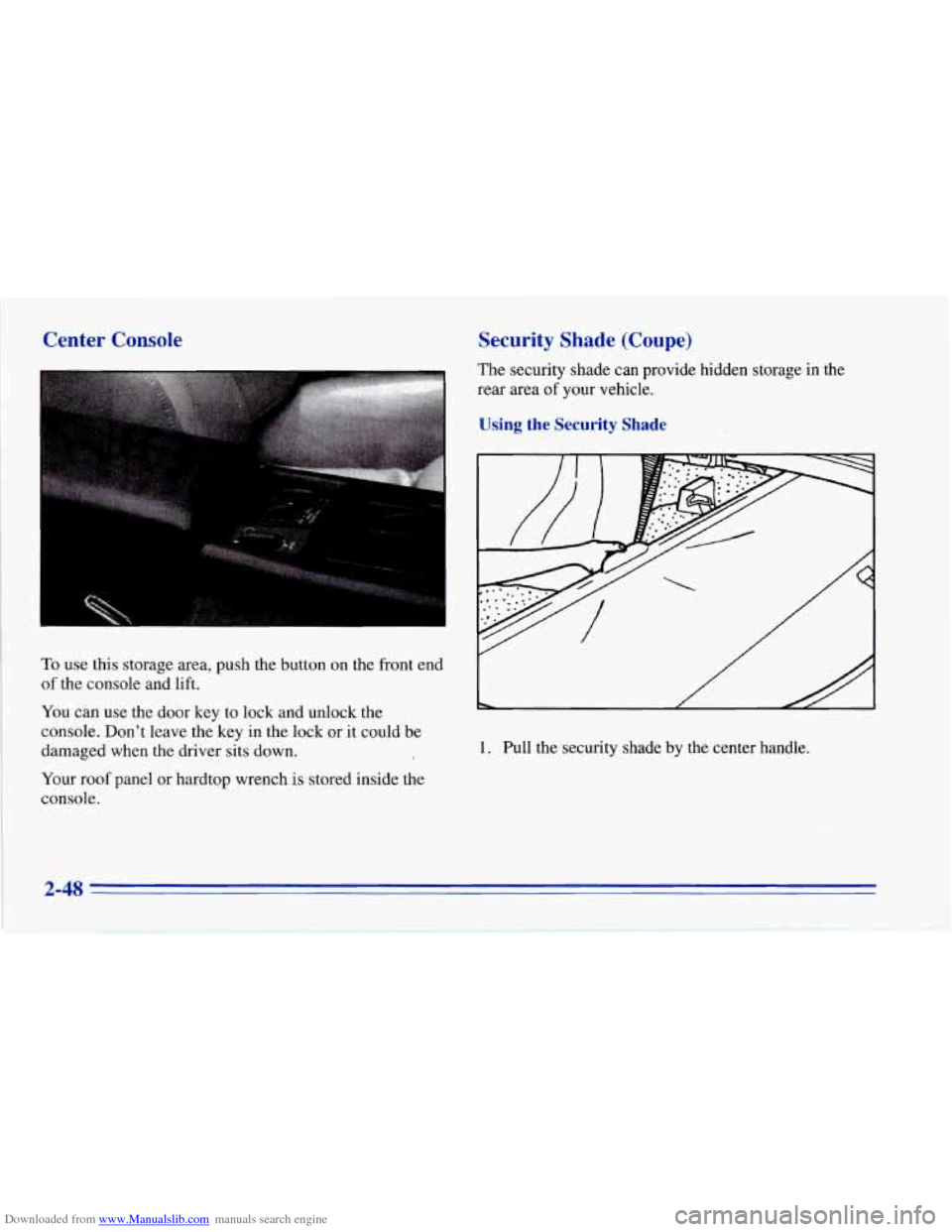
To use this storage area, push the button on the front end
of the console and lift.
You can use the door key to lock and unlock the
console. Don’t leave the key in the lock or it could be
damaged when the driver sits down.
Security Shade (Coupe)
The security shade can provide hidden storage in the
rear area of your vehicle.
Using the Security Shade
1. Pull the security shade by the center handle.
Your roof panel or hardtop wrench is stored inside the
console.
2-48
Page 92 of 386
Downloaded from www.Manualslib.com manuals search engine Rear Storage
V
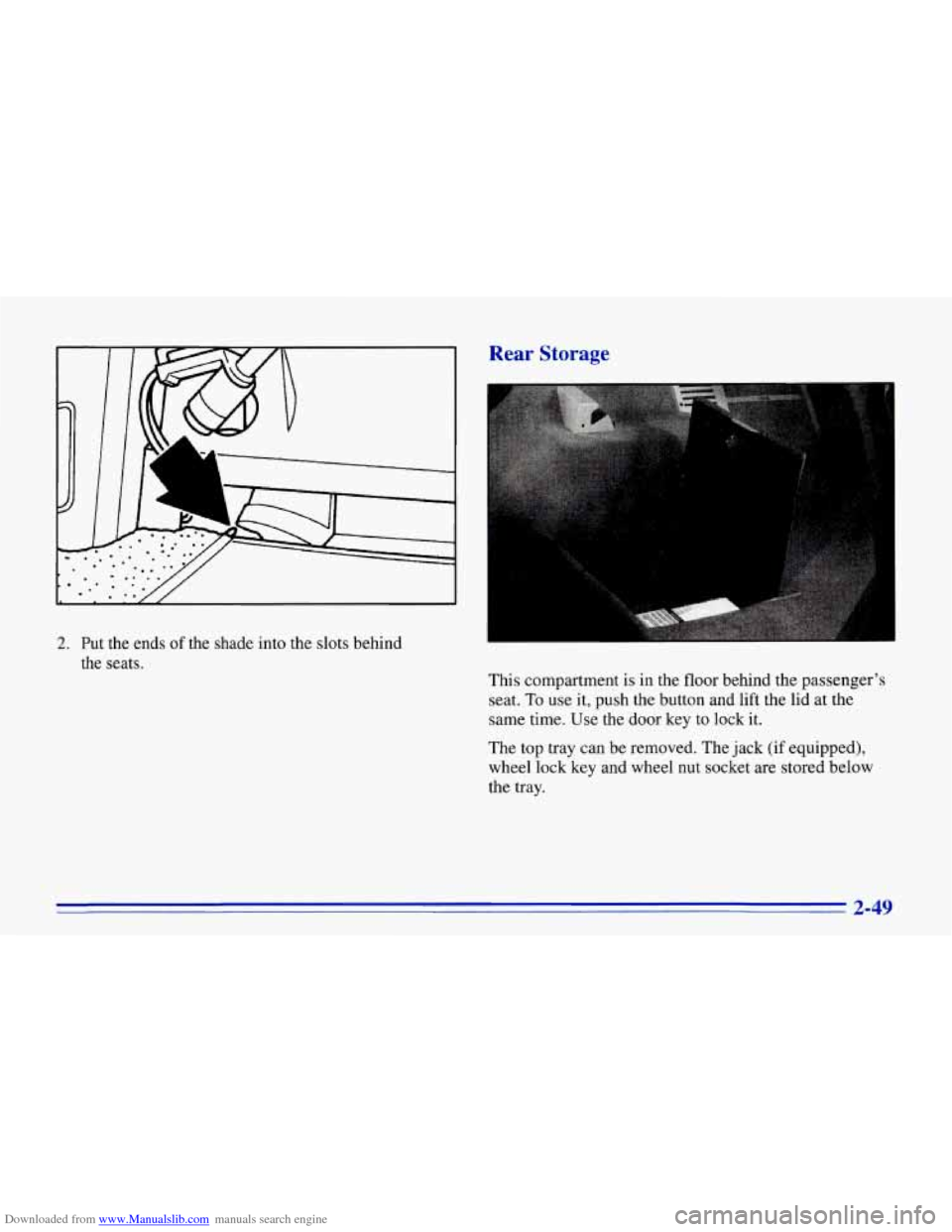
2. Put the ends of the shade into the slots behind
the seats. This compartment is in the floor behind the passenger’s
seat.
To use it, push the button and lift the lid at the
same time. Use the door key to lock it.
The top tray can be removed. The jack (if equipped),
wheel lock key and wheel nut socket are stored below
the tray.
2-49
Page 96 of 386
Downloaded from www.Manualslib.com manuals search engine The pink wire connects to the ignition. Power is only
available in the RUN position.
The black wire connects to the ground.
NOTICE:
When using the accessory plug:
Don’t splice wires directly into the accessory
plug
wire. If done incorrectly, splicing might
cause damage to your electrical system.
The maximum load of any electrical
equipment should not exceed
10 amps.
0 Be sure to turn off any electrical equipment
when not in use. Leaving electrical
equipment on for extended periods can
drain your battery.
0 Do not use this plug if the electrical
equipment requires frequent connecting
and disconnecting. This may cause
excessive wear on the accessory plug and
damage your electrical system.
After you’ve installed the electrical equipment, put the trim
panel and console lid back in place and install the screws.
Roof Panel (Coupe)
Until you are sure you can remove the panel alone, have
someone help you.
Removing the Roof Panel
A CAUTION:
Don’t try to remove the roof panel while the
vehicle is moving. Trying to remove the roof
panel while the vehicle
is moving could cause an
accident. The panel could fall into the vehicle and
cause you to lose control, or it could
fly off and
strike another vehicle. You or others could be
injured. Remove the roof panel only when the
vehicle is parked.
1. Park on a level surface, set the parking brake firmly
and shift an automatic transmission into PARK (P).
Shift a manual transmission into REVERSE
(R).
Lower both windows, turn the ignition key to LOCK
and move both sunshades to the side.
2-53