1996 CHEVROLET CORVETTE automatic transmission
[x] Cancel search: automatic transmissionPage 111 of 386
Downloaded from www.Manualslib.com manuals search engine Installing Your Convertible Hardtop
1. Park on a level surface, set the parking brake firmly
and shift an automatic transmission into
PARK (P).
Shift a manual transmission into REVERSE (R).
Lower both windows and sunshades. Turn off the
radio to lower the power antenna and turn the
ignition key to the
LOCK position.
2. Disconnect both rear window defogger electrical
3. Lower the convertible top. Refer to “Convertible
connectors
behind the lock pillar.
Top” in the Index.
This procedure will require the use of the storage
compartment lid release button behind the driver’s seat
or the center console release switch. The fuse that
enables these releases is not installed at the assembly
plant and should
be in your center console. See
“Instrument Panel Fuse Block” in the Index for
location of the fuse. The fuse is labeled HATCH (45). 4. With
one person on each side, carefully position the
hardtop over the vehicle. Lower the hardtop slowly,
aligning the rear bolt spacers onto the bezels, and
front conical nuts into the tapered receivers. Realign
the hardtop, if necessary.
NOTICE:
To help avoid damage, don’t force the rear
of the hardtop
down. The hardtop may rest
slightly above the storage compartment lid
until the release lever
is pulled. See Step 8 in
this procedure.
5. Move both seatbacks forward. Slide the lock pillar
bracket into the receiver bracket until the scribed line
is even with the lower edge of the receiver bracket.
6. Connect the electrical connectors and make sure they
are inside the vehicle.
Page 136 of 386
Downloaded from www.Manualslib.com manuals search engine Security Light Check Gauges Light
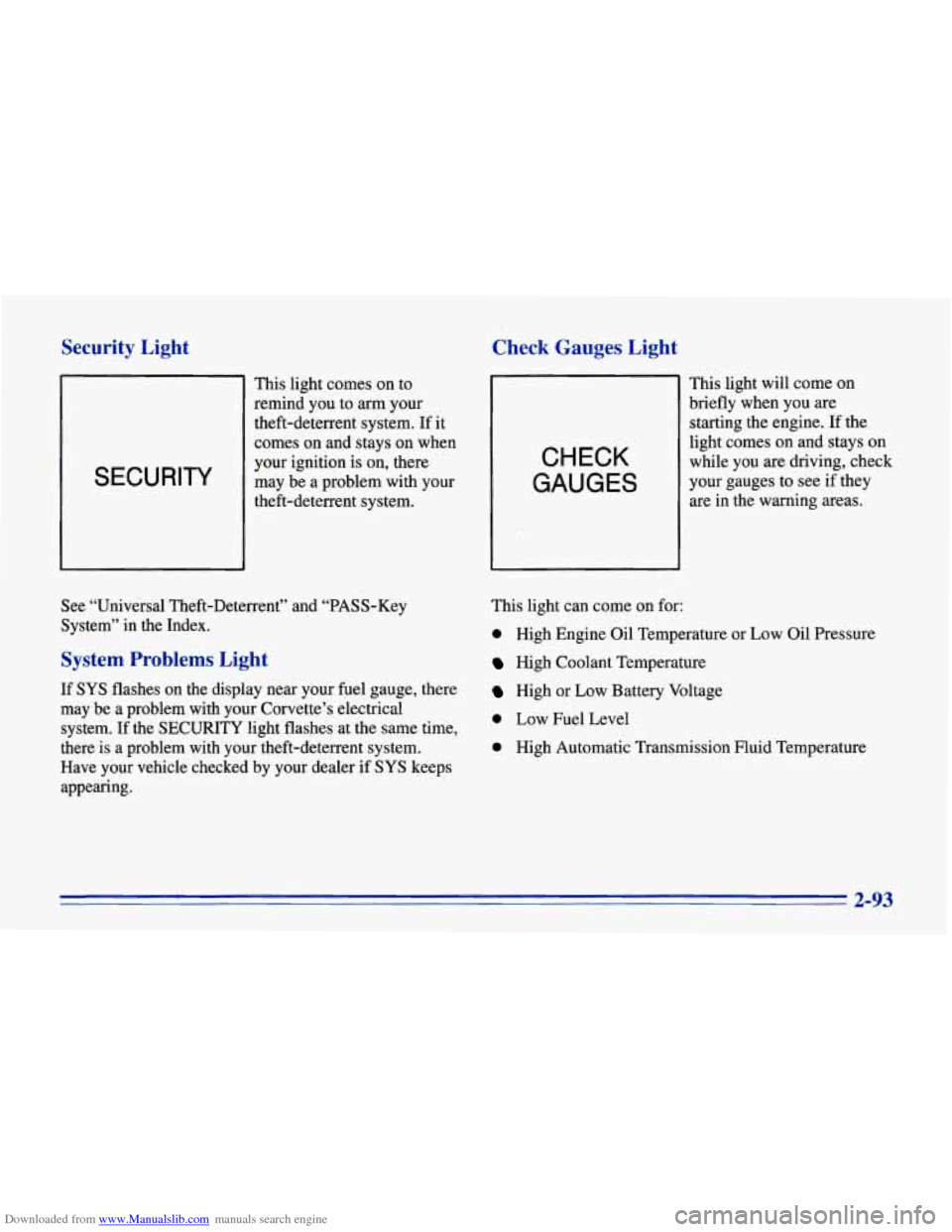
SECURITY
This light comes on to
remind you to
arm your
theft-deterrent system. If it
comes on and stays on when
your ignition is on, there
may be a problem with your
theft-deterrent system.
CHECK
GAUGES
This light will come on
briefly when you are
starting the engine.
If the
light comes on and stays on
while you are driving, check
your gauges to see if they
are in the warning areas.
See “Universal Theft-Deterrent” and “PASS-Key
System” in the Index.
System Problems Light
If SYS flashes on the display near your fuel gauge, there
may be a problem with your Corvette’s electrical
system. If the
SECURITY light flashes at the same time,
there is
a problem with your theft-deterrent system.
Have your vehicle checked by your dealer
if SYS keeps
appearing. This
light can come on for:
0 High Engine Oil Temperature or Low oil Pressure
High Coolant Temperature
High or Low Battery Voltage
0 Low Fuel Level
0 High Automatic Transmission Fluid Temperature
2-93
Page 140 of 386
Downloaded from www.Manualslib.com manuals search engine Automatic Transmission Fluid Temperature Reading
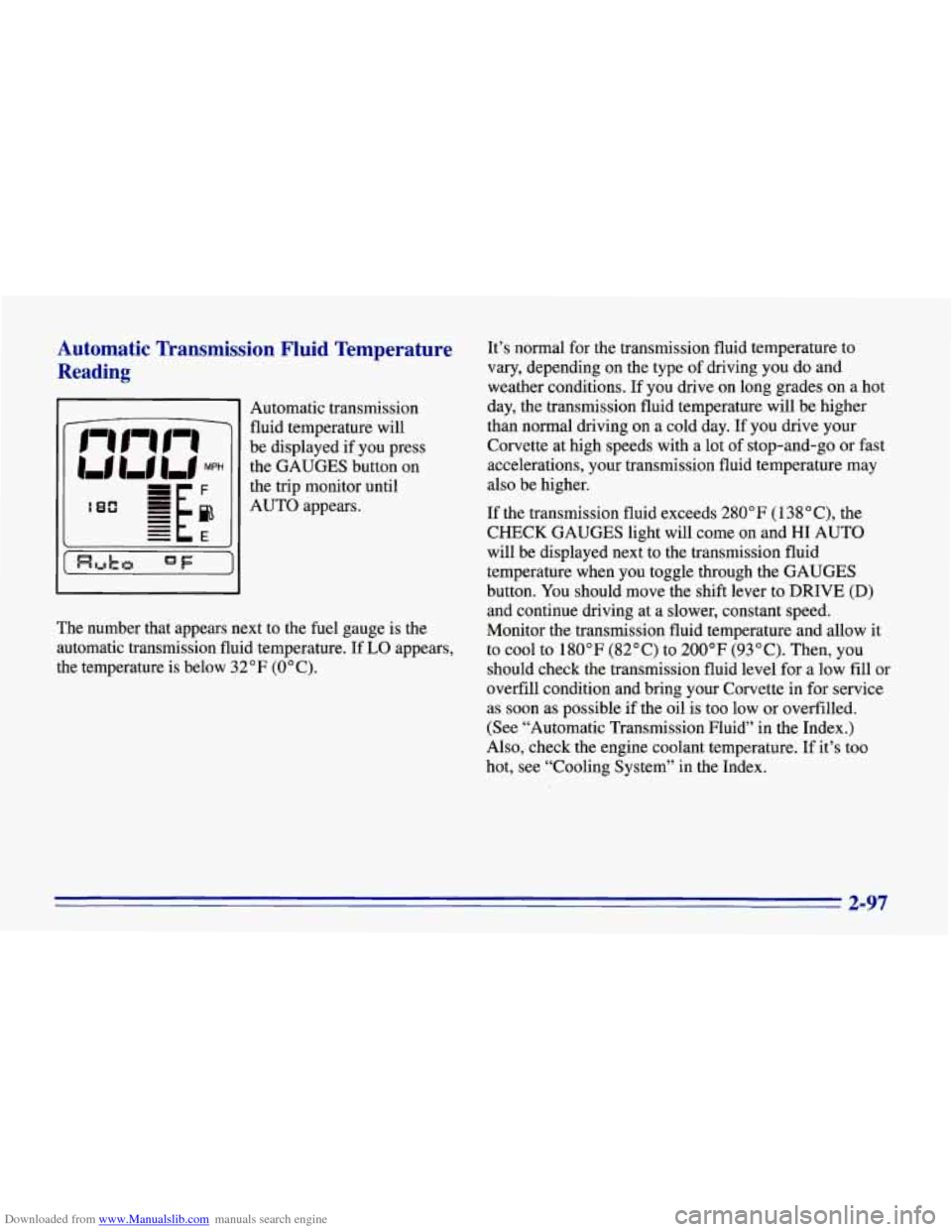
Automatic transmission
fluid temperature will
be displayed if you press
the GAUGES button on
the trip monitor until
AUTO appears.
The number that appears next to the fuel gauge is the
automatic transmission fluid temperature. If
LO appears,
the temperature is below 32°F (0°C). It’s
normal for the transmission fluid temperature to
vary, depending on the type
of driving you do and
weather conditions. If you drive on long grades on a hot
day, the transmission fluid temperature will be higher
than normal driving on a cold day. If you
drive your
Corvette at high speeds with a lot of stop-and-go or fast
accelerations, your transmission fluid temperature may
also be higher.
If the transmission fluid exceeds
280” F (1 38 “C), the
CHECK GAUGES light will come on and HI AUTO
will be displayed next to the transmission fluid
temperature when you toggle through the GAUGES
button. You should move the shift lever to DRIVE
(D)
and continue driving at a slower, constant speed.
Monitor the transmission fluid temperature and allow it
to cool to 180°F (82°C) to 200°F (93°C). Then, you
should check the transmission fluid level for a low fill or
overfill condition and bring your Corvette in for service
as soon as possible if the oil is too low or overfilled.
(See “Automatic Transmission Fluid” in the Index.)
Also, check the engine coolant temperature. If it’s too
hot, see “Cooling System” in the Index.
2-97
Page 193 of 386
Downloaded from www.Manualslib.com manuals search engine Your hazard warning flashers work no matter what
position your key is in, and even if the key isn’t in.
To turn off the flashers, pull out on the collar.
When the hazard warning flashers
are on, your turn
signals won’t work.
Other Warning Devices
If you carry reflective triangles, you can set one up at the sid\
e
of the road about
300 feet (100 m) behind your vehicle.
Jump Starting
If your battery has run down, you may want to use another
vehicle and some jumper cables to start your Corvette.
But please use the following steps to do it safely.
NOTICE:
Ignoring these steps could result in costly damage
to your vehicle that wouldn’t be covered by
your warranty.
Trying to start your Corvette by pushing or
pulling
it could damage your vehicle, even if you
have
a manual transmission. And if you have an
automatic transmission, it won’t
start that way.
Batteries can hurt you. They can be dangerous
because:
They contain acid that can burn you.
They contain gas that can explode or ignite.
They contain enough electricity to
If you don’t follow these steps exactly, some or all
of these things can hurt you.
burn
you.
1. Check the other vehicle. It must have a 12-volt
battery with a negative ground system.
NOTICE:
If the other system isn’t a 12-volt system with a
negative ground, both vehicles can be damaged.
5-2
I
Page 205 of 386
Downloaded from www.Manualslib.com manuals search engine If No Steam Is Corning From Your Engine
If you get the overheat warning but see or hear no
steam, the problem may not be too serious. Sometimes
the engine can get a little too hot when you:
Climb a long hill on a hot day.
Stop after high-speed driving.
Idle for long periods in traffic.
If .you get the overheat warning with no sign of steam,
try this for a minute or
so:
1. Turn off your air conditioner.
2. Turn on your heater to full hot at the highest fan
speed and open the window as necessary.
3. If you’re in a traffic jam, shift to NEUTRAL (N);
otherwise, shift to the highest gear while
driving
-- AUTOMATIC OVERDRIVE (@)
or DRIVE (D) for automatic transmissions. If you no longer have the overheat warning, you can
drive. Just
to be
safe, drive slower for about 10 minutes.
If the warning doesn’t come back on, you can
drive normally.
If the warning continues, pull over, stop, and park your
. vehicle right away.
If there’s still no sign of steam, you can idle the engine
for two or three minutes while you’re parked, to see
if the warning stops. But then,
if you still have the
warning,
turn oJjcthe engine and get everyone out of
the vehicle until it cools down.
You may decide not to lift the hood but to get service
help right away.
5-14
Page 213 of 386
Downloaded from www.Manualslib.com manuals search engine If a Tire Goes Flat
It’s unusual for a tire to “blow out’’ while you’re driving,
especially if you maintain your tires properly. If air goes
out of a tire, it’s much more likely to leak out slowly.
But if you should ever have a “blowout,” here are a few
tips about what to expect and what to do:
If a front tire fails, the flat tire will create a drag that
pulls the vehicle toward that side. Take your foot
off
the accelerator pedal and grip the steering wheel firmly.
Steer to maintain lane position, and then gently brake
to
a stop well out of the traffic lane.
A rear blowout, particularly on a curve, acts much like a
skid and may require the same correction you’d use in a
skid. In any rear blowout, remove your foot from the
accelerator pedal. Get
the vehicle under control by
steering the way you want the vehicle to go. It may be
very bumpy and noisy, but you can still steer. Gently
brake to a stop
-- well off the road if possible.
If
a tire goes flat, the next part shows how to use your
jacking equipment to change a flat tire safely. If your
vehicle has Extended Mobility Tires (tires with
“EMT”
molded on the sidewalls), see “Extended Mobility Tires”
in the Index.
.Changing a Flat Tire
If a tire goes flat, avoid further tire and wheel damage
by driving slowly to a level place. Turn on your hazard
warning flashers.
A CAUTION:
3
Changing a tire can cause an injury. The vehicle
can slip off the jack and roll over you or other
people. You and they could be badly injured.
Find
a level place to change your tire. To help
prevent the vehicle from moving:
1. Set the parking brake firmly.
2. Put an automatic transmission shift lever in
PARK (P), or shift a manual transmission
to
FIRST (1) or REVERSE (R).
3. lbrn off the engine.
To
be even more certain the vehicle won’t move,
you can put blocks at the front and rear of the
tire farthest away from the one being changed.
That would be the tire on the other side of the
vehicle, at the opposite end.
Page 230 of 386
Downloaded from www.Manualslib.com manuals search engine NOTICE:
When the compact spare is installed, don’t take
your vehicle through an automatic car wash with
guide rails. The compact spare can get caught on
the rails. That can damage the tire and wheel,
and maybe other parts
of your vehicle.
Don’t use your compact spare on other vehicles.
And don’t mix your compact spare tire or wheel with
other wheels
or tires. They won’t fit. Keep your spare
tire and its wheel together.
NOTICE:
Tire chains won’t fit your compact spare. Using
them can damage your car and can damage
the chains too. Don’t use tire chains on your
compact spare.
If You’re Stuck: In Sand, Mud,
Ice
or Snow
What you don’t want to do when your vehicle is stuck is
to spin your wheels too fast. The method known as
“rocking” can help you get out when you’re stuck, but
you must use caution.
If you let your tires spin at high speed, they can
explode, and you or others could be injured. And,
the transmission
or other parts of the vehicle can
overheat. That could cause an engine
compartment fire or other damage. When you’re
stuck, spin the wheels
as little as possible. Don’t
spin the wheels above
35 mph (55 kmh) as shown
on the speedometer.
5-39
Page 239 of 386
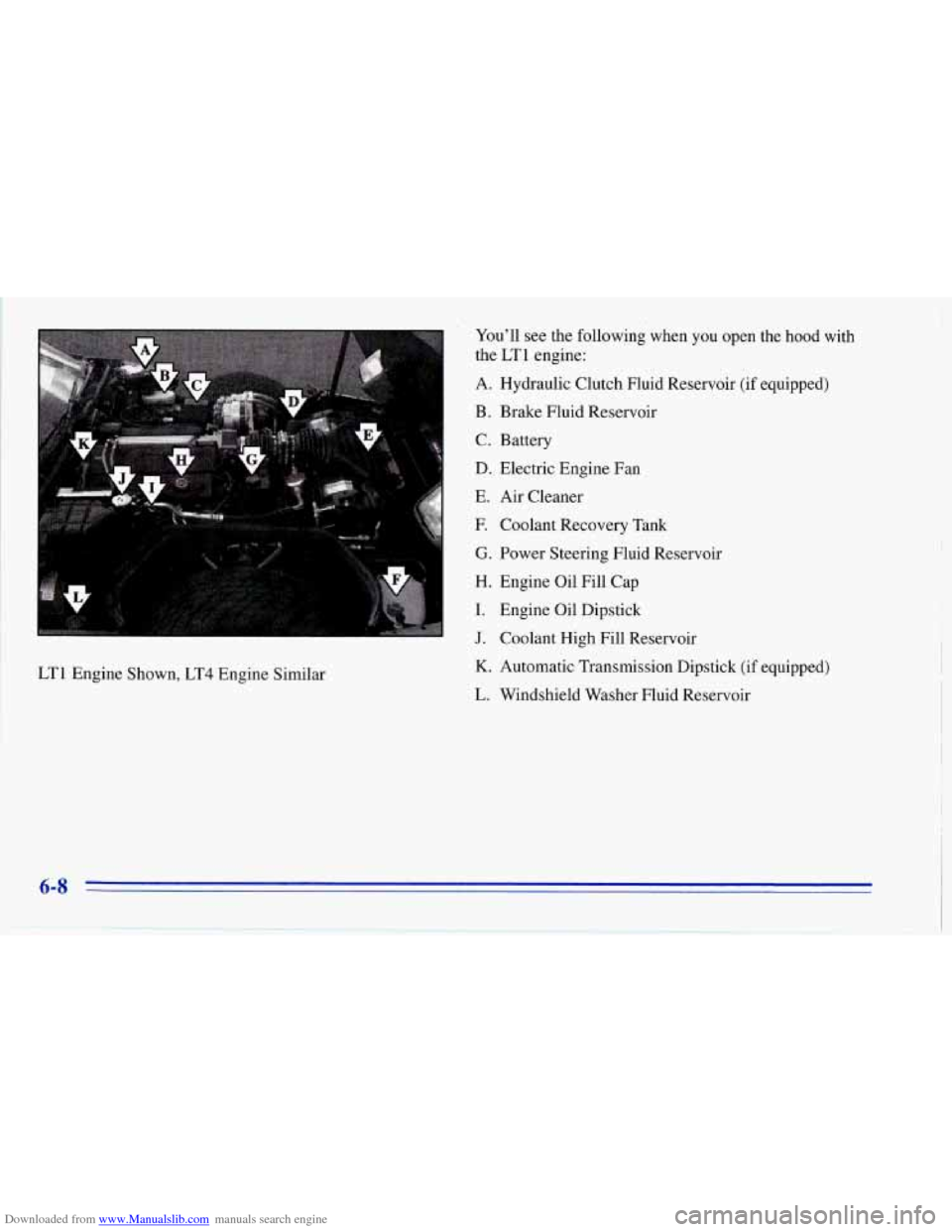
Downloaded from www.Manualslib.com manuals search engine LT1 Engine Shown, LT4 Engine Similar You’ll
see the following when you open the hood with
the
LT1 engine:
A. Hydraulic Clutch Fluid Reservoir
(if equipped)
B. Brake Fluid Reservoir
C. Battery
D. Electric Engine Fan
E. Air Cleaner
E Coolant Recovery Tank
G. Power Steering Fluid Reservoir
H. Engine Oil Fill Cap
I. Engine Oil Dipstick
J. Coolant High Fill Reservoir
K. Automatic Transmission Dipstick (if equipped)
L. Windshield Washer Fluid Reservoir
6-8