Page 207 of 386
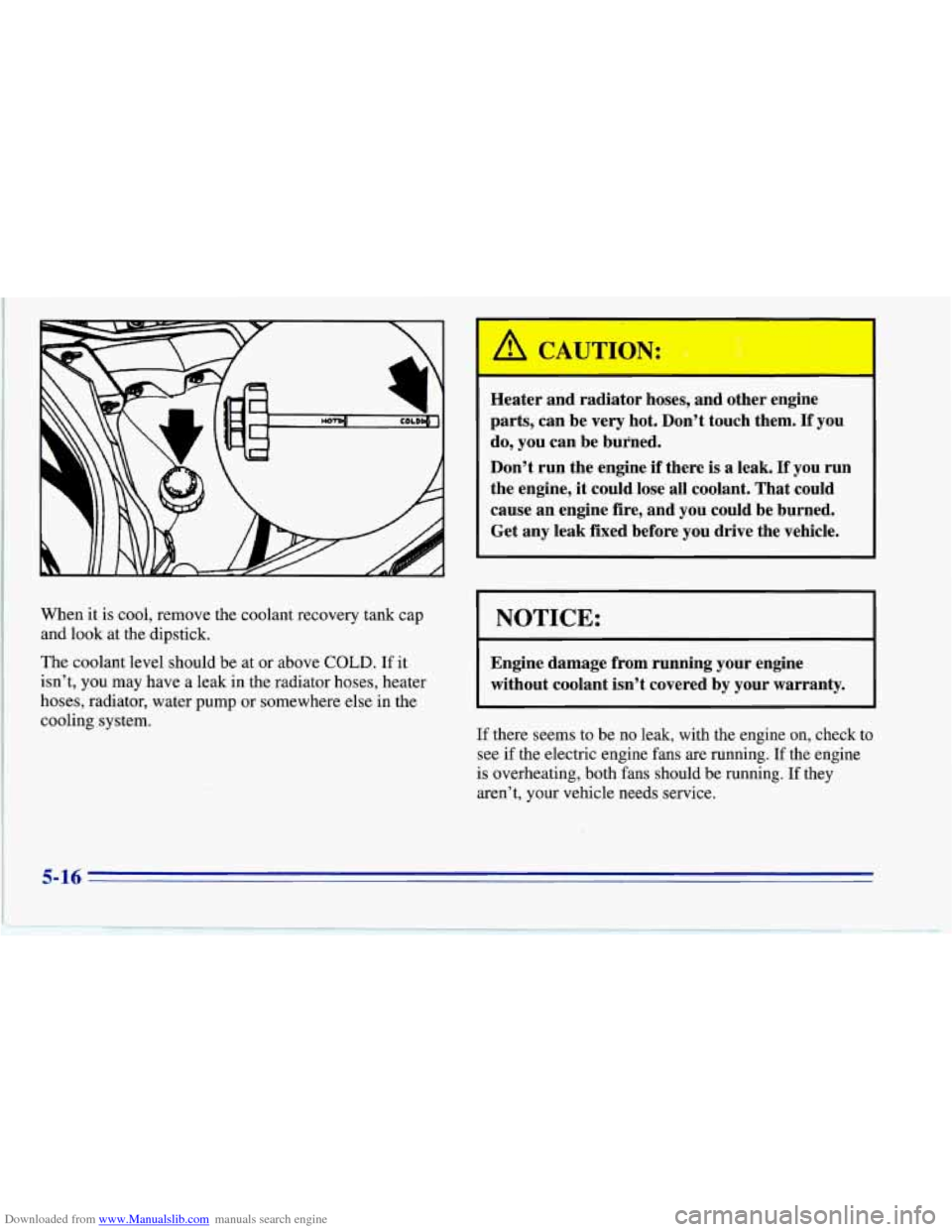
Downloaded from www.Manualslib.com manuals search engine When it is cool, remove the coolant recovery tank cap
and look at the dipstick.
The coolant level should be at or above
COLD. If it
isn’t, you may have a leak in the radiator hoses, heater
hoses, radiator, water pump
or somewhere else in the
cooling system.
.h CAUTION:
*
8’
Heater and radiator hoses, and other engine
parts, can be very
hot. Don’t touch them. If you
do, you can be bul‘ned.
Don’t run the engine
if there is a leak. If you run
the engine, it could lose all coolant. That could
cause an engine fire, and you could be burned.
Get any leak fixed before you drive the vehicle.
I NOTICE:
I
Engine damage from running your engine
without coolant isn’t covered by your warranty.
I
If there seems to be no leak, with the engine on, check to
see if the electric engine fans are running.
If the engine
is overheating, both fans should be running. If they
aren’t, your vehicle needs service.
5-16
Page 210 of 386
Downloaded from www.Manualslib.com manuals search engine How to Add Coolant to the C
Fill Reservoir mt
H
I NOTICE:
Your engine has a specific coolant high fill
reservoir
fill procedure. Failure to follow this
procedure could cause your engine
to overheat
and be severely damaged.
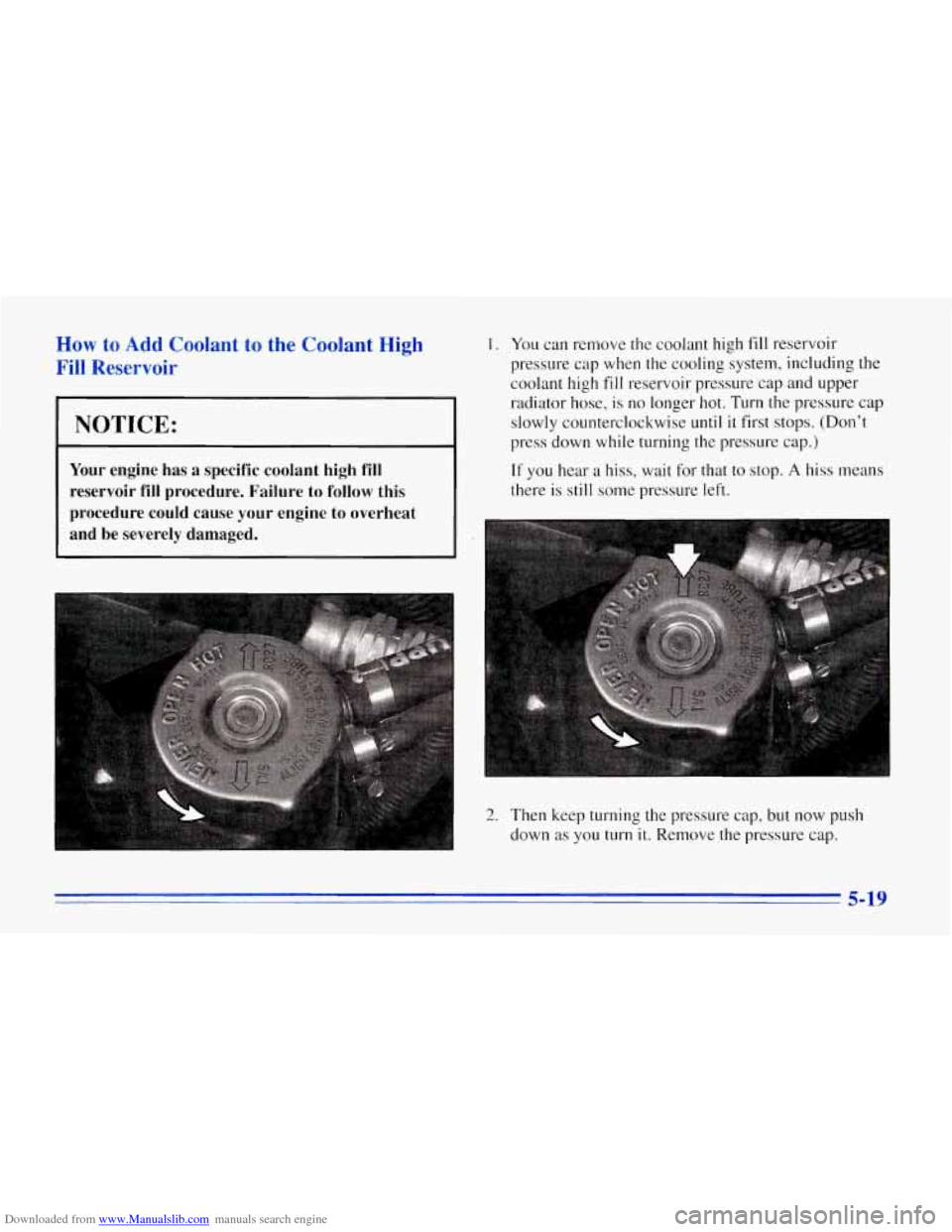
1. You can remove the coolant high fill reservoir
pressure cap when the cooling system, including the
coolant high
fill reservoir pressure cap and upper
radiator hose, is no longer hot. Turn the pressure cap
slowly counterclockwise
until it first stops. (Don’t
press down while turning
the pressure cap.)
If you hear a hiss, wait for that to stop. A hiss means
there is still some pressure left.
2. Then keep turning the pressure cap, but now push
down
as you turn it. Remove the pressure cap.
5-19
Page 259 of 386
Downloaded from www.Manualslib.com manuals search engine Adding Coolant to the Recovery Tank
If you need more coolant, add the proper mix at the
coolant recovery tank, but only when your engine is
cool. If the tank is
very low or empty, also add coolant
to the coolant high fill reservoir. See “Engine
Overheating” in the Index for information.
.JTION:
r
Turning the coolant high fill reservoir pressure cap
when the engine and radiator are hot
can allow
steam and scalding liquids to blow out and burn
you badly. Never
turn the pressure cap -- even a
little
-- when the engine and radiator are hot.
Add coolant mix at the recovery tank, but be careful not
to spill it.
I
CAUTION:
You can be burned if you spill coolant on hot
engine
parts. Coolant contains ethylene glycol.
and
it will burn if the engine parts are hot
enough. Don’t spill coolant on a hot engine.
For complete drain, flush and refill of the engine,
contact your Chevrolet dealer or the procedure may be
found in a Chevrolet Corvette Service Manual.
To
purchase a service manual, see “Service and Owner
Publications” in the Index.
6-28
Page 260 of 386
Downloaded from www.Manualslib.com manuals search engine Coolant High Fill Reservoir Cap
NOTICE:
Your coolant high fill reservoir cap is a 15 psi
(105 kPa) pressure-type cap and must be tightly
installed to prevent coolant loss
and possible
engine damage from overheating. Be sure the
arrows on the cap line up with the overflow tube.
Thermostat
Engine coolant temperature is controlled by a thermostat
in the engine coolant system. The thermostat stops the
flow of coolant through the radiator until the coolant
reaches a pre-set temperature.
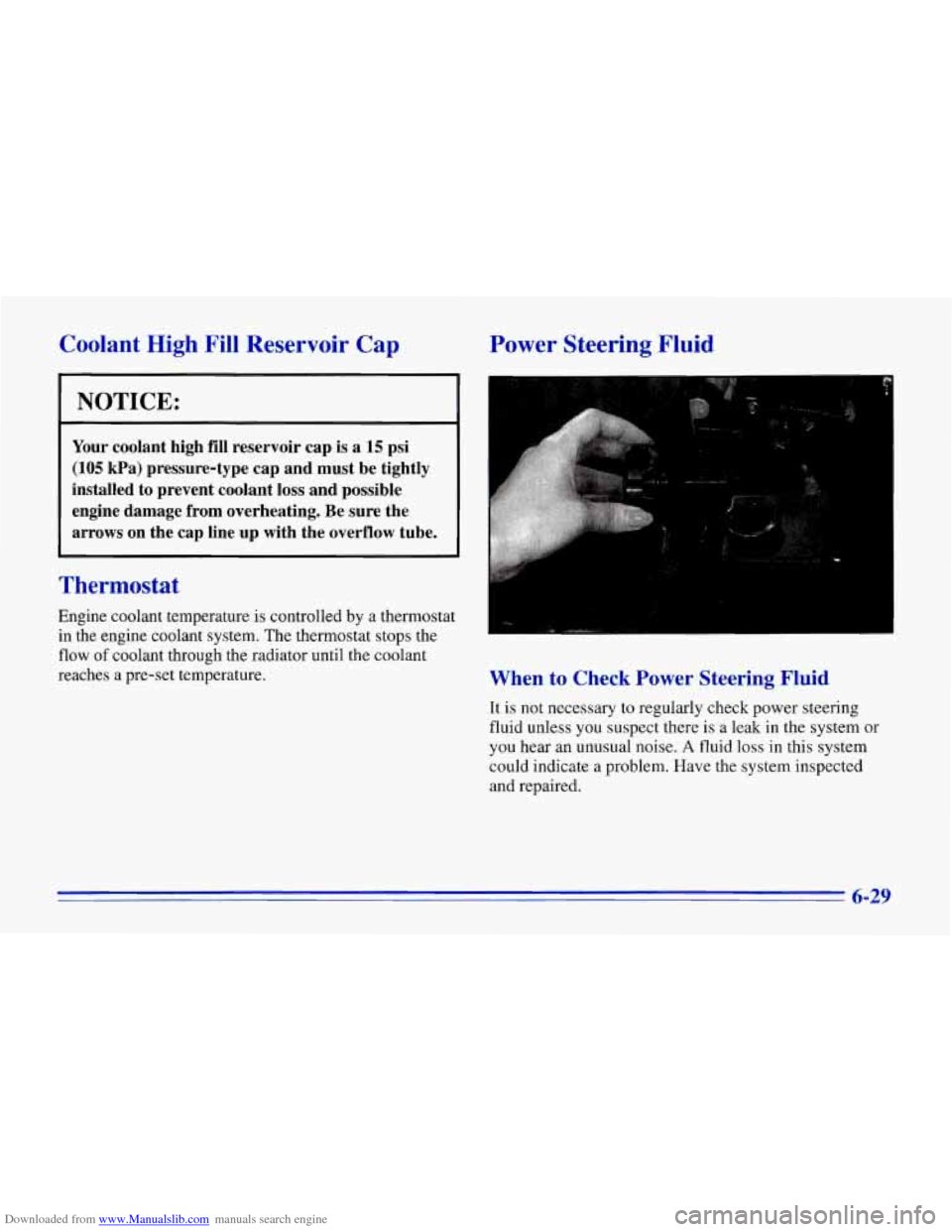
Power Steering Fluid
When to Check Power Steering Fluid
It is not necessary to regularly check power steering
fluid unless you suspect there is a leak in the system or
you hear an unusual noise.
A fluid loss in this system
could indicate a problem. Have the system inspected
and repaired.
6-29
Page 262 of 386
Downloaded from www.Manualslib.com manuals search engine Ai g Washer Fluid
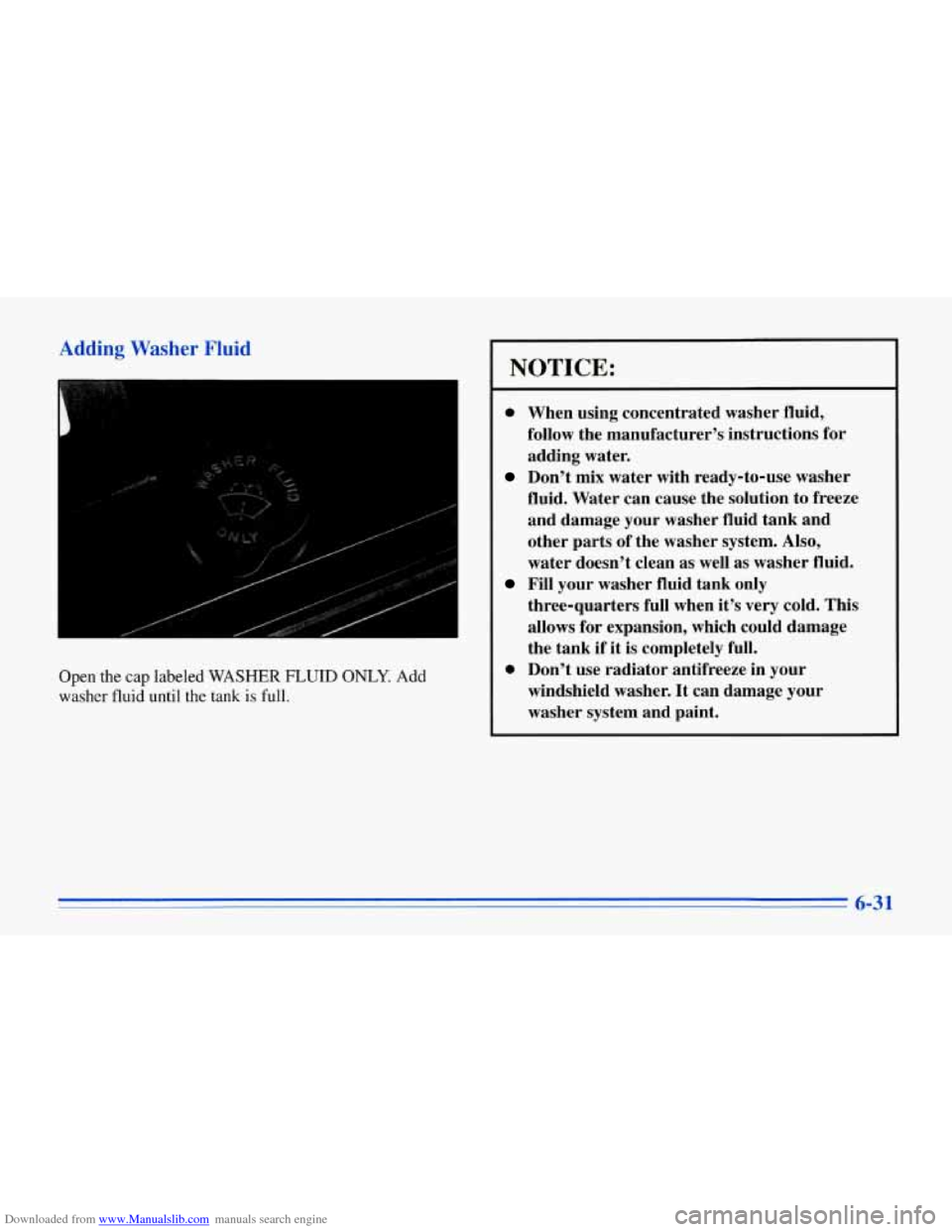
Open the cap labeled WASHER FLUID ONLY. Add
washer fluid until the tank is full.
L
NOTICE:
0 When using concentrated washer fluid,
follow the manufacturer’s instructions for
adding water.
Don’t mix water with ready-to-use washer
fluid. Water can cause the solution to freeze and damage your washer fluid tank and
other parts of the washer system. Also,
water doesn’t clean
as well as washer fluid.
three-quarters full when it’s
very cold. This
allows for expansion, which could damage
the tank if it is completely full.
windshield washer. It can damage your
washer system and paint.
Fill your washer fluid tank only
0 Don’t use radiator antifreeze in your
6-31
Page 337 of 386
Downloaded from www.Manualslib.com manuals search engine I I Short TripKity Maintenance Schedule I I I I
99,000 Miles (165 000 km)
0 Change engine oil and filter (or every
3 months, whichever occurs first).
An Emission Control Service. *
DATE ACTUAL MILEAGE SERVICED BY:
100,000 Miles (166 000 km)
0 Drkin, flush and refill cooling system
(of every 60 months since last service,
whichever occurs first). See “Engine
Caolant” in the Index for what to use.
In pect hoses. Clean radiator, condenser,
pr
1 ;ssure cap and neck. Pressure test cooling
system and pressure cap.
An Emission Control Service.
7-26
Page 349 of 386
Downloaded from www.Manualslib.com manuals search engine Long Trip/Highway Maintenance Schedule
97,50~ Miles (~OL 300 km)
Change engine oil and filter (or every
I2 months, whichever occurs first).
An Emission Control Service. *
I7 Lubricate the suspension, steering and
parking brake cable guides, underbody
contact points and linkage (or every
12
months, whichever occurs first).
DATE ACTUAL MILEAGE SERVICED BY:
I
luu,OOO Miles (166 000 km)
0 Drain, flush and refill cooling system
(or every
60 months since last service,
whichever occurs first). See “Engine
Coolant’’ in the Index for what to use.
Inspect hoses. Clean radiator, condenser,
pressure cap and neck. Pressure test the
cooling system and pressure cap.
An Emission Control Service.