1996 CHEVROLET CORVETTE fuel
[x] Cancel search: fuelPage 117 of 386
Downloaded from www.Manualslib.com manuals search engine Speedometer and Odometer
Your speedometer lets you see your speed in either miles Tachometer
per hour (mph) or kilometers p& how: (km/h). Your
odometer shows how far your vehicle has been driven, in The
tachometer displays the engine speed in thousands
either miles or kilometers. Press the
ENG MET button on of
revolutions per minute (rpm).
the trip monitor to switch the display between English
units (miles) and metric units (kilometers).
Your Corvette’s odometer is tamper-resistant. It will
read
OD0 ERR if someone has tampered with it.
If a new odometer is installed, it will automatically reset to
the correct reading.
If an electrical or other problem makes
setting the odometer correctly impossible, then it’s set at
zero, but
a label on the driver’s door must show the old
reading and when the new one was installed.
Trip Odometer
The trip odometer can tell you how far your Corvette has
been driven since you last set the trip odometer to zero.
To display the trip odometer, press TRIP
OD0 on the
Trip Monitor.
To reset it, press and hold RESET TRIP
for two seconds. Fuel
will shut
off at about 6400 rpm for the LT4 (Code 5)
engine and at about 5850 rpm for the LT1 (Code P)
engine.
If you continue to drive your Corvette
at the fuel shut
off rpm, you could damage your engine. Be sure to
operate your Corvette below the fuel shut
off rpm or
reduce your rpm quickly when the fuel shuts
off.
Warning Lights, Gauges and
Indicators
This part describes the warning lights and gauges that may
be on your vehicle. The pictures will help you locate them.
Warning lights and gauges can signal
that something is
wrong before it becomes serious enough to cause an
expensive repair or replacement. Paying attention to
your warning lights and gauges could also save you or
others from injury.
Page 120 of 386
Downloaded from www.Manualslib.com manuals search engine Voltmeter
El
VOLTS
18
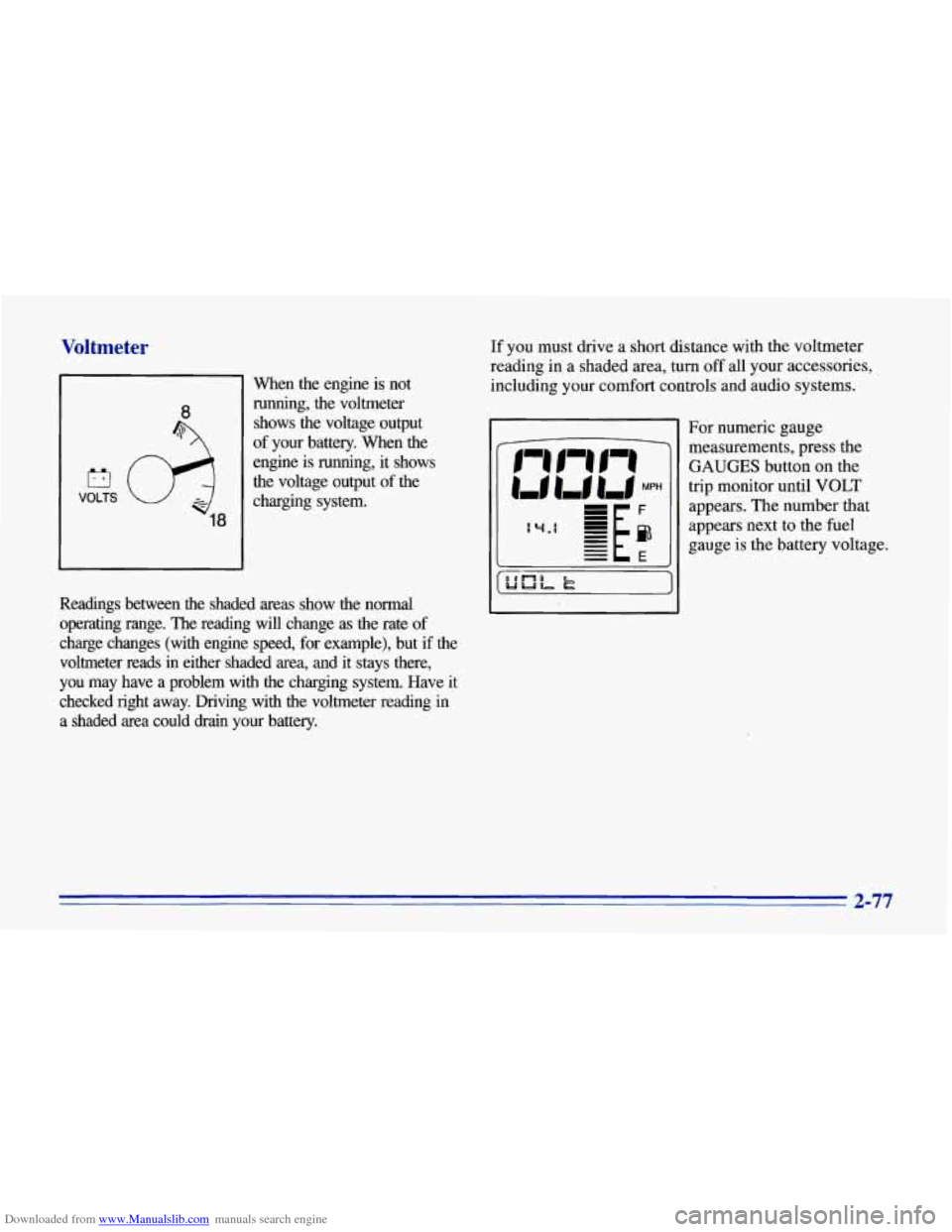
When the engine is not running, the voltmeter
shows the voltage output
of your battery.
When the
engine is running, it shows
the voltage output of the
charging system.
Readings between the shaded areas show the normal
operating range. The reading will change as the rate of
charge changes (with engine speed, for example), but
if the
voltmeter reads in either shaded area, and it stays there,
you may have a problem with the charging system. Have it
checked right away. Driving with the voltmeter reading
in
a shaded area could drain your battery. If you
must drive a short distance with the voltmeter
reading in a shaded area, turn
off all your accessories,
including your comfort controls and audio systems.
For numeric gauge
measurements, press the
GAUGES button on the
trip monitor until
VOLT
appears. The number that
appears next to the fuel
gauge is the battery voltage.
2-77
Page 125 of 386
Downloaded from www.Manualslib.com manuals search engine Engine Coolant Temperature Gauge
185
TEMP
HH
“F
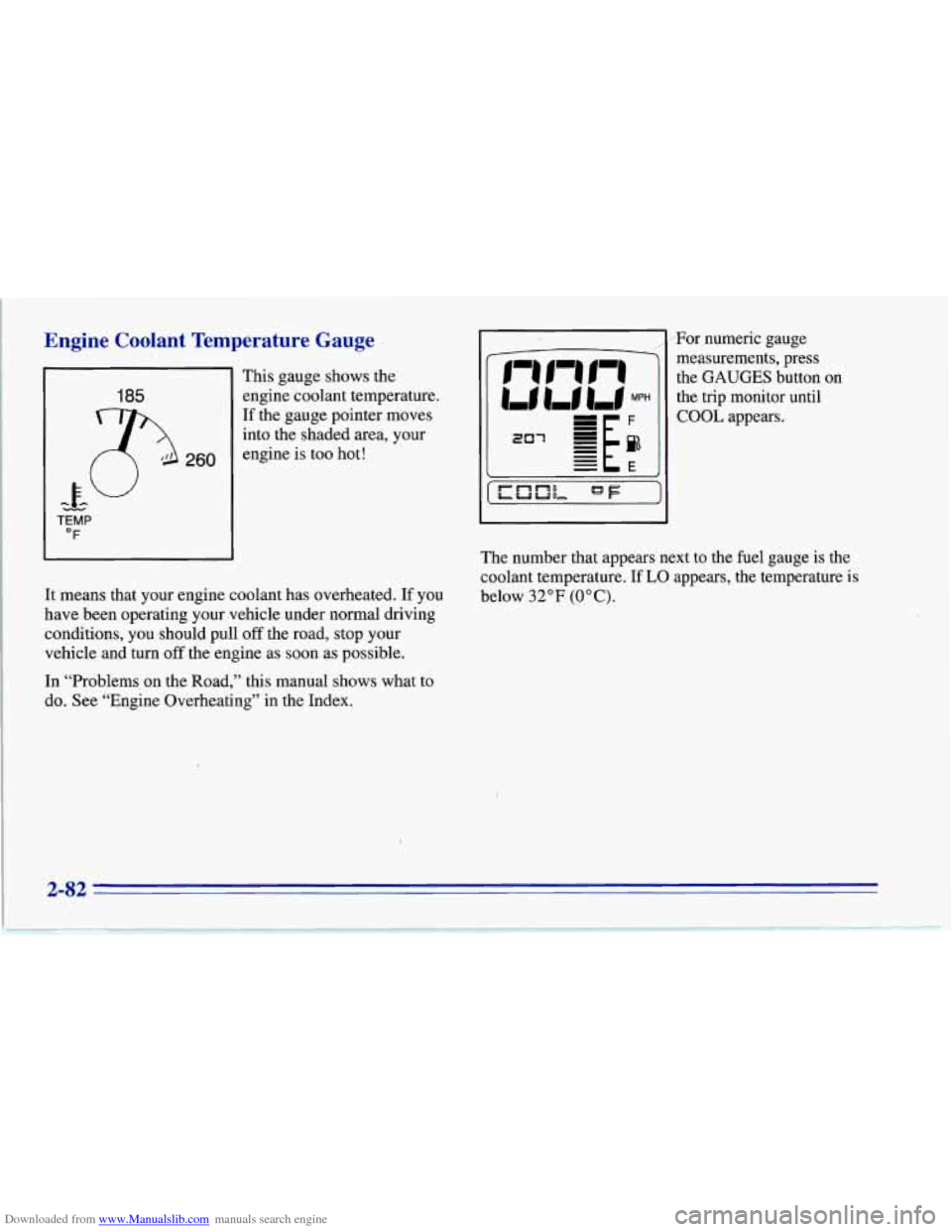
This gauge shows the
engine coolant temperature.
If the gauge pointer moves
into the shaded area, your
engine is too hot!
The number that appears next to the fuel gauge is the
-~ 1- -For numeric gauge
measurements, pies
the GAUGES button
on
I coolant temperature. If LO appears, the temperature is
It means that your engine coolant has overheated. If you below 32”~ (0°C).
have been operating your vehicle under normal driving
conditions, you should pull
off the road, stop your
vehicle and turn
off the engine as soon as possible.
In “Problems on the Road,” this manual shows what to
do. See “Engine Overheating” in the Index.
2-82
Page 129 of 386
Downloaded from www.Manualslib.com manuals search engine Malfunction Indicator Lamp (Service Engine Soon Light)
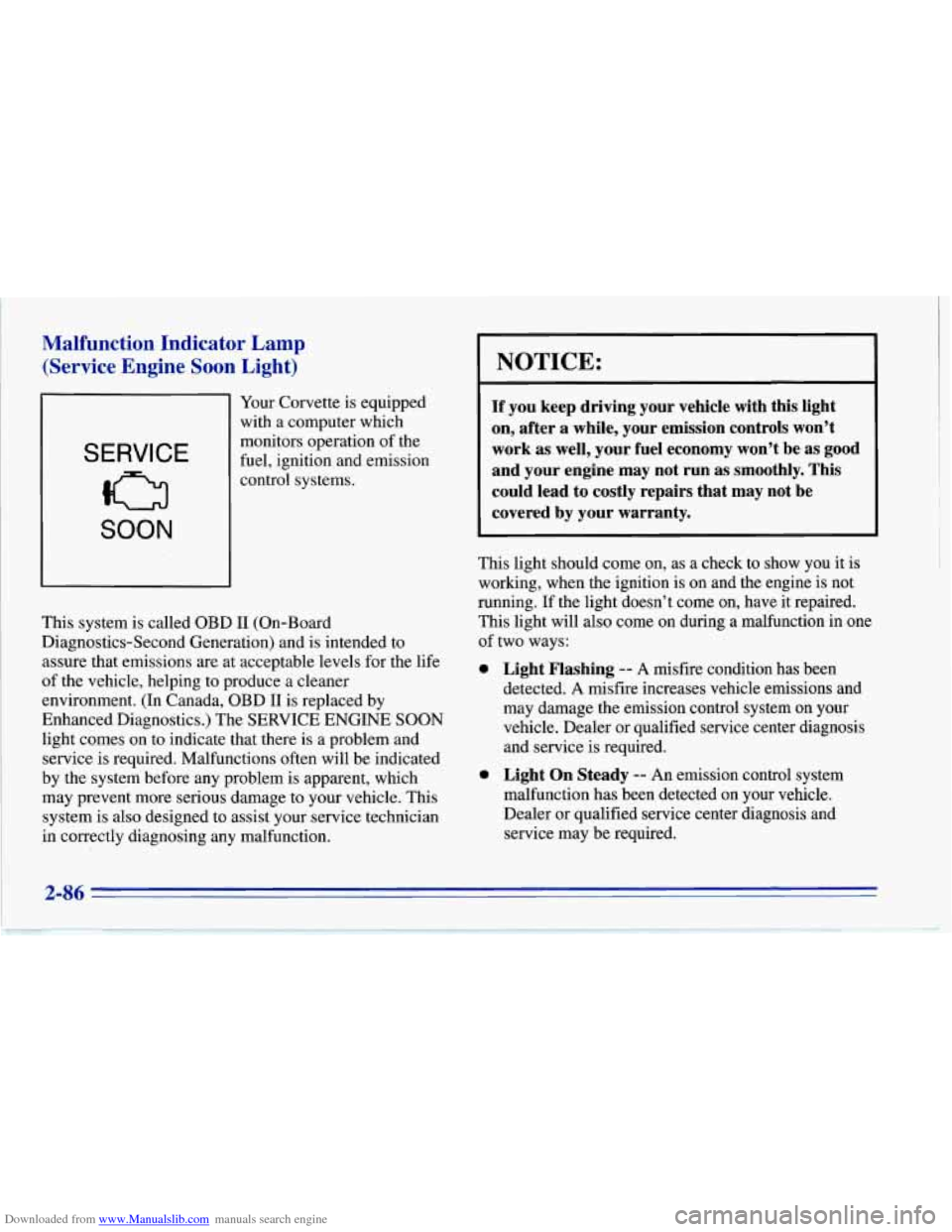
Your Corvette is equipped
with a.computer which
SERVICE
SOON
monitors operation of the
fuel, ignition and emission
control systems.
This system is called OBD I1 (On-Board
Diagnostics-Second Generation) and is intended to
assure that emissions are at acceptable levels for the life
of the vehicle, helping to produce a cleaner
environment. (In Canada, OBD I1 is replaced by
Enhanced Diagnostics.) The SERVICE ENGINE
SOON
light comes on to indicate that there is a problem and
service is required. Malfunctions often will be indicated
by the system before any problem is apparent, which
may prevent more serious damage to your vehicle. This
system is also designed to assist your service technician
in correctly diagnosing any malfunction.
NOTICE:
If you keep driving your vehicle with this light
on, after a while, your emission controls won’t
work as well, your fuel economy won’t be as good
and your engine may not run as smoothly. This
could lead to costly repairs that may not be
covered by your warranty.
This light should come on, as a check to show you it is
working, when the ignition is on and the engine
is not
running. If the light doesn’t come on, have it repaired.
This light will also come on during a malfunction in one
of two ways:
0
0 Light Flashing -- A misfire condition has been
detected. A misfire increases vehicle emissions and
may damage the emission control system on your
vehicle. Dealer or qualified service center diagnosis
and service is required.
Light On Steady -- An emission control system
malfunction has been detected on your vehicle.
Dealer or qualified service center diagnosis and
service may be required.
2-86
Page 130 of 386
Downloaded from www.Manualslib.com manuals search engine If the Light Is Flashing
The following may prevent more serious damage to
your vehicle:
If the Light Is On Steady
You may be able to correct the emission system
malfunction by considering the following:
Did you just put fuel into your vehicle?
If
so, reinstall the fuel cap, making sure to fully install
the cap. The diagnostic system can determine if the fuel
cap has been left
off or improperly installed. This will
allow fuel to evaporate into the atmosphere.
A few
driving trips should turn the light
off.
Did you just drive through a deep puddle of water?
If
so, your electrical system may be wet. The condition
will usually
be corrected when the electrical system
dries out. A few driving trips should turn the light
off.
Are you low on fuel?
As your engine starts to run out of fuel, your engine may
not run as efficiently as designed since small amounts of
air are sucked into the fuel line causing a misfire. The
system can detect this. Adding fuel should correct this
condition. Make sure to install the fuel cap properly. It
will take a few driving trips to turn the light
off.
Reduce vehicle speed.
Avoid hard accelerations.
0 Avoid steep uphill grades.
If the light stops flashing and remains
on steady see “If
the Light Is On Steady” following.
If
the light continues to flash, when it is safe to do so,
stop the vehicle. Put your vehicle in PARK (P). Turn the
key off,
wait at least 10 seconds and restart the engine.
If the light remains on steady, see “If the Light Is On
Steady” following. If the light is still flashing follow the
previous steps, and drive the vehicle to your dealer or
qualified service center for service.
2-87
Page 131 of 386
Downloaded from www.Manualslib.com manuals search engine Have you recently changed brands of fuel?
If so, be sure to fuel your vehicle with quality fuel (see
“Fuel” in the Index). Poor
fuel quality will cause your
engine not to run as efficiently as designed.
You may
notice this as stalling after start-up, stalling when you
put the vehicle into gear, misfiring, hesitation on
acceleration or stumbling on acceleration. (These
conditions may go away once the engine is warmed up.)
This will be detected by the system and cause the light
to turn on.
If you experience this condition, change the fuel brand
you use. It will require at least one full tank of the
proper fuel to turn the light
off.
If none of the above steps have made the light turn off,
have your dealer or qualified service center check the
vehicle. Your dealer has the proper test equipment and
diagnostic tools to fix any mechanical or electrical
problems that may have developed.
Low Oil Light
LOW
OIL
This light should come on
while you are starting your
engine.
If the light doesn’t
come on, have it repaired. If
the light comes on while
starting your engine and
stays on, your engine oil
level may be too low.
You
may need to add oil. See
“Engine Oil” in the Index.
2-88
Page 133 of 386
Downloaded from www.Manualslib.com manuals search engine Engine Oil Temperature Gauge
320
OIL TEMP OF
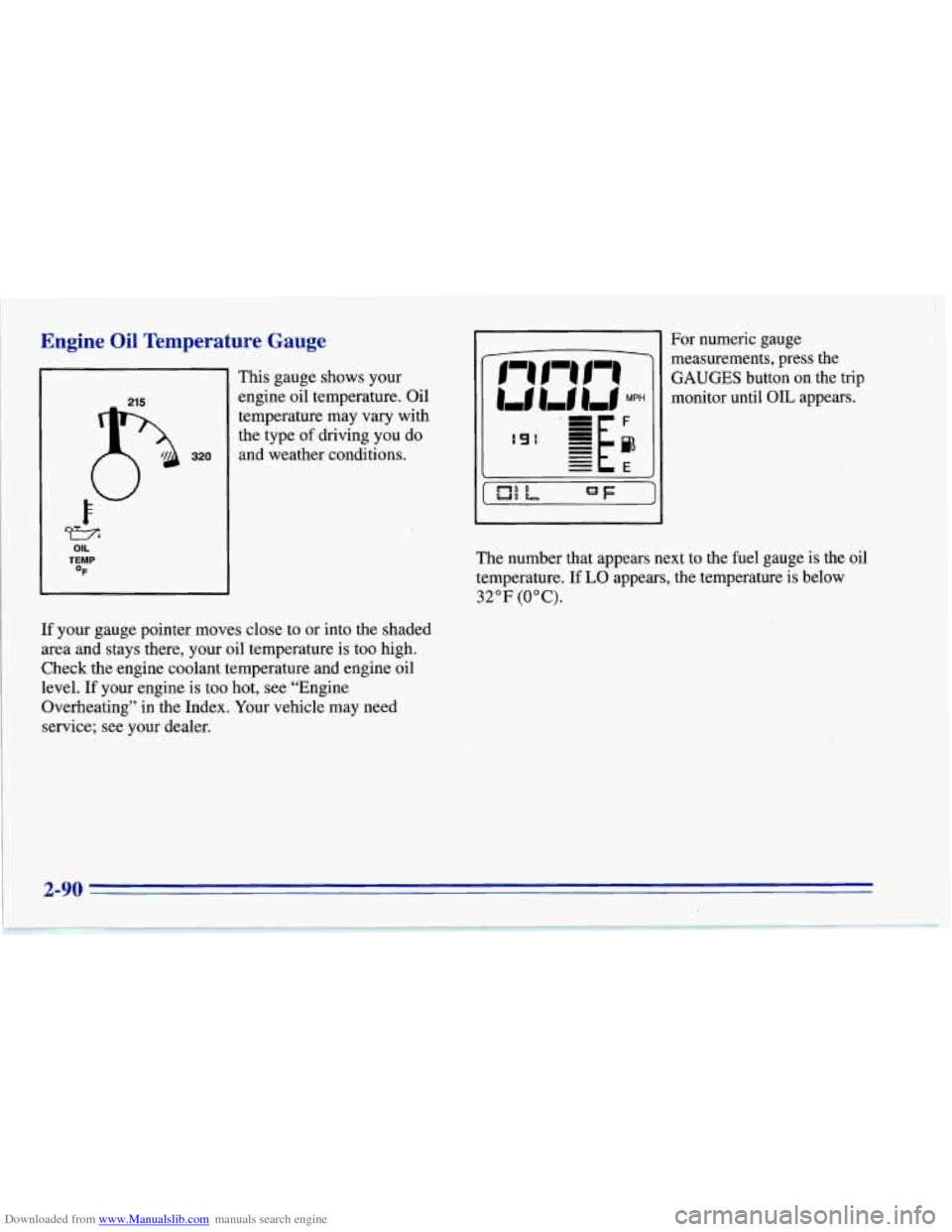
This gauge shows your
engine oil temperature. Oil
temperature may vary with
the type
of driving you do
and weather conditions.
If your gauge pointer moves close to or into the shaded
area and stays there, your oil temperature is too high.
Check the engine coolant temperature and engine oil
level.
If your engine is too hot, see “Engine
Overheating” in the Index. Your vehicle may need
service; see your dealer.
I,
For numeric gauge
measurements, press the GAUGES button on the trip
monitor until
OIL appears.
The number that appears next to the fuel gauge is the oil
temperature.
If LO appears, the temperature is below
32°F (OOC).
2-90
Page 136 of 386
Downloaded from www.Manualslib.com manuals search engine Security Light Check Gauges Light
SECURITY
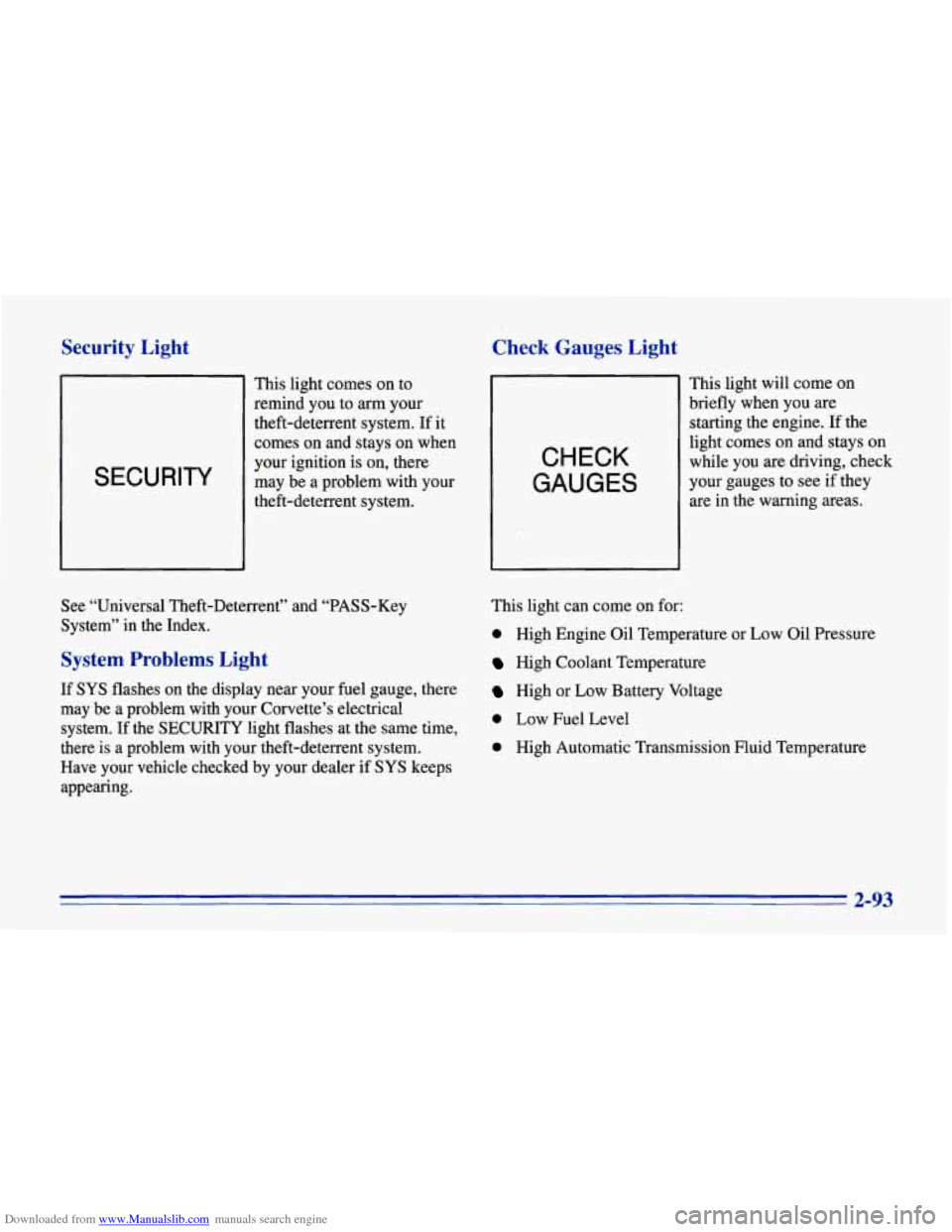
This light comes on to
remind you to
arm your
theft-deterrent system. If it
comes on and stays on when
your ignition is on, there
may be a problem with your
theft-deterrent system.
CHECK
GAUGES
This light will come on
briefly when you are
starting the engine.
If the
light comes on and stays on
while you are driving, check
your gauges to see if they
are in the warning areas.
See “Universal Theft-Deterrent” and “PASS-Key
System” in the Index.
System Problems Light
If SYS flashes on the display near your fuel gauge, there
may be a problem with your Corvette’s electrical
system. If the
SECURITY light flashes at the same time,
there is
a problem with your theft-deterrent system.
Have your vehicle checked by your dealer
if SYS keeps
appearing. This
light can come on for:
0 High Engine Oil Temperature or Low oil Pressure
High Coolant Temperature
High or Low Battery Voltage
0 Low Fuel Level
0 High Automatic Transmission Fluid Temperature
2-93