Page 184 of 386
Downloaded from www.Manualslib.com manuals search engine If you drive regularly in steep country, or if you’re
planning to visit there, here are some tips that can make
your trips safer and more enjoyable.
0
0 Keep your vehicle in good shape. Check all fluid
levels and also the brakes, tires, cooling system and
transmission. These parts can work hard on
mountain roads.
Know how to
go down hills. The most important
thing to know is this: let your engine do some of the
slowing down. Shift
to a lower gear when you go
down a steep or long hill.
I
If you don’t shift down, your brakes could get so
hot that they wouldn’t work well. You would then
have poor braking or even none going down a hill.
You could crash. Shift down to let your engine
assist your brakes on a steep downhill slope.
’ A CAUTION:
I
Coasting downhill in NEUTRAL (N) or with the
ignition
off is dangerous. Your brakes will have to
do all the work of slowing down. They could get
so
hot that they wouldn’t work well. You would then
have poor braking or even none going down a
hill.
You could crash. Always have your engine running
and your vehicle
in gear when you go downhill.
Know how to go uphill. You may want to shift down
to a lower gear. The lower gears help cool your engine
and transmission, and you can climb the
hill better.
Stay in your own lane when driving on two-lane
roads in hills or mountains. Don’t swing wide or cut
across the center of the road. Drive at speeds that let
you stay in your own lane.
something
in your lane, like a stalled car or an accident,
As you go over the top of a hill, be alert. There could be
0 You may see highway signs on mountains that warn of
special problems. Examples are long grades, passing or
no-passing zones, a falling rocks area or windmg
roads. Be
alert to these and take appropriate action.
4-23
Page 207 of 386
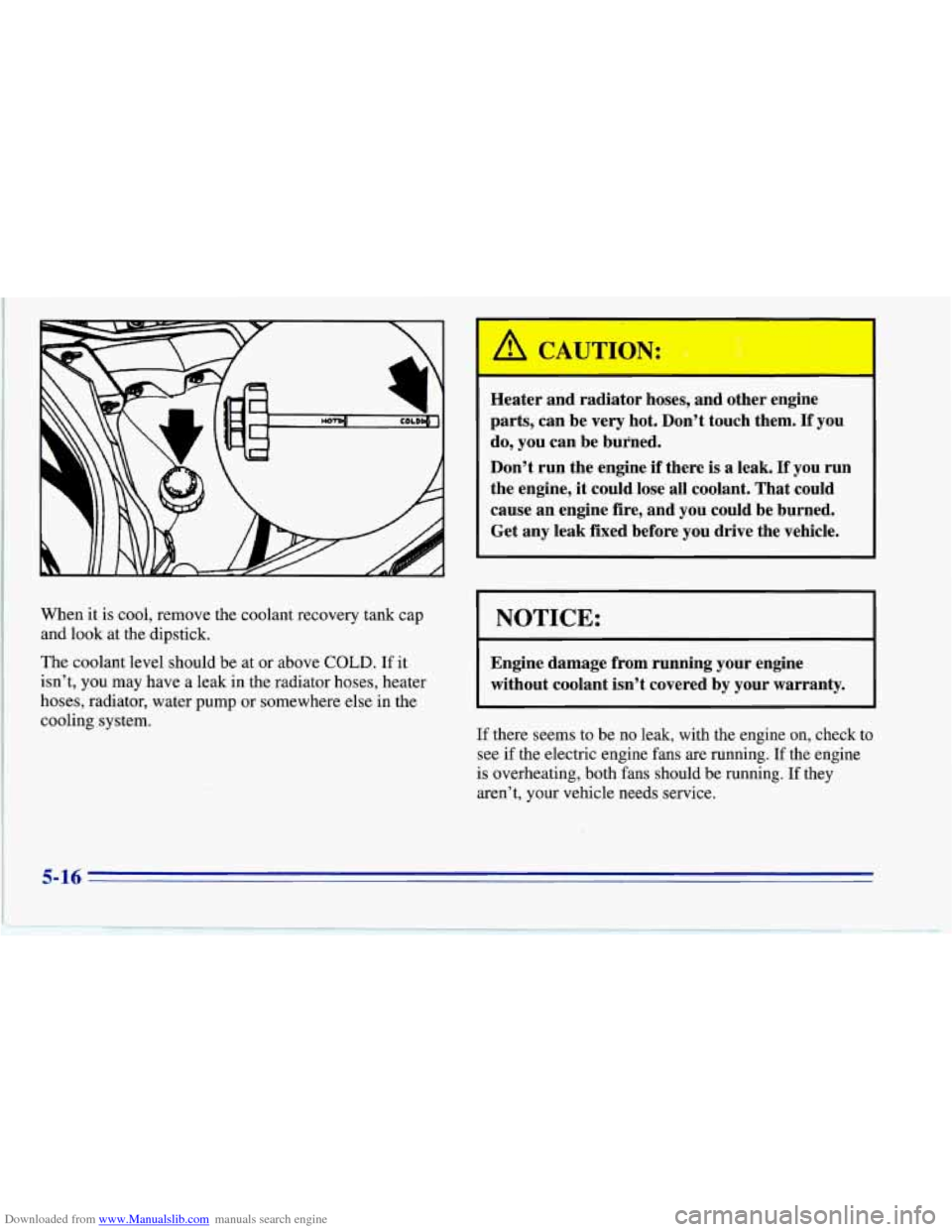
Downloaded from www.Manualslib.com manuals search engine When it is cool, remove the coolant recovery tank cap
and look at the dipstick.
The coolant level should be at or above
COLD. If it
isn’t, you may have a leak in the radiator hoses, heater
hoses, radiator, water pump
or somewhere else in the
cooling system.
.h CAUTION:
*
8’
Heater and radiator hoses, and other engine
parts, can be very
hot. Don’t touch them. If you
do, you can be bul‘ned.
Don’t run the engine
if there is a leak. If you run
the engine, it could lose all coolant. That could
cause an engine fire, and you could be burned.
Get any leak fixed before you drive the vehicle.
I NOTICE:
I
Engine damage from running your engine
without coolant isn’t covered by your warranty.
I
If there seems to be no leak, with the engine on, check to
see if the electric engine fans are running.
If the engine
is overheating, both fans should be running. If they
aren’t, your vehicle needs service.
5-16
Page 208 of 386
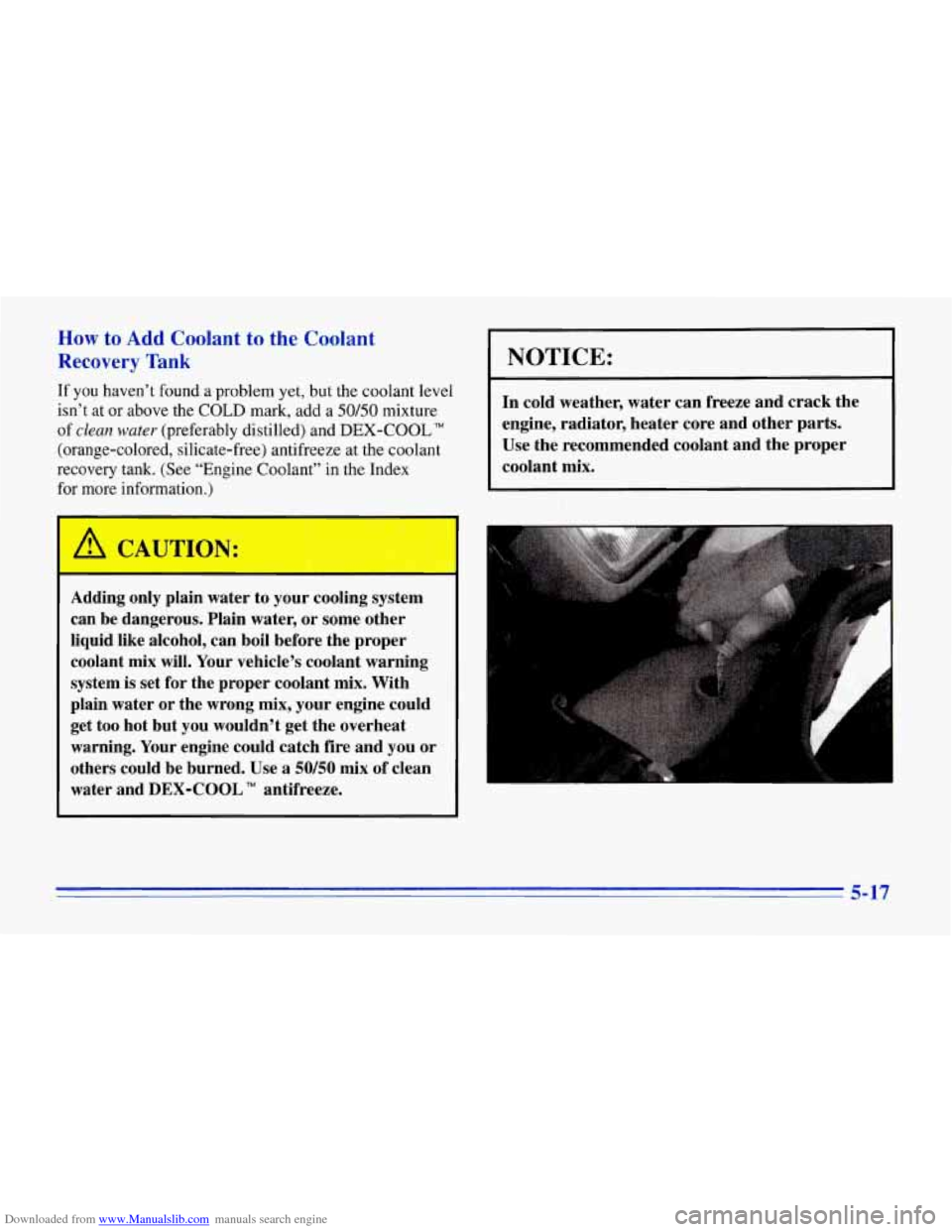
Downloaded from www.Manualslib.com manuals search engine How to Add Coolant to the Coolant
Recovery Tank
If you haven’t found a problem yet, but the coolant level
isn’t at
or above the COLD mark, add a 50/50 mixture
of
clean water (preferably distilled) and DEX-COOL“
(orange-colored, silicate-free) antifreeze at the coolant
recovery tank. (See “Engine Coolant” in the Index
for more information.)
-
A CAUTION:
Adding only plain water to your cooling system
can be dangerous. Plain water, or some other
liquid like alcohol, can boil before the proper
coolant
mix will. Your vehicle’s coolant warning
system is set for the proper coolant mix. With
plain water or the wrong mix, your engine could
get too hot but you wouldn’t get the overheat
warning.
Your engine could catch fire and you or
others could be burned. Use
a 50/50 mix of clean
water and
DEX-COOL TM antifreeze.
NOTICE:
In cold weather, water can freeze and crack the
engine, radiator, heater core and other parts.
Use the recommended coolant and the proper
coolant mix.
5-17
Page 209 of 386
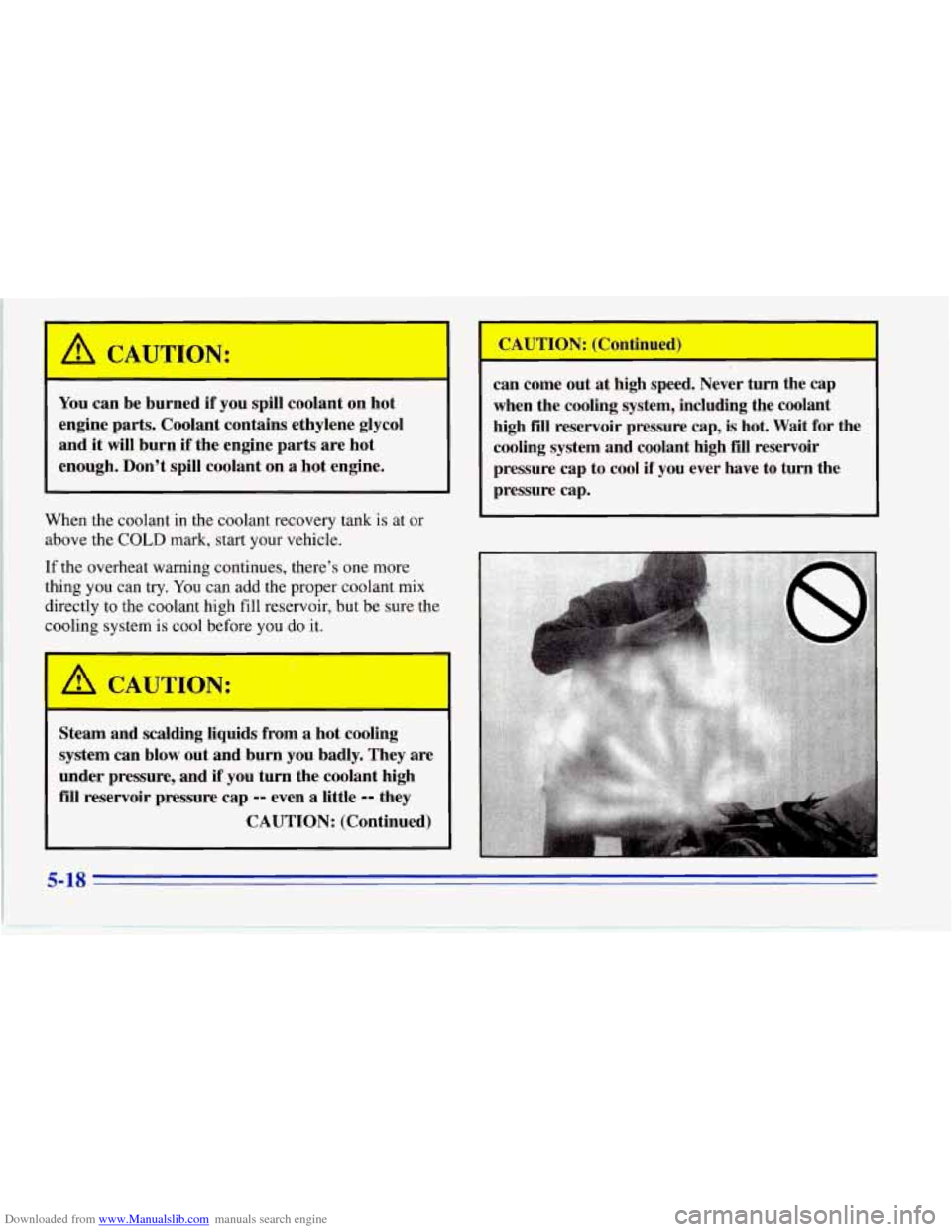
Downloaded from www.Manualslib.com manuals search engine You can be burned if you spill coolant on hot
engine parts. Coolant contains ethylene glycol
and it will burn
if the engine parts are hot
enough. Don’t spill coolant on a hot engine.
I
When the coolant in the coolant recovery tank is at or
above the
COLD mark, start your vehicle.
If the overheat warning continues, there’s one more
thing
you can try. You can add the proper coolant mix
directly
to the coolant high fill reservoir, but be sure the
cooling system is cool before
you do it.
Steam and scalding liquids from
a hot cooling
system can blow out and burn you badly. They are
under pressure, and if you turn the coolant high
fill reservoir pressure
cap -- even a little -- they
CAUTION: (Continued) can
come out
at high speed. Never turn the cap
when the cooling system, including the coolant
high fill reservoir pressure cap,
is hot. Wait for the
cooling system and coolant high fill reservoir
pressure cap to cool
if you ever have to turn the
I pressure cap.
5-18
Page 210 of 386
Downloaded from www.Manualslib.com manuals search engine How to Add Coolant to the C
Fill Reservoir mt
H
I NOTICE:
Your engine has a specific coolant high fill
reservoir
fill procedure. Failure to follow this
procedure could cause your engine
to overheat
and be severely damaged.
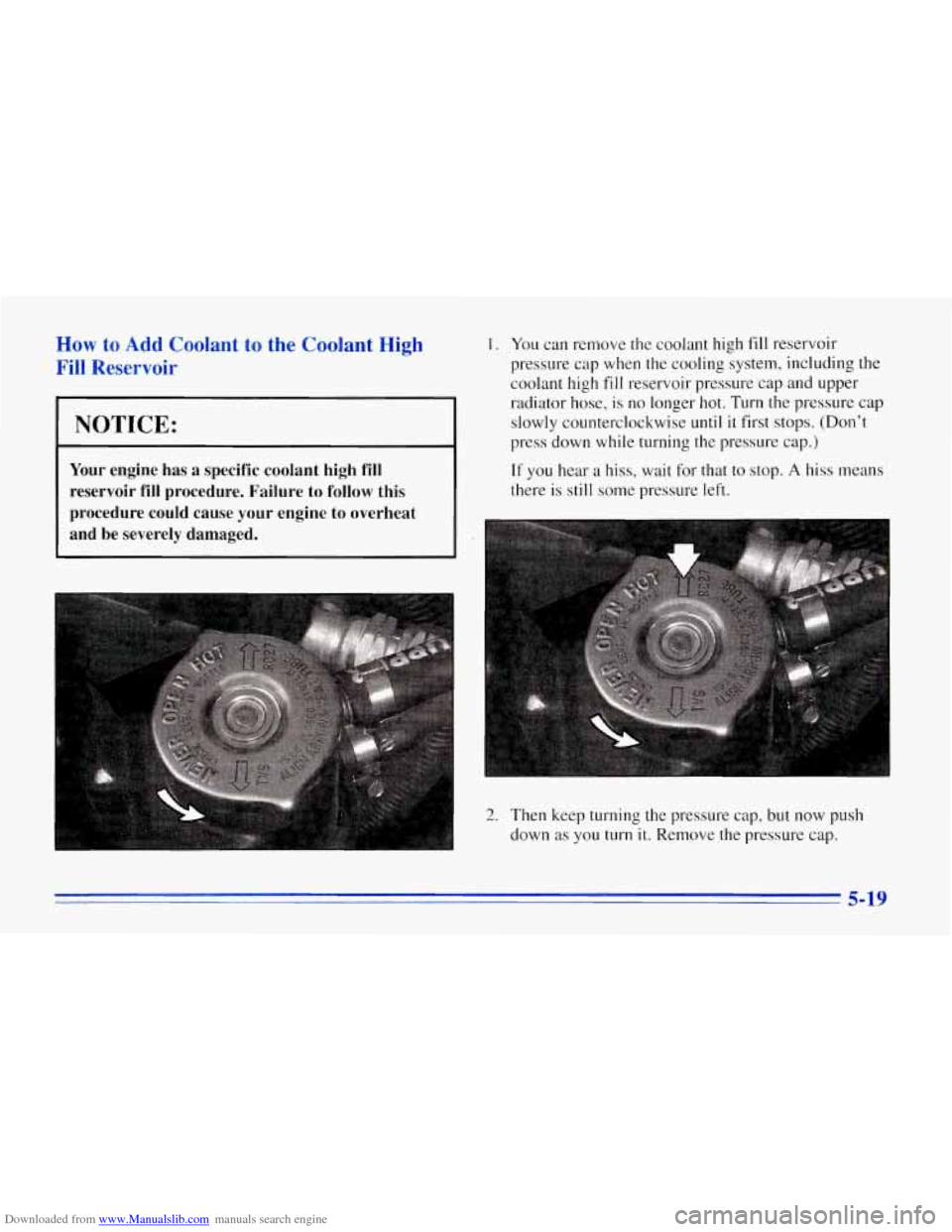
1. You can remove the coolant high fill reservoir
pressure cap when the cooling system, including the
coolant high
fill reservoir pressure cap and upper
radiator hose, is no longer hot. Turn the pressure cap
slowly counterclockwise
until it first stops. (Don’t
press down while turning
the pressure cap.)
If you hear a hiss, wait for that to stop. A hiss means
there is still some pressure left.
2. Then keep turning the pressure cap, but now push
down
as you turn it. Remove the pressure cap.
5-19
Page 256 of 386
Downloaded from www.Manualslib.com manuals search engine What to Use
To add lubricant when the level is low, use Axle
Lubricant (GM
Part No. 12345977) or SAE SOW-90
GL-5 gear lubricant.
To completely refill after draining,
add 4 ounces
(1 18 ml) of Limited-Slip Differential
Lubricant Additive (GM Part
No. 1052358). Then fill to
the bottom
of the filler plug hole with Axle Lubricant
(GM
Part No. 12345977) or SAE SOW-90 GL-5 gear
lubricant.
Engine Coolant
The cooling system in your vehicle is filled with new
DEX-COOL (orange-colored, silicate-free) engine
coolant. This coolant is designed
to remain in your
vehicle for
5 years or 100,000 miles (166 000 km),
whichever occurs first.
The following explains your cooling system and how
to
add coolant when it is low. If you have a problem with
engine overheating or
if you need to add coolant to
your high fill reservoir, see “Engine Overheating”
in the Index.
A 50/50 mixture of water and the proper coolant for
your Corvette will:
0 Give freezing protection down to -34°F (-37°C).
0 Give boiling protection up to 265 OF ( 129 O C).
Protect against rust and corrosion.
Help keep the proper engine temperature.
0 Let the warning lights and gauges work as they should.
NOTICE:
When adding coolant it is important that you use
DEX-COOL (orange-colored, silicate-free)
coolant meeting GM Specification 6277M.
If
silicated coolant is added to the system,
premature engine, heater core or radiator
corrosion may result. In addition, the engine
coolant will require change sooner
-- at
30,000 miles (50 000 km) or 24 months,
whichever occurs first.
6-25
Page 257 of 386
Downloaded from www.Manualslib.com manuals search engine What to Use
Use a mixture of one-half clean water (preferably
distilled) and one-half
DEX-COOL TM (orange-colored,
silicate-free) antifreeze that meets GM Specification
6277M, which won’t damage aluminum parts. Use
GM Engine Coolant Supplement (sealer) (GM
Part
No. 3634621) with any complete coolant change. If you
use this mixture, you don’t need to add anything else.
Adding only plain water to your cooling system
can be dangerous. Plain
water, or some other
liquid like alcohol, can boil before the proper
coolant mix will. Your vehicle’s coolant warning
system is set for the proper coolant mix. With
plain water or the wrong mix, your engine could
get too hot but you wouldn’t get the overheat
warning. Your engine could catch fire and
you or
others could be burned. Use
a 50/50 mix of clean
water and
DEX-COOL TM (orange-colored.
silicate-free) antifreeze.
NOTICE:
If you use an improper coolant mix, your engine
could overheat and be badly damaged. The
repair cost wouldn’t be covered by your
warranty. Too much water in the
mix can freeze
and crack the engine, radiator, heater core and
other parts.
If you have to add coolant more than four times a year,
have your dealer check your cooling system.
NOTICE:
If you use the proper coolant, you don’t have to
add extra inhibitors or additives which claim to
improve the system. These can be harmful.
.
Page 284 of 386
Downloaded from www.Manualslib.com manuals search engine Used Replacement Wheels
L
Using the wrong replacement wheels, wheel bolts
or wheel nuts on your vehicle can be dangerous.
It could affect the braking and handling
of your
vehicle, make your tires lose
air and make you
lose control. You could have a collision in which
you or others could be injured. Always use the
correct wheel, wheel bolts and wheel nuts for
replacement.
NOTICE:
The wrong wheel can also cause problems with
bearing life, brake cooling, speedometer/odometer
calibration, headlamp
aim, bumper height, vehicle
ground clearance
and tire clearance to the body
and chassis.
See “Changing a Flat Tire” in the Index for more
information.
r
Putting a used wheel on your vehicle is
dangerous. You can’t know how it’s been used or
how many miles
it’s been driven. It could fail
suddenly and cause an accident.
If you have to
replace a wheel, use
a new GM original
equipment wheel.
rire Chains
NOTICE:
Don’t use tire chains. They can damage your
vehicle.
6-53