1996 CHEVROLET CORVETTE light
[x] Cancel search: lightPage 204 of 386
Downloaded from www.Manualslib.com manuals search engine Engine Overheating
You will find an engine coolant temperature gauge on
the instrument cluster and a
LOW COOLANT light on
the Driver Information Center.
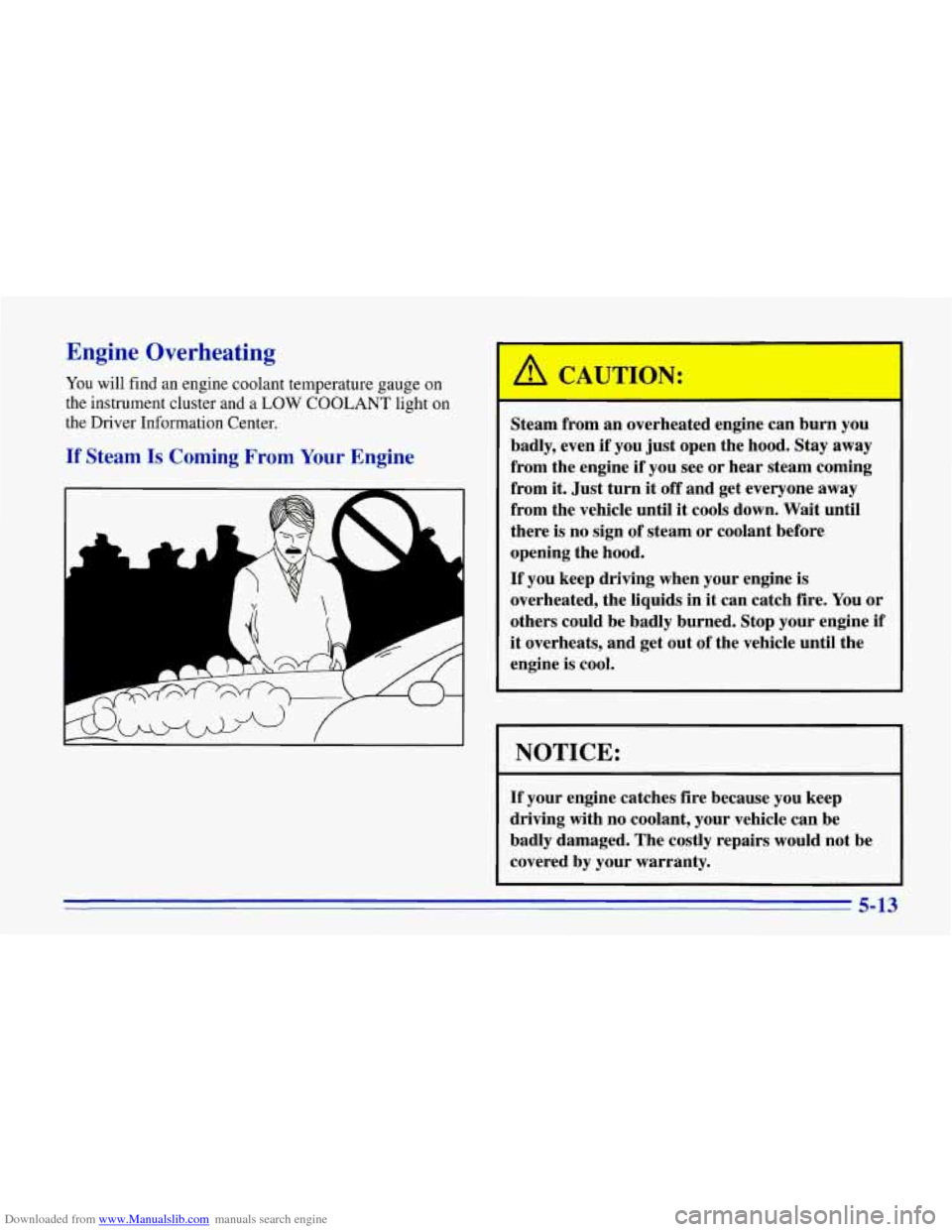
If Steam Is Coming From Your Engine
Steam from an overheated engine can burn you
badly, even if you just open the hood. Stay away
from the engine
if you see or hear steam coming
from it. Just turn it
off and get everyone away
from the vehicle until it cools down. Wait until
there is no sign of steam or coolant before
opening the hood.
If you keep driving when your engine is
overheated, the liquids in it can catch fire.
You or
others could be badly burned. Stop your engine if
it overheats, and get out of the vehicle until the
engine is cool.
I NOTICE:
If your engine catches fire because you keep
driving with no coolant, your vehicle can be
badly damaged. The costly repairs would not be
covered by your warranty.
Page 224 of 386
Downloaded from www.Manualslib.com manuals search engine NOTICE:
Improperly tightened wheel nuts can lead to
brake pulsation and rotor damage.
To avoid
expensive brake repairs, evenly tighten the wheel
nuts in the proper sequence and to the proper
torque specification.
The LOWPLAT TIRE or SERVICE LTPWS light
will stay on as long as
you are using the compact spare
tire. It should
go out when the original tire is replaced.
After you have the flat tire repaired or replaced,
install the plastic nut caps and tighten them to
22 lb-in (2.5 N-m).
Storing a mat -- Except Grand Sport Coupe
Rear Tires
or Spare Tire and Tools
-A
,A CAUTION:
Storing a jack, a tire or other equipment in the
passenger compartment
of the vehicle could
cause injury. In a sudden stop or collision, loose
equipment could strike someone. Store all these
in the proper place.
5-33
Page 231 of 386
Downloaded from www.Manualslib.com manuals search engine I NOTICE:
Spinning your wheels can destroy parts of your
vehicle as well as the tires. If you spin the wheels
too fast while shifting your transmission back
and forth, you can destroy your transmission.
For information about using tire chains on your vehicle,
see “Tire Chains” in the Index.
Rocking Your Vehicle to Get it Out
First, turn your steering wheel left and right. That will
clear the area around your front wheels. You should turn
your ASR system off. (See “ASR System” in the Index.)
Then shift back and forth between REVERSE (R) and a
forward gear (or with a manual transmission, between
FIRST
(1) or SECOND (2) and REVERSE (R)),
spinning the wheels as little as possible. Release the
accelerator pedal while you shift, and press lightly on
the accelerator pedal when the transmission is in gear. If
that doesn’t get you out after a few tries, you may need
to be towed out. If you do need to be towed out, see
“Towing Your Vehicle” in the Index.
5-40
_I
Page 245 of 386
Downloaded from www.Manualslib.com manuals search engine . When to Change Engine Oil
If any one of these is true for you, use the short tripkity
maintenance schedule:
Most trips are less than 5 to 10 miles (8 to 16 km).
This is particularly important when outside
temperatures are below freezing.
Most trips include extensive idling (such as frequent
driving in stop-and-go traffic).
Most trips are through dusty areas.
Driving under these conditions causes engine oil to break
down sooner.
If any one of these is true for your vehicle,
you need to change your oil and filter every
3,000 miles
(5 OOO km) or 3 months -- whichever occurs first.
If none of them is true, use the long triphighway
maintenance schedule. Change the oil and filter every
7,500 miles (12 500 km) or 12 months -- whichever
occurs first. Driving a vehicle with a fully warmed
engine under highway conditions causes engine oil to
break down slower.
Your Corvette has an Oil Life Monitor. This featwe will
let you know when to change your
oil and filter -- usually
between
3,000 miles (5 O00 krn) and 7,500 miles
(12
500 km) since your last oil change. Under severe
conditions, the indicator may come on before
3,000 miles
(5 000 km). Never drive your vehicle more than
7,500 miles (12 500 km) or 12 months (whichever
occurs first) without
an oil change.
The system won’t detect dust in the oil.
So, if you
drive in a dusty area, be sure to change your oil every
3,000 miles
(5 000 km) or sooner if the CHANGE OIL
light comes on. Remember to reset the monitor when the
oil has been changed. For more information, see
“Engine Oil Life Monitor”
in the Index.
What to Do with Used Oil
Did you know that used engine oil contains certain
elements that may
be unhealthy for your skin and could
even cause cancer? Don’t let used oil stay on your
skin for
very long. Clean your skin and nails with soap and water,
or a good hand cleaner. Wash or throw away clothing or
rags containing used engine
oil. (See the manufacturer’s
warnings about the use and disposal of oil products.)
Used oil can be a real threat to the environment. If you
change your own oil, be sure to
drain all free-flowing oil
from the filter before disposal. Don’t ever dispose of oil by
putting it in the trash, pouring it on the ground, into
sewers, or into
streams or bodies of water. Instead, recycle
it by taking it to a place that collects used oil.
If you have
a problem properly disposing of your used oil, ask your dealer, a service station or a local recycling center for help\
.
6-14
Page 256 of 386
Downloaded from www.Manualslib.com manuals search engine What to Use
To add lubricant when the level is low, use Axle
Lubricant (GM
Part No. 12345977) or SAE SOW-90
GL-5 gear lubricant.
To completely refill after draining,
add 4 ounces
(1 18 ml) of Limited-Slip Differential
Lubricant Additive (GM Part
No. 1052358). Then fill to
the bottom
of the filler plug hole with Axle Lubricant
(GM
Part No. 12345977) or SAE SOW-90 GL-5 gear
lubricant.
Engine Coolant
The cooling system in your vehicle is filled with new
DEX-COOL (orange-colored, silicate-free) engine
coolant. This coolant is designed
to remain in your
vehicle for
5 years or 100,000 miles (166 000 km),
whichever occurs first.
The following explains your cooling system and how
to
add coolant when it is low. If you have a problem with
engine overheating or
if you need to add coolant to
your high fill reservoir, see “Engine Overheating”
in the Index.
A 50/50 mixture of water and the proper coolant for
your Corvette will:
0 Give freezing protection down to -34°F (-37°C).
0 Give boiling protection up to 265 OF ( 129 O C).
Protect against rust and corrosion.
Help keep the proper engine temperature.
0 Let the warning lights and gauges work as they should.
NOTICE:
When adding coolant it is important that you use
DEX-COOL (orange-colored, silicate-free)
coolant meeting GM Specification 6277M.
If
silicated coolant is added to the system,
premature engine, heater core or radiator
corrosion may result. In addition, the engine
coolant will require change sooner
-- at
30,000 miles (50 000 km) or 24 months,
whichever occurs first.
6-25
Page 258 of 386
Downloaded from www.Manualslib.com manuals search engine Checking Coolant
LOW
COOLANT
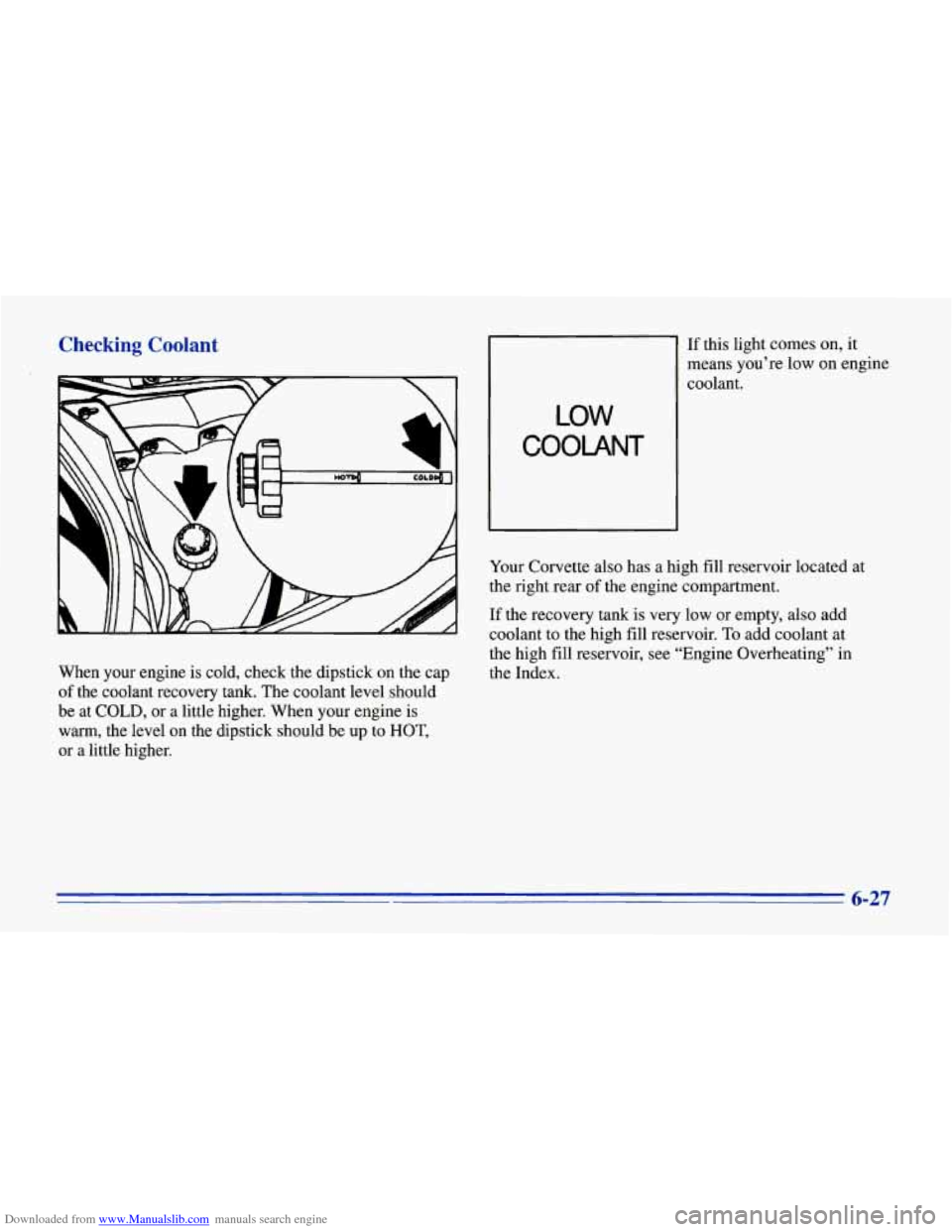
When your engine is cold, check the dipstick on the cap
of the coolant recovery tank. The coolant level should
be at COLD, or a little higher. When your engine is
warm, the level on the dipstick should be up to HOT,
or a little higher. If this
light comes on, it
means you’re
low on engine
coolant.
Your Corvette also has a high fill reservoir located at
the right rear
of the engine compartment.
If the recovery tank is very low or empty, also add
coolant to the high fill reservoir.
To add coolant at
the high fill reservoir, see “Engine Overheating” in
the Index.
6-27
Page 265 of 386
Downloaded from www.Manualslib.com manuals search engine Brake Wear
Your Corvette has four-wheel disc brakes.
Disc brake pads have built-in wear indicators that make
a high-pitched warning sound when the brake pads
are
worn and new pads are needed. The sound may come
and go or be heard all the time your vehicle is moving
(except when you
are pushing on the brake pedal
firmly).
I A CAUTION:
The brake wear warning sound means that
sooner or later your brakes won’t work well.
That could lead to an accident. When you hear
-.he brake wear warning sound, have your vehicle
I serviced*
NOTICE:
Continuing to drive with worn-out brake pads
could result in costly brake repair.
Some driving conditions or climates may cause a brake
squeal when the brakes are first applied or lightly
applied. This does not mean something is wrong with
your brakes.
Brake linings should always be replaced as complete
axle sets.
Brake Pedal Travel
See your dealer if the brake pedal does not return to
normal height, or
if there is a rapid increase in pedal
travel. This could be a sign of brake trouble.
Brake Adjustment
As you make brake stops, your disc brakes
automatically adjust for wear.
6-34
Page 278 of 386
Downloaded from www.Manualslib.com manuals search engine Extended Mobility Tires (Option)
If your Corvette has optional Goodyear Extended
Mobility Tires
(EMT’s), the tires will have “EMT”
molded on the sidewalls. Your vehicle may also have a
spare tire delete option. With the spare tire delete option,
there’s no spare tire,
no tire changing equipment and no
place to store
a tire in the vehicle. Extended Mobility
Tires perform
so well without any air that a Low Tire
Pressure Warning System (LTPWS) is used to alert you
if a tire has lost pressure. A LOWFLAT TIRE light will
appear on your Driver Information Center if a tire’s
inflation pressure is less than
25 psi (170 kPa). If the
LOWFLAT TIRE light comes
on, check your tire
pressures as soon as you can. See
“Low Tire Pressure
Warning Light” in the Index for additional information.
When the LOWELAT TIRE warning light is on,
your vehicle’s handling capabilities will be
reduced during severe maneuvers.
If you drive
too fast, you could lose control of your vehicle.
You or others could be injured. Don’t drive over 1 ,
55 mph (90 kmh) when the LOWLFLAT TIRE
warning light
is on. Drive cautiously, and check
your tire pressures as soon as you can.
I
6-47