Page 4 of 392
Downloaded from www.Manualslib.com manuals search engine This information replaces the “Recreational Vehicle
Towing”
portion located in Section 4 in your
owner’s manual.
Recreational Vehicle Towing
(Four-wheel Drive with the Manual
Transfer Case
Only)
1. Set the parking brake fiily.
2. Place an automatic transmission in PARK (P) or a
manual transmission
in FIRST (1).
3. Firmly attach the vehicle being towed to the tow
vehicle.
Do not tow the vehicle by the rear bumper
bar. Refer to the hitch manufacturer’s instructions.
4. Place the manual shift transfer case shift lever in
NEUTRAL (N).
Shifting the transfer case into NEUTRAL (N) can
cause your vehicle to
roll even if the transmission
is in PARK (P), for an automatic transmission,
or if your vehicle is in gear, for a manual
transmission. You
or others could be injured.
Make
sure the parking brake is firmly set before
you
shift the transfer case into NEUTRAL (N).
5. Release the parking brake only after the vehicle
being towed is firmly attached to the tow vehicle.
6. Insert the ignition key into the ignition switch and
turn it one notch forward of the LOCK position. This
places the key in the
OFF position, which unlocks
the steering column while preventing battery drain.
Unlocking the steering column will allow
for proper
movement of the front wheelskires during towing.
2
Page 11 of 392
Downloaded from www.Manualslib.com manuals search engine Vehicle Symbols
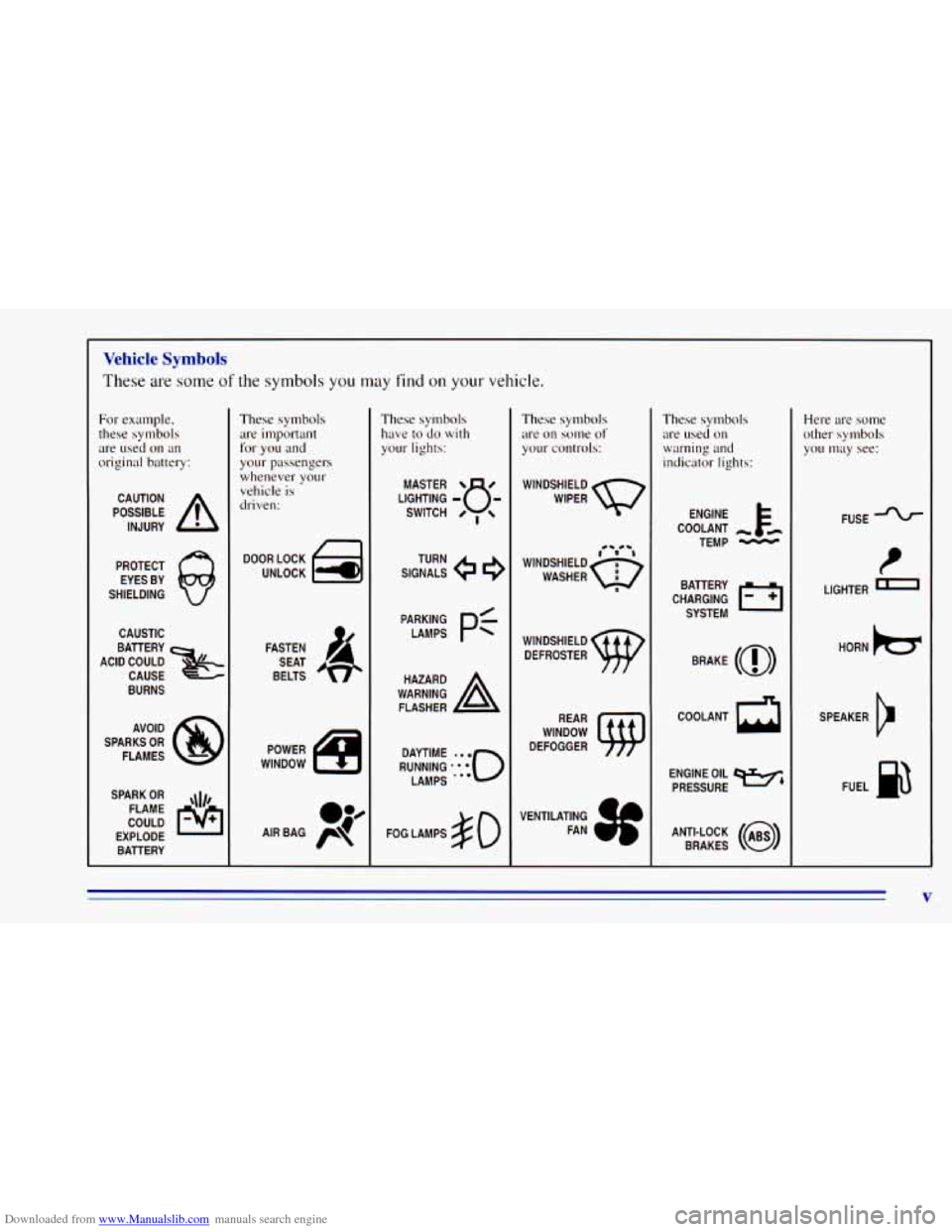
These are some of the symbols you may find on your vehicle.
For example,
these symbols
are used on an
original battery:
POSSIBLE A
CAUTION
INJURY
PROTECT EYES BY
SHIELDING
CAUSTIC
BURNS AVOID
SPARKS
OR
FLAMES
SPARK
OR ,\I/,
COULD pq
FLAME
EXPLODE BATTERY
These symbols
are important
for you and
your passengers
whenever your
vehicle is
driven:
DOOR LOCK
FASTEN SEAT
BELTS
These symbols have to do
with
your lights:
SIGNALS e
TURN
FOG LAMPS
# 0
These symbols
are on some
of
yo11r controls:
WINDSHIELD
WIPER
These symbols are used on
warning and
indicator lights:
COOLANT -
TEMP -
CHARGING I-1
BATTERY
SYSTEM
BRAKE
(0)
COOLANT a
ENGINE OIL e,
PRESSURE
ANTI-LOCK
(a)
BRAKES
Here are some
other symbols
you
may see:
FUSE -%-
I
LIGHTER I
HORN )cr
SPEAKER
b
FUEL siE3
V
Page 13 of 392
Downloaded from www.Manualslib.com manuals search engine Section 1 Seats and Restraint Systems
Here you’ll find information about the seats in your
vehicle and how
to use your safety belts properly. You
can also learn about some things you should not do with
air bags and safety belts.
Seats and Seat Controls
This section tells you about the seats -- how to adjust
them, and fold them up and down.
Manual Front Seat
You can lose control of the vehicle if you try to
adjust a manual driver’s seat while the vehicle is
moving. The sudden movement could startle and
confuse you, or make you push a pedal when you
don’t want
to. Adjust the driver’s seat only when
the vehicle
is not moving.
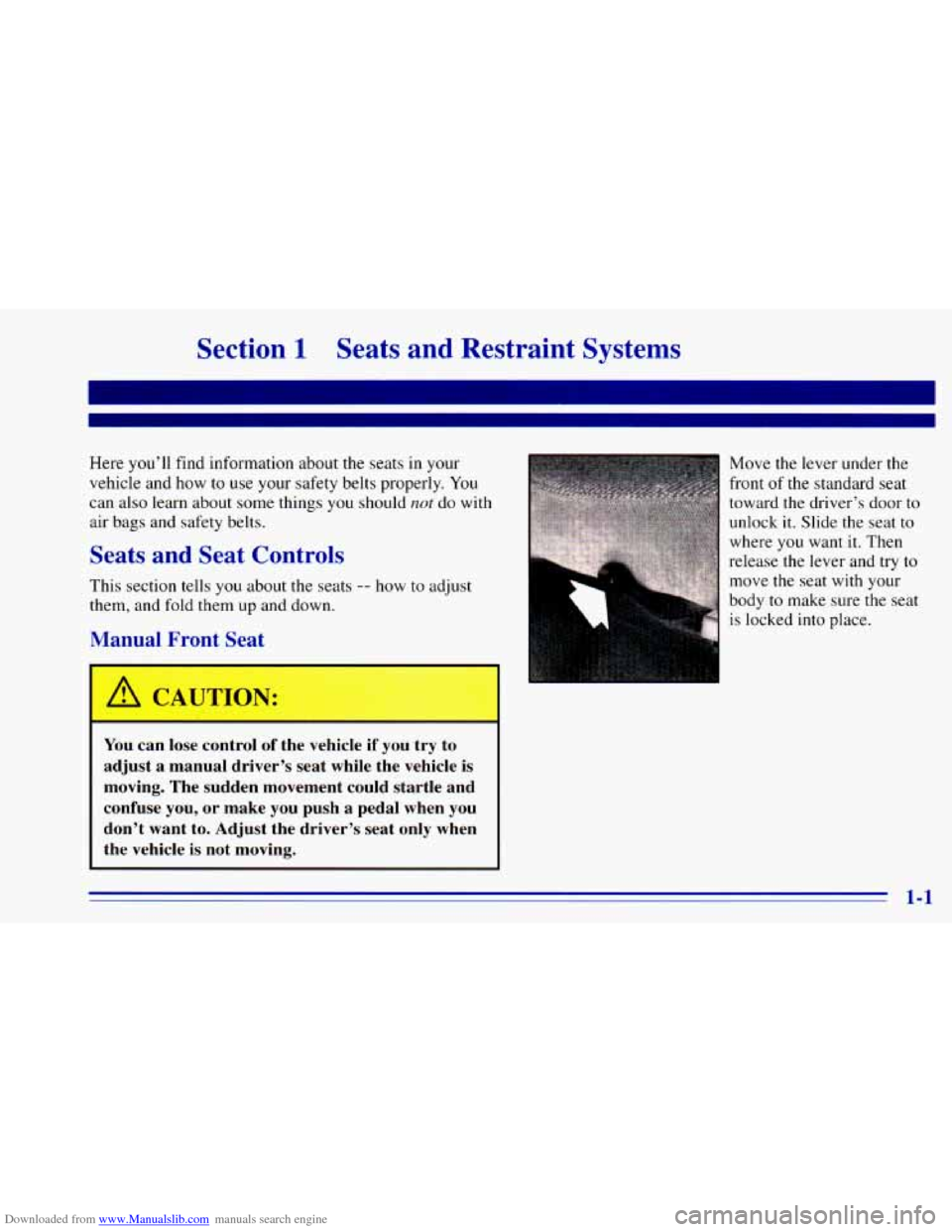
Move the lever under the
front of the standard seat
toward the driver’s door to
unlock
it. Slide the seat to
where
you want it. Then
release the lever and try to
move the seat with your
body,to make sure the seat
is locked into place.
1-1
Page 14 of 392
Downloaded from www.Manualslib.com manuals search engine I
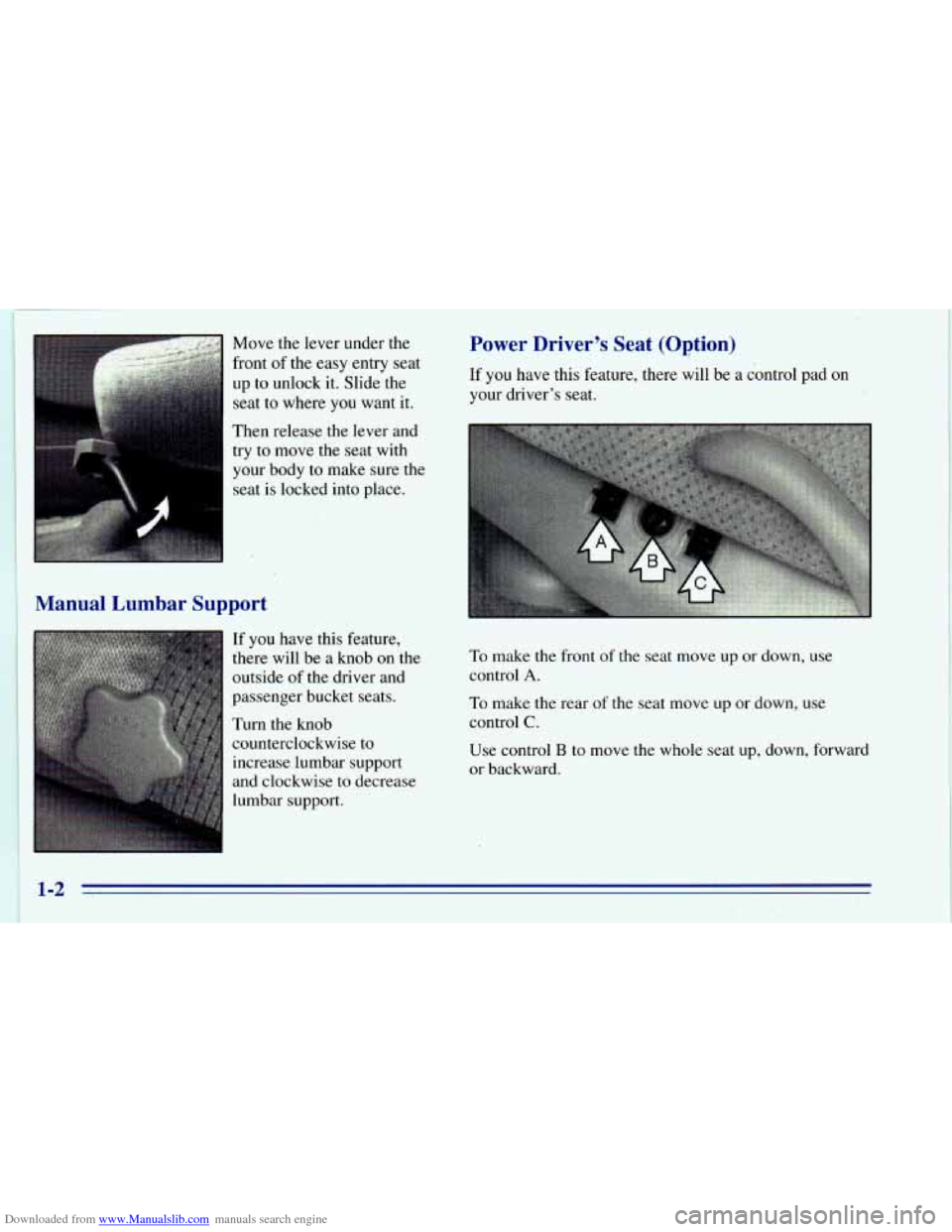
Move the lever under the
front of the easy entry seat
up to unlock it. Slide the
seat to where you want it.
Then release the lever and
try to move the seat with
your body to make sure the
'seat
is locked into place.
I
Manual Lumbar Support
If you have this feature,
there will'be a knob on the
outside of the driver and
passenger bucket seats.
Turn the knob
counterclockwise to
increase lumbar support
and clockwise to decrease
lumbar support.
Power Driver's Seat (Option)
If you have this feature, there will be a control pad on
your driver's seat.
To make the front of the seat move up or down,.use
control
A.
To make the rear of the seat move up or down, use
control C.
Use control
B to move the whole seat up, down, forward
or backward.
1-2
Page 15 of 392
Downloaded from www.Manualslib.com manuals search engine Power Lumbar Control (Option)
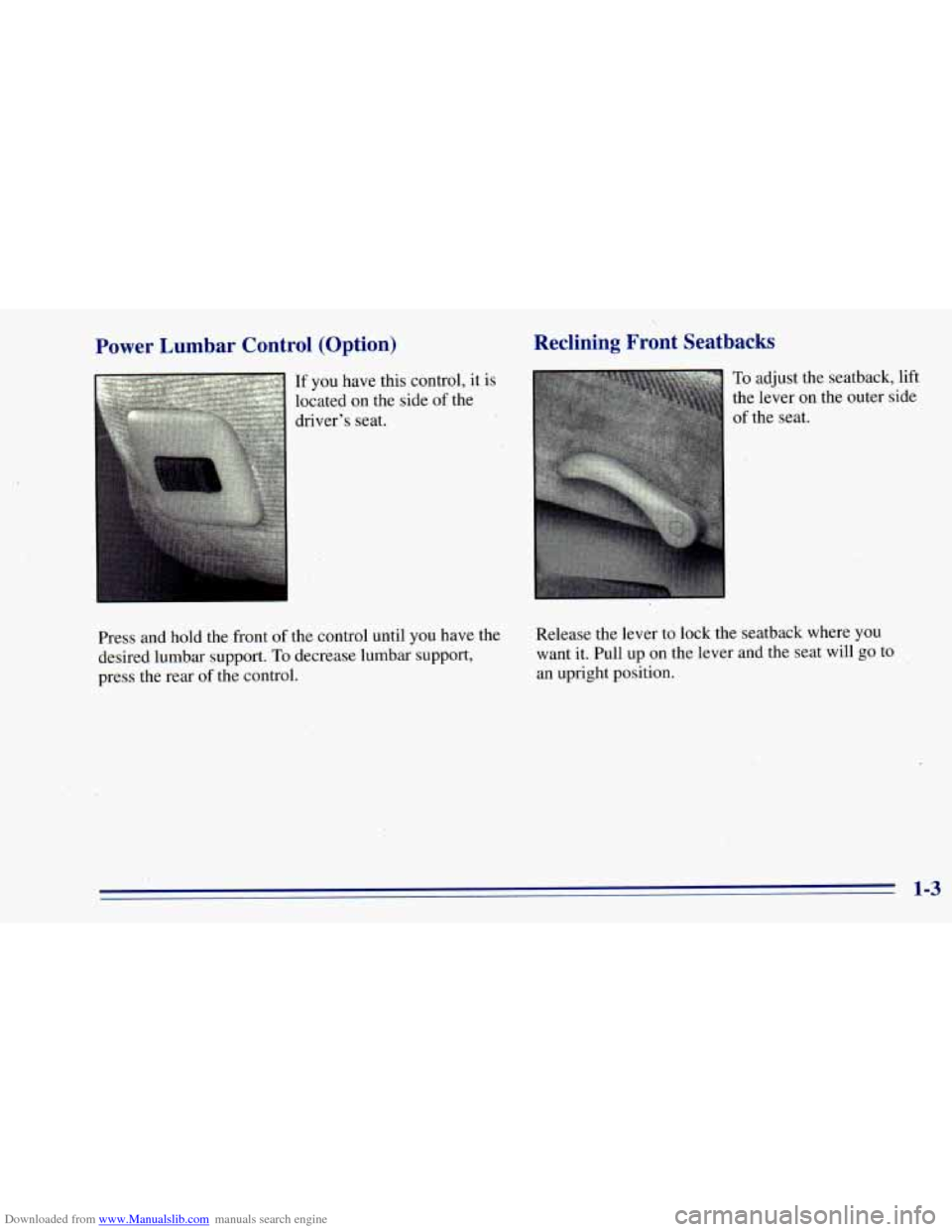
If you have this control, it is
located on the side of the
driver's seat.
Reclining Front Seatbacks
To adjust the seatback, lift
the lever on the outer side
of the seat.
Press and hold'the front
of the control until you have the
desired lumbar support.
To decrease lumbar support,
press the rear
of the control. Release
the lever to lock the seatback where
you
want it. Pull up on the lever and the seat will go to
an upright position.
Page 17 of 392
Downloaded from www.Manualslib.com manuals search engine Head Restraints
Head restraints are fixed on some models and adjustable
on others. Slide an adjustable head restraint up or down
so that the top of the restraint is closest to the top of
your ears. This position reduces the chance of a neck
injury in
a crash.
Your adjustable head restraint may also be tilted forward
for greater comfort.
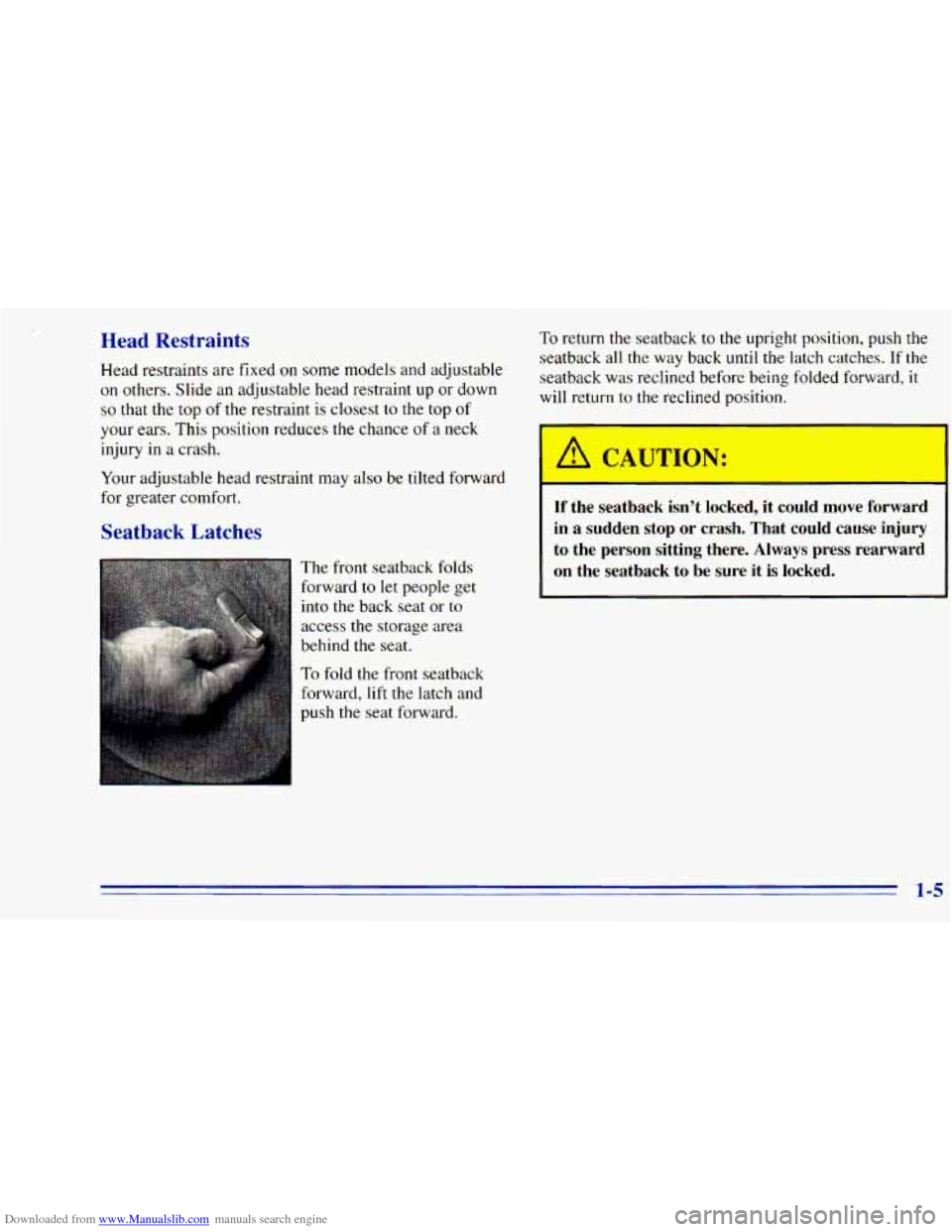
Seatback Latches
The front seatback folds
forward to
let people get
into the back seat or
to
access the storage area
behind
the seat.
To fold the front seatback
~ forward, lift the latch and
push the seat forward.
To return the seatback to the upright position, push the
seatback all the way back until the latch catches. If the
seatback was reclined before being folded forward, it
will return to
the reclined position.
I
If the seatback isn't locked, it could move forward
in a sudden stop or crash. That could cause injury
to the person sitting there. Always press rearward
on the seatback to be sure it
is locked.
1-5
Page 18 of 392
Downloaded from www.Manualslib.com manuals search engine Easy Entry Seat (2-Door Models)
The right front seat of your vehicle makes it easy to get
in
and out of the rear seat.
Tilt the right front seatback completely forward and
Move the seatback to its original position after
the whole seat
will slide
forward,
someone gets into the rear seat area. Then move the
seat rearward
until it locks.
If an easy entry right front seat isn’t locked, it
can move. In a sudden stop or crash, the person
sitting there could be injured. After you’ve used
it, be sure to push rearward on an easy entry seat
to be sure it
is locked.
Rear Seats
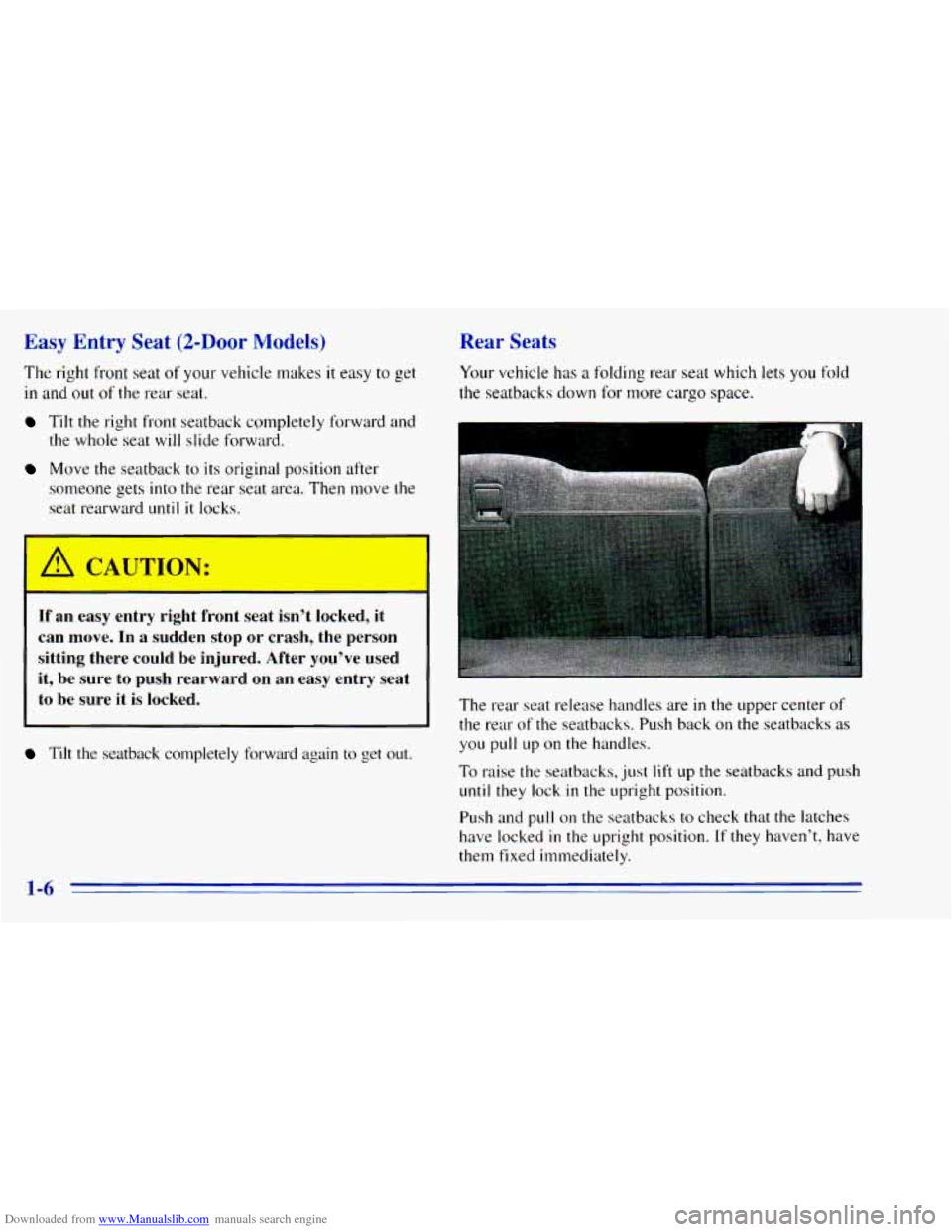
Your vehicle has a folding rear seat which lets you fold
the seatbacks down for more cargo space.
Tilt the seatback completely forward again to get out. The rear seat release handles
are
in the upper center of
the rear
of the seatbacks. Push back on the seatbacks as
you pull up on the handles.
To raise the seatbacks, just
lift up the seatbacks and push
until they lock in the upright position.
Push and pull on the seatbacks to check that
the latches
have locked
in the upright position. If they haven’t, have
them fixed immediately.
1-6
Page 24 of 392
Downloaded from www.Manualslib.com manuals search engine How to Wear Safety Belts Properly
Adults
This part is only for people of adult size.
Be aware that there are special things to know about safety belts and children.
And there are different rules for
smaller children and babies, If a child will be riding in
your vehicle, see the part of this manual called
“Children.” Follow
those rules for everyone’s protection.
First,
you’ll want to know which restraint systems your
vehicle has.
We’ll start with the driver position.
Driver Position
This part describes the driver’s restraint system.
Lap-Shoulder Belt
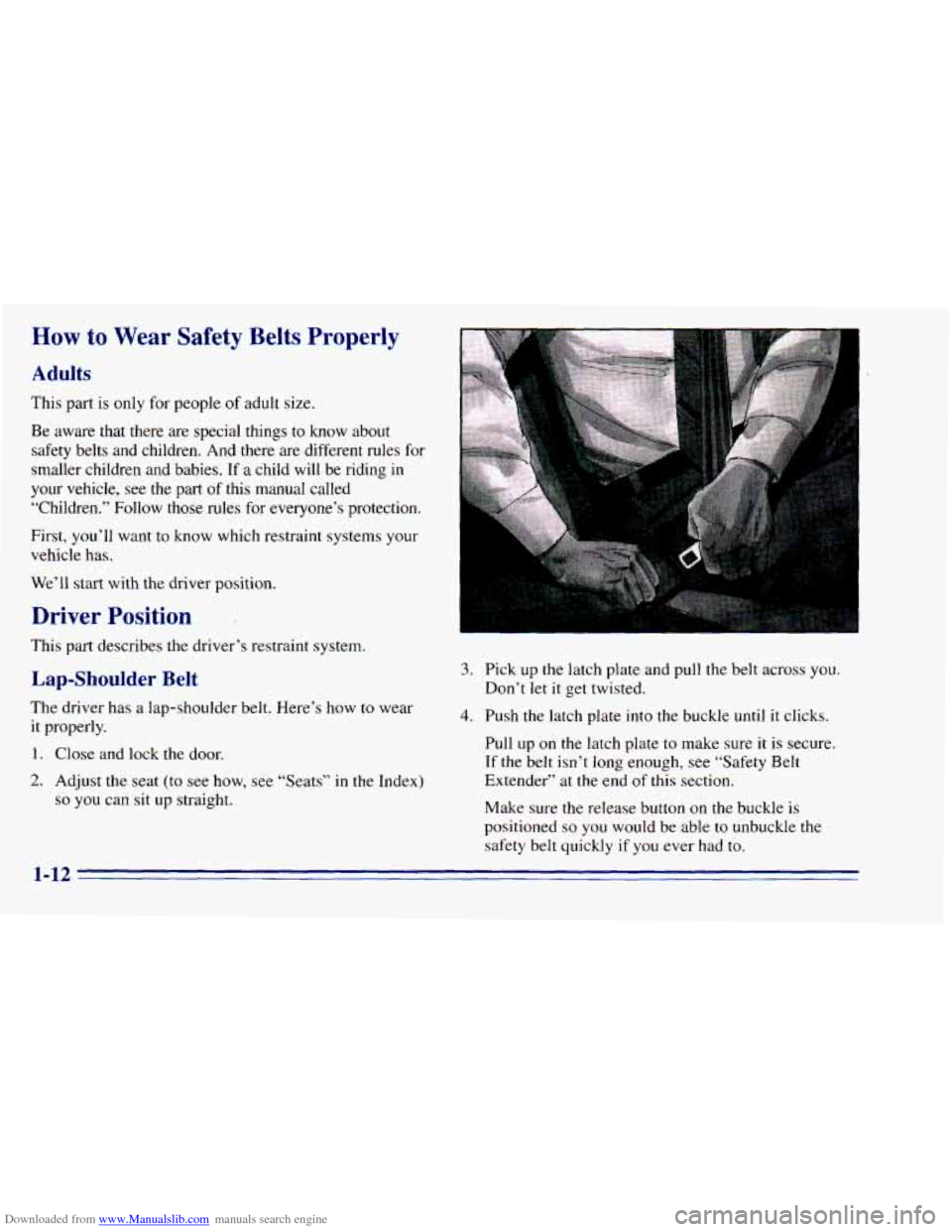
The driver has a lap-shoulder belt. Here’s how to wear
it properly.
1. Close and lock the door.
2. Adjust the seat (to see how, see “Seats” in the Index)
so you can sit up straight.
:, .... : -
3. Pick up the latch plate and pull the be
Don’t let it get twisted.
:It across you.
4. Push the latch plate into the buckle until it clicks.
Pull
up on the latch plate to make sure it is secure.
If
the belt isn’t long enough, see “Safety Belt
Extender” at the end
of this section.
Make sure
the release button on the buckle is
positioned so you would be able to unbuckle the
safety belt quickly
if you ever had to.
1-12