1996 CHEVROLET BLAZER service
[x] Cancel search: servicePage 292 of 392
Downloaded from www.Manualslib.com manuals search engine When It’s Time for New Tires
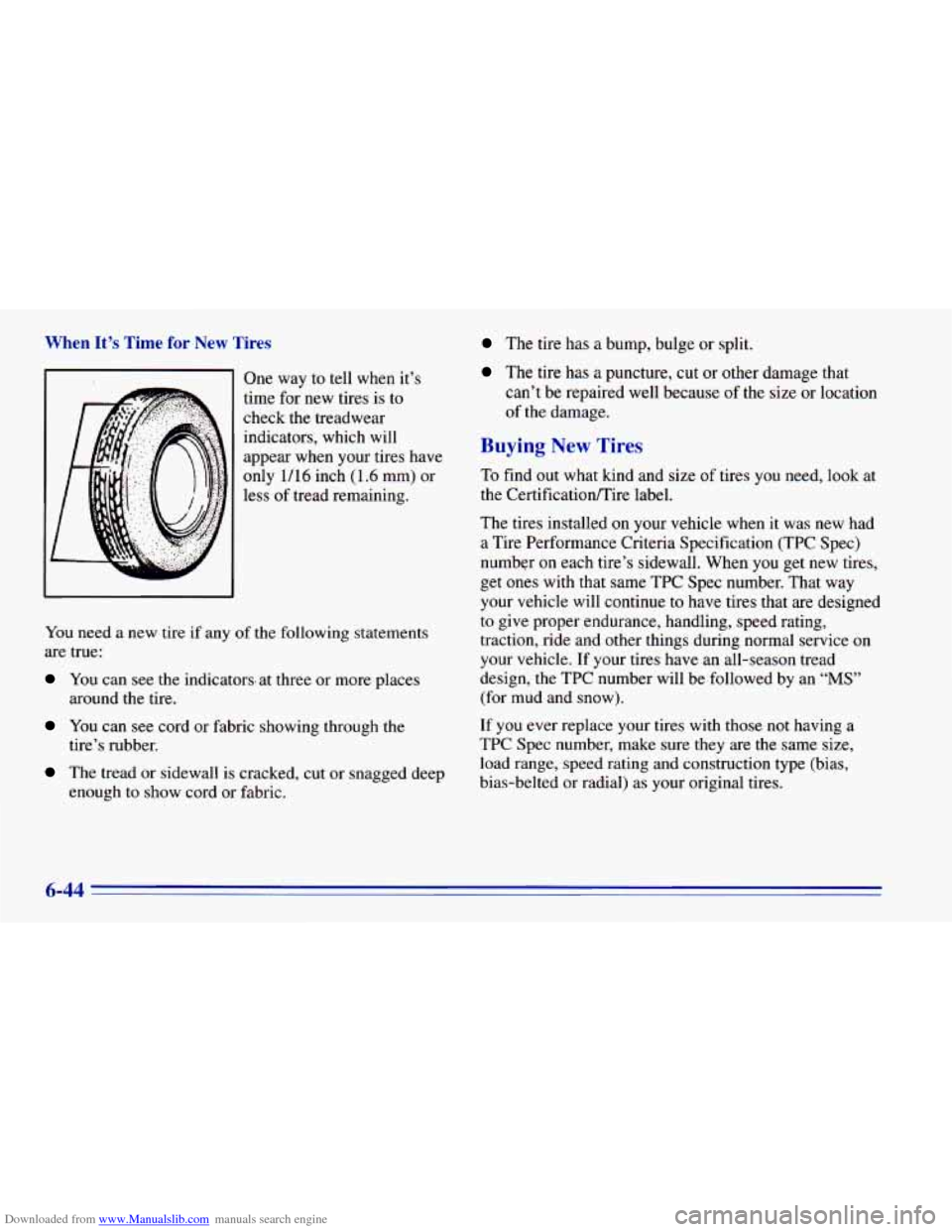
One way to tell when it’s
time for new tires is
to
check the treadwear
indicators, which will
appear when your tires have
only 1/16 inch (1.6 mm) or
less of tread remaining.
You need
a new tire if any of the following statements
are true:
You can see the indicators. at three or more places
around the tire.
You can see cord or fabric showing through the
tire’s rubber.
The tread or sidewall is cracked, cut or snagged deep
enough to show cord or fabric.
The tire has a bump, bulge or split.
The tire has a puncture, cut or other damage that
can’t be repaired well because of the size or location
of the damage.
Buying New Tires
To find out what kind and size of tires you need, look at
the Certificatioflire label.
The tires installed on your vehicle when it was new had
a Tire Performance Criteria Specification (TPC Spec)
number on each tire’s sidewall. When you get new tires,
get ones with that same TPC Spec number. That way
your vehicle will continue to have tires that are designed
to give proper endurance, handling, speed rating,
traction, ride and other things during normal service on
your vehicle. If your tires have an all-season tread
design,
the TPC number will be followed by an “MS”
(for mud and snow).
If you ever replace your tires with those not having a
TPC Spec number, make sure they are the same size,
load range, speed rating and construction type (bias,
bias-belted or radial) as your original tires.
6-44
Page 293 of 392
Downloaded from www.Manualslib.com manuals search engine Mixing tires could cause you to lose control while
driving.
If you mix tires of different sizes or types
(radial and bias-belted tires), the vehicle may not
handle properly, and you could have a crash.
Using tires
of different sizes may also cause
damage to your vehicle. Be sure
to use the same
size and type tires
on all wheels.
Uniform Tire Quality Grading
The following information relates to the system
developed by the United States National Highway
Traffic Safety Administration, which grades tires by
treadwear, traction and temperature performance. (This
applies only to vehicles sold
in the United States.) The
grades are molded on the sidewalls of most passenger
car tires. The Uniform Tire Quality Grading system does
not apply to deep tread, winter-type snow tires,
space-saver or temporary use spare tires, tires with
nominal rim diameters of
10 to 12 inches (25 to 30 cm),
or to some limited-production tires. While the tires
available on General Motors passenger
cars and light trucks may vary with respect to these
grades, they must also conform to Federal safety
requirements and additional General Motors Tire
Performance Criteria (TPC) standards.
Treadwear
The treadwear grade is a comparative rating based on
the wear rate of the tire when tested under controlled
conditions on a specified government test course. For
example, a tire graded
150 would wear one and a half
(1 1/2) times as well on the government course as a tire
graded 100. The relative performance of tires depends
upon the actual conditions of their use, however, and
may depart significantly from the norm due to variations
in driving habits, service practices and differences in
road characteristics and climate.
Traction - A, B, C
The traction grades, from highest to lowest, are A, B,
and C, and they represent the tire’s ability to stop
on wet pavement as measured under controlled
conditions on specified government test surfaces
of asphalt and concrete. A tire marked C may have
poor traction performance.
6-45
Page 303 of 392
Downloaded from www.Manualslib.com manuals search engine Sheet Metal Damage
If your vehicle is damaged and requires sheet metal
repair or replacement, make sure the body repair shop
applies anti-corrosion material
to the parts repaired or
replaced
to restore corrosion protection.
Finish Damage
Any stone chips, fractures or deep scratches in the finish
should be repaired right away. Bare metal will corrode
quickly and may develop into
a major repair expense.
Minor chips and scratches can be repaired with touch-up
materials available from your dealer or other service
outlets. Larger areas
of finish damage can be corrected
in your dealer’s body and paint shop.
Underbody Maintenance
Chemicals used for ice and snow removal and dust
control can collect on
the underbody. If these are not
removed, accelerated corrosion (rust) can occur on
the underbody parts such as
fuel lines, frame, floor
pan, and exhaust system even though they have
corrosion protection. At least
every spring,
flush these materials from the
underbody with plain water. Clean any areas where mud
and other debris can collect. Dirt packed
in closed areas
of the frame should be loosened before being flushed.
Your dealer or an underbody vehicle washing system
can do this for
you.
Chemical Paint Spotting
Some weather and atmospheric conditions can create a
chemical fallout. Airborne pollutants can fall
upon and
attack painted surfaces
on your vehicle. This damage can
take two forms: blotchy, ringlet-shaped discolorations, and small irregular dark spots etched
into the paint surface.
Although no defect
in the paint job causes this, GM
will repair, at no charge to the owner, the surfaces of
new vehicles damaged by this fallout condition within
12 months or 12,000 miles (20
000 km) of purchase,
whichever occurs first.
6-55
Page 305 of 392
Downloaded from www.Manualslib.com manuals search engine Vehicle Identification Number (VIN)
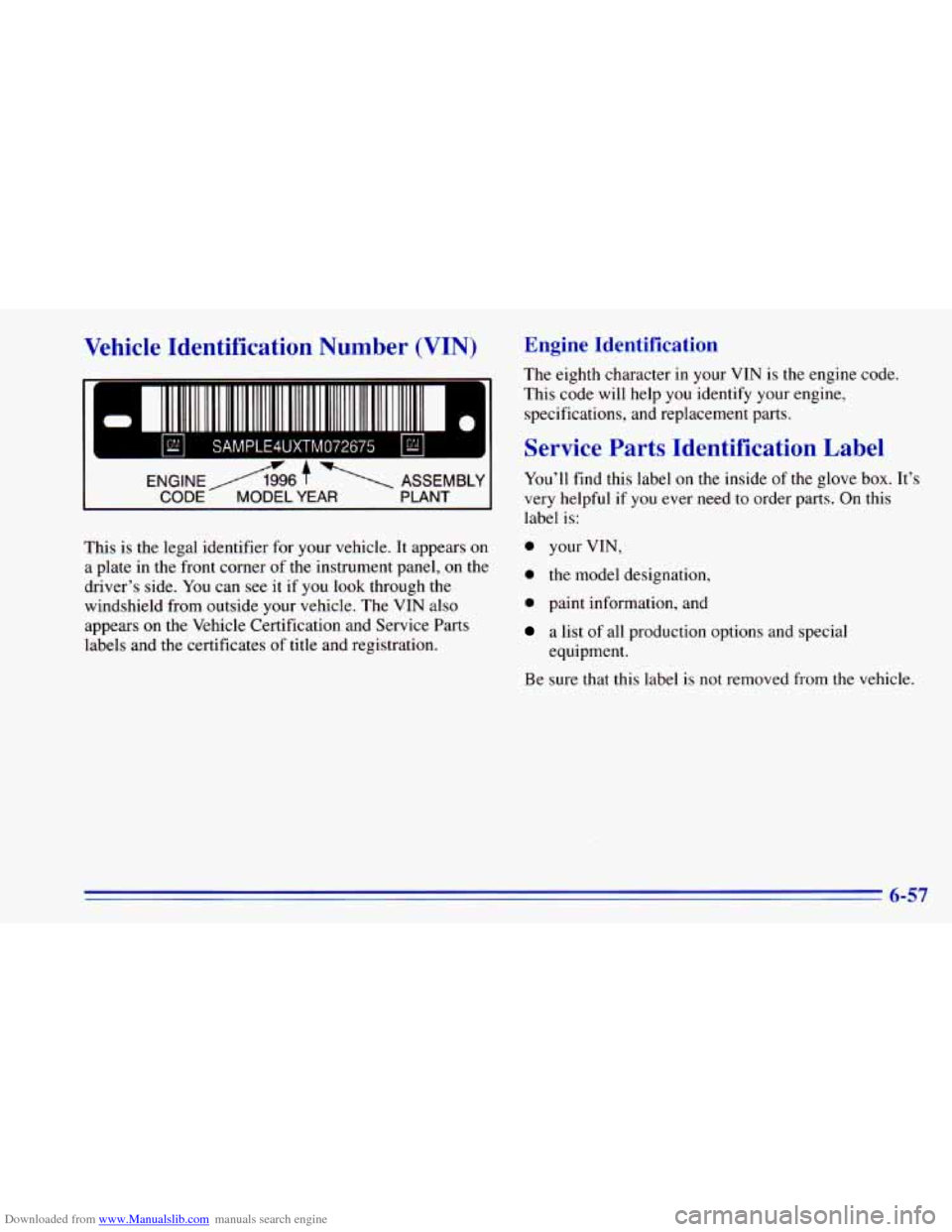
- -1 II 11111.11 1.11 111 111111 II.1111111. 1111111.111. 111..1111 11- e
bd SAMPLE4UXTM072675
ENGINEfi96 7 ASSEMBLY
CODE MODEL YEAR PLANT
This is the legal identifier for your vehicle. It appears on
a plate in the front corner of the instrument panel, ,on the
driver’s side. You can see
it if you look through the
windshield from outside your vehicle. The
VIN also
appears
on the Vehicle Certification and Service Parts
labels and the certificates
of title and registration.
Engine Identification
The eighth character in your VIN is the engine code.
This code
will help you identify your engine,
specifications, and replacement parts.
Service Parts Identification Label
You’ll find this label on the inside of the glove box.
very helpful
if you ever need to order parts. On this
label is:
0 your VIN,
0 the model designation,
0 paint information, and
a list of all production options and special
equipment.
It’s
Be sure that this label is not removed from the vehicle.
6-57
Page 313 of 392
Downloaded from www.Manualslib.com manuals search engine Section 7 Maintenance Schedule
IMPORTANT-
KEEP ENGINE OIL
AT THE PROPER
LEVEL AND CHANGE AS
RECOMMENDED
This section covers the maintenance required for your
vehicle. Your vehicle needs these services to retain its
safety, dependability and emission control performance.
es
Protection
Plan
Have you purchased the GM Protection Plan? The Plan
supplements
your new vehicle warranties. See your
Warranty and Owner Assistance booklet, or your GM
dealer for details.
Introduction
Your Vehicle and the Environment
Proper vehicle maintenance not only helps to keep your
vehicle
in good working condition, but also helps the
environment. All recommended maintenance procedures
are important. Improper vehicle maintenance can even
affect the quality of
the air we breathe. Improper fluid
levels or
the wrong tire inflation can increase the level
of emissions from your vehicle.
To help protect our
environment, and to keep your vehicle
in good
condition, please maintain your vehicle properly.
7-1
Page 314 of 392
Downloaded from www.Manualslib.com manuals search engine How This Section is Organized v
The remainder of this section is divided into five parts:
“Part
A: Scheduled Maintenance Services” shows
what to have done and
how often. Some of these
services can be complex,
so unless you are technically
qualified and have
the necessary equipment, you should
let your dealer’s service department or another qualified
service center do these
jobs.
Performing maintenance work on a vehicle can
be dangerous. In trying
to do some jobs, you can
be seriously injured. Do your own maintenance
work only if you have the required know-how
and the proper tools and equipment for the
job.
If you have any doubt, have a qualified
technician do the work.
If you are skilled enough to do some work on your
vehicle,
you will probably want to get the service
information
GM publishes. See “Service and Owner
Publications’’ in the Index. “Part
B: Owner Checks and
Services” tells you what
should be checked whenever
you stop for fuel. It also
explains what you can easily do to help keep your
vehicle
in good condition.
“Part
C: Periodic Maintenance Inspections?’
explains important inspections that your
GM dealer’s
service department or another qualified service center
should perform.
“Part
D: Recommended Fluids and Lubricants”
lists some products
GM recommends to help keep your
vehicle properly maintained. These products, or their
equivalents, should be used whether you do
the work
yourself or have
it done.
“Part
E: Maintenance Record’’ provides a place for
you
to record the maintenance performed on your
vehicle. Whenever any maintenance
is performed, be
sure to write
it down in this part. This will help you
determine when
your next maintenance should be done.
In addition, it is a good idea to keep your maintenance
receipts. They may be needed to qualify your vehicle for
warranty repairs.
7-2
Page 315 of 392
Downloaded from www.Manualslib.com manuals search engine Part A: Scheduled Maintenance
Services
Using Your Maintenance Schedule
We at General Motors want to help you keep your
vehicle in good working condition. But
we don’t know
exactly bow you’ll drive it. You may drive very short
distances
only a few times a week. Or you may drive
long distances
all the time in very hot, dusty weather.
You may use your vehicle
in making deliveries. Or
you may drive it to work, to do errands or
in many
other ways.
Because
of all the different ways people use their GM
vehicles, maintenance needs vary.
You may even need
more frequent checks and replacements than you’ll find
in the schedules
in this section. So please read this
section and note how you drive.
If you have any
questions on
how to keep your vehicle in good
condition, see your
GM dealer.
This part tells
you the maintenance services you should
have done and when
you should schedule them. If you
go to your dealer for your service needs, you’ll know
that GM-trained and supported service people will
perform the work using genuine
GM parts. The
proper fluids and lubricants
to use are listed in
Part D. Make sure whoever services your vehicle
uses these. All parts should be replaced and all
necessary repairs done before
you or anyone else
drives the vehicle.
These schedules are for vehicles
that:
carry passengers and cargo within recommended
limits. You will find these limits
on your vehicle’s
CertificationEire label. See “Loading Your Vehicle”
in the Index.
are driven on reasonable road surfaces within legal
driving limits.
0 are driven off-road in the recommended manner. See
“Off-Road Driving With Your Four-Wheel-Drive
Vehicle’’ in the Index.
use the recommended fuel. See “Fuel” in the Index.
Selecting the Right Schedule
First you’ll need to decide which of the two schedules is
right
for your vehicle. Here’s how to decide which
schedule
to follow:
7-3
Page 316 of 392
Downloaded from www.Manualslib.com manuals search engine Maintenance Schedule
I Short TripKity Definition
Follow the Short TripKity Maintenance Schedule if any
one
of these conditions is true for your vehicle:
Most trips are less than 5 to 10 miles (8 to 16 km).
This
is particularly important when outside
temperatures are below freezing.
Most trips include extensive idling (such as frequent
driving
in stop-and-go traffic).
You operate your vehicle in dusty areas or
off-road frequently.
You frequently tow a trailer or use a carrier on top of
If the vehicle is used for delivery service, police, taxi
your vehicle.
or other
commercial application.
One of the reasons you should follow this schedule if
you operate your vehicle under any of these conditions
is that these conditions cause engine
oil to break
down
soonex
Short Trip/City Intervals
Every 3,000 Miles (5 000 km): Engine Oil and Filter
Change (or
3 months, whichever occurs first). Chassis
Lubrication (or
3 months, whichever occurs first). Drive
Axle Service (or
3 months, whichever occurs first).
At 6,000 Miles (10 000 km) -- Then Every
12,000 Miles
(20 000 km): Tire Rotation.
Every 15,000 Miles (25 000 km): Air Cleaner Filter
Inspection, if driving in dusty conditions. Front
Wheel Bearing Repack (2WD only) (or at each brake
relining, whichever occurs first).
Every 30,000 Miles (50 000 km): Air Cleaner Filter
Replacement. Fuel Filter Replacement.
Every 50,000 Miles (83 000 km): Automatic
Transmission Service (severe conditions
only).
Every 60,000 Miles (100 000 km): Engine
Accessory Drive Belt Inspection.
Fuel Tank, Cap
and Lines Inspection.
Every 100,000 Miles (166 000 km): Cooling System
Service (or every
60 months, whichever occurs first).
Spark Plug Wire Inspection. Spark Plug Replacement.
Positive Crankcase Ventilation (PCV) Valve Inspection.
These intervals only summarize maintenance services.
Be sure to follow the complete maintenance schedule
on
the following pages.
7-4