1996 CHEVROLET BLAZER transmission
[x] Cancel search: transmissionPage 122 of 392
Downloaded from www.Manualslib.com manuals search engine Speedometer ar Odometer
Your speedometer lets you see your speed in both miles
per hour (mph) and kilometers per hour (km/h).
Your odometer shows how far your vehicle has been
driven, in either miles (used in the United States)
or
kilometers (used in Canada).
Your odometer
is tamper resistant. It will show silver lines
between the numbers if someone tries to turn it back.
You may wonder what happens if your vehicle needs a
new odometer installed.
If the new one can be set to the
mileage total
of the old odometer, then it must be. But if
it can’t, then it’s set at zero, and a label must be put on
the driver’s door to show the old mileage reading when
the new odometer was installed.
Trip Odometer
The trip odometer can tell you how far your vehicle has
been driven since you last set the trip odometer to zero.
To set
the trip odometer to zero, press the button near
the readout.
Tachometer (Option)
The tachometer displays the engine speed in revolutions
per minute
(rpm).
Each tachometer has a different limit depending on the
powertrain
in your vehicle. The tachometer has three
areas: normal operating range, red warning range and
red danger range.
Normal operating range shows your engine speed during
normal driving conditions. For example, when the
needle points to
2, it means the engine is running at
2,000 revolutions per minute (rpm). The tachometer
needle will vary all
the time that the engine is running.
The red warning range tells you that your engine speed
is reaching its upper limits. Don’t drive very long with
the tachometer in
the red warning range. If you have a
manual transmission, shift to a higher gear as soon as
possible. If
you have an automatic transmission, lift
your
foot off of the accelerator pedal.
The red danger range
tells you that your engine speed is
at its upper limits. You should immediately shift to a
higher gear, or lift your
foot off of the accelerator pedal.
L
NOTICE:
Do not operate the engine with the tachometer in
the red range, or engine damage will occur.
2-64
Page 131 of 392
Downloaded from www.Manualslib.com manuals search engine Shift Light
SHIFT
You have the shift light if
you have a manual
transmission. This light
comes on very briefly as
a
bulb check when you start
the engine. Shifting when
the indicator light
is on will
help you get the best fuel
economy. See “Shift Light”
in the Index.
Daytime Running Lamps Indicator Light
You have this light on the
instrument panel.
It goes on whenever the
DRL are
on, the ignition
is on, the headlamp switch
is
off and the parking brake
is released.
2-73
Page 175 of 392
Downloaded from www.Manualslib.com manuals search engine What should I do if my vehicle stalls, or is about
to stall, and
I can’t make it up the hill?
A: If this happens, there are some things you should
0
0
0
do, and there are some things you must not do.
First, here’s what
you should do:
Push the brake pedal to stop the vehicle and keep it
from rolling backwards. Also, apply the parking
brake.
If your engine is still running, shift the transmission
to REVERSE (R), release the parking brake, and
slowly back down the hill in REVERSE (R).
If your engine has stopped running, you’ll need to
restart it. With the brake pedal depressed and the
parking brake still applied, shift the transmission to
PARK (P) (or, shift
to NEUTRAL (N) if your
vehicle has a manual transmission) and restart the
engine. Then, shift
to REVERSE (R), release the
parking brake, and slowly back down the hill as
straight as possible in REVERSE
(R).
As you are backing down the hill, put your left hand
on the steering wheel at the 12 o’clock position. This
way,
you’ll be able to tell if your wheels are straight
and maneuver as
you back down. It’s best that you
back down the hill with your wheels straight rather
than in the
left or right direction. Turning the wheel
too far to
the left or right will increase the possibility
of a rollover.
Here are some things
you must not do if you stall, or are
about to stall, when going up a hill.
0 Never attempt to prevent a stall by shifting into
NEUTRAL (N) (or depressing the clutch, if
you
have a manual transmission) to “rev-up” the engine
and regain forward momentum. This won’t work.
Your vehicle will roll backwards very quickly and
you could go
out of control.
Instead, apply the regular brake
to stop the vehicle.
Then apply the parking brake.
Shift to REVERSE (R),
release the parking brake,
and slowly back straight down.
0 Never attempt to turn around if you are about to stall
when going up a hill. If the hill is steep enough
to
stall your vehicle, it’s steep enough to cause you to
roll over if you turn around. If you can’t make it up
the
hill, you must back straight down the hill.
Page 176 of 392
Downloaded from www.Manualslib.com manuals search engine Suppose, after stalling, I try to back down
the hill and decide
I just can’t do it. What
should
I do?
A: Set the parking brake, put your transmission
in PARK (P) (or the manual transmission
in
FIRST (1)) and turn off the engine. Leave the
vehicle and go get some help. Exit
on the uphill
side and stay clear
of the path the vehicle would
take
if it rolled downhill. Do not shift the transfer
case
to NEUTRAL (N) when you leave the vehicle.
Leave
it in some gear.
I
A CAUTION:
If you have a manual transfer case shift lever,
shifting the transfer case to NEUTRAL
(N) can
cause your vehicle to roll even if the transmission
is in PARK
(P) (or, if you have the manual
transmission, even if you’re in gear). This is
because the NEUTRAL
(N) position on the
transfer case overrides the transmission.
If you
are going to leave your vehicle, set the parking
brake and shift the transmission to PARK
(P)
(or, put your manual transmission in FIRST (1)).
But do not shift the transfer case to the
NEUTRAL
(N) position. Leave the transfer
case in the 2HI,4HI or 4LO position.
4-22
Page 178 of 392
Downloaded from www.Manualslib.com manuals search engine Q: Are there some things I should not do when
A: Yes! These are important because if you
driving down a hill?
0
ignore them you could lose control and have a
serious accident.
When driving downhill, avoid turns that take you
across the incline
of the hill. A hill that’s not too
steep to drive down may be too steep to drive across.
You could roll over if you don’t drive straight down.
Never go downhill with
the transmission in
NEUTRAL (N), or with the clutch pedal depressed
in
a manual shift. This is called “free-wheeling.”
Your brakes will have to
do all the work and could
overheat and fade.
@’ Am I likely to stall when going downhill?
A: It’s much more likely to happen going uphill.
But if it happens going downhill, here’s what to do.
Stop your vehicle by applying the regular brakes.
0 Shift to PARK (P) (or to NEUTRAL (N) with the
Apply the parking brake.
manual transmission) and, while still braking, restart
the engine.
0 Shift back to a low gear, release the parking brake,
If the engine won’t start, get out and get help.
and
drive straight down,
4-24
Page 192 of 392
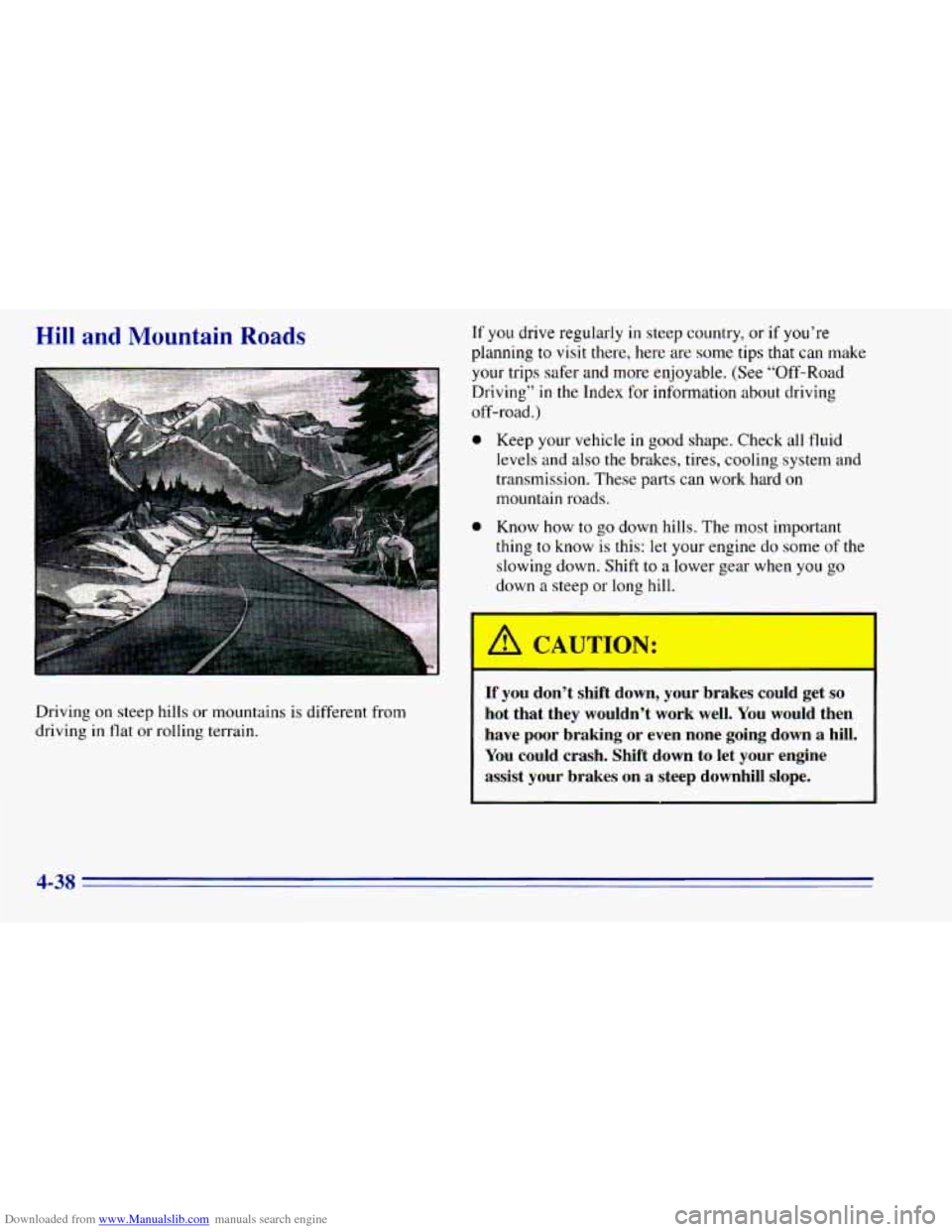
Downloaded from www.Manualslib.com manuals search engine Hill and Mountain Roads If you drive regularly in steep country, or if you’re
planning
to visit there, here are some tips that can make
your trips safer and more enjoyable. (See “Off-Road
Driving”
in the Index for information about driving
off-road.)
0
Driving on steep hills or mountains is different from
driving
in flat or rolling terrain.
0
Keep your vehicle in good shape. Check all fluid
levels and also the brakes, tires, cooling system and
transmission. These parts can work hard
on
mountain roads.
Know how to go down hills. The most important
thing
to know is this: let your engine do some of the
slowing down. Shift to a lower gear when you
go
down a steep or long hill.
If you don’t shift down, your brakes could get so
hot that they wouldn’t work well. You would then
have poor braking or even none going down a hill.
You could crash. Shift down to let your engine
assist your brakes on a steep downhill slope.
4-38
Page 193 of 392
Downloaded from www.Manualslib.com manuals search engine A CAUTION: : '. i. .. ,tb.,.. ;I: ' ,...?-+: . '';
<. _.. .,%. , .. , , ' . .. ,. ... . . 2- . .. .
Coasting downhill in NEUTRAL (N) or with the
ignition
off is dangerous. Your brakes will have to
do all the work
of slowing down. They could get so
hot that they wouldn't work well. You would then
have poor braking or even none going down
a hill.
You could crash. Always have your engine running
and your vehicle in gear when you go downhill.
0 Know how to go uphill. You may want to shift down
to a lower gear. The lower gears help cool your engine
and transmission, and you can climb the hill better.
Stay in your own lane when driving on two-lane
roads
in hills or mountains. Don't swing wide or cut
across
the center of the road. Drive at speeds that let
you stay in your own lane.
0 As you go over the top of a hill, be alert. There could be
something in your lane, like a stalled car or an accident.
You may see highway signs on mountains that warn of
special problems. Examples are long grades, passing or
no-passing zones, a falling rocks. area or winding
roads. Be alert to
these and take appropriate action.
Winter Driving
4-39
Page 197 of 392
Downloaded from www.Manualslib.com manuals search engine Run your engine only as long as you must. This saves
fuel. When
you run the engine, make it go a little faster
than just idle. That
is, push the accelerator slightly. This
uses less fuel for the heat that
you get and it keeps the
battery charged. You will need a well-charged battery
to
restart the vehicle, and possibly for signaling later on
with your headlamps. Let the heater run for awhile.
Then, shut the engine off and close the window almost
all
the way to preserve the heat. Start the engine again
and repeat this
only when you feel really uncomfortable
from the cold. But
do it as little as possible. Preserve the
fuel as long as you can. To help keep warm, you can get
out
of the vehicle and do some fairly vigorous exercises
every half hour or
so until help comes.
Recreational Vehicle Towing
(Four-wheel Drive Only)
1. Set the parking brake firmly.
2. Place an automatic transmission in PARK (P) or a
manual transmission
in FIRST (1).
3. Firmly attach the vehicle being towed to the tow
vehicle.
Do not tow the vehicle by the rear bumper
bar. Refer to the hitch manufacturer’s instructions.
4. Place the transfer case shift lever in NEUTRAL (N).
Recreational vehicle towing is not recommended for
vehicles with
the optional electronic shift transfer
case or all-wheel drive because the transfer cases
have
no neutral position.
Shifting the transfer case into NEUTRAL (N) can
cause your vehicle to roll even if the transmission
is in PARK (P), for an automatic transmission,
or if your vehicle is in gear, for a manual
transmission. This is because the transfer case
overrides the transmission.
5. Release the parking brake only after the vehicle
being towed is firmly attached to the tow vehicle.
6. Insert the ignition key into the ignition switch and
turn it
one notch forward of the LOCK position. This
places the key
in the OFF position, which unlocks
the steering column while preventing battery drain.
Unlocking the steering column will allow for proper
movement
of the front wheelshires during towing.
4-43