1996 CHEVROLET BLAZER headlamp
[x] Cancel search: headlampPage 138 of 392
Downloaded from www.Manualslib.com manuals search engine Ventilation Tips
a
0
0
Keep the hood and front air inlet free of ice, snow or
any
other obstruction (such as leaves). The heater
and defroster will work far better, reducing the
chance
of fogging the inside of your windows.
When
you enter a vehicle in cold weather, turn the
blower fan to
HI for a few moments before driving
off. This helps clear the intake ducts of snow and
moisture, and reduces the chance
of fogging the
inside of your windows.
Keep
the air path under the front seats clear of
objects. This helps air
to circulate throughout
your vehicle.
Defogging and Defrosting
On cool, humid days, use BLEND to keep the
windshield and side windows clear.
Use DEFROST to remove fog or ice from the
windshield quickly in extremely humid or cold
conditions. Turn the temperature knob clockwise and move
the fan control toward HI.
Rear Window Defogger (Option)
1
If your vehicle has this option, the rear window will
have lines that warm the glass. For best results, clear the
window of
as much snow or ice as possible before using
the rear window defogger.
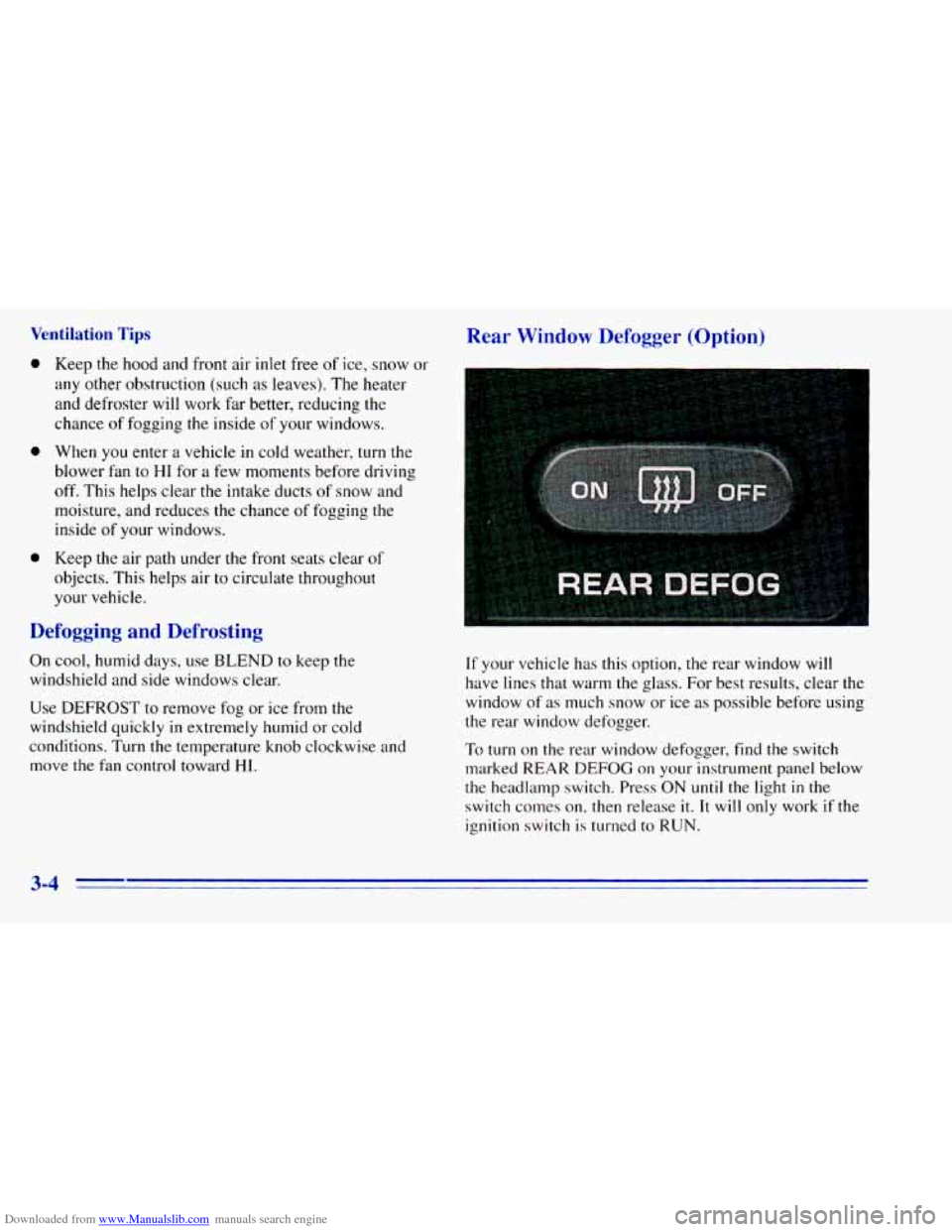
To turn on the rear window defogger, find
the switch
marked REAR
DEFOG on your instrument panel below
the headlamp switch. Press ON
until the light in the
switch conles on, then release
it. It will only work if the
ignition switch
is turned to RUN.
3-4
Page 174 of 392
Downloaded from www.Manualslib.com manuals search engine Driving Uphill
Once you decide you can safely drive up the hill, you
need to take some special steps.
0 Use a low gear and get a firm grip on the
0 Get a smooth start up the hill and try to maintain
steering wheel.
your speed. Don’t
use more
power than you need,
because
you don’t want your wheels to start spinning
or sliding.
If the path twists and turns, you might want to find
another route.
0 Try to drive straight up the hill if at all possible.
0
0
0
0
Ease up on your speed as you approach the top of
the hill.
Attach a flag
to the vehicle to make you more visible
to approaching traffic
on trails or hills.
Sound
the horn as you approach the top of the hill to
let opposing traffic know you’re there.
Use your headlamps even during the day. They make
you more visible
to oncoming traffic.
Awning or driving across steep hills can be
dangerous.
You could lose traction, slide
sideways, and possibly roll over.
You could be
seriously injured or killed. When driving up hills,
always try to
go straight up.
A CAUTION: I
Driving to the top (crest) of a hill .at full speed can
cause an accident. There could be
a drop-off,
embankment, cliff, or even another vehicle.
You
could be seriously injured or killed. As you near
the top
of a hill, slow down and stay alert.
4-20
Page 184 of 392
Downloaded from www.Manualslib.com manuals search engine Here are some tips on night driving.
0 Drive defensively.
0 Don’t drink and drive.
Adjust your inside rearview mirror to reduce the
Since you can’t see as well, you may need to
glare from headlamps behind you.
slow down and keep more space between you and
other vehicles.
Slow down, especially on higher speed roads. Your
headlamps can light up only
so much road ahead.
In remote areas, watch for animals.
If you’re tired, pull off the road in a safe place
and rest.
Night Vision
No one can see as well at night as in the daytime. But as
we get older these differences increase. A 50-year-old
driver may require at least twice as much light to see the
same thing at night as a 20-year-old.
What you do in the daytime can also affect your night
vision. For example, if you spend the day in bright
sunshine you are wise to wear sunglasses. Your eyes will
have less trouble adjusting
to night. But if you’re driving,
don’t wear sunglasses at night. They may cut
down
on glare from headlamps, but they also make a lot
of things invisible.
You can be temporarily blinded by approaching lights.
It can take a second
or two, or even several seconds, for
your eyes
to readjust to the dark. When you are faced
with severe glare (as from a driver who doesn’t lower
the high beams, or a vehicle with misaimed headlamps),
slow down a little. Avoid staring directly into the
approaching lights.
Keep
your windshield and all the glass on your vehicle
clean
-- inside and out. Glare at night is made much
worse by dirt
on the glass. Even the inside of the glass
can build up a
film caused by dust. Dirty glass makes
lights dazzle and
flash more than clean glass would,
making the pupils of your
eyes contract repeatedly.
Remember that your headlamps light up far less
of a
roadway when you are in a turn or curve. Keep your
eyes moving; that way, it’s easier
to pick out dimly
lighted objects. Just as your headlamps should be
checked regularly for proper aim,
so should your eyes
be examined regularly. Some drivers suffer from night
blindness
-- the inability to see in dim light -- and
aren’t even aware of it.
4-30
Page 197 of 392
Downloaded from www.Manualslib.com manuals search engine Run your engine only as long as you must. This saves
fuel. When
you run the engine, make it go a little faster
than just idle. That
is, push the accelerator slightly. This
uses less fuel for the heat that
you get and it keeps the
battery charged. You will need a well-charged battery
to
restart the vehicle, and possibly for signaling later on
with your headlamps. Let the heater run for awhile.
Then, shut the engine off and close the window almost
all
the way to preserve the heat. Start the engine again
and repeat this
only when you feel really uncomfortable
from the cold. But
do it as little as possible. Preserve the
fuel as long as you can. To help keep warm, you can get
out
of the vehicle and do some fairly vigorous exercises
every half hour or
so until help comes.
Recreational Vehicle Towing
(Four-wheel Drive Only)
1. Set the parking brake firmly.
2. Place an automatic transmission in PARK (P) or a
manual transmission
in FIRST (1).
3. Firmly attach the vehicle being towed to the tow
vehicle.
Do not tow the vehicle by the rear bumper
bar. Refer to the hitch manufacturer’s instructions.
4. Place the transfer case shift lever in NEUTRAL (N).
Recreational vehicle towing is not recommended for
vehicles with
the optional electronic shift transfer
case or all-wheel drive because the transfer cases
have
no neutral position.
Shifting the transfer case into NEUTRAL (N) can
cause your vehicle to roll even if the transmission
is in PARK (P), for an automatic transmission,
or if your vehicle is in gear, for a manual
transmission. This is because the transfer case
overrides the transmission.
5. Release the parking brake only after the vehicle
being towed is firmly attached to the tow vehicle.
6. Insert the ignition key into the ignition switch and
turn it
one notch forward of the LOCK position. This
places the key
in the OFF position, which unlocks
the steering column while preventing battery drain.
Unlocking the steering column will allow for proper
movement
of the front wheelshires during towing.
4-43
Page 281 of 392
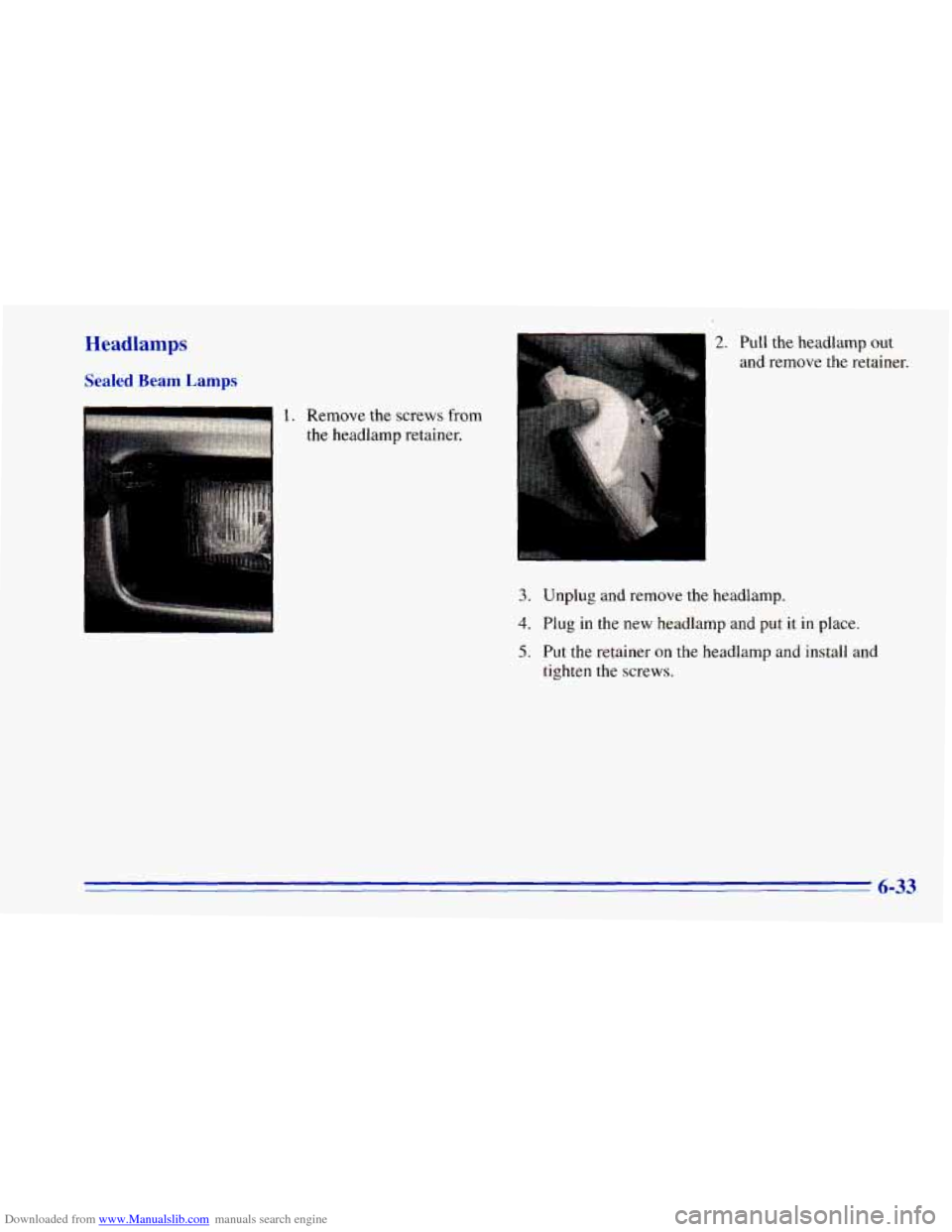
Downloaded from www.Manualslib.com manuals search engine Headlamps
Sealed Beam Lamps
1. Remove the screws from
the headlamp retainer.
2. Pull the headlamp out
I and remove the retainer.
3. Unplug and remove the headlamp.
4. Plug in the new headlamp and put it in place.
5. Put the retainer on the headlamp and install and
tighten the screws.
6-33
Page 282 of 392
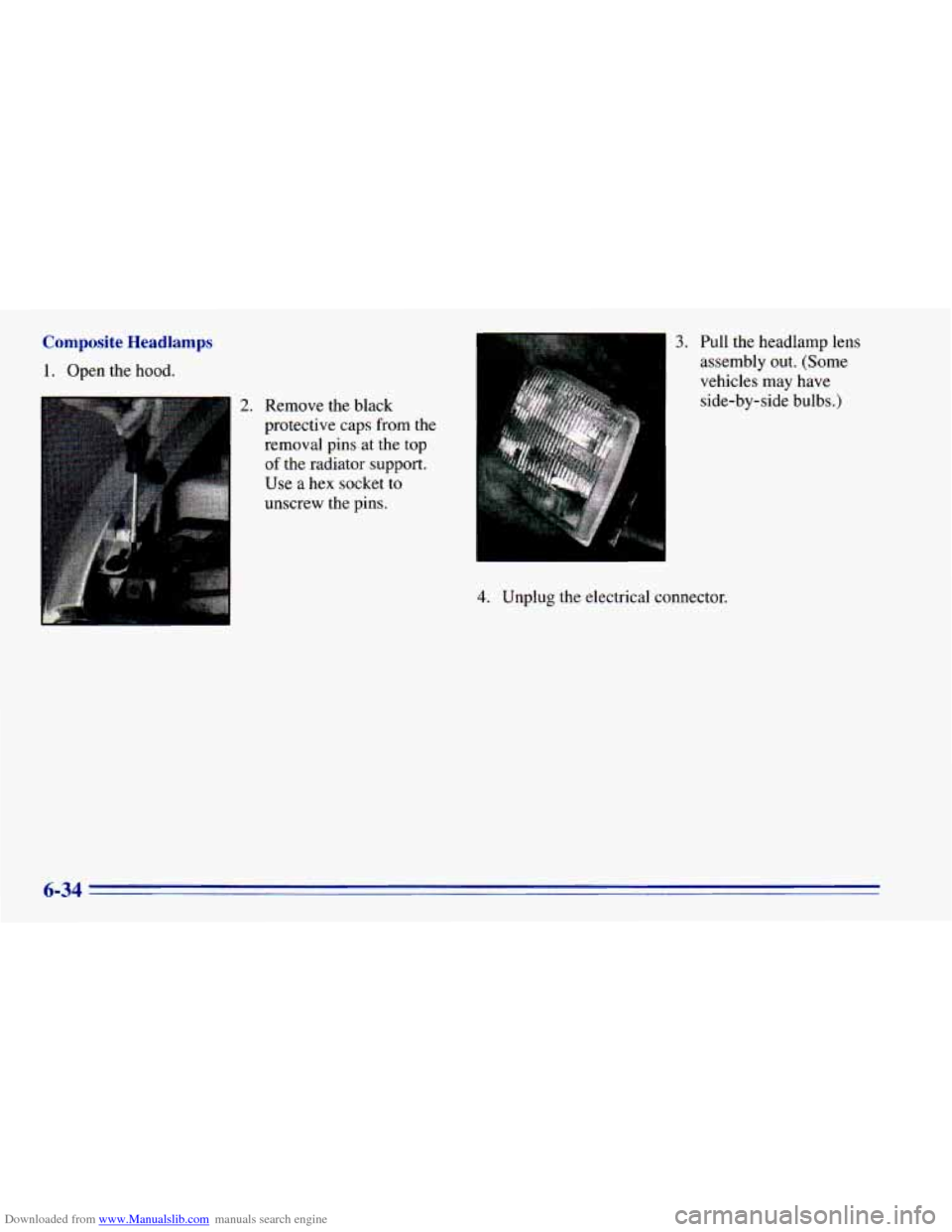
Downloaded from www.Manualslib.com manuals search engine Composite Headlamps
1. Open the hood. removal pins at the top
of the radiator support.
Use a hex socket
to
unscrew the pins.
3. Pull the headlamp lens
assembly out. (Some
vehicles may have
side-by-side bulbs.)
~ ~ ~~~
4. Unplug the electrical connector.
6-34
Page 283 of 392
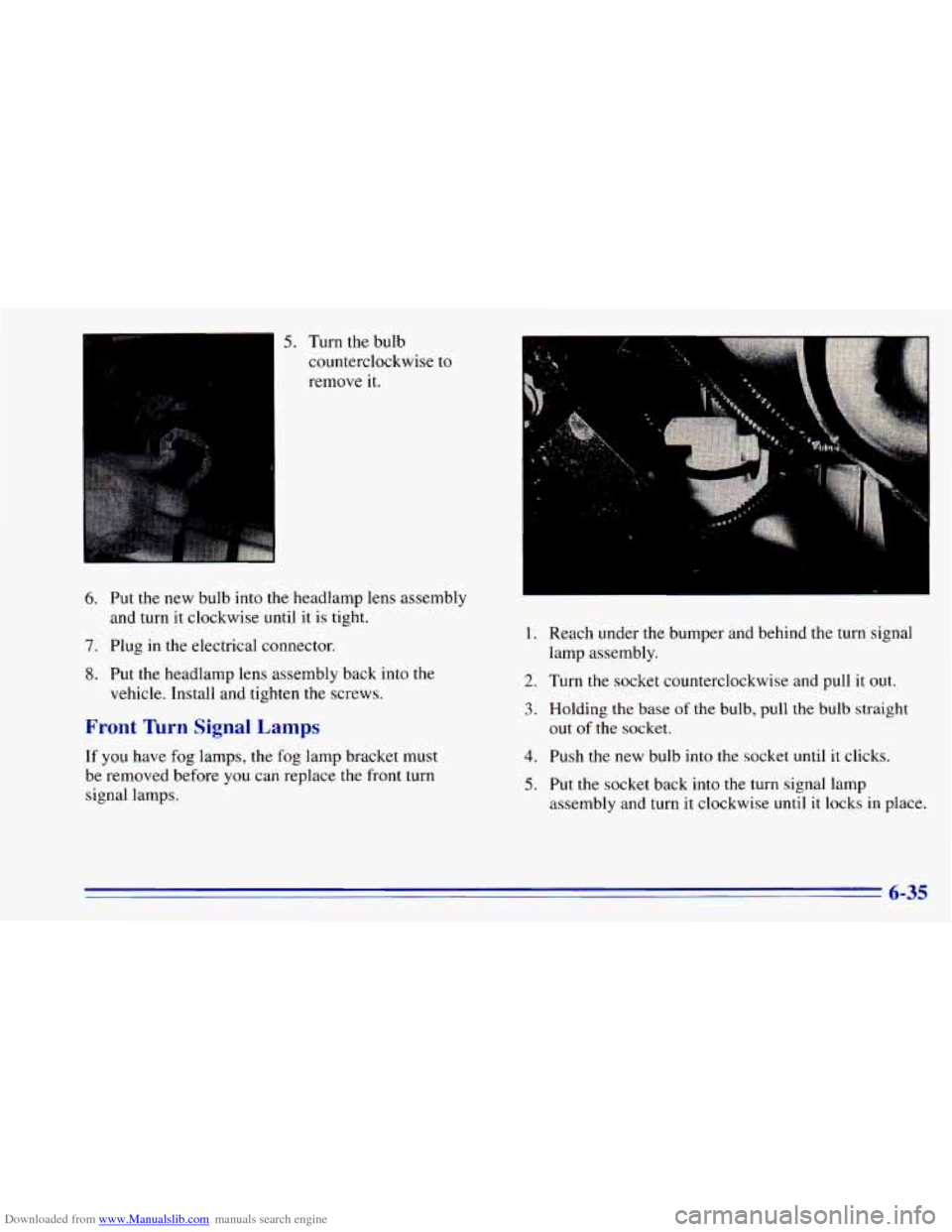
Downloaded from www.Manualslib.com manuals search engine 5. Turn the bulb
counterclockwise to remove it.
6. Put the new bulb into the headlamp lens assembly
and turn it clockwise until it is tight.
7. Plug in the electrical connector.
8. Put the headlamp lens assembly back into the
vehicle. Install and tighten the screws.
Front Turn Signal Lamps
If you have fog lamps, the fog lamp bracket must
be removed before you can replace the front turn
signal lamps.
.
1. Reach under the bumper and behind the turn signal
2. Turn the socket counterclockwise and pull it out.
3. Holding the base of the bulb, pull the bulb straight
lamp
assembly.
out of the socket.
4. Push the new bulb into the socket until it clicks.
5. Put the socket back into the turn signal lamp
assembly and turn it clockwise until
it locks in place.
6-35
Page 295 of 392
Downloaded from www.Manualslib.com manuals search engine Each new wheel should have the same load carrying
capacity, diameter, width, offset and be mounted the
same way as the one
it replaces.
If you need to replace any of your wheels, wheel bolts
or wheel nuts, replace them only
with new GM original
equipment parts. This way, you
will be sure to have the
right wheel, wheel bolts and wheel nuts for your model.
Using the wrong replacement wheels, wheel bolts
or wheel nuts on your vehicle can be dangerous.
It could affect the braking and handling of your
vehicle, make your tires lose air and make you
lose control. You could have
a collision in which
you or others could be injured. Always use the
correct wheel, wheel bolts and wheel nuts
for replacement.
NOTICE:
The wrong wheel can also cause problems with
bearing life, brake cooling, speedometer/odometer
calibration, headlamp aim, bumper height, vehicle
ground clearance and tire or tire chain clearance
to the body and chassis.
See “Changing a Flat Tire”
in the Index for
more information.
Used Replacement Wheels
Putting
a used wheel on wr vehicle is
dangerous. You can’t know how it’s been used
or
how many miles it’s been driven. It could fail
suddenly and cause an accident.
If you have to
replace a wheel, use a new
GM original
equipment wheel.
6-47