Page 217 of 372
NOTICE:
~~~~~
Never remove or restow a tire frondto a stowage
position under the vehicle while the vehicle is
supported
by a jack. Always tighten the tire
fully against the underside of the vehicle when restowing.
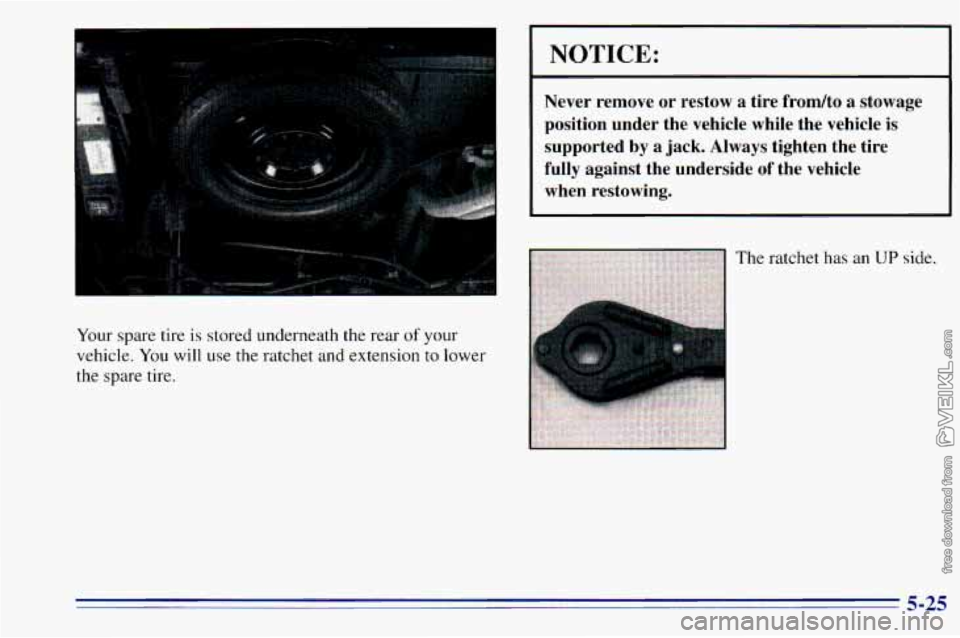
The ratchet has an UP side.
Your spare tire is stored underneath the rear
of your
vehicle.
You will use the ratchet and extension to lower
the spare tire.
5-25
Page 224 of 372
I I
9.
A CAUTION:
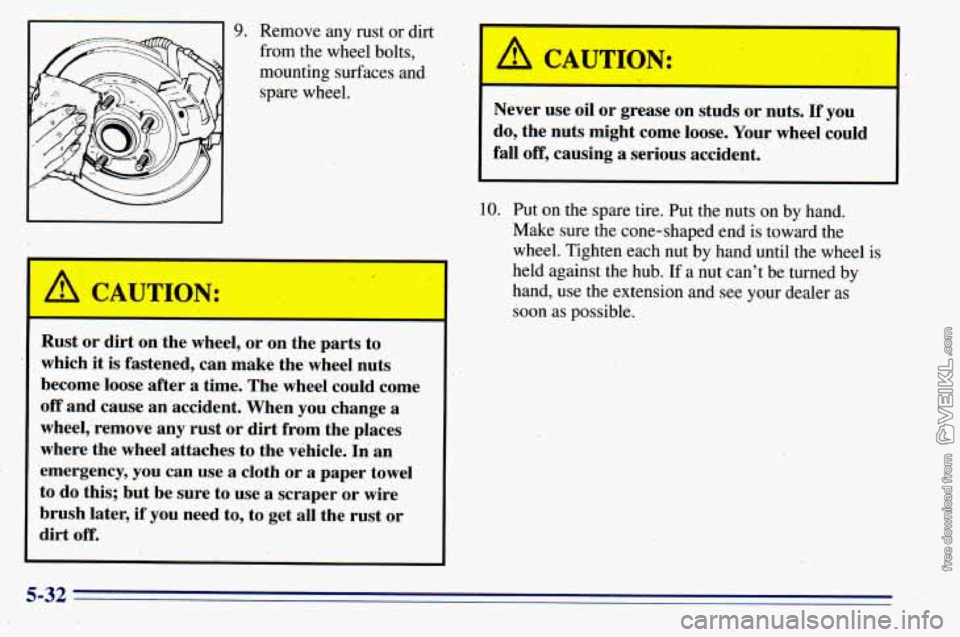
Remove any rust or dirt
from the wheel bolts,
mounting surfaces and
spare wheel.
-
Never use oil or grease on studs or nuts. If you
do, the nuts might come loose. Your wheel could
fall
off, causing a serious accident.
Rust or dirt on the wheel, or on tL parts to
which it is fastened, can make the wheel nuts
become loose after a time. The wheel could come
off and cause an accident. When you change a
wheel, remove any rust or dirt from the places
where the wheel attaches to the vehicle..In an
emergency, you can use a
cloth or a paper towel
to do this; but be sure to use a scraper or wire
brush later, if ybu need to, to get all the rust or
dirt
off.
10. Put on the spare tire. Put the nuts on by hand.
Make sure the cone-shaped end is toward the
wheel. Tighten each
nut by hand until the wheel is
held against the hub.
If a nut can’t be turned by
hand, use the extension and see your dealer as
soon as possible.
5-32
Page 229 of 372
If You’re Stuck: In Sand, Mud, Ice
or Snow
What you don’t want to do when your vehicle is stuck is
to spin your wheels too fast. The method known as
“rocking” can help
you get out when you’re stuck, but
you must use caution.
A CAUTION:’
I
If you let your tires spin at high speed, they can
explode, and you or others could be injured.
And, the transmission or other parts of the
vehicle can overheat. That could cause an engine
compartment fire or other damage. When you’re
stuck, spin the wheels
as little as possible. Don’t
~ spin the wheels above 35 mph (55 km/h) as shown
~ on the speedometer.
I
NOTICE:
Spinning your wheels can destroy parts of your
vehicle
as well as the tires. If you spin the wheels
too fast while shifting your transmission back
and forth, you can destroy your transmission.
For information about using tire chains
on your vehicle,
see “Tire Chains” in
the Index.
Rocking your vehicle to get it out:
First, turn your steering wheel left and right. That will
clear the area around your front wheels. Then shift back
and forth between REVERSE
(R) and a forward gear,
spinning the wheels as little as possible. Release the
accelerator pedal while you shift, and press lightly
on
the accelerator pedal when the transmission is in gear. If
that doesn’t get
you out after a few tries, you may need
to be towed out. If you do need to be towed out, see
“Towing Your Vehicle’’’ in the Index.
5-37
Page 242 of 372
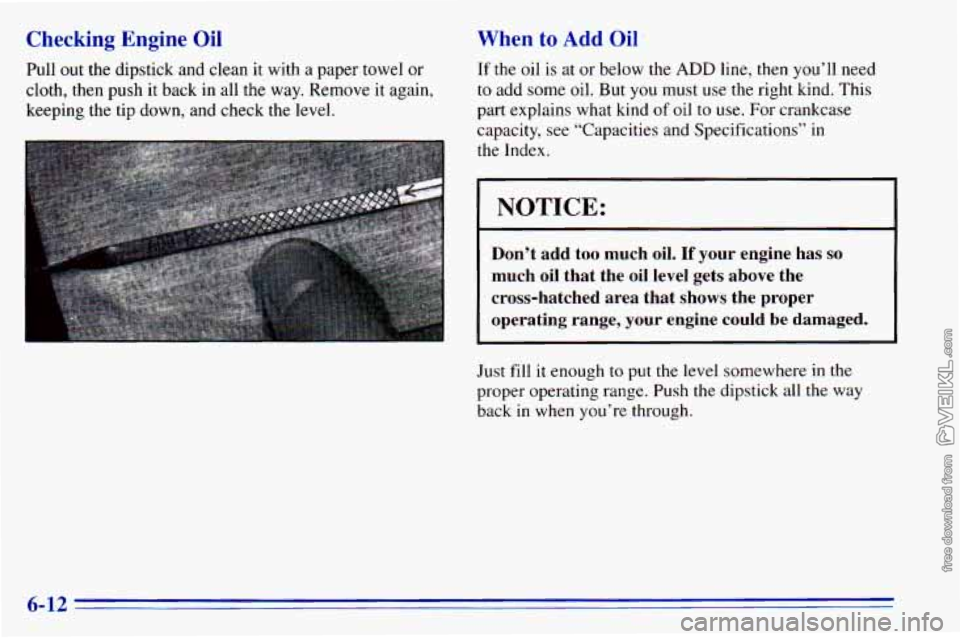
Checking Engine Oil
Pull out the dipstick and clean it with a paper towel or
cloth, then
push it back in all the way. Remove it again,
keeping the tip down, and check
the level.
When to Add Oil
If the oil is at or below the ADD line, then you’ll need
to add some oil. But
you must use the right kind. This
part explains what kind
of oil to use. For crankcase
Don’t add too much oil. If your engine has so
much oil that the oil level gets above the
cross-hatched area that shows the proper
operating range, your engine could
be damaged.
Just fill it enough to put the level somewhere in the
proper operating range. Push
the dipstick all the way
back
in when you’re through.
6-12
Page 244 of 372
As shown in the chart, SAE 5W-30 is best for your
vehicle. However,
you can use SAE 1OW-30 if it’s going
to be
0°F (- 18 “C) or above. These numbers on an oil
container show its viscosity,
or thickness. Do not use
other viscosity oils, such as
SAE 20W-50.
NOTICE:
Use only engine oil with the American Petroleum
Institute Certified For Gasoline Engines
“Starburst” symbol. Failure to use the
recommended oil can result in engine damage
not covered
by your warranty.
GM Goodwrench@ oil meets all the requirements for
your vehicle.
Engine Oil Additives
Don’t add anything to your oil. Your GM dealer is ready
to advise if
you think something should be added.
When to Change Engine Oil
See if any one of these is true for you:
0
0
e
e
e
Most trips are less than 5 to 10 miles (8 to 16 km).
This is particularly important when outside
temperatures are below freezing.
Most trips include extensive idling (such
as frequent
driving in stop-and-go traffic).
Most trips are through dusty areas.
You frequently tow a trailer or use a carrier on top
of
your vehicle.
The vehicle is used for delivery service, police, taxi
or other commercial application.
Driving under these conditions causes engine oil to
break down sooner. If any
one of these is true for your
vehicle, then
you need to change your oil and filter
every 3,000 miles
(5 000 km) or 3 months -- whichever
occurs first.
If
none of them is true, change the oil and filter every
7,500 miles (12 500 km) or 12 months -- whichever
occurs first. Driving a vehicle with
a fully warmed
engine under highway conditions causes engine oil to
break down slower.
6-14
Page 250 of 372

Refer to the Maintenance Schedule to determine when to
replace the air filter and the crankcase ventilation filter.
See “Scheduled
N ntenance Services” in the Index.
Operating th, mgine with the air cleaner off
can cause
you or others to be burned. The air
cleaner not only cleans the air, it stops flame if
the engine backfires. If it isn’t there, and the
engine backfires, you could be burned. Don’t
drive with it
off, and be careful working on the
engine with the
air cleaner off.
NOTICE:
If the air cleaner is off, a backfire can cause a
damaging engine fire. And, dirt can easily get
into your engine, which will damage it. Always
have the air cleaner in place when you’re driving.
Automatic Transmission Fluid
When to Check and Change
A good time to check your automatic transmission fluid
level is when the engine oil is changed,
Change both the fluid and filter every
15,000 miles
(25 000 km) if the vehicle is mainly driven under one
or more of these conditions:
In heavy city traffic where the outside temperature
In hilly or mountainous terrain.
When doing frequent trailer towing.
Uses such as found in taxi, police or delivery service.
If
you do not use your vehicle under any of these
conditions, change
the fluid and filter every
30,000 miles (50 000 km).
See “Scheduled Maintenance Services” in
the Index.
regularly reaches
90°F (32°C) or
higher.
6-20
Page 252 of 372

Checking Transmission Fluid Cold
A cold check is made after the vehicle has been sitting
for eight hours
or more with the engine off and is used
only as a reference. Let the engine run at idle for five
minutes if outside temperatures are 50°F (10°C) or
more. If it's colder than
50°F ( 10°C), you may have
to idle the engine longer. Should the fluid level be low
during a cold check,
you must perform a hot check
before adding fluid.
This will give you a more accurate
reading
of the fluid level.
Checking the Fluid Hot or Cold
Park your vehicle on a level place. Keep the
With the parking brake applied, place the shift lever
engine
running.
in PARK (P).
With your foot on the brake pedal, move the shift
lever through each gear range, pausing for about
three seconds in each range. Then, position the shift
lever in PARK
(P).
0 Let the engine run at idle for three minutes or more. Then, without shutting
off the engine, follow these steps:
1. Flip the handle up and then pull out the dipstick and
wipe
it with a clean rag or paper towel.
2. Push it back in all the way, wait three seconds and
then
pull it back out again.
6-22
Page 274 of 372

Tire Inspection and Rotation
Tires should be inspected every 6,000 to 8,000 miles
(10 000 to 13 000 km) for any signs of unusual wear.
If unusual wear is present, rotate your tires as soon as
possible and check wheel alignment. Also check for
damaged tires or wheels. See “When It’s Time for New
Tires” and “Wheel Replacement” later in this section for
more information.
The purpose of regular rotation
is to achieve more
uniform wear for all tires on the vehicle. The first
rotation is the most important. See “Scheduled
Maintenance Services” in the Index for scheduled
rotation intervals. When
rotating your tires, always use the correct rotation
pattern shown here.
Don’t include the compact spare tire in your tire rotation. \
After the tires have been rotated, adjust the front and
rear inflation pressures as shown on the
CertificatiodTire label. Make certain that all wheel nuts
are properly tightened. See “Wheel
Nut Torque” in
the Index.
’ A CAUTIO1
Rust or dirt on a wheel, or on the parts to which
it
is fastened, can make wheel nuts become loose
after a time. The wheel could come
off and cause
an accident. When you change a wheel, remove
any rust or dirt from places where the wheel
attaches to the vehicle. In an emergency, you can
use a cloth or a paper towel to do this; but be
sure to use a scraper or wire brush later,
if you
need to, to get all the rust or dirt
off. (See
“Changing
a Flat Tire” in the Index.)