Page 83 of 372
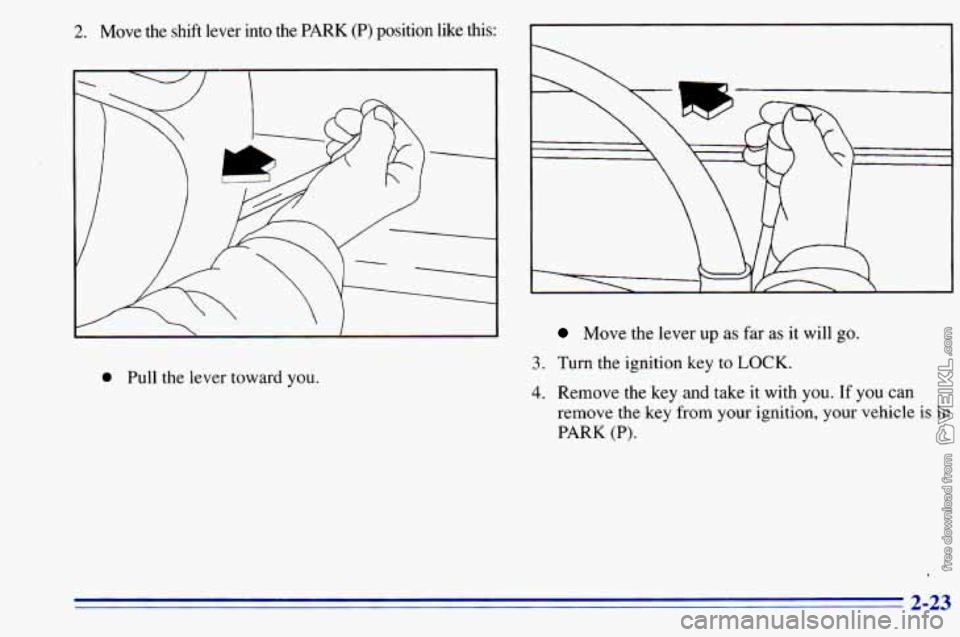
2. Move the shift lever into the PARK (P) position like this:
0 Pull the lever toward you.
Move the lever up as far as it will go.
3. Turn the ignition key to LOCK.
4. Remove the key and take it with you. If you can
remove the key from your ignition, your vehicle is in
PARK (P).
2-23
Page 84 of 372
Leaving Your Vehicle With the
E.noiqe Rmnnjnq
r
can be ( lgerous to we your vt cle wi
the engine running. Your vehicle could move
suddenly if the shift lever
is not fully in PARK (P)
with the parking brake firmly set. And, if you
leave the vehicle with the engine running, it could
overheat and even catch fire. You or others could
be injured. Don’t leave your vehicle with the
engine running unless you have
to.
If you have to leave your vehicle with the engine
running, be sure your vehicle is in PARK (P) and your
parking brake is firmly set before you leave it. After
you’ve moved the shift lever into the PARK (P)
position, hold the regular brake pedal down. Then, see
if you can move
the shift lever away from PARK (P)
without first pulling it toward
you. If you can, it means
that the shift lever wasn’t fully locked into PARK (P).
Torque Lock I
If you are parking on a hill and you don’t shift your
transmission
into PARK (P) properly, the weight of the
vehicle may put
too much force on the parking pawl in
the transmission. You may find it difficult to pull the
shift lever out of PARK (P). This is called “torque lock.”
To prevent torque lock, set the parking brake and then
shift into PARK (P) properly before you leave the
driver’s seat.
To find out how, see “Shifting Into
PARK (P)” in the Index.
When you are ready to drive, move the shift lever out
of
PARK (P) before you release the parking brake.
If torque lock does occur,
you may need to have another
vehicle push yours a little uphill
to take some of the
pressure from the transmission, so you can pull the shift
lever out
of PARK (P).
2-24
Page 87 of 372
CAUTION:
It can be dangerous to get out of your vehicle if
the shift lever is not fully in
PARK (P) with the
parking brake firmly set. Your vehicle can roll.
Don’t leave your vehicle when the engine is
running unless you have to.
If you’ve left the
engine running, the vehicle can move suddenly.
You or others could be injured.
To be sure your
vehicle won’t move, even when you’re on fairly
level ground, always set your parking brake and
move the shift lever to
PARK (P).
Follow the proper steps to be sure your vehicle won’t
move. See “Shifting Into
PARK (P)” in the Index.
If you’re pulling a trailer, see “Towing
a Trailer” in
the Index.
Windows
Manual Windows
To open your manual windows, turn the hand crank on
each door to raise or lower your side door windows.
Power Windows
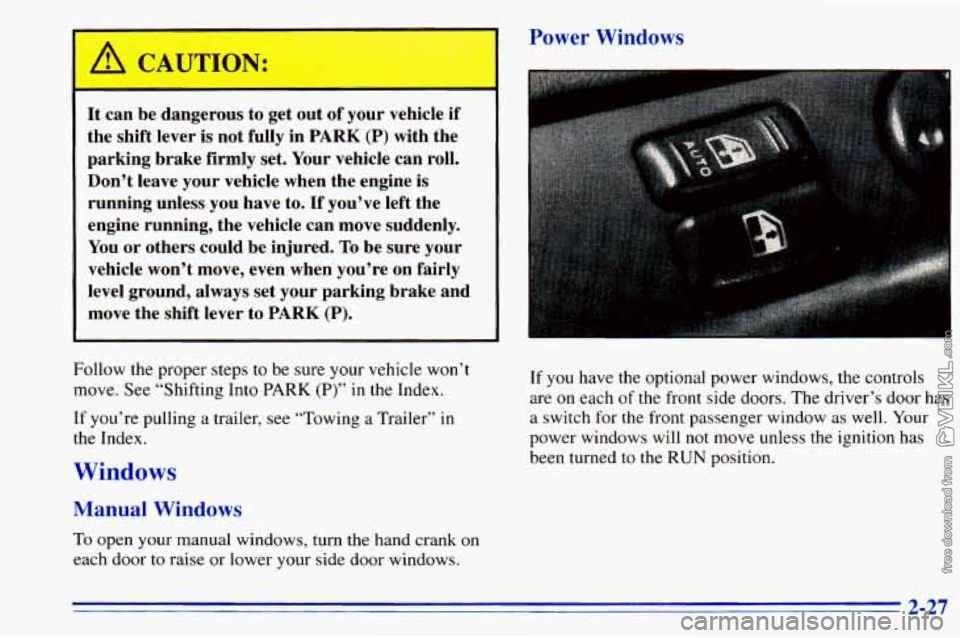
If you have the optional power windows, the controls
are
on each of the front side doors. The driver’s door has
a switch for the front passenger window
as well. Your
power windows will not move unless the ignition has
been turned to the
RUN position.
2-27
Page 88 of 372
Exprer- ’ wn Window
The driver
s window switch also has an “express”
feature that allows
it to lower without holding the
window switch. Hold the driver’s window switch down
for more than 112 second to activate the express-down
feature. Lightly tap the switch to open the window
slightly. The express-down feature can be interrupted
at any time by pressing the up arrow end of the switch.
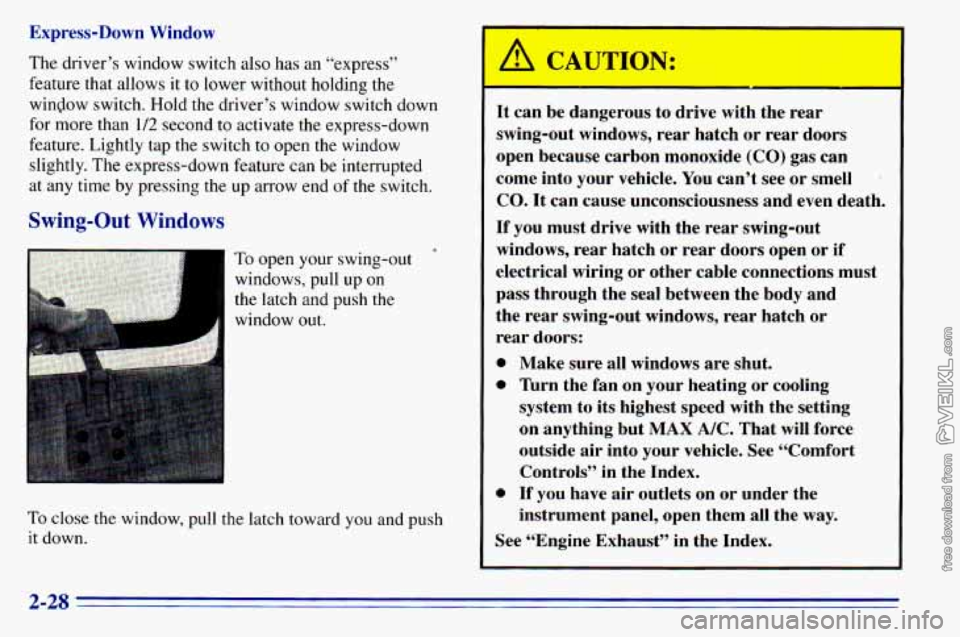
Swing-Out Windows
‘D‘. : .,,: TO open your swing-out +
windows, pull up on
the latch and push the
window out.
e
It can be dangerous to drive with the rear
swing-out windows, rear hatch or rear doors
open because carbon monoxide
(CO) gas can
come into your vehicle. You can’t see or smell
*
CO. It can cause unconsciousness and even death.
If you must drive with the rear swing-out
windows, rear hatch or rear doors open or if
electrical wiring or other cable connections must
pass through the seal between the body and
the rear swing-out windows, rear hatch
or
rear doors:
TO close the window, pull the latch toward you and push
it down.
e
e Make sure all windows are shut.
”urn the fan on your heating or cooling
system to its highest speed with the setting
on anything but MAX
A/C. That will force
outside air into your vehicle. See “Comfort
Controls” in the Index.
If you have air outlets on or under the
instrument panel, open them all the way.
See “Engine Exhaust’’ in the Index.
2-28
Page 90 of 372

Turn and Lane Change Signals
The turn signal has two upward (for right) and two
downward (for left) positions. These positions allow you
to signal a turn or a lane change.
To signal
a turn, move the lever all the way up or down.
When the
turn is finished, the lever will return automatically.
A
An arrow on the instrument
panel will flash in
the
direction of the turn or
lane change.
To signal a lane change, just raise or lower the lever
until the arrow starts to flash. Hold it there until
you
complete your lane change. The lever will return by
itself when you release
it.
As you signal a turn or a lane change, if the arrows don’t
flash
but just stay on, a signal bulb may be burned out
and other drivers won’t see your turn signal.
If a bulb is burned out, replace it to help avoid an
accident. If the arrows don’t go on at all when you
signal a turn, check the fuse (see “Fuses and Circuit
Breakers” in the Index) and for burned-out bulbs.
If you have a trailer towing option with added wiring for
the trailer lamps,
a different turn signal flasher is used.
With this flasher installed, the signal indicator will flash
even if a turn signal bulb is burned out. Check the front
and rear turn signal lamps regularly to make sure they
are working.
Headlamp High/Low Beam Changer
To change the headlamps from low beam to high or high
to low, pull the multifunction lever all the way toward
you. Then release it.
When the high beams are
on, this indicator light on
the instrument panel also
will be on.
2-30
Page 95 of 372
1-
,
Lamps
I
I i
i
I
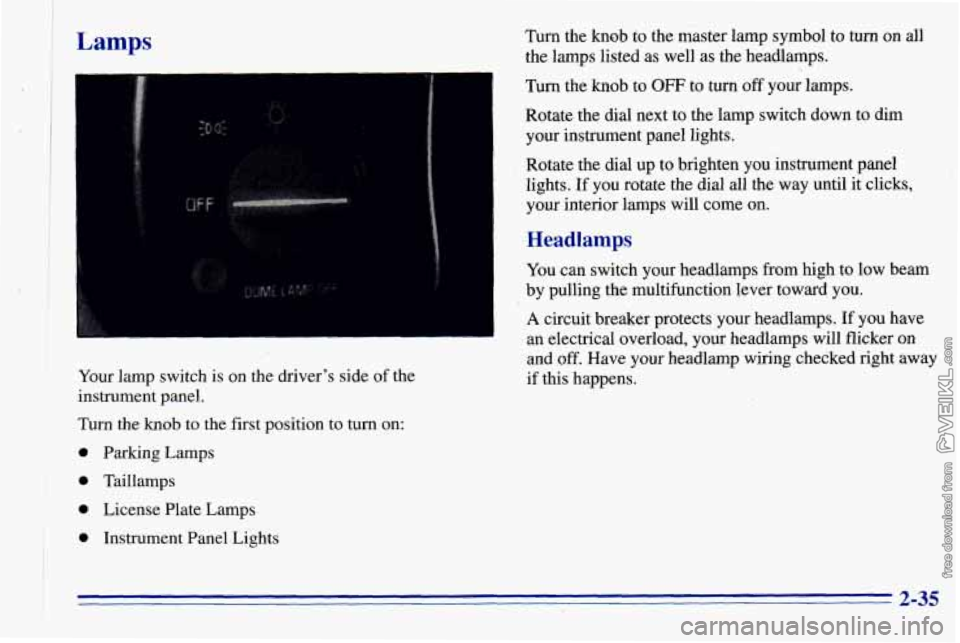
Turn the knob to the master lamp symbol to turn on all
the lamps listed as well as the headlamps.
Turn the
knob to OFF to turn off your lamps.
Rotate the dial next to the lamp switch down to dim
your instrument panel lights.
Rotate the dial up to brighten you instrument panel
lights. If you rotate the dial all the way until it clicks,
your interior lamps will come on.
Headlamps
You can switch your headlamps from high to low beam
by pulling the multifunction lever toward you.
A circuit breaker protects your headlamps. If you have
an electrical overload, your headlamps will flicker on
and off. Have your headlamp wiring checked right away
I Your lamp switch is on the driver's side of the if this happens.
instrument panel.
Turn the
knob to the first position to turn on:
I 0 'parking Lamps ! 0 Taillamps
I * * License Plate Lamps
0 Instrument Panel Lights
* 2-35
Page 98 of 372
If the button is pressed in, the interior lamps will not
come on when any
of the vehicle’s doors are open,
unless your vehicle has the optional Keyless Entry
system. The button
is located next to the lamp
switch knob.
If you have the optional reading lamps, they will still
operate if the button
is pressed-in.
Reading Lamps.(Option)
You may have the optional reading lamps next to the
dome lamps. Turn the lamps on and
off by pressing the
switch next
to the lamp.
You can adjust the lamps to any desired position by
rotating the ,lamp and they will work when the ignition
is on or off. Be sure to turn the lamps off before you
leave the vehicle.
.- , , ,,
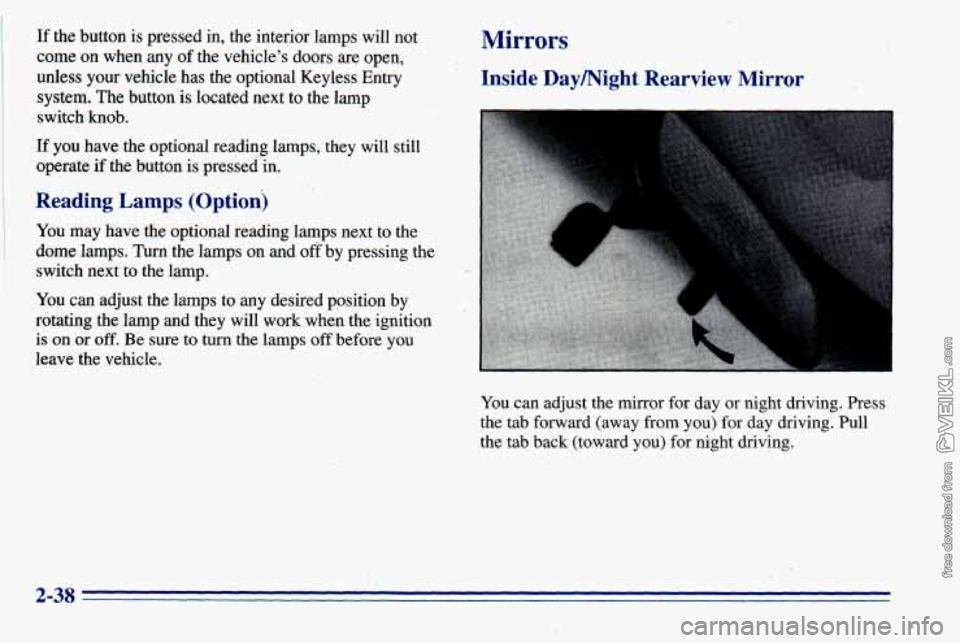
Mirrors
Inside Daymight Rearview Mirror
You can adjust the mirror for day or night driving. Press
the tab forward ‘(away from
you) for day driving. Pull
the tab back (toward
you) for night driving.
2-38
Page 99 of 372
Outside Mirrors
Adjust your outside mirrors so you can just see the side
of your vehicle.
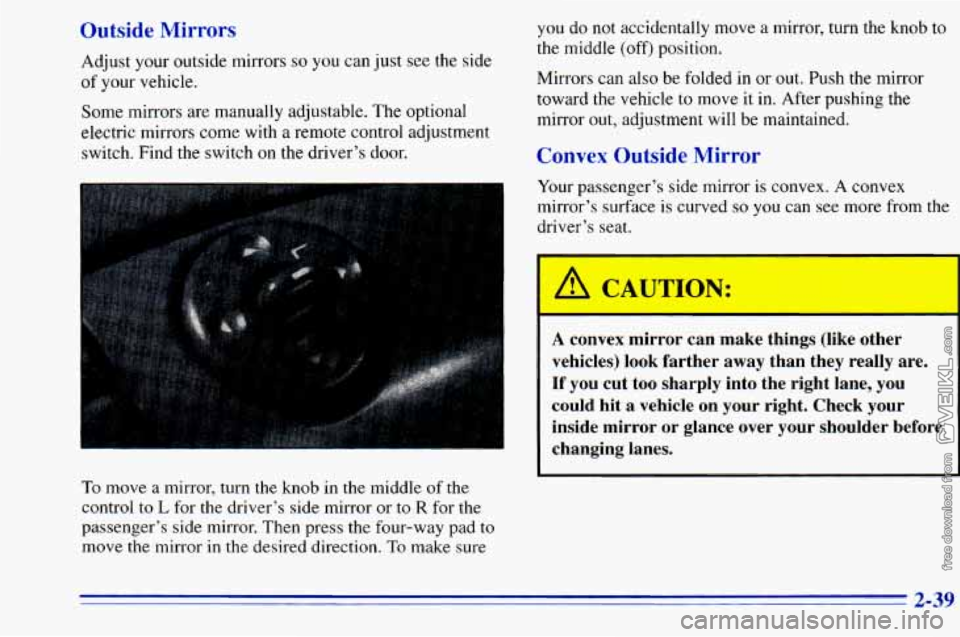
Some mirrors are manually adjustable. The optional
electric mirrors come with a remote control adjustment
switch. Find the switch on the driver’s door. you
do not accidentally move a mirror, turn the knob to
the middle (off‘) position.
Mirrors can also be folded in
or out. Push the mirror
toward the vehicle to move it in. After pushing the
mirror out, adjustment will be maintained.
Convex Outside Mirror
Your passenger’s side mirror is convex. A convex
mirror’s surface
is curved so you can see more from the
driver’s seat.
To move a mirror, turn the knob in the middle of the
control
to L for the driver’s side mirror or to R for the
passenger’s side mirror. Then press the four-way pad to
move the mirror in
the desired direction. To make sure
A convex mirror can make things (likl- Aher
vehicles) look farther away than they really are.
If you cut too sharply into the right lane, you
could hit
a vehicle on your right. Check your
inside mirror or glance over your shoulder before
changing lanes.
2-39