Page 52 of 372
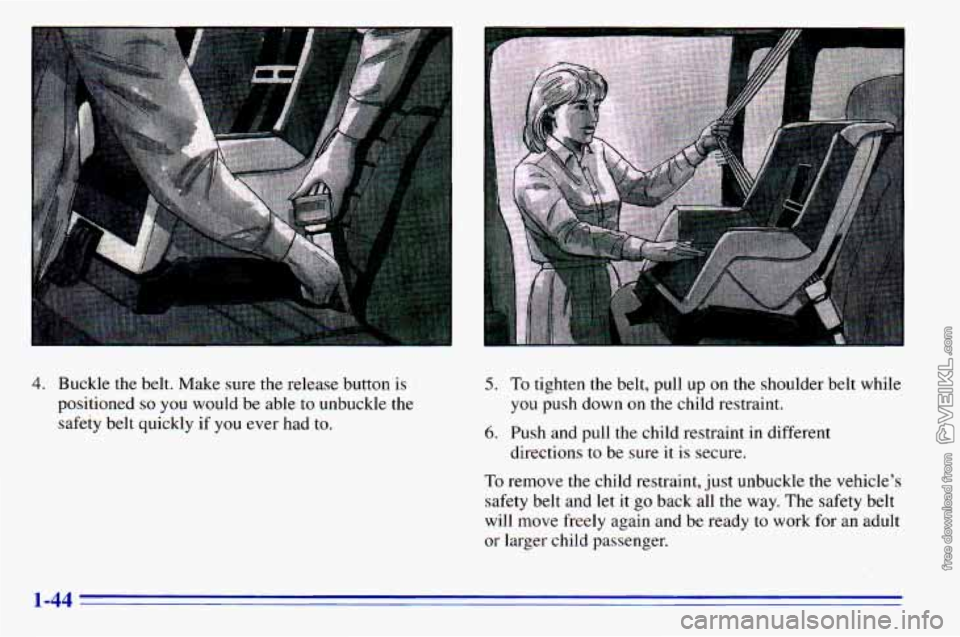
4. Buckle the belt. Make sure the release button is
positioned
so you would be able to unbuckle the
safety belt quickly if
you ever had to.
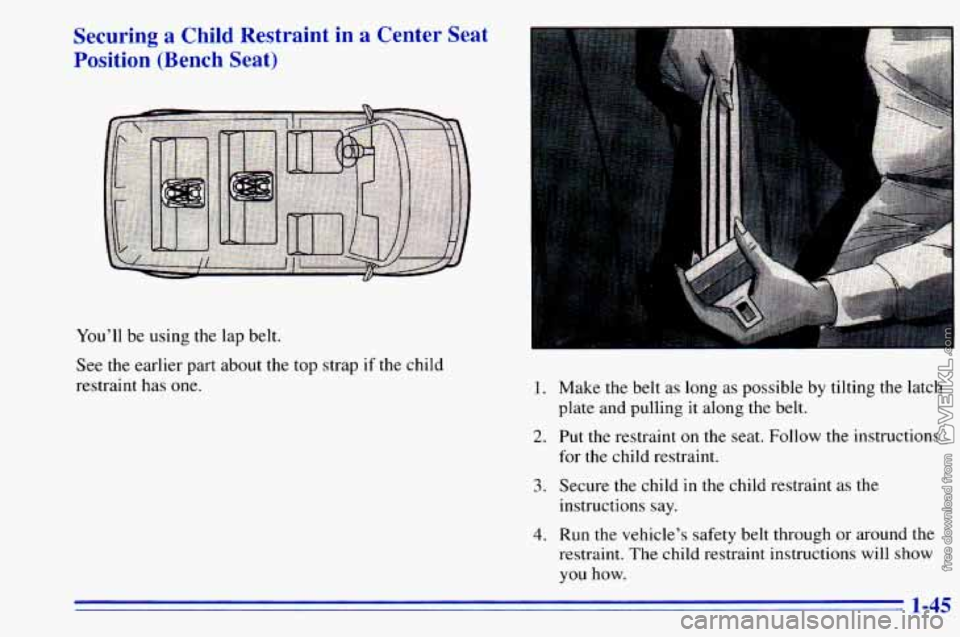
5. To tighten the belt, pull up on the shoulder belt while
you push down on the child restraint.
6. Push and pull the child restraint in different
directions to be sure
it is secure.
To remove the child restraint, just unbuckle the vehicle’s
safety belt and let
it go back all the way. The safety belt
will move freely again and be ready to work for an adult
or larger child passenger.
1-44
Page 53 of 372
Securing a Child Restraint in a Center Seat
Position (Bench Seat)
You’ll be using the lap belt.
See the earlier part about the top strap if the child
restraint has
one.
1.. .
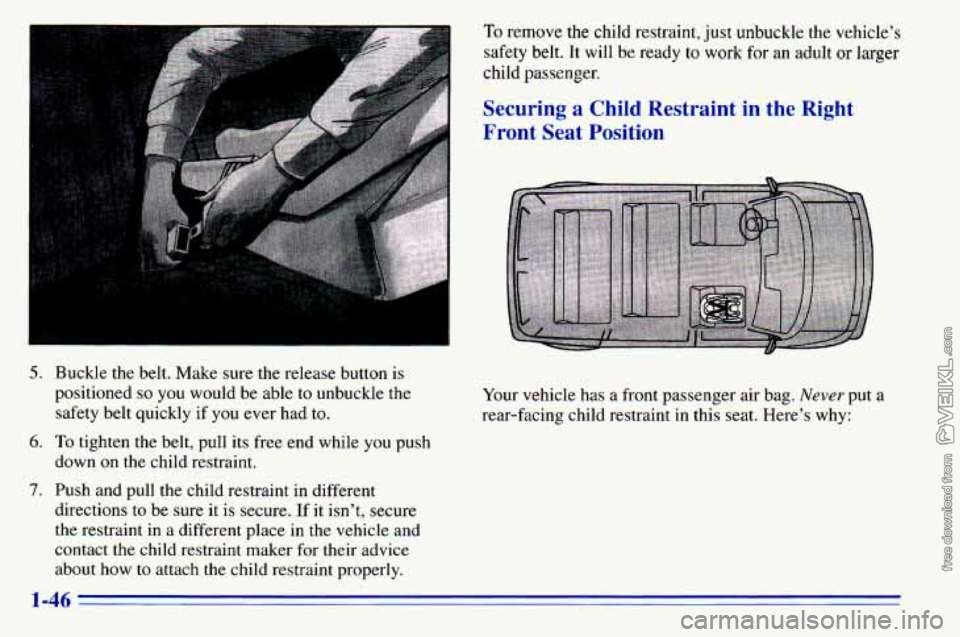
1. Make the belt as long as possible by tilting the latch
2. Put the restraint on the seat. Follow the instructions
plate and pulling
it along the belt.
for the child restraint.
3. Secure the child in the child restraint as the
instructions say.
4. Run the vehicle’s safety belt through or around the
restraint. The child restraint instructions will show
you how.
1-45
Page 54 of 372
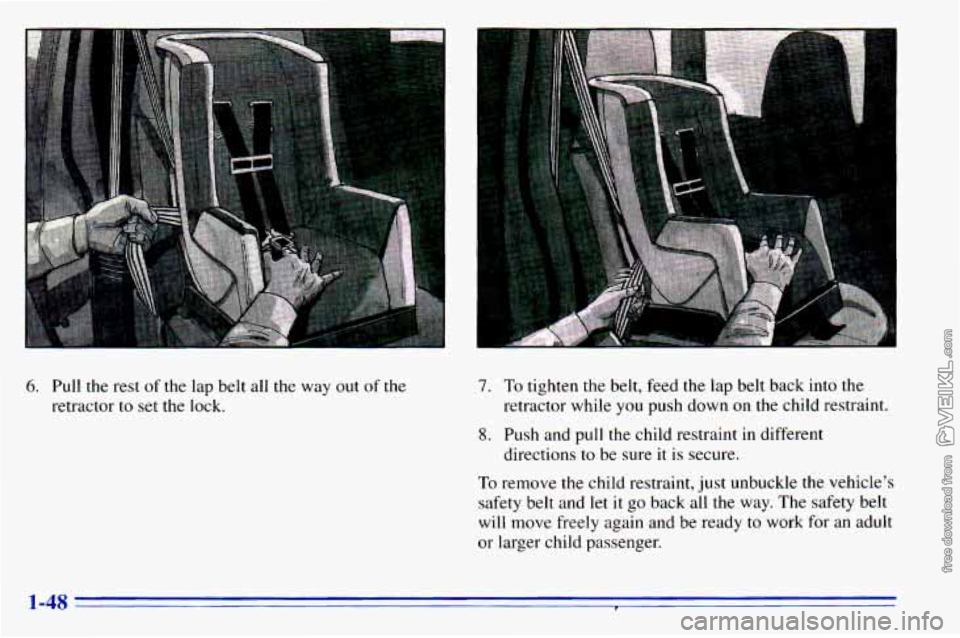
5. Buckle the belt. Make sure the release button is
positioned
so you would be able to unbuckle the
safety belt quickly if you ever had to.
6. To tighten the belt, pull its free end while you push
7. Push and pull the child restraint in different
down
on the child restraint.
directions to be sure it is secure. If it isn’t, secure
the restraint in
a different place in the vehicle and
contact the child restraint maker for their advice
about how to attach the child restraint properly.
To remove the child restraint, just unbuckle the vehicle’s
safety belt. It will be ready
to work for an adult or larger
child passenger.
Securing a Child Restraint in the Right
Front Seat Position
Your vehicle has a front passenger air bag. Never put a
rear-facing child restraint in this seat. Here’s why:
1-46
Page 55 of 372
A ch 1 a rear-fac lg child ;traint can be
seriously injured
if the front passenger’s air bag
inflates. This is because the back of a rear-facing
child restraint would be very close to the inflating
air bag.
If your vehicle is a passenger van, always
secure a rear-facing child restraint in
a rear seat.
If your vehicle is a cargo van, do not use a
rear-facing child restraint in this vehicle.
If a
forward-facing child restraint is suitable for your
child, always move the passenger seat as far back
as it will go.
You’ll be using
the lap-shoulder belt. See the earlier part
about the top strap if the child restraint has one.
1. Because your vehicle has a front passenger air bag,
always move
the seat as far back as it will go before
securing a forward-facing child restraint. (See
“Seats”
in the Index.)
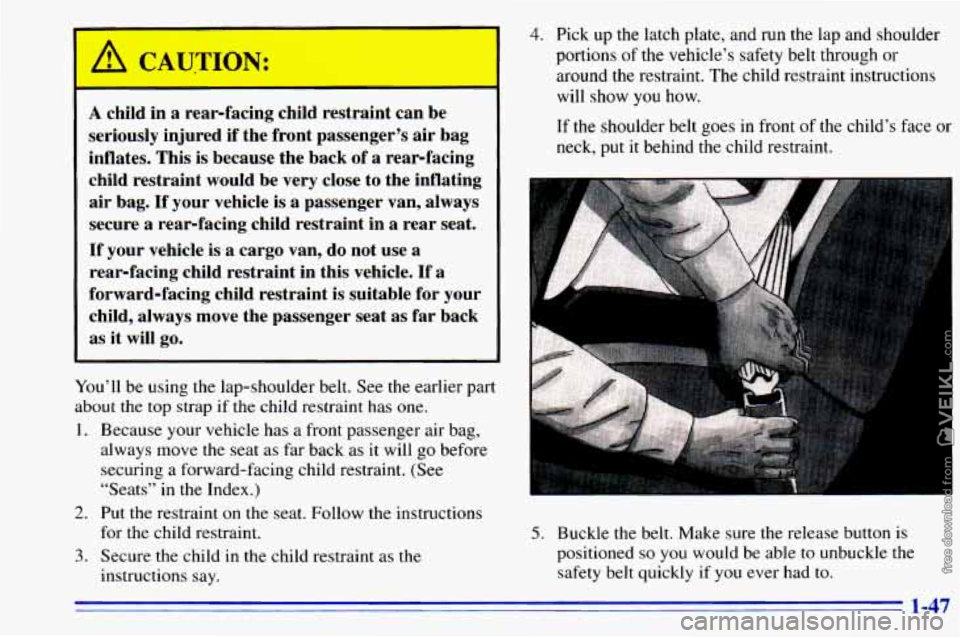
4. Pick up the latch plate, and run the lap and shoulder
portions
of the vehicle’s safety belt through or
around the restraint. The child restraint instructions
will show
you how.
If the shoulder belt goes in front
of the child’s face or
neck, put it behind
the child restraint.
2. Put the restraint on the seat. Follow the instructions
3. Secure the child in the child restraint as the positioned so you would be able to unbuckle the
for
the child restraint.
5. Buckle the belt. Make sure the release button is
instructions say. safety belt quickly if you ever had to.
1-47
Page 56 of 372
6. Pull the rest of the lap belt all the way out of the
retractor to set the lock.
.a.
7. To tighten the belt, feed the lap belt back into the
8. Push and pull the child restraint in different
retractor while
you push
down on the child restraint.
directions
to be sure it is secure.
To remove the child restraint, just unbuckle the vehicle's
safety belt and let
it go back all the way. The safety belt
will move freely again and be ready to work for an adult
or larger child passenger.
,1-48 I
Page 62 of 372
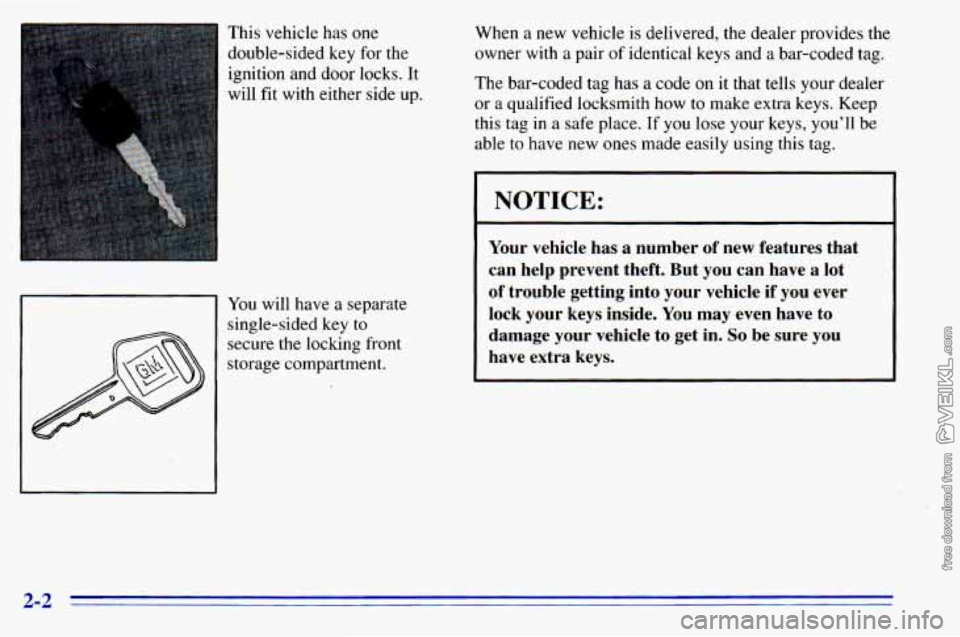
This vehicle has one
double-sided key for the
ignition and door locks. It
will fit with either side up.
You will have a separate
single-sided key
to
secure the locking front
storage compartment. When
a new vehicle is delivered, the dealer provides the
owner
with a pair of identical keys and a bar-coded tag.
The bar-coded tag has a code on
it that tells your dealer
or a qualified locksmith how to make extra keys. Keep
this tag
in a safe place. If you lose your keys, you'll be
able to have new ones made easily using this tag.
NOTICE:
Your vehicle has a number of new features that
can help prevent theft. But you can have a lot
of trouble getting into your vehicle if you ever
lock your keys inside. You may even have to
damage your vehicle to get in.
So be sure you
have extra keys.
2-2
Page 70 of 372
Sliding Door Child Security Lock
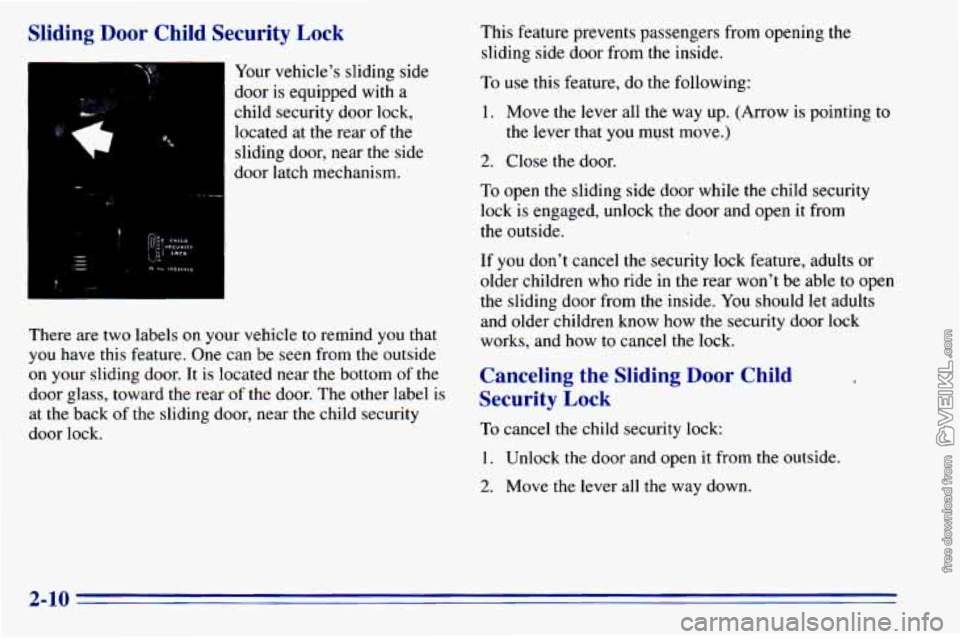
Your vehicle’s sliding side
door is equipped with
a
child security door lock,
located at the rear of the
sliding door, near the side
door latch mechanism. This
feature prevents passengers from opening the
sliding side door from
the inside.
To use this feature, do the following:
1. Move the lever all the way up. (Arrow is pointing to
the lever that you must move.)
2. Close the door.
To open
the sliding side door while the child security
lock is engaged, unlock the door and open it from
the outside.
If
you don’t cancel the security lock feature, adults or
older children who ride
in the rear won’t be able to open
the sliding door from the inside.
You should let adults
and older children know how the security door lock
There are
two labels on your vehicle to remind you that works, and how to cancel the lock,
you have this feature. One can be
seen from the outside
on your sliding door. It is located near the bottom
of the Canceling the Sliding Door Child
door glass, toward the rear of the door. The other label is Security Lock
at the back of the sliding door, near the child security
door lock.
To cancel the child security lock:
1. Unlock the door and open it from the outside.
2. Move the lever all the way down.
2-10
Page 107 of 372
Luggage Carrier (Option)
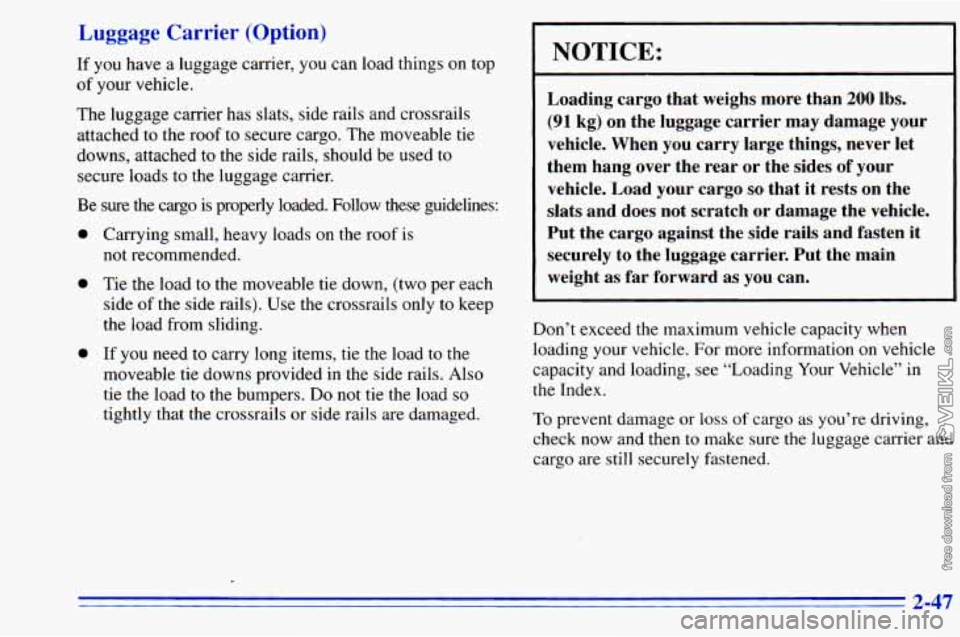
If you have a luggage carrier, you can load things on top
of your vehicle.
The luggage carrier has slats, side rails and crossrails
attached to the roof to secure cargo. The moveable tie
downs, attached to the side rails, should be used to
secure loads to the luggage carrier.
Be sure the cargo
is properly loaded. Follow these guidelines:
a
a
a
Carrying small, heavy loads on the roof is
not recommended.
Tie the load to the moveable tie down,
(two per each
side of the side rails). Use the crossrails only to keep
the load from sliding.
If you need to carry long items, tie the load
to the
moveable tie downs provided in the side rails. Also
tie the load to the bumpers.
Do not tie the load so
tightly that the crossrails or side rails are damaged.
NOTICE:
Loading cargo that weighs more than 200 lbs.
(91 kg) on the luggage carrier may damage your
vehicle. When you carry large things, never let
them hang over the rear or the sides
of your
vehicle. Load your cargo
so that it rests on the
slats and does not scratch or damage the vehicle.
Put the cargo against the side rails and fasten it
securely to the luggage carrier. Put the main
weight
as far forward as you can.
Don’t exceed the maximum vehicle capacity when
loading your vehicle. For more information on vehicle
capacity and loading, see “Loading Your Vehicle” in
the Index.
To prevent damage or loss of cargo as you’re driving,
check now and then to make sure the luggage carrier and
cargo are still securely fastened.
2-47