1996 CADILLAC SEVILLE sensor
[x] Cancel search: sensorPage 40 of 354
Downloaded from www.Manualslib.com manuals search engine c
L-
o c
c
0
c
c
bag system. If you don’t get them, the air bag system
won’t be
there to help protect you in another crash.
A new system will include air bag modules and
possibly other parts. The service manual for your
vehicle covers the need to replace other parts.
Your vehicle
is equipped with a crash sensing and
diagnostic module., which records information about
the air bag system. The module records information
about the readiness
of the system, when the sensors
are activated and driver’s safety belt usage at
deployment,
Let only qualified technicians work on your air bag
system. Improper service can mean that your air bag
system won’t work properly. See your dealer for
service.
NOTICE:
If you damage the cover for the driver’s air bag,
it may not work properly.
You may have to
replace the air bag module.
Do not open or break
the air bag cover.
Servicing Your Air Bag-Equipped Cadillac
Air bags affect how your Cadillac should be serviced.
There are parts of the air bag system in several places
around your vehicle. You don’t want the system
to
inflate while someone is working on your vehicle. Your
Cadillac dealer and the Cadiliac service manual have
information about servicing your vehicle and the air bag system.
To purchase a service manual, see “Service and
Owner Publications” in the Index.
A CAUTION:
For up to 10 seconds after the ignition key is
turned off and the battery is disconnected, an air
bag can still inflate during improper service.
You
can be injured if you are close to an air bag when
it inflates. Avoid wires wrapped with yellow tape
or yellow connectors. They
are probably part of
the air bag system. Be sure to follow proper
service procedures, and make sure the person
performing work for you
is qualified to do so.
The air bag system does not need regular maintenance.
1-25
Page 81 of 354
Downloaded from www.Manualslib.com manuals search engine NEUTRAL (N): In this position, the engine doesn’t
connect with the wheels.
To restart when you’re already
moving, use
NEUTRAL (N) only. Also, use
NEUTRAL (N) when your vehicle is being towed.
~~ ~
A CAUTION:
Shifting out of PARK (P) or NEUTRAL (N) while
your engine is “racing” (running at high speed) is
dangerous. Unless your foot is firmly on
the
brake pedal, your vehicle could move very
rapidly.
You could lose control and hit people or
objects. Don’t shift out of PARK
(P) or
NEUTRAL
(N) while your engine is racing.
I NOTICE:
Damage to your transaxle caused by shifting out
of
PARK (P) or NEUTRAL (N) with the engine
racing isn’t covered by your warranty. OVERDRIVE
(@): This position
is for normal driving.
If you need more power for passing, and you’re:
Going less than 35 mph (55 km/h), push the
accelerator pedal about halfway down.
Going about 35 mph (55 km/h) or more, push the
accelerator all the way down.
The transaxle
will shift down to the next gear and
have more power.
NOTICE:
If your vehicle seems to start up rather slowly, or
if it doesn’t seem to shift gears as you accelerate,
something may be wrong with a transaxle system
sensor. If
you drive very far that way, your
vehicle can be damaged.
So if this happens, have
your vehicle serviced right away. Until then, you
can use SECOND
(2) when you are driving less
than
35 mph (55 km/h) and OVERDRIVE (0)
for higher speeds.
c-
2-22
Page 94 of 354
Downloaded from www.Manualslib.com manuals search engine II
c
Rainsense Wipers (STS Only)
I
:-
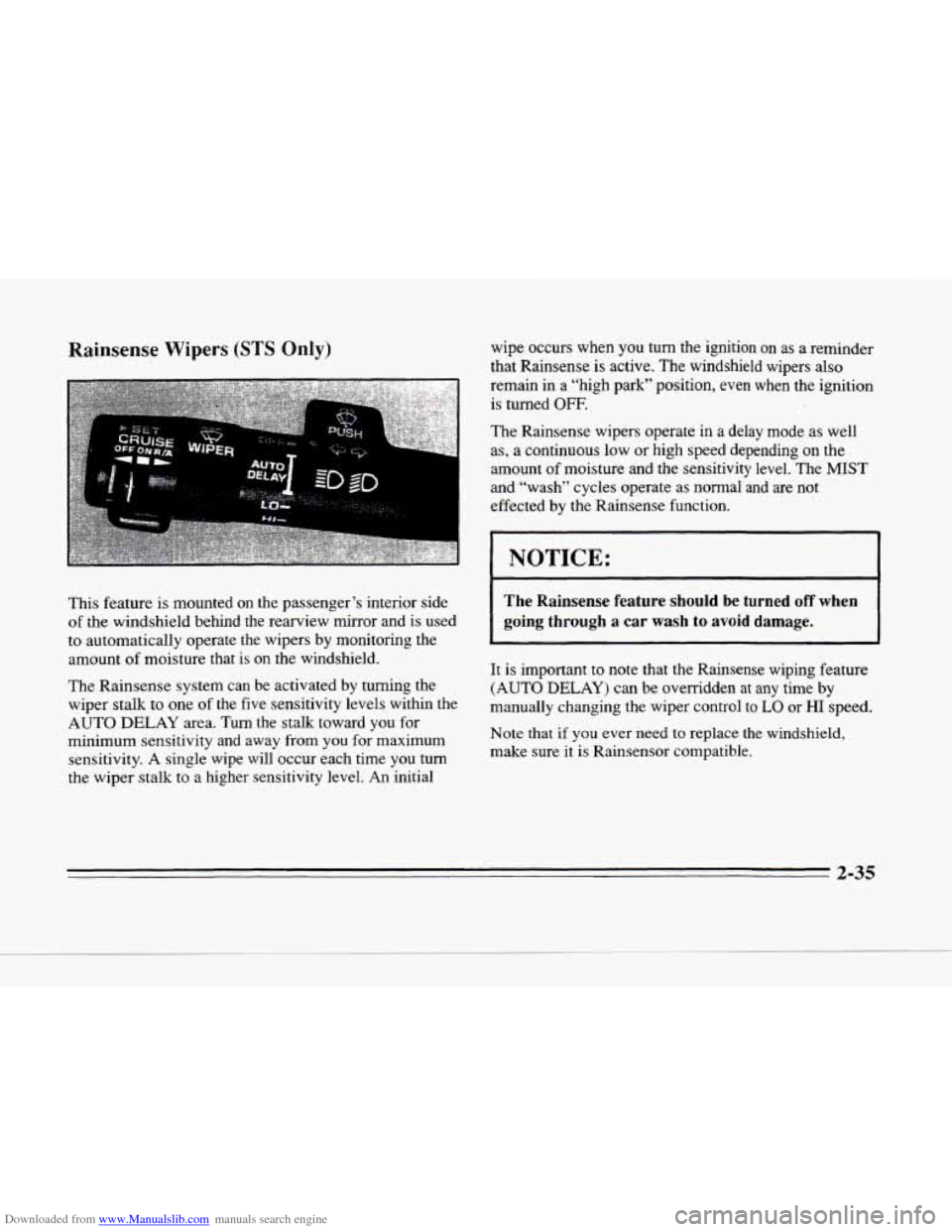
This feature is mounted on the passenger’s interior side
of the windshield behind the rearview mirror and is used
to automatically operate the wipers by monitoring the
amount of moisture that is on the windshield.
The Rainsense system can be activated by turning the
wiper stalk
to one of the five sensitivity levels within the
AUTO DELAY area. Turn
the stalk toward you for
minimum sensitivity and away from you for maximum
sensitivity. A single wipe will occur each time
you turn
the wiper stalk to a higher sensitivity level. An initial wipe occurs when
you turn the ignition on as a
reminder
that Rainsense
is active. The windshield wipers also
remain in a “high park” Position,
even when the ignition
is turned OFF.
The Rainsense wipers operate in a delay mode as well
as, a continuous low
or high speed depending on the
amount of moisture and the sensitivity level. The MIST
and “wash” cycles operate as normal and are not
effected by the Rainsense function.
I NOTICE:
The Rainsense feature should be turned off when
going
through a car wash to avoid damage.
It is important to note that the Rainsense wiping feature
(AUTO DELAY) can be overridden at any time
by
manually changing the wiper control to LO or HI speed.
Note that
if you ever need to replace the windshield,
make sure it is Rainsensor compatible.
2-35
Page 100 of 354
Downloaded from www.Manualslib.com manuals search engine c
c
Pull the knob out to the first stop to turn on the parking
and taillamps, sidemarker lamps and instrument panel
lights. Pull the knob out all the way to turn
on the
headlamps.
You can brighten or dim the instrument
cluster by rotating the headlamp
knob. Press the knob
all the way in to turn them off. The exterior lamps
will automatically turn
on after several seconds of
wiper activation.
Headlamps
Wiper Activated Headlamps
This feature activates the headlamps and parking lamps
after the windshield wipers have been in use for
approximately
20 seconds.
In order to operate the wiper activated headlamps, the
twilight sentinel must be in the
on position. This feature
lights the way in poor weather and
it also makes your
vehicle more visible to other drivers.
If the wiper
activated headlamps are on, and the ignition switch
is
turned off, the wiper activated headlamps will
immediately turn
off.
The wiper activated headlamps will deactivate if you
turn off the twilight sentinel or if the windshield wipers
have been turned
off for a period of one or two seconds.
Lamps On Reminder
You will hear a warning chime if you pull the key from
the ignition while leaving the lamps on, if the manual
headlamp control is activated. An exception to this is
when you're using twilight sentinel.
Daytime Running Lamps
Daytime Running Lamps (DRL) can make it easier
for-others
to see the front of your vehicle during the
day, DRL can be helpful in many different driving
conditions, but they can be especially helpful in the
short periods after dawn and before sunset.
A light sensor on top of the instrument panel makes the
DRL work,
so be sure it isn't covered.
The
DRL system will make the high-beam headlamps
come on at reduced brightness when:
the ignition is on,
0 the headlamp switch is oft' and
the transaxle is not in PARK (P).
- 2-41
Page 103 of 354
Downloaded from www.Manualslib.com manuals search engine Light Sensor
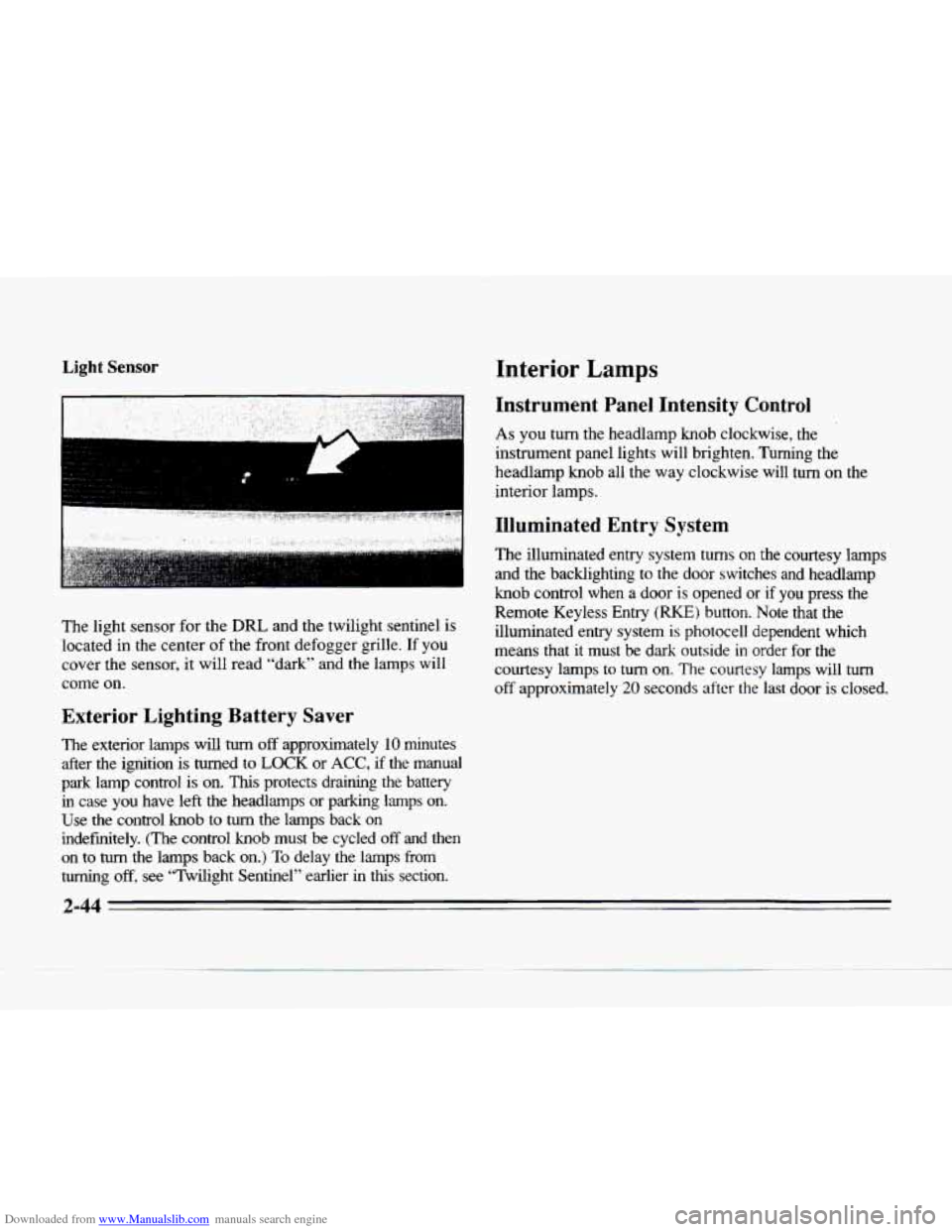
The light sensor for the DRL and the twilight sentinel is
located
in the center of the front defogger grille. If you
cover the sensor, it will read "dark" and the lamps will
come on.
Exterior Lighting Battery Saver
The exterior lamps will turn off approximately 10 minutes
after the ignition
is turned to LOCK or ACC, if the manual
park lamp control
is on. This protects draining the battery
in case you have left the headlamps or parking
lamps on.
Use the control
knob to turn the lamps back on
indefmitely. (The control
knob must be cycled off and then
on
to turn the lamps back on.) To delay the lamps from
turning off, see "Twilight Sentinel" earlier in this section.
Interior Lamps
Instrument Panel Intensity Control
As you turn the headlamp knob clockwise, the
instrument panel lights will brighten. Turning the
headlamp
knob all the way clockwise will turn on the
interior lamps.
Illuminated Entry System
The illuminated entry system turns on the courtesy lamps
and the backlighting to the door switches and headlamp
knob control when a door
is opened or if you press the
Remote Keyless Entry
(RKE) button. Note that the
illuminated entry system
is photocell dependent which
means that it must be dark outside
in order for the
courtesy lamps
to turn on. The courtesy lamps will turn
off approximately 20 seconds after the last door is closed.
2-44
Page 125 of 354
Downloaded from www.Manualslib.com manuals search engine Safety Belt Reminder Light
When the key is turned to RUN or START, a chime will
come on for about eight seconds to remind people to
fasten their safety belts,
unless the driver’s safety belt is
already buckled.
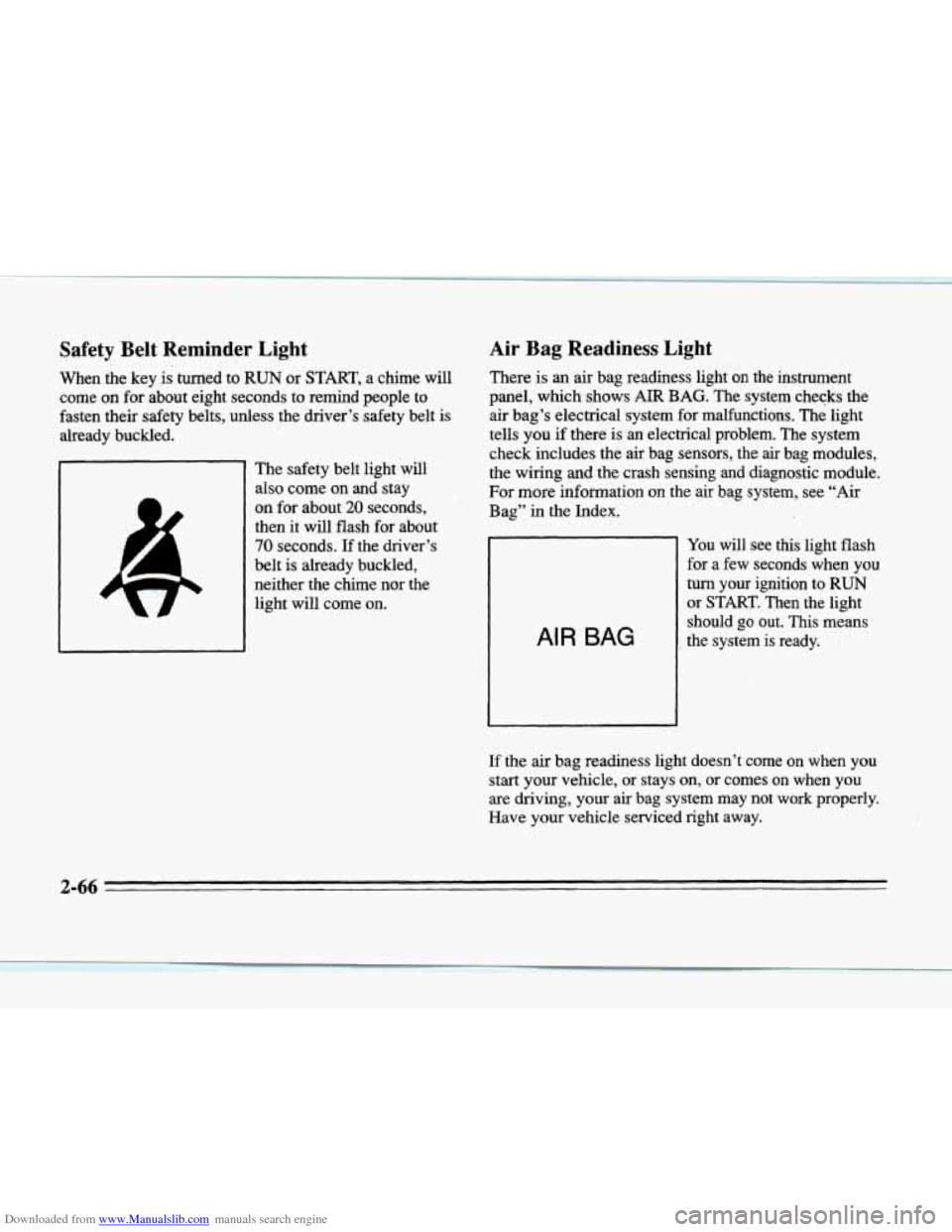
The safety belt light will
also come on and stay
on for about
20 seconds,
then
it will flash for about
70 seconds. If the driver’s
belt is already buckled,
neither the chime nor the
light will come on.
Air Bag Readiness Light
There is an air bag readiness light on the instrument
panel, which shows
AIR BAG. The system checks the
air bag’s electrical system for malfunctions. The light
tells
you if there is an electiical problem. The system
check includes the air bag sensors, the air bag modules,
the wiring and the crash sensing and diagnostic module.
For more information on the air bag system, see “Air
Bag” in the Index.
, You will see this light flash
for a few seconds when you
turn your ignition to RUN
or START. Then the light
should
go out. This means
,, the system is ready.
If the air bag readiness light doesn’t come on when you
start your vehicle, or stays on, or comes on when you
are driving, your air bag system may not work properly.
Have your vehicle serviced right away.
2-66 i--
I
Page 140 of 354
Downloaded from www.Manualslib.com manuals search engine P
c
BATTERY NO CHARGE - 07: This message will
appear if the battery is not being charged. Have the
electrical system checked by your Cadillac dealership
at your earliest convenience.
BATTERY VOLTS HIGH - 08: This message shows
that the electrical charging system is overcharging (more
than 16 volts).
To avoid being stranded, have the
electrical system checked by your Cadillac dealership.
You can reduce the charging overload by using the
accessories. Turn on the lamps and radio, set the climate
control on
AUTO and the fan speed on HI, and turn the
rear window defogger on. You can monitor battery
voltage on the
DIC by pressing the INFORMATION
button. The normal range
is 11.5 to 15.5 volts when the
engine is running.
BATTERY VOLTS LOW - 06: This message will
appear when the electrical system
‘is charging less than
10 volts or if the battery has been drained. If this message
appears immediately after starting,
it is possible that the
generator can still recharge the battery. The battery should
recharge after driving a few
miles and the message should
go out.
Lf this message appears while driving or after
starting your vehicle and stays on, have it checked
immediately to determine the cause
of this problem. To
help the generator recharge the battery quickly you can
reduce the load on the electrical system by turning
off the
accessories.
You can monitor battery voltage on the DIC
by pressing the INFORMA’TION button. The normal range
is 11.5 to
15.5 volts.
BRAKE VACUUM PROBLEM - 108: Thecircuit in
the brake booster vacuum has shorted
or is loose when
this message appears. Your vehicle
may lose power
brakes but you will still have the
use of manual brakes.
The power brakes will not be affected
if the problem is
caused by a failed sensor. Have your vehicle serviced
immediately at your Cadillac dealership.
CHANGE ENGINE OIL - 82: This means that the life
of the engine oil has expired and it should be changed
within
200 miles. See “Engine Oil” and “Filter
Recommendations” in the Maintenance Schedule. After
an oil change, the Oil Life Indicator must be reset. See
“Oil Life Indicator” in the Index
on how to reset it.
CHANGE TRANS FLUID - 47: This message will
appear when it is time
to replace the transaxle fluid
(system has determined that the transaxle fluid has
reached
0%). See the Maintenance Schedule booklet for
the proper fluid and change intervals.
CHECK BRAKE FLUID LEVEL - 37: This message
will display if the ignition is in the
RUN position to
inform the driver that the brake fluid level is low. Check
the brake reservoir level and add
fluid as needed. Have
the brake system serviced by a Cadillac technician as
soon
as possible. If the brake warning light is on, follow
the directions in that part.
2-81
Page 142 of 354
Downloaded from www.Manualslib.com manuals search engine FUEL LEVEL VERY LOW - 11: This message serves
as a warning that the fuel level in the tank is critically
low. Stop for fuel immediately.
MONITORED SYSTEMS OK - 1: This message only
appears in the “recall” mode by pressing the RESET
button. It
lets you know that no other messages are
stored
or currently active.
PASS KEY NOT PROGRAMMED - 31: This
warning message displays when the PASS-Key pellet
information has not been programmed into your vehicle.
See your Cadillac dealership for service.
PCM FAULT - 110: The circuit in the Powertrain
Control Module (PCM) has shorted
or is loose when this
message appears. Have your Cadillac serviced by your
dealership at once.
REDUCED ENGINE POWER - 41: This message
informs the driver that due
to wheel slippage your
vehicle is reducing engine power
to compensate for the
loss of traction. Accelerating too fast causing the tires to
spin is an example of when this message would display.
REMOVE KEY - 70: This message will appear when
the Personalized Automotive Security System
(PASS-Key
11) is unable to read the pellet on the
ignition key
or an improper key pellet has been inserted.
Wait for the
DIC to display STARTING DISABLED
DUE TO THEFT SYSTEM REMOVE IGNITION
KEY. The instrument panel cluster will then run a timer
and change the messages to WAIT
3 MINUTES, WAIT
2 MINUTES, WAIT 1 MINUTE and then START CAR.
When the REMOVE
KEY message is displayed, remove
the ignition key. Check the ignition
key for damage. If it
is damaged, it may need to be replaced. If you see no
damage, clean the pellet contacts
with a soft cloth or
napkin before inserting
the key back into the ignition.
Have your vehicle serviced
if the message still appears.
SERVICE A/C SYSTEM A/C COMPRESSOR
OFF - 14: This message appears when the electronic
sensors that control the A/C and heating systems are no
longer workmg. Have the climate control system serviced
if you notice a drop in heating and A/C efficiency.
2-83