1996 CADILLAC ELDORADO suspension
[x] Cancel search: suspensionPage 10 of 354
Downloaded from www.Manualslib.com manuals search engine ...
For the 1948 model, Cadillac introduced the legendary
tail
fin which once more set the trend in automotive
styling for nearly two decades. This was closely
followed with the two door hardtop Coupe DeVille and
the industry's first modem overhead valve, high
compression V8 engine on the 1949 model.
Engineering innovations, conveniences and styling
dominated the
'50s and '60s. Cruise control, automatic
climate control, tilt and telescoping steering wheels,
twilight sentinel and four door hard tops all debuted in
these years.
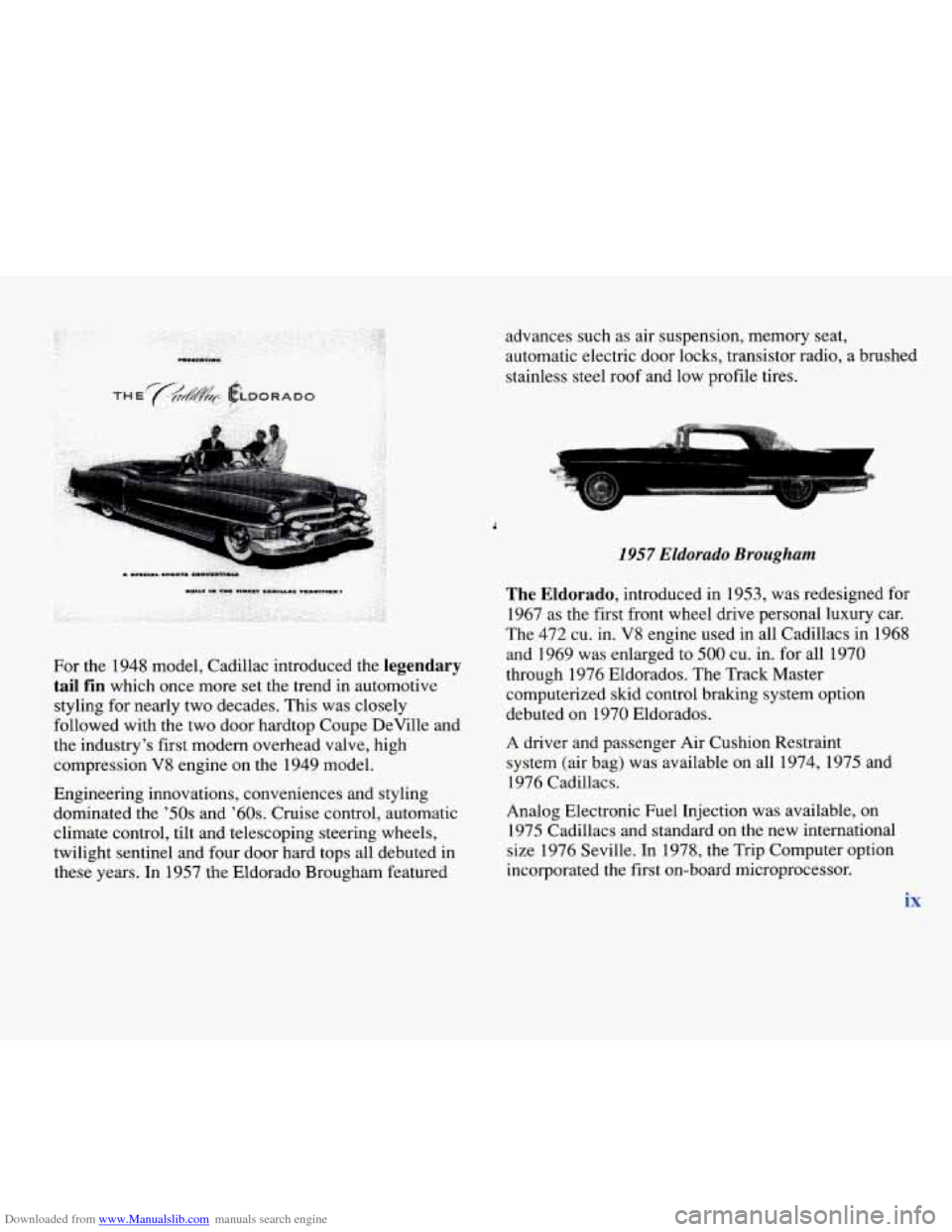
In 1957 the Eldorado Brougham featured advances such
as air suspension, memory seat,
automatic electric door locks, transistor radio, a brushed
stainless steel roof and low profile tires.
1957 Eldorado Brougham
The Eldorado, introduced in 1953, was redesigned for
1967 as the first front wheel drive personal luxury car.
The 472 cu. in.
V8 engine used in all Cadillacs in 1968
and 1969 was enlarged to
500 cu. in. for all 1970
through 1976 Eldorados. The Track Master
computerized skid control braking system option
debuted on 1970 Eldorados.
A driver and passenger Air Cushion Restraint
system (air bag) was available on all 1974, 1975 and
1976 Cadillacs.
Analog Electronic Fuel Injection was available, on
1975 Cadillacs and standard on the new international
size 1976 Seville. In 1978, the Trip Computer option
incorporated the first on-board microprocessor.
ix
Page 11 of 354

Downloaded from www.Manualslib.com manuals search engine The electronics and computerization which were
pioneered by Cadillac
in the ’70s came of age in the
’80s with Digital Fuel Injection and On-Board
Diagnostics in
1980, four wheel Anti-lock Brakes on
1986 models and Traction Control in the fall of 1989.
The 1992 Seville STS was the first car ever to win all
three major automotive awards: Car
of the Year, Motor
Trend; Ten Best List, Car
& Driver; Car of the Year,
Automobile Magazine.
The year
1993 saw the introduction of the Northstar
system. The state of
the art system includes the 32 valve,
dual overhead camshaft, Northstar
4.6 liter V8 engine,
4T80-E electronically controlled automatic transaxle,
road sensing suspension, speed sensitive steering,
anti-lock brakes and traction control.
For more than nine decades Cadillac has been a leader in
quality and technical innovation.
Now more than ever,
Cadillac is “Creating
a Higher Standard.”
X
Page 144 of 354

Downloaded from www.Manualslib.com manuals search engine SERVICE RIDE CONTROL - 84: This message is
displayed to indicate that the suspension system
is not
operating properly. To correct this problem have your
vehicle serviced at your Cadillac dealership.
SERVICE TRANSMISSION - 100: If a problem is
detected with the transaxle, this message will appear.
Have your vehicle checked by your Cadillac dealership.
SPEED SENSOR FAULT - 109: A circuit problem
with the vehicle speed sensor will trigger this message
to appear. Have your Cadillac dealership service your
vehicle.
STARTING DISABLED DUE TO THEFT SYSTEM
REMOVE IGNITION KEY
- 33: This message will
appear when the Personalized Automotive Security
System (PASS-Key
11) senses that an improper ignition
key is being used to try to start the vehicle. Check the
ignition key for damage.
If it is damaged, it may need to
be replaced.
If you see no damage, clean the pellet
contacts with a soft cloth
or napkin. Remove the ignition
key and wait for the DIC to display WAIT
3 MINUTES.
The instrument panel cluster will then run a timer and
change
the messages to WAIT 2 MINUTES, WAIT
1 MINUTE and then START CAR. When the START
CAR message is displayed, try again to start the engine.
STOP ENGINE ENGINE OVERHEATED - 42: This
message will appear when the engine has overheated.
Stop and turn the engine
off immediately to avoid severe
engine damage. See “Engine Overheating” in the Index.
STOP ENGINE LOW OIL PRESSURE - 35: If this
message appears while the engine is running, stop the
engine and do not operate
it until the cause of low oil
pressure is corrected. Severe damage to the engine
can result.
THEFT SYSTEM PROBLEMKAR MAY NOT
RESTART
- 34: This message means there is a problem
in the Personalized Automotive Security System
(PASS-Key 11). A fault has been detected in the system
which means that the PASS-Key I1 system is disabled
and is not protecting the vehicle. The vehicle usually
restarts however, you may want to take your vehicle to
a
proper service center before turning off the engine.
TOP SPEED FUEL CUT-OFF - 111: This message
will appear when the PCM senses that the maximum
speed for your Cadillac has been reached. The speed of
your vehicle will decrease several mph as the fuel
supply is cutoff. This allows your vehicle to stay in a
stable operating range.
2-83
1
Page 145 of 354

Downloaded from www.Manualslib.com manuals search engine TRACTION READY - 91: This message informs the
driver that the traction control system is available. This
occurs when the traction on/off button in the glove box
has been returned to an on position (pressing
the button
once turns the traction control system off; pressing the
button again turns the system back on).
TRACTION OFF - 89: This message will be displayed
after the traction control has been turned off.
TRANS FLUID RESET - 48: With the engine not
running and the ignition on, press and hold the
OFF and
rear defog buttons until the
TRANS FLUID RESET
message appears on the DIC (between 5 and 20 seconds).
TRANSMISSION HOT - 112: This messages indicates
that. the transmission fluid in your vehicle is too hot
(message appears when fluid temperature has reached
266°F (130°C) for 15 minutes or when the temperature
reaches
291 OF (144°C) for 32 seconds). Have your
vehicle serviced immediately.
TRUNK OPEN - 24: This message indicates that the
trunk is open when the ignition is in
RUN.
TURN SIGNAL ON - 20: This message is a reminder,
after driving about a mile, that you have the
turn signal on.
VEHICLE SPEED LIMITED TO XXX MPH
(KM/H)
- 113: A failure in the suspension control
system has occurred when this message appears. The
PCM determines the speed your vehicle is limited to.
Have your Cadillac serviced if this message appears.
VERY LOW REFRIGERANT A/C COMPRESSOR
OFF
- 12: This message means that the air conditioning
system detects a refrigerant level that
is low enough to
cause damage to the A/C compressor.
To avoid damage
the A/C compressor automatically turns
off and the
Electronic Climate Control will automatically switch
from AUTO to
ECON and remain there. Have the
A/C system serviced if this message appears.
Page 146 of 354
Downloaded from www.Manualslib.com manuals search engine Traction Active
When your traction control system is limiting wheel spin,
the TRACTION ACTIVE message will
be displayed.
Slippery road conditions may exist
if this message is
displayed,
so adjust your driving accordingly. This
message will stay on for a few seconds after the traction
control system stops limiting wheel spin.
Road Sensing Suspension
The Road Sensing Suspension (RSS) and the optional
Continuous Variable-Road Sensing Suspension
(CV-RSS) automatically adjust the ride of your vehicle,
with the CV-RSS having a wider range of control.
Automatic ride control is achieved through the RSS
controller, a computer used to control and monitor the
suspension system. The controller receives inputs from
various sensors to determine the proper system response.
If the controller detects a problem within the system, the
DIC will display
a SERVICE RIDE CONTROL
message. If this message appears, have your vehicle
serviced at your Cadillac dealership.
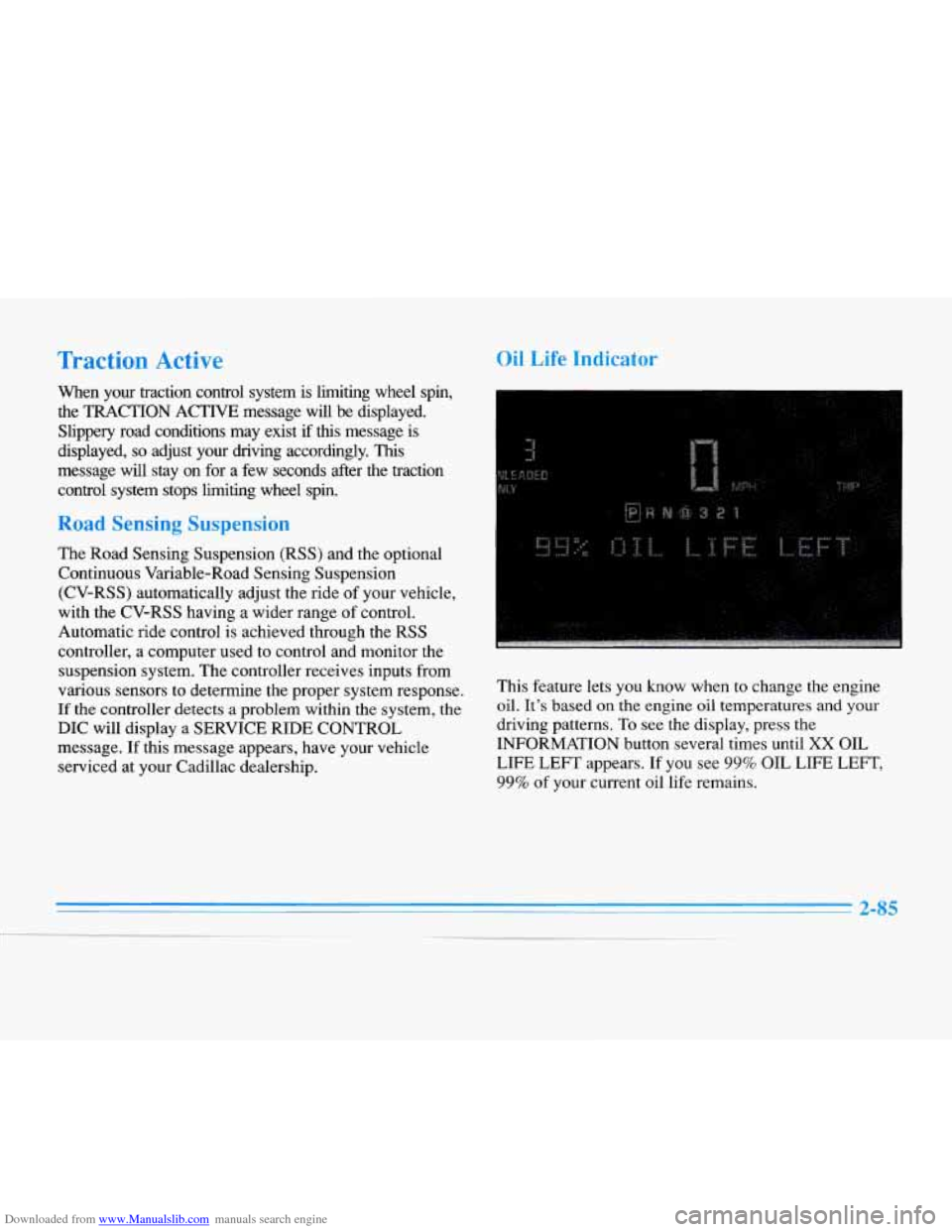
Oil Life Indicator
This feature lets you know when to change the engine
oil.
It’s based on the engine oil temperatures and your
driving patterns. To see the display, press the
INFORMATION button several times until
XX OIL
LIFE
LEFT appears. If you see 99% OIL LIFE LEFT,
99% of your current oil life remains.
2-85
-__
Page 231 of 354

Downloaded from www.Manualslib.com manuals search engine A vehicle can fall from a car carrier if it isn’t
adequately secured. This can cause
a collision,
serious personal injury and vehicle damage. The
vehicle should be tightly secured with chains or
steel cables before it is transported.
Don’t use substitutes (ropes, leather straps,
canvas webbing, etc.) that can be cut by sharp
edges underneath the towed vehicle. Always use
T-hooks inserted in the front T-hook slots or
R-hooks inserted in the
rear R-hook slots.
Never use J-hooks. They will damage drivetrain
and suspension components.
When your vehicle is being towed, have the ignition key
turned to the
OFF position. The steering wheel should
be clamped in a straight-ahead position, with a clamping
device designed for towing service.
Do not use the
vehicle’s steering column lock for this. The transaxle
should be in NEUTRAL (N) and the parking brake
released.
Don’t have your vehicle towed on the drive wheels
unless you must. If the vehicle must be towed on the
drive wheels, be sure to follow the speed and distance
restrictions later in this section or your transaxle will be
damaged.
If these limitations must be exceeded, then the
drive wheels have to be supported on a dolly.
Page 232 of 354
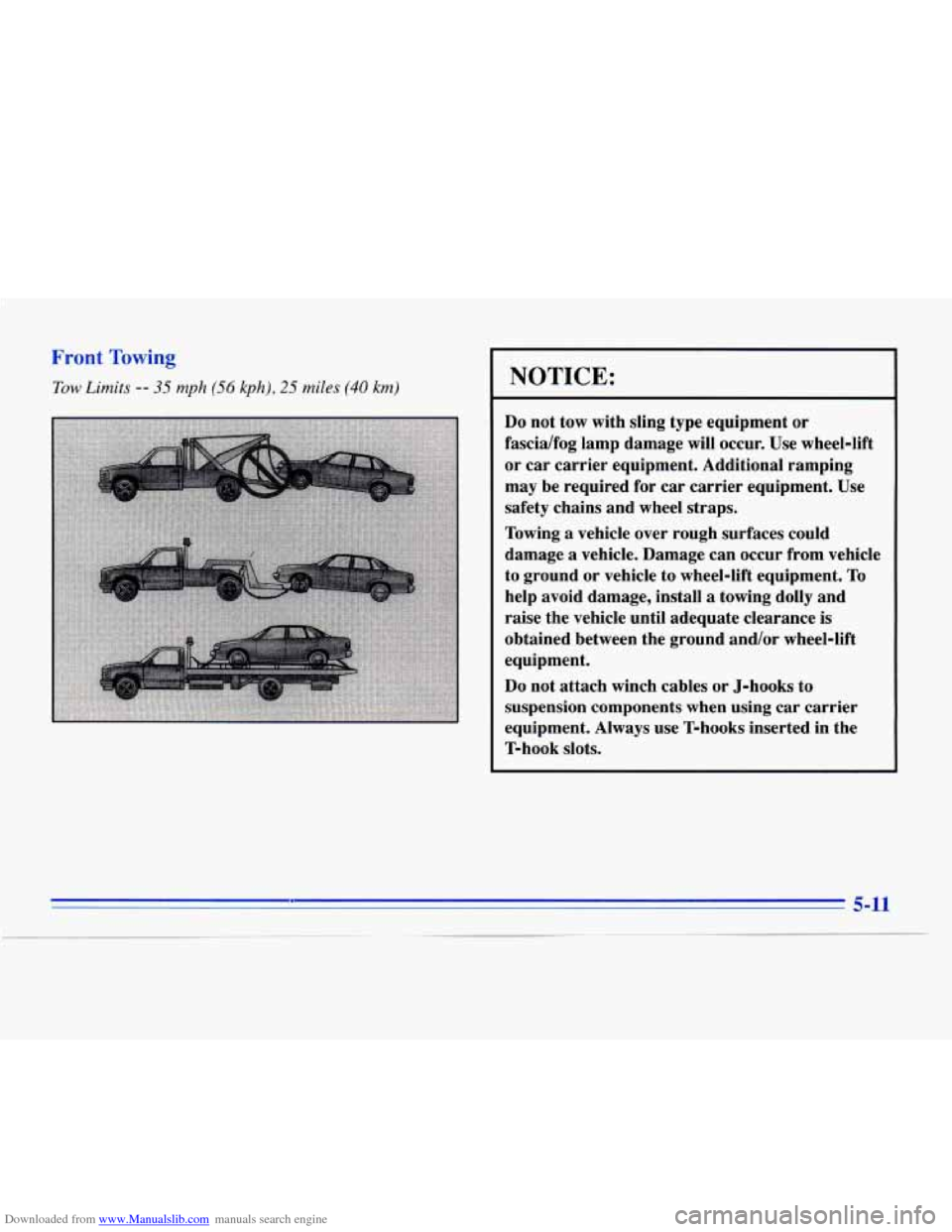
Downloaded from www.Manualslib.com manuals search engine Front Towing
Tow Limits -- 35 mph (56 kph), 25 miles (40 km) NOTICE:
Do not tow with sling type equipment or
fascia/fog lamp damage will occur. Use wheel-lift
or car carrier equipment. Additional ramping
may be required for car carrier equipment. Use
safety chains and wheel straps.
Towing
a vehicle over rough surfaces could
damage
a vehicle. Damage can occur from vehicle
to ground or vehicle to wheel-lift equipment.
To
help avoid damage, install a towing dolly and
raise the vehicle until adequate clearance is
obtained between the ground and/or wheel-lift
equipment.
Do not attach winch cables or J-hooks to
suspension components when using car carrier
equipment. Always use T-hooks inserted in the
T-hook slots.
5-11
i 1
Page 234 of 354
Downloaded from www.Manualslib.com manuals search engine I
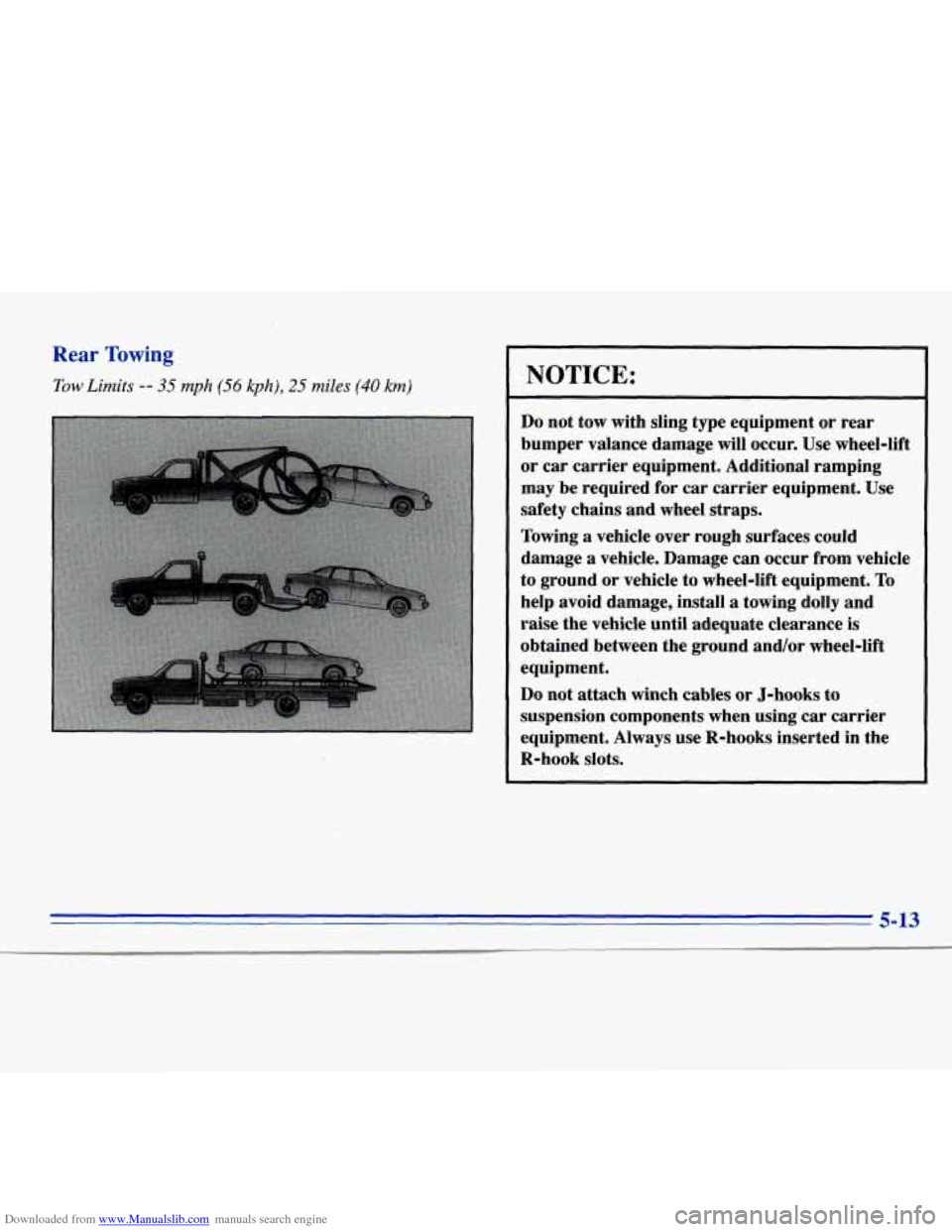
Rear Towing
Tow Limits -- 35 mph (56 kph), 25 miles (40 km) NOTICE:
Do not tow with sling type equipment or rear
bumper valance damage will occur. Use wheel-lift
or car carrier equipment. Additional ramping
may be required for car carrier equipment. Use
safety chains and wheel straps.
Towing
a vehicle over rough surfaces could
damage
a vehicle. Damage can occur from vehicle
to ground or vehicle ta wheel-lift equipment.
To
help avoid damage, install a towing dolly and
raise the vehicle until adequate clearance is
obtained between the ground and/or wheel-lift
equipment.
Do not attach winch cables
or J-hooks to
suspension components when using car carrier
equipment. Always use R-hooks inserted in the
R-hook slots.
. __
5-13