Page 231 of 354

Downloaded from www.Manualslib.com manuals search engine A vehicle can fall from a car carrier if it isn’t
adequately secured. This can cause
a collision,
serious personal injury and vehicle damage. The
vehicle should be tightly secured with chains or
steel cables before it is transported.
Don’t use substitutes (ropes, leather straps,
canvas webbing, etc.) that can be cut by sharp
edges underneath the towed vehicle. Always use
T-hooks inserted in the front T-hook slots or
R-hooks inserted in the
rear R-hook slots.
Never use J-hooks. They will damage drivetrain
and suspension components.
When your vehicle is being towed, have the ignition key
turned to the
OFF position. The steering wheel should
be clamped in a straight-ahead position, with a clamping
device designed for towing service.
Do not use the
vehicle’s steering column lock for this. The transaxle
should be in NEUTRAL (N) and the parking brake
released.
Don’t have your vehicle towed on the drive wheels
unless you must. If the vehicle must be towed on the
drive wheels, be sure to follow the speed and distance
restrictions later in this section or your transaxle will be
damaged.
If these limitations must be exceeded, then the
drive wheels have to be supported on a dolly.
Page 233 of 354
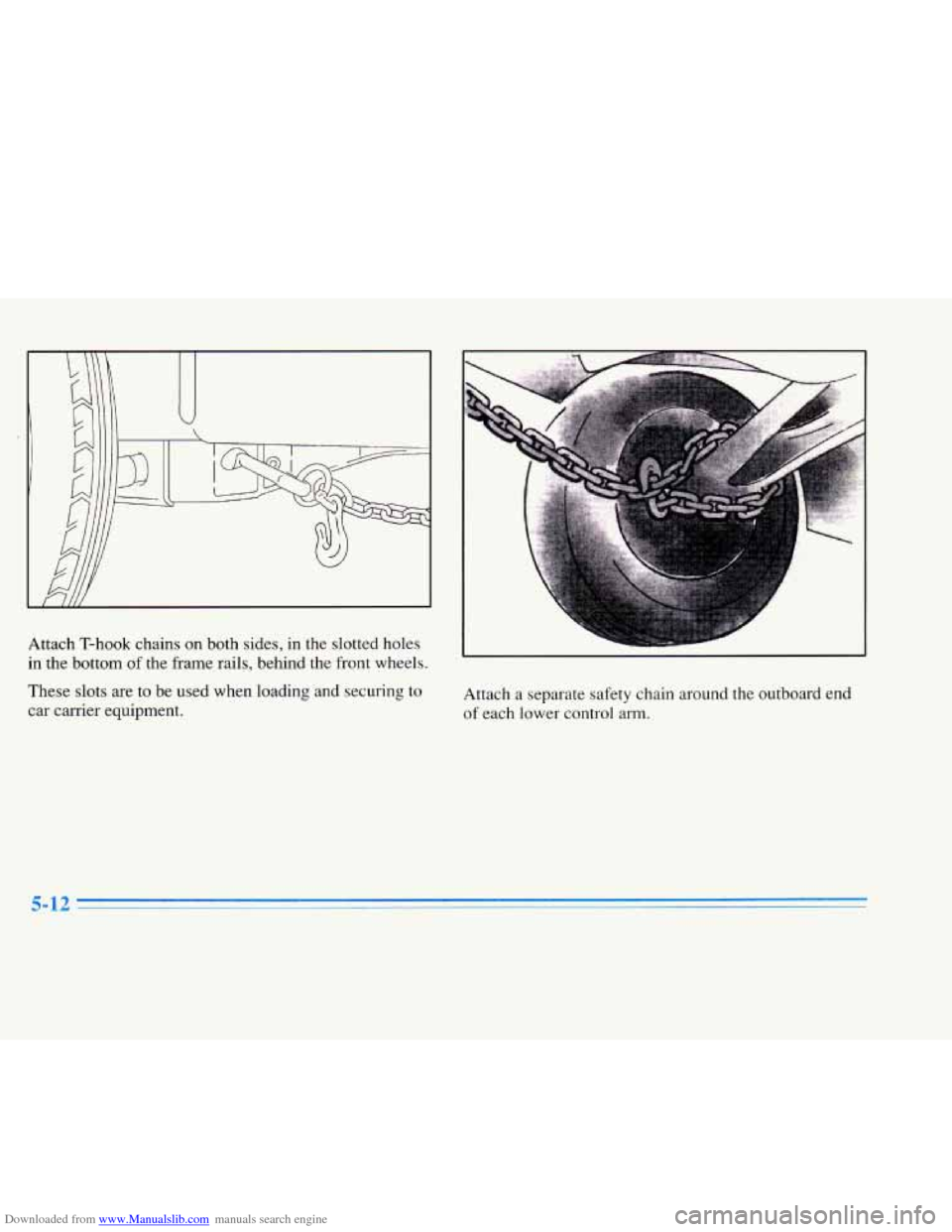
Downloaded from www.Manualslib.com manuals search engine Attach T-hook chains on both sides, in the slotted holes
in the bottom of the frame rails, behind the front wheels.
These slots are
to be used when loading and securing to
car carrier equipment. Attach
a separate safety chain around the outboard
end
of each lower control arm.
Page 235 of 354
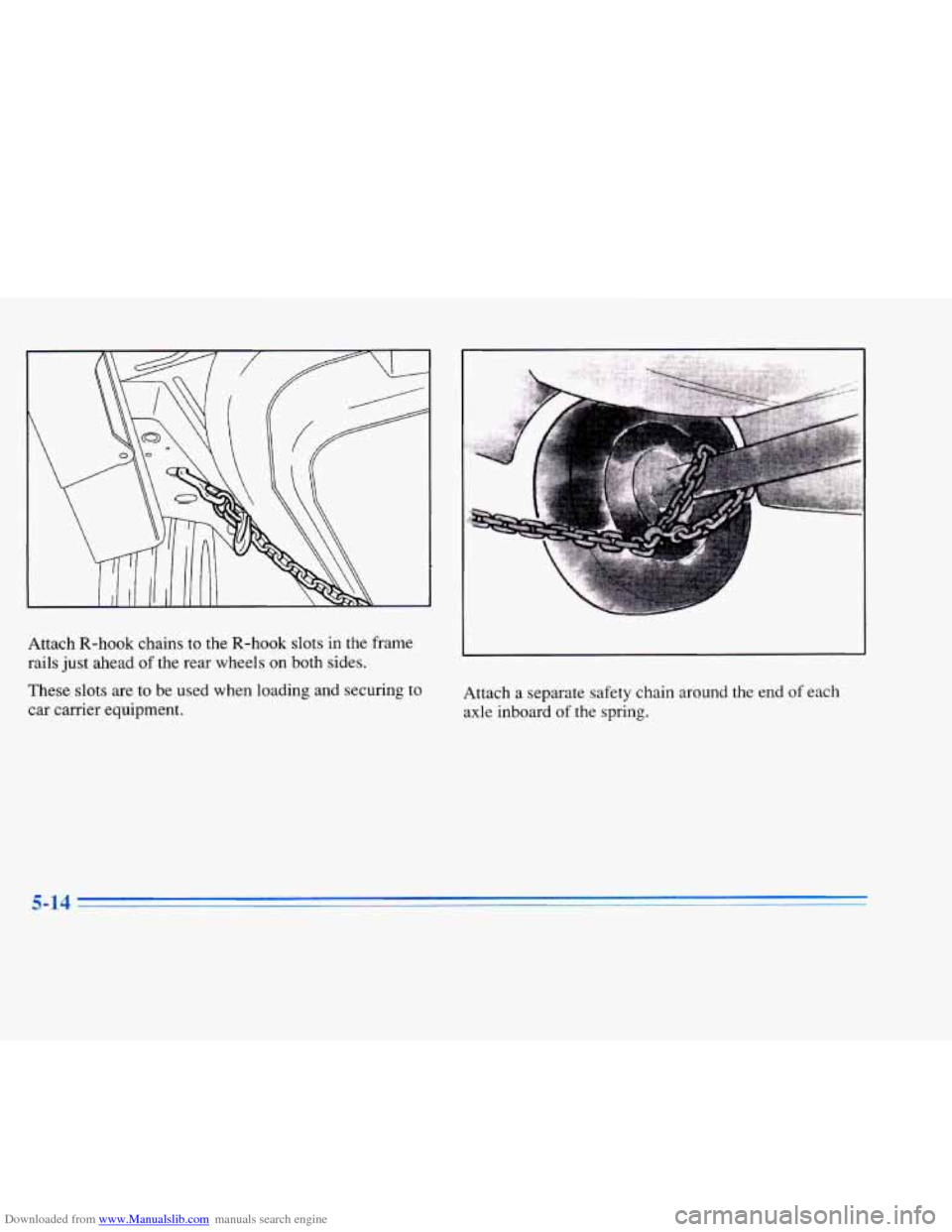
Downloaded from www.Manualslib.com manuals search engine Attach R-hook chains to the R-hook slots in the frame
rails just ahead
of the rear wheels on both sides.
These slots are to be used when loading and securing
to
car carrier equipment. Attach
a separate safety chain around the end
of each
axle inboard of the spring.
Page 254 of 354
Downloaded from www.Manualslib.com manuals search engine NOTICE:
Improperly tightened wheel nuts can lead to
brake pulsation and rotor damage.
To avoid
expensive brake repairs, evenly tighten the wheel
nuts in the proper sequence and to the proper
torque specification.
Don’t try to put a wheel cover on your compact spare
tire.
It won’t fit. Store the wheel cover in the trunk until
you have the flat tire repaired or replaced.
I NOTICE:
Wheel covers won’t fit on your compact spare. If
you try to put a wheel cover on your compact
spare, you could damage the cover or the
compact spare.
Storing the Fla’ Tire and Tools
A CAUTION:
Storing a jack, a tire or other equipment in the
passenger compartment
of the vehicle could
cause injury. In
a sudden stop or collision, loose
equipment could strike someone. Store all these
in the proper place.
After you’ve put the compact spare tire on your vehicle,
you’ll need to store the flat tire
in your trunk. Use the
following procedure to secure the flat tire in the
trunk.
Put the flat tire in the trunk so the side that faces out
when it is on the vehicle is facing down. The full-size
tire will not fit down into the well. Place it
so the front is
in the well and the rear is out of the well.
5-33
Page 255 of 354
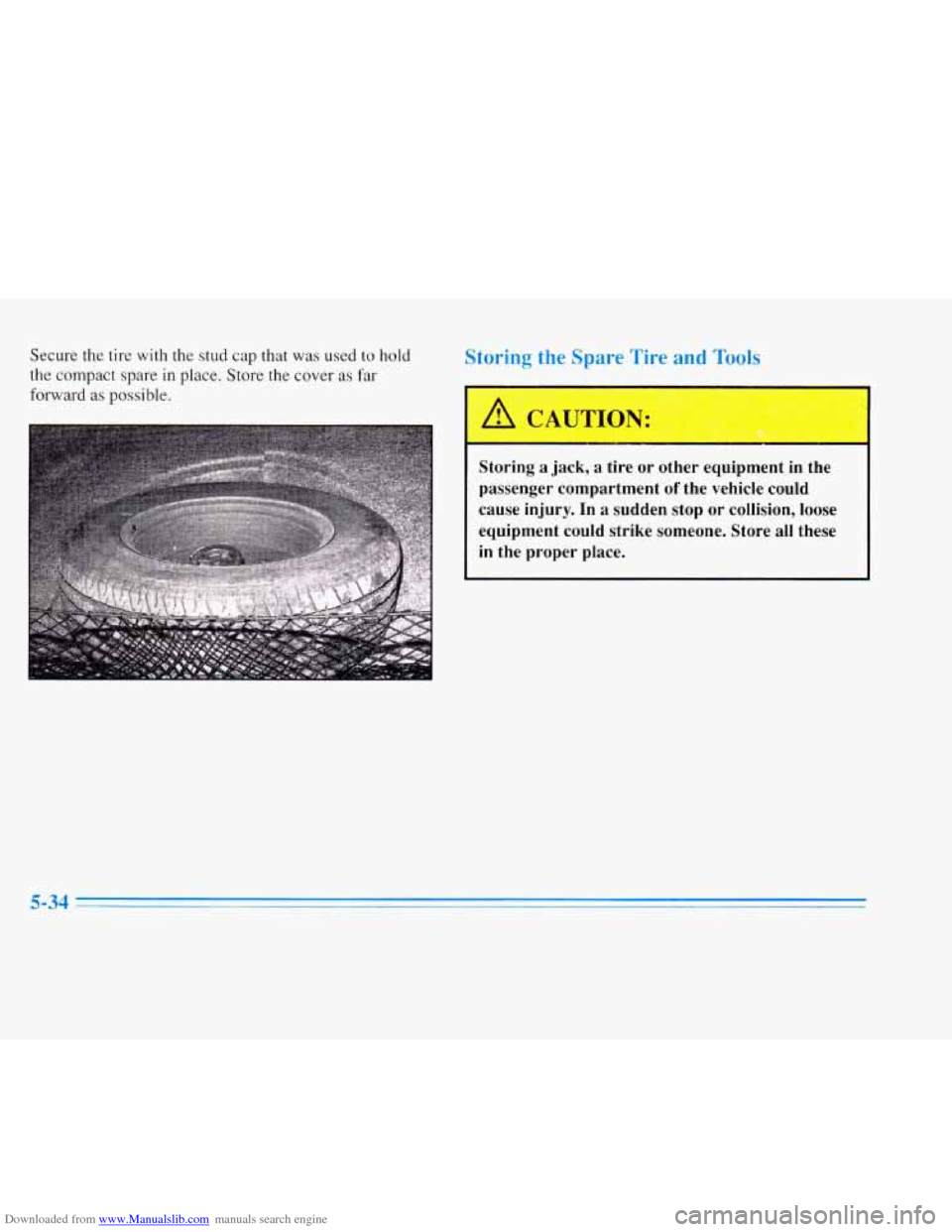
Downloaded from www.Manualslib.com manuals search engine Secure the tire with the stud cap that was used to hold
the compact spare
in place. Store the cover as far
forward as
possible.
Storing
a jack, a tire or other equipment in the
passenger compartment
of the vehicle could
cause injury. In a sudden stop or collision, loose
equipment could strike someone. Store all these
in the proper place.
5-34
Page 274 of 354
Downloaded from www.Manualslib.com manuals search engine Follow these steps to reinstall the air cleaner assembly:
1.
2.
3.
4.
5.
Slide the air cleaner lid into the slots in the front
edge
of the air cleaner base.
Pivot the air cleaner Cover and the air duct assembly
downward. Make sure that both latches are secure
and fully engaged.
Reinstall the clean air duct over the mass airflow
sensor. Make sure that the duct is secure around the
entire outer edge of the sensor.
Tighten the air duct clamp.
Reconnect the
IAT sensor.
Refer
to the Maintenance Schedule to determine when to
replace the air filter.
See “Scheduled Maintenance Services” in the
Maintenance Schedule booklet.
Operating the engine with the air cleaner off can
cause you or others to be burned. The air cleaner
not only cleans the air, it stops flames if the
engine backfires.
If it isn’t there, and the engine
backfires, you could be burned. Don’t drive with
it off, and be careful working on the engine with
the air cleaner off.
I NOTICE:
If the air cleaner is off, a backfire can cause a
damaging engine fire. And, dirt can easily get
into your engine, which
will damage it. Always
have the air cleaner in place when you’re driving.
6- 15
Page 290 of 354
Downloaded from www.Manualslib.com manuals search engine Cor1 ring amps
1. Open the hood to gain access to the mounting screw.
2. Remove the screw
securing the cornering
lamp housing.
I
4. After removing the wiring harness from the
headlamp housing socket, replace the bulb and
socket. Reconnect
it to the wiring harness and
reinstall
the headlamp housing socket back into the
headlamp assembly.
-31
T
Page 303 of 354
Downloaded from www.Manualslib.com manuals search engine Tire Chains
NOTICE:
Use tire chains only where legal and only when
you must. Use only
SAE Class “S” type chains
that are the proper size for your tires. Install
them on the front tires and tighten them
as
tightly as possible with the ends securely
fastened. Drive slowly and follow the chain
manufacturer’s instructions.
If you can hear the
chains contacting your vehicle, stop and retighten
them.
If the contact continues, slow down until it
stops. Driving too fast or spinning the wheels
with chains on will damage your vehicle.
Appearance Care
Remember, cleaning products can be hazardous. Some
are toxic. Others can burst into flames
if you strike a
match or get them on
a hot part of the vehicle. Some are
dangerous
if you breathe their fumes in a closed space.
When you use anything from
a container to clean your
Cadillac, be sure to follow
the manufxturer’s warnings and
instructions. And always open your doors
or
windows when you’re cleaning the inside.
Never use these to clean your vehicle:
Gasoline
0 Benzene
Naphtha
0 Carbon Tetrachloride
0 Acetone
Paint Thinner
Turpentine
Lacquer Thinner
0 Nail Polish Remover
They can
all be hazardous -- some more than
others
-- and they can all damage your vehicle too.
Don’t use any
of these unless this manual says you can.
In many uses, these will damage
your vehicle:
Alcohol
0 Laundry Soap
0 Bleach
Reducing Agents
6-44