Page 98 of 354

Downloaded from www.Manualslib.com manuals search engine P
P
c
Windshield Washer
A CAUTION:
In freezing weather, don’t use your washer until
the windshield
is warmed. Otherwise the washer
fluid can form ice on the windshield, blocking
your vision.
NOTICE:
When using concentrated washer fluid,
follow the manufacturer’s instructions for
adding water.
Don’t mix water with ready-to-use washer
fluid. Water can cause the solution to freeze
and damage your washer fluid tank and
other parts of the washer system.
Also,
water doesn’t clean as well as washer fluid.
NOTICE: (Continued)
NOTICE: (Continued)
Fill your washer fluid tank only 314 full
when
it’s very cold. This allows for
expansion, which could damage the tank
if
it is completely full.
windshield washer. It can damage your
washer system and paint.
Don’t use radiator antifreeze in your
Press and hold the
PUSH paddle to wash the windshield.
Release the paddle when you have enough fluid. The
wipers will
clear the windshield and either stop or return
to your preset speed.
LOW WASHER FLUID will be displayed on the DIC
when the washer fluid reaches a low level.
Driving without washer fluid can be dangerous.
A bad
mud splash
can block your vision and you could hit
another
vehicle or go off the road. Check the washer
fluid level often.
2-35 c
Page 242 of 354
Downloaded from www.Manualslib.com manuals search engine F
c
7
a
The coolant level should be indicated by a CHECK
COOLANT LEVEL message on the Driver Information
Center.
If it isn't, you may have a leak in the radiator
hoses, heater
hoses, radiator, water pump or somewhere
else in the cooling system.
A CAUTION:
Heater and radiator hoses, and other engine
parts, can be very hot. Don't touch them.
If you
do, you can be burned.
Don't run the engine if there
is a leak. If you run
the engine,
it could lose all coolant. That could
cause an engine fire, and
you could be burned.
Get
any leak fixed before you drive the vehicle.
5-19
Page 245 of 354
Downloaded from www.Manualslib.com manuals search engine NOTICE:
In cold weather, water can freeze and crack the
engine, radiator, heater core and other parts.
So
use the recommended coolant.
A CAUTION:
You can be burned if you spill coolant on hot
engine parts. Coolant contains ethylene glycol
and it
will burn if the engine parts are hot
enough. Don't spill coolant on
a hot engine.
A
1. You can remove the coolant surge tank pressure
cap when
the cooling system, including the coolant
surge tank pressure cap and upper radiator hose,
is no longer hot.
Turn the pressure cap slowly
counterclockwise until it first stops. (Don't press
down while turning the pressure cap.)
If you hear a hiss, wait for that to stop. A hiss means
there is
still some pressure left.
Page 247 of 354
Downloaded from www.Manualslib.com manuals search engine k
4. With the coolant surge tank pressure cap off, start the
engine and let it run until
you can feel the upper
radiator hose getting hot. Watch out for the engine
fans.
By this time, the coolant level inside the coolant
surge tank may be lower.
If the level is lower, add
more
of the proper mix to the coolant surge tank
until the level reaches about
2.5 inches (60 mm)
below the base of the filler neck.
5. Then replace the pressure cap. Be sure the arrows on
the pressure cap line up like this.
Start
the engine and allow it to warm up. If the CHECK
COOLANT LEVEL message does not appear on the
Driver Information Center, coolant is at the proper fill
level.
If a CHECK COOLANT LEVEL message does
appear, repeat Steps 1 to
3 or see your dealer.
Page 270 of 354
Downloaded from www.Manualslib.com manuals search engine f
r
r
f
r
Engine Oil
.-: ::U" ?... . U. : . ... . .. :::: : :.. :: %. : . . T' .. . . . -. .-. . . ... . . .""." . : ::: : ?a. :::: .. .U. .... "a". . ". UI..... -.-. . L.L
A CHECK OIL LEVEL message will appear when
the engine oil
is approximately a quart low. If the
message
is displayed, check the dipstick level and add
oil
as needed.
It's a good idea to check your engine oil every time you
get fuel.
In order to get an accurate reading, the oil must
be
warm and the vehicle must be on level ground. The engine oil dipstick
is
located behind
the radiator
on the driver's side of the
engine. The black handle
says ENGINE OIL on it.
Turn off the engine and
give the oil a few minutes
to
drain back into the oil
pan. If you don't, the oil
dipstick
might not show
the actual level.
6-9
Page 272 of 354
Downloaded from www.Manualslib.com manuals search engine c
The oil fill cap is located
behind the radiator
on the
L
~ passenger’s side of the
~ engine. Turn the cap
1 counterclockwise to
remove.
Just fill it enough to
put the level somewhere in the
proper operating range. Push the dipstick all
the way
back in when
you’re through.
What Kind of Oil to Use
Oils recommended for your vehicle can be identified by
looking for the “Starburst” symbol. This symbol
indicates that the oil has been certified by the American
Petroleum Institute
(API). Do not use any oil which
does not carry this Starburst symbol.
If you change your own
oil, be sure you use oil
that has the Starburst
symbol on the front
of the
oil container. If you have
your oil changed for you,
be sure the oil put into
your engine
is American
Petroleum Institute certified
for gasoline engines.
You should also use the proper viscosity oil for your
vehicle, as shown in the following chart:
6-11
Page 276 of 354
Downloaded from www.Manualslib.com manuals search engine P
c
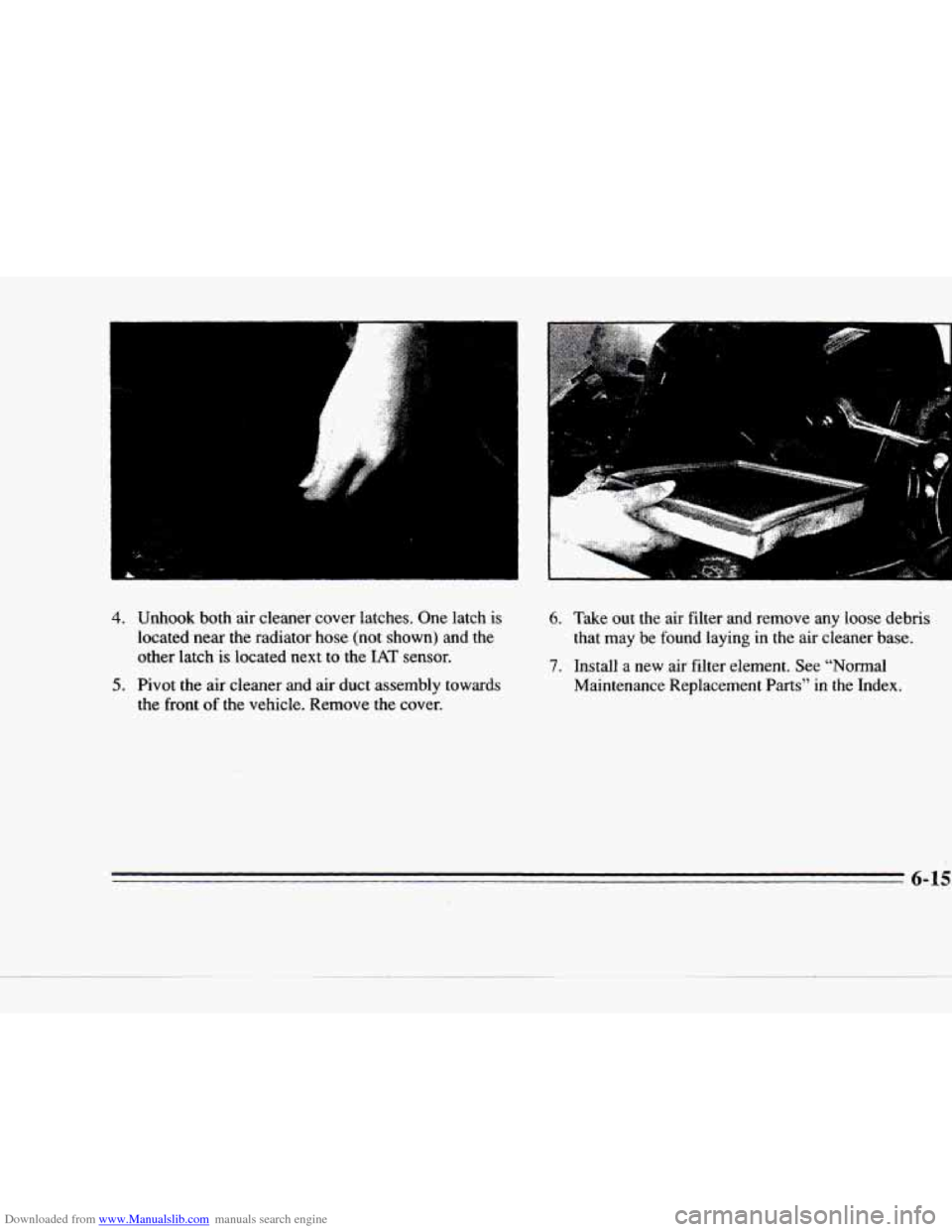
4. Unhook both air cleaner cover latches. One latch is
located near
the radiator hose (not shown) and the
other latch is located next to the
IAT sensor.
5. Pivot the air cleaner and air duct assembly towaras
the front
of the vehicle. Remove the cover.
6. Take out the air filter and remove any loose debris
that
may be found laying in the air cleaner base.
7. Install a new air filter element. See “Normal
Maintenance Replacement Parts” in the Index.
Page 279 of 354

Downloaded from www.Manualslib.com manuals search engine Wait at least 30 minutes before checking the transaxle
fluid level
if you have been driving:
When outside temperatures are above 90°F (32°C).
At high speed for quite a while.
0 In heavy traffic -- especially in hot weather.
While pulling a trailer.
To get the right reading, the fluid should be at normal
operating temperature, which is
180°F to 200°F
(82°C to 93°C).
Get the vehicle warmed up by driving abut 15 miles (24 km)
when outside temperatures are above 50°F (10°C). If it's
colder
than 50°F (lO"C), you may have to drive longer.
Checking the Fluid Level
0
0
0
0
Park your vehicle on a level place. Keep the engine
running.
With the parking brake applied, place the shift Lever
in
PARK (P).
With your foot on the brake pedal, move the shift
lever through each gear range, pausing for about
three seconds in each range. Then, position the shift lever
in PARK (P).
Let the engine run at idle for three to five minutes. Then, without shutting off
the engine, follow these steps:
1. The black transaxle fluid cap is located next to the
radiator hose and below the air cleaner assembly
on
the driver's side of the engine. Remove the air
cleaner assembly
so you can reach the transaxle fluid
cap. The assembly is attached to the vehicle
by two
fasteners. Simply
lift up on the air cleaner assembly
to remove it. Find the transaxle fluid cap and turn
it
counterclockwise to remove. Pull out the dipstick
and wipe
it with a clean rag or paper towel.
then pull it back out again.
2. Push it back in all the way, wait three seconds and
6-18