1996 CADILLAC DEVILLE mirror
[x] Cancel search: mirrorPage 118 of 354
Downloaded from www.Manualslib.com manuals search engine r
P
Visor Vanity Mirror Illuminated Rear Seat Visor Vanity Mirror
To use
one, turn the sunshade down and lift the cover to (Concours Only)
see the mirror.
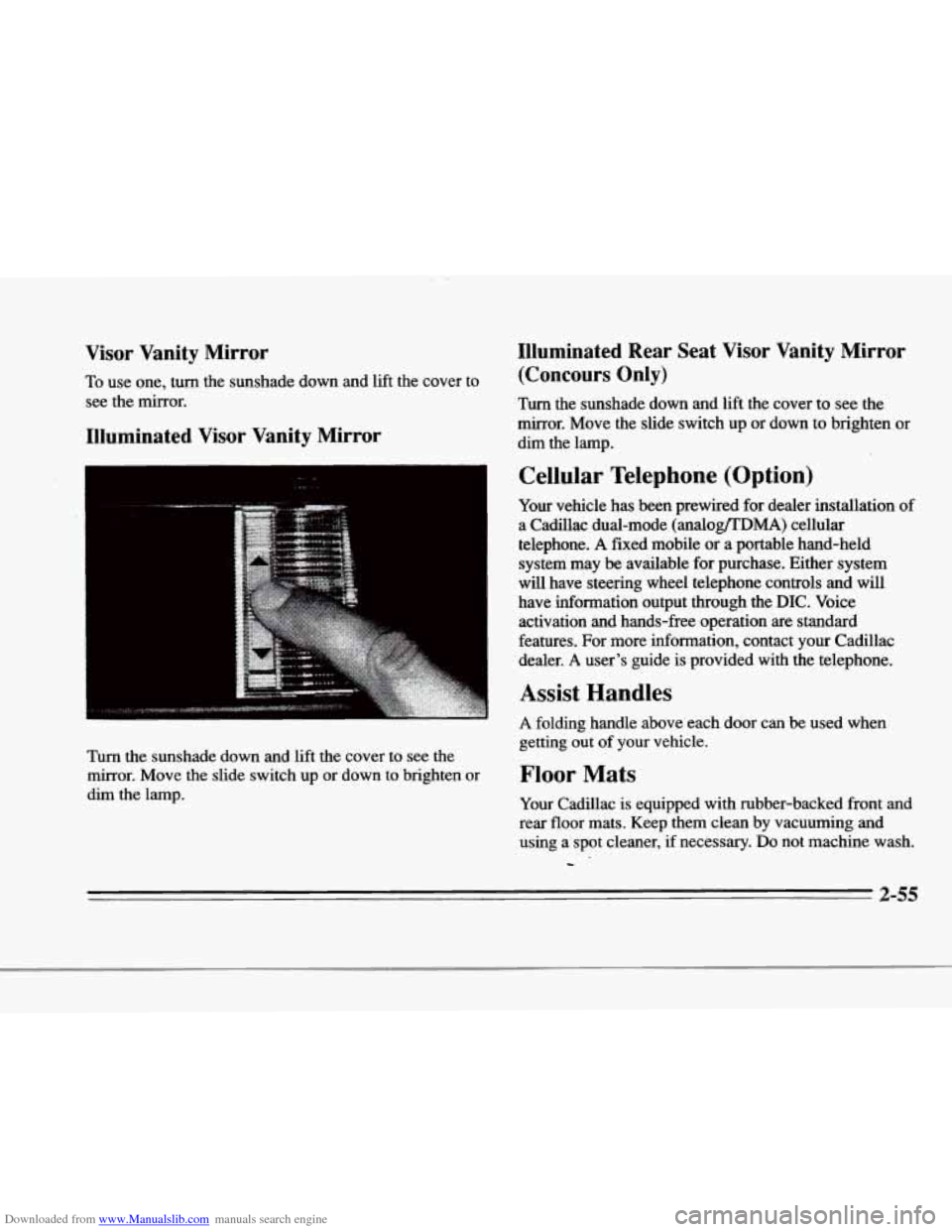
Illuminated Visor Vanity Mirror
Turn the sunshade down and lift the cover to see the
mirror. Move the slide switch up or down to brighten or
dim the lamp.
Cellular Telephone (Option)
Turn the sunshade down and lift the cover to see the
mirror. Move the slide switch up or down to brighten
or
dim the lamp. Your vehicle has been prewired
for dealer installation of
a Cadillac dual-mode (analog/TDMA) cellular
telephone.
A fixed mobile or a portable hand-held
system may be available for purchase. Either system
will have steering wheel telephone controls
and will
have information output through the DIC. Voice
activation and hands-free operation are standard
features. For more information, contact your Cadillac
dealer.
A user's guide is provided with the telephone.
Assist Handles
A folding handle above each door can be used when
getting out
of your vehicle.
Floor Mats
Your Cadillac is equipped with rubber-backed front and
rear floor mats. Keep them clean by vacuuming and
using a spot cleaner,
if necessary. Do not machine wash.
2-55
Page 156 of 354

Downloaded from www.Manualslib.com manuals search engine P
L-
c
(@ Rear Window Defogger
The lines you see on the rear window warrn the glass.
Press the button to turn on the rear defogger. With it,
the rear window and both outside rearview mirrors are heated.
The system will automatically shut off after
10 minutes. If further defogging is desired, press the
button again.
Do not attach a temporary vehicle license, tape or decals
across the defogger grid on the rear window.
NOTICE:
Scraping the inside of your rear window could
cut and damage the heating grids.
Your warranty
would not cover this damage.
And don’t put
decals there;
you might have to scrape them off.
Steering Wheel Controls for
Climate Control
Some heating and cooling
controls can be adjusted at
the steering wheel. Other touch controls operate some audio controls. See
“Steering Wheel Controls
for Audio System’’ later in
this section.
# FAN SPEED: Press the up arrow lever to increase
the
fan speed and the down arrow lever to decrease
fan speed.
TEMP: Press the up arrow lever to increase
the temperature and the down arrow lever to
decrease temperature.
c
Page 195 of 354

Downloaded from www.Manualslib.com manuals search engine 0
0
a
a
Check your mirrors, glance over your shoulder and
start your left lane change signal before moving out
of the right lane to pass. When you are far enough
ahead of the passed vehicle to see its front in your
inside mirror, activate your right lane change signal
and move back into the right lane. (Remember that
your right outside mirror is convex. The vehicle you
just passed may seem to be farther away from you
than it really is.)
Try not to pass more than one vehicle at a time on
two-lane roads. Reconsider before passing the next
vehicle.
Don’t overtake a slowly moving vehicle too rapidly.
Even though the brake
lamps are not flashing, it may
be slowing down or starting to turn.
If you’re being passed, make it easy for the
following driver
to get ahead of you. Perhaps you
can ease a little to the right.
Loss of Control
Let’s review what driving experts say about what
happens when the three control systems (brakes, steering
and acceleration) don’t have enough friction where
the
tires meet the road to do what the driver has asked.
In any emergency, don’t give up. Keep trying to steer and
constantly seek
an escape route or area of less danger.
Skidding
In a skid, a driver can lose control of the vehicle.
Defensive drivers avoid most skids
by taking reasonable
care suited to existing conditions, and by not “overdriving”\
those conditions. But skids are always possible.
The three types
of skids correspond to your Cadillac’s
three control systems. In the braking skid, your wheels aren’t rolling.
In the steering or cornering skid, too
much speed or steering in a curve causes tires to slip and
lose comering force. And in the acceleration skid, too
much throttle causes the driving wheels
to spin.
A cornering skid is best handled by easing your foot off
the accelerator pedal.
Remember: Any traction control system helps avoid
only the acceleration skid.
If your traction control system is
off, then an
acceleration skid is also best handled by easing your
foot
off the accelerator pedal.
If your vehicle starts to slide, ease your foot off the
accelerator pedal and quickly steer the way you want the
vehicle to go. If you
start steering quickly enough, your
vehicle may straighten out. Always be ready for a
second skid
if it occurs.
4-14
Page 196 of 354

Downloaded from www.Manualslib.com manuals search engine c
L
LI
Of course, traction is reduced when water, snow, ice,
gravel or other material is on the road. For safety, you’ll\
want to slow down and adjust your driving
to these
conditions.
It is important to slow down on slippery
surfaces because stopping distance will be longer and
vehicle control more limited.
While driving on a surface with reduced traction,
try
your best to avoid sudden steering, acceleration or
braking (including engine braking by shifting
to a lower
gear).
Any sudden changes could cause the tires to
slide.
You may not realize the surface is slippery until
your vehicle is skidding. Learn to recognize warning
clues
-- such as enough water, ice or packed snow on
the road
to make a “mirrored surface” -- and slow
down when you have any doubt.
Remember: Any anti-lock brake system
(ABS) helps
avoid only the braking skid.
Driving at Night
Night driving is more dangerous than day driving. One
reason is that some drivers
are likely to be impaired -- by
alcohol or
drugs, with night vision problems or by fatigue.
4-15
Page 202 of 354

Downloaded from www.Manualslib.com manuals search engine Freeway Driving
c
c
w-..
?A- . __
Mile for mile, freeways (also called thruways, parkways,
expressways, turnpikes or superhighways) are the safest
of all roads. But they have their own special rules.
The most important advice on freeway driving is: Keep
up with traffic and keep to the right. Drive at
the same
speed most
of the other drivers are driving. Too-fast or
too-slow driving breaks a smooth traffic flow. Treat the.
left lane on
a freeway as a passing lane.
At the entrance, there is usually a ramp that leads to the
freeway. If you have a clear view of the freeway as YOU
drive along the entrance ramp, you should begin to
check traffic. Try to determine where you expect to
blend with
the flow. Try to merge into the gap at close to
the prevailing speed. Switch on your
turn signal, check
your mirrors and glance over your shoulder as often as
necessary. Try to blend smoothly with the traffic
flow.
Once you are on the freeway, adjust your speed to the
posted
limit or to the prevailing rate if it’s slower. Stay
in the right lane unless
you want to pass.
Before changing lanes, check your mirrors. Then use
your turn signal.
Just before
you leave the lane, glance quickly over your
shoulder to make sure there isn’t another vehicle in your
“blind” spot.
Once you
are moving on the freeway, make certain you
allow a reasonable following distance. Expect to move slightly slower
at night.
When you want to leave
the freeway, move to the proper
lane well in advance.
If you miss your exit, do not,
under any circumstances, stop
and back up. Drive on to
the
next exit.
The exit ramp can be curved, sometimes quite sharply.
Page 204 of 354

Downloaded from www.Manualslib.com manuals search engine r
r
F
r
r
r
r
r
Highway Hypnosis
Is there actually such a condition as “highway
hypnosis”? Or is it just plain falling asleep at the wheel?
Call it highway hypnosis, lack
of awareness or whatever.
There
is something about an easy stretch of road with
the same scenery, along with
the hum of the tires on the
road, the drone
of the engine and the rush of ,the wind
against the vehicle that can make you sleepy. Don’t let it \
happen to you!
If it does, your vehicle can leave the
road
in less than a second, and you could crash and be
injured.
What can you do about highway hypnosis? First,
be
aware that it can happen.
Then here are some tips:
Make sure your vehicle is well ventilated, with a
comfortably cool interior.
Keep your eyes moving. Scan the road ahead and to
the sides. Check your rearview
mirrors and your
instruments frequently.
If you get sleepy, pull off the road into a rest, service
or parking area and take a nap, get some exercise
or
both. For safety, treat drowsiness on the highway as
an emergency.
Hill and Mountain Roads
Driving on steep hills or mountains is different from
driving
in flat or rolling terrain.
4-23
Page 217 of 354

Downloaded from www.Manualslib.com manuals search engine nailer Wiring Harness
If your vehicle is equipped with the 3,000-lb.
(1 360 kg) trailer towing package option, you will have
a wiring harness located under the trunk
trim. The
harness is a five wire, with connector.
These trailer wiring harness color codes should be followed when connecting it to your trailer:
WHITE: Direct trailer ground for trailer lamps.
BROWN: Parking lamps.
YELLOW: Left turn and stoplamps.
GREEN: Right turn and stoplamps.
BLUE: Auxiliary circuit.
Driving with a Trailer
Towing a trailer requires a certain amount of expenence.
Before setting out
for the open road, you'll want to get
to know your
rig. Acquaint yourself with the feel of
handling and braking with the added weight of the
trailer.
And always keep in mind that the vehicle you are
driving is now a good deal longer and not nearly as
responsive
as your vehicle is by itself.
Before you start, check the trailer hitch and platform
(and attachments), safety chains, electrical connector,
lamps, tires and mirror adjustment. If the trailer has
electric brakes, start your vehicle and trailer moving and then apply the trailer brake controller
by hand to be sure
the brakes are working. This lets you check your
electrical connection at the same time.
During your trip, check occasionally to be sure that the
load
is secure, and that the lamps and any trailer brakes
are still working.
4-36
Page 313 of 354

Downloaded from www.Manualslib.com manuals search engine Appearance Care Materials Chart
PART NUMBER SIZE DESCRIPTION USAGE
1050004 2.75 sq. ft. Chamois Shines vehicle without scratching
1050172 16 oz. (0.473
L) Tar and Road Oil Remover Also removes old waxes and polishes
, 1050173 16 oz. (0.473
L) Chrome Cleaner and Polish Removes rust and corrosion
1050 174
16 oz. (0.473 L) White Sidewall Tire Cleaner
Removes soil and black marks
1050201 16 02. (0.473 L) Magic Mirror Cleaner Polish
Exterior cleaner and polish
10502 14 32
02. (0.946 L) Vinyl and Leather Cleaner Spot and stain removal
1050427 23
02. (0.680 L) Glass Cleaner Cleans grease, grime and smoke film
1050429
6 lbs. (2.72 kg) Multi-Purpose Powdered Cleaner Cleans vinyl, cloth, tires and mats
1 1051398* I 8 oz. (0.237 L) I Spot Lifter I For cloth
I 1051515 I 32
oz. (0.946 L) } Optikleen I Windshield washer solvent and antifreeze
1052870 16
oz. (0.473 L) Wash and Wax Concentrate Exterior wash
1052918**
8 oz. (0.237 L) Armor All TM Protector Protects vinyl, leather and rubber
1052929
16 oz. (0.473 L) Wheel Cleaner
Spray on wheel cleaner
1052930
8 oz. (0.237 L) Capture Dry Spot Remover Attracts and absorbs soils
12345002** 16
02. (0.473 L) Armor All TM Cleaner
Cleans vinyl, leather and rubber
12345725
I 12 oz. (0.354 L) I Silicone Tire Shine I Shines tires
See
your General Motors Parts Department for these products. * Not recommended for pigskin suede leather.
See ‘Fluids and Lubricants”
in the Index. ** Not recommended for use on instrument panel vinyl.
6-52
-.
-.