1996 BUICK REGAL ignition
[x] Cancel search: ignitionPage 145 of 356

Theft-Deterrent Feature
THEFTLOCK" is designed to discourage theft of your
radio. It works by using
a secret code to disable all radio
functions whenever battery power is removed.
If THEFTLOCK is active, the THEFTLOCK indicator
will flash when the ignition is
OFF.
The THEFTLOCK feature for the radio may be used or
ignored.
If ignored, the system plays normally and the
radio is not protected by the feature. If THEFTLOCK is
activated, your radio will not operate if stolen.
When THEFTLOCK is activated, the radio will display
LOC to indicate a locked condition anytime battery
power is removed. If your battery loses power for any
reason, you must unlock the radio with the secret code
before it will operate.
Activating the Theft-Deterrent Feature
The instructions which follow explain how to enter your
secret code to activate the THEFTLOCK system. It
is
recommended that you read through all nine steps
before starting the procedure.
NOTE:
If you allow more than 15 seconds to elapse
between any steps, the radio automatically reverts to
time and you must start the procedure over at Step
4.
1. Write down any three or four-digit number from
000 to 1999 and keep it in a safe place separate from
the vehicle.
2. Turn the ignition to the ACC or RUN position.
3. Turn the radio off.
4. Press the 1 and 4 buttons together. Hold them down
until
--- shows on the display. Next you will use the
secret code number which you have written down.
5. Press MIN and 000 will appear on the display.
6. Press MIN again to make the last two digits agree
with your code.
7. Press HRS to make the first or two digits agree with
your code.
8. Press AM-FM after you have confirmed that the code
matches the secret code you have written down. The
display
will show REP to let you know that you need to
repeat Steps
5 through 7 to confirm your secret code.
9. Press AM-FM and this time the display will show
SEC to let you know that your radio is secure.
3-21
ProCarManuals.com
Page 146 of 356
Unlocking the Theft-Deterrent 1 ature After a
Power
Loss
Enter your secret code as follows; pause no more than
15 seconds between steps:
1.
2.
3.
4.
5.
LOC appears when the ignition is on.
Press MIN and
000 will appear on the display.
Press MIN again to make the last two digits agree
with your code.
Press
HRS to make the first or two digits agree with
your code.
Press AM-FM after
you have confirmed that the
code matches the secret code
you have written down.
The display will show SEC, indicating the radio is
now operable and secure.
If you enter
the wrong code eight times, INOP will
appear on the display.
You will have to wait an hour
with the ignition on before
you can try again. When you
try again, you will only have three chances to enter the
correct code before
INOP appears.
If you lose or forget your code, contact your dealer.
Disabling the Theft-Deterrent Feature
Enter your secret code as follows; pause no more than
15 seconds between steps:
1.
2.
3.
4.
5.
6.
7.
Turn the ignition to the ACC or RUN position.
Turn the radio
off.
Press the 1 and 4 buttons together. Hold them down
until
SEC shows on the display.
Press MIN and
000 will appear on the display.
Press
MTN again to make the last two digits agree
with your code.
Press HRS to make the first one or two digits agree
with your code.
Press AM-FM after you have confirmed that the
code matches the secret code you have written down.
The display will
show ---, indicating that the radio is
no longer secured.
If the code entered is incorrect, SEC will appear on the
display. The radio will remain secured
until the correct
code is entered.
When battery power
is given to a secured radio, the
radio
won’t turn on and LOC will appear on the display.
3-22
ProCarManuals.com
Page 150 of 356
1 Ma:
The fixed mast antenna can withstand most car washes
without being damaged.
If the mast should ever become
slightly bent, you can straighten
it out by hand. If the
mast is badly bent, as it might be by vandals, you should
replace it.
Check every once
in a while to be sure the mast is still
tightened to the fender.
Powe: intenna ast Care
Your power antenna will look its best and work well if
it’s cleaned from time to time. To clean the antenna mast:
1.
2.
3.
4.
5.
6.
Turn on the ignition and radio to raise the antenna.
Dampen
a clean cloth with mineral spirits or
equivalent solvent.
Wipe the cloth over the mast sections, removing
any dirt.
Wipe dry with a clean cloth.
Make
the antenna go up and down by turning the
radio or ignition off and on.
Repeat
if necessary.
I NOTICE:
Don’t lubricate the power antenna. Lubrication
could damage it.
NOTICE:
Before entering an automatic car wash, turn off
your radio to make the power antenna go down.
This
will prevent the mast from possibly getting
damaged.
If the antenna does not go down when
you turn the radio off, it may be damaged
or
need to be cleaned. In either case, lower the
antenna by hand by carefully pressing the
antenna down.
If the mast portion of your antenna is damaged, you can
easily replace
it. See your dealer for a replacement kit
and follow the instructions
in the kit.
3-26
ProCarManuals.com
Page 174 of 356
Coasting downhill in NEUTRAL (N) or with the
ignition
off is dangerous. Your brakes will have to
do all the work
of slowing down. They could get so
hot that they wouldn’t work well. You would then
have poor braking
or even none going down a hill.
You could crash. Always have your engine running
and your vehicle in gear when you go downhill.
Know how to go uphill. You may want to shift down
to
a lower gear. The lower gears help cool your engine
and transaxle, and
you can climb the hill better.
Stay in your own lane when driving on two-lane
roads in hills or mountains. Don’t swing wide or cut
across the center of the road. Drive at speeds that let
you stay
in your own lane.
As you go over the top of a hill, be alert. There could be
something in your lane, like a stalled car
or an accident.
0 You may see highway signs on mountains that warn of
special problems. Examples are long grades, passing or
no-passing zones, a falling rocks area or winding
roads. Be alert to these and take appropriate action.
ProCarManuals.com
Page 191 of 356
2. Get the vehicles close enough so the jumper cables
can reach, but be sure the vehicles aren’t touching
each other. If they are, it could cause a ground
connection you don’t want.
You wouldn’t be able to
start your Buick, and the bad grounding could
damage the electrical systems.
You could be injured if the vehicles roll. Set the
parking brake firmly on each vehicle.
Put an
automatic transaxle in PARK
(P) or a manual
transaxle in NEUTRAL
(N).
3. Turn off the ignition on both vehicles. Unplug
unnecessary accessories plugged into the cigarette
lighter or accessory power outlet. Turn off all lamps
that aren’t needed as well as radios. This will avoid
sparks and help save both batteries. In addition,
it
could save your radio!
I I
I NOTICE:
If you leave your radio on, it could be badly
damaged. The repairs wouldn’t be covered by
your warranty.
4. Open the hoods and locate the batteries.
An electric fan can start up even when the engine
is not running and can injure you. Keep hands,
clothing and tools away from any underhood
electric fan.
5. Find the positive (+) and negative (-) terminals on
each battery. Your Buick has a remote positive
(+)
jump starting terminal. The terminal is on the same
side
of the engine compartment as your battery. You
should always use
the remote positive (+) terminal
instead
of the positive (+) terminal on your battery.
To uncover the remote positive (+) terminal, lift the
red plastic cap.
5-3
ProCarManuals.com
Page 196 of 356
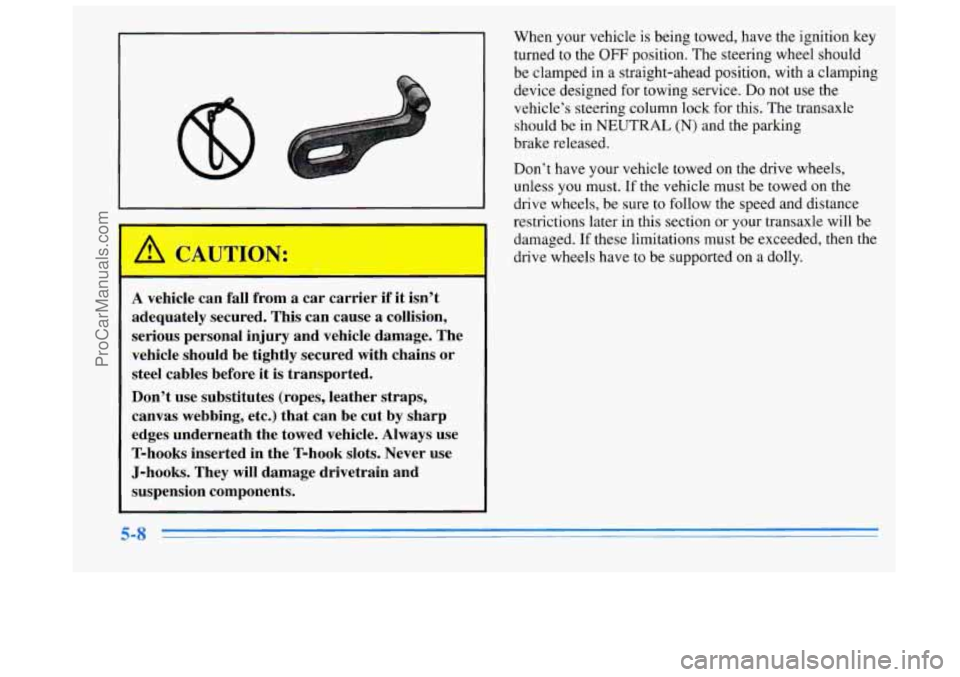
A V
A vehicle can fall from a car carrier if it isn’t
adequately secured. This can cause a collision,
serious personal injury and vehicle damage. The
vehicle should be tightly secured with chains or
steel cables before it is transported.
Don’t use substitutes (ropes, leather straps,
canvas webbing, etc.) that can be cut by sharp
edges underneath the towed vehicle. Always use
T-hooks inserted in the T-hook slots. Never use
J-hooks. They will damage drivetrain and
suspension components.
When your vehicle is being towed, have the ignition key
turned to the
OFF position. The steering wheel should
be clamped in a straight-ahead position, with a clamping
device designed for towing service.
Do not use the
vehicle’s steering column lock for this. The transaxle
should be in
NEUTRAL (N) and the parking
brake released.
Don’t have your vehicle towed on the drive wheels,
unless you must.
If the vehicle must be towed on the
drive wheels, be sure to follow the speed and distance
restrictions later in this section or your transaxle will be
damaged.
If these limitations must be exceeded, then the
drive wheels have
to be supported on a dolly.
3
ProCarManuals.com
Page 277 of 356
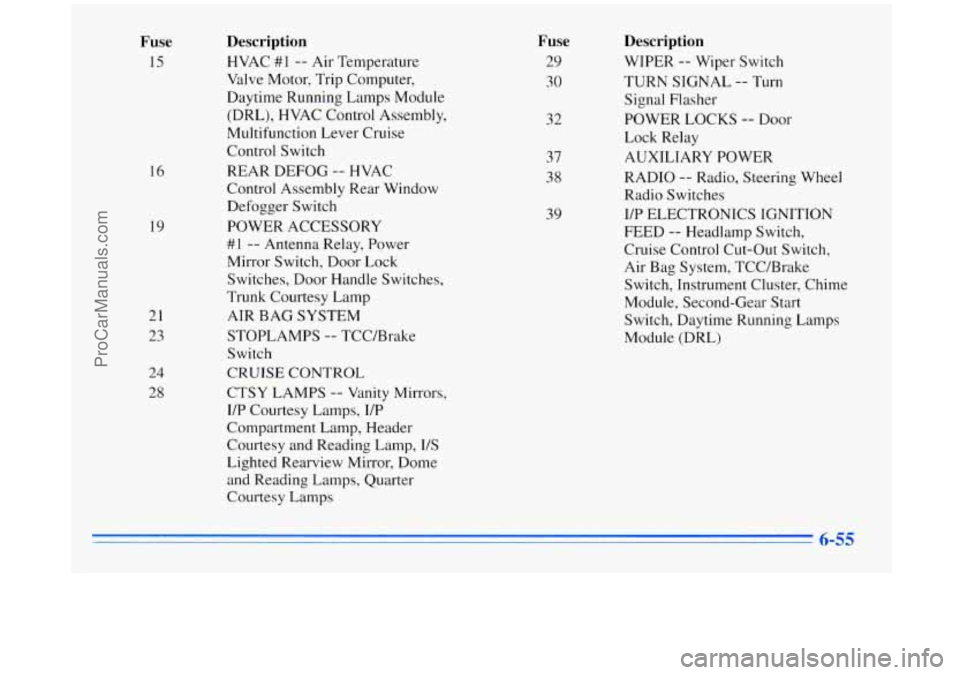
Fuse
15
16
19
21
23
24
28
Description
HVAC #1 -- Air Temperature
Valve Motor: Trip Computer,
Daytime Running Lamps Module
(DRL), HVAC Control Assembly,
Multifunction Lever Cruise
Control Switch
Control Assembly Rear Window
Defogger Switch
POWER ACCESSORY
#1 -- Antenna Relay, Power
Mirror Switch, Door Lock
Switches,
Door Handle Switches,
Trunk Courtesy Lamp
AIR BAG SYSTEM
STOPLAMPS
-- TCC/Brake
Switch
CRUISE CONTROL
CTSY LAMPS -- Vanity Mirrors,
T/P Courtesy Lamps, I/P
Compartment Lamp, Header
Courtesy and Reading Lamp,
I/S
Lighted Rearview Mirror, Dome
and Reading Lamps, Quarter
Courtesy Lamps
REAR
DEFOG
-- HVAC
Fuse
29
30
32
37
38
39
Description
WIPER -- Wiper Switch
TURN SIGNAL
-- Turn
Signal Flasher
POWER LOCKS
-- Door
Lock Relay
AUXILIARY POWER
RADIO
-- Radio, Steering Wheel
Radio Switches
I/P ELECTRONICS IGNITION
FEED
-- Headlamp Switch,
Cruise Control Cut-Out Switch,
Air Bag System, TCC/Brake
Switch, Instrument Cluster, Chime
Module, Second-Gear Start
Switch, Daytime Running Lamps
Module (DRL)
6-55
ProCarManuals.com
Page 279 of 356

Fuse
ECM IGN
ELEK IGN
10
11
12
13
Description
Powertrain Control Module
(PCM), EGR, CCP, VAPSW,
Mass Air Flow (MAF) Sensor
(VIN
X only), Oxygen Sensor,
Vac Canister Switch, Fan
#2 Relay
Electronic Ignition (EI)
Control Module
I/P
Fuse Block
FAN CONT
#I Relay
Passenger’s Side Underhood
Electrical Center and
I/P Fuse
Blocks: Fuses
5, 14,23 and 32
FAN CONT
#2 Relay and UP Fuse
Block:
Fuse 16, Power Seat
Circuit Breaker
“D”
Relay
14
15
16
17
18
Description
FUEL PUMP
A/C CMPR
FAN CONT #2
-- Secondary
Cooling Fan (Passenger Side)
FAN CONT
#I -- Primary
Cooling Fan (Driver Side)
Ignition Relay
6-57
ProCarManuals.com