1996 BUICK PARK AVENUE instrument panel
[x] Cancel search: instrument panelPage 210 of 388
Tbrn Signals When Towing a Trailer
The arrows on your instrument panel will flash
whenever you signal a turn or lane change. Properly
hooked up, the trailer lamps will also flash, telling other
drivers you’re about
to turn, change lanes or stop.
When towing a trailer, the arrows on your instrument
panel will flash for turns even if the bulbs on the trailer
are burned out. Thus, you may think drivers behind you
are seeing your signal when they are not. It’s important
to check occasionally to be sure the trailer bulbs are still
working.
Your vehicle
has bulb warning lights. When you plug a
trailer lighting system into your vehicle’s lighting
system, its bulb warning lights may not let you know if
one of your lamps goes out.
So, when you have a trailer
lighting system plugged in, be sure
to check your
vehicle and trailer lamps from time to time to be sure
they’re all working. Once you disconnect the trailer
lamps, the bulb warning lights again can tell you if one
of your vehicle lamps
is out.
Driving On Grades
Reduce speed and shift to a lower gear before you start
down a long or steep downgrade.
If you don’t shift
down, you might have to use your brakes
so much that
they would get hot and no longer work well.
On a long uphill grade,
shift down to THIRD (3) and
reduce your speed to around
45 mph (70 km/h) to reduce
the possibility of engine and transaxle overheating.
Parking on Hills
You really should not park your vehicle, with a trailer
attached, on a hill.
If something goes wrong, your rig
could start to move. People can be injured, and both
your vehicle and the trailer can
be damaged.
But if you ever have to park your rig on a hill, here’s
how
to do it:
1. Apply your regular brakes, but don’t shift into
PARK (P) yet.
2. Have someone place chocks under the trailer wheels.
3. When the wheel chocks are in place, release the
regular brakes until the chocks absorb the load.
4. Reapply the regular brakes. Then apply your parking
5. Release the regular brakes.
brake, and the shift
to PARK
(P).
4-36
ProCarManuals.com
Page 224 of 388
Engine Overheating
You will find a warning light about a hot engine on your
Buick instrument panel and
if you have the optional
gage cluster, a coolant temperature gage. You
will also
find a LOW COOLANT warning light.
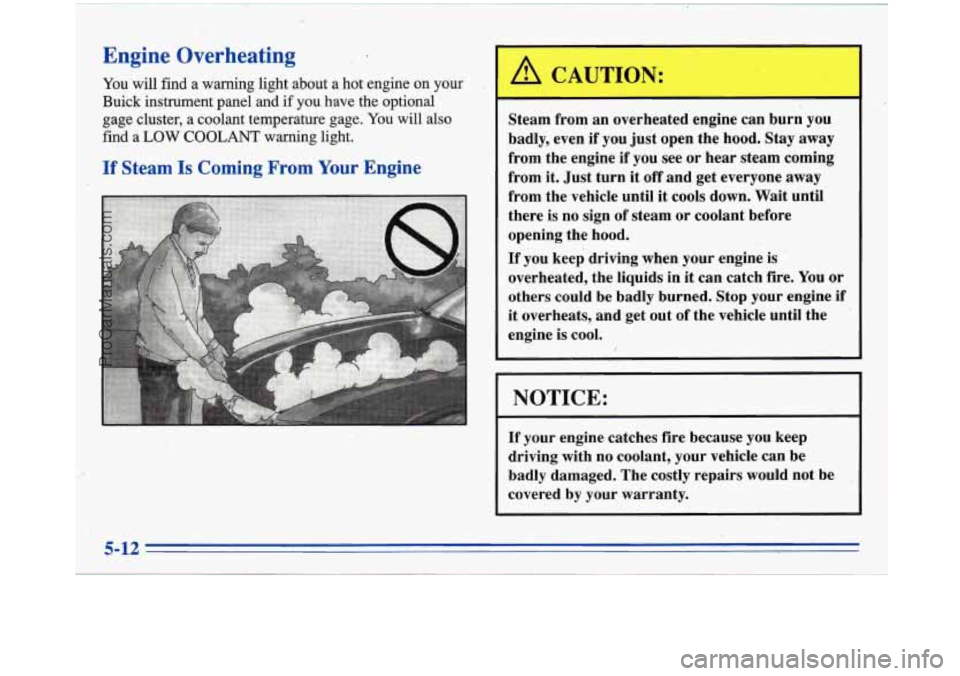
If Steam Is Coming From Your Engine
Steam from an overheated engine can burn you
badly, even if you just open the hood. Stay away
from the engine
if you see or hear steam coming
from it. Just turn it off and get everyone away
from the vehicle until it cools down. Wait until
there
is no sign of steam or coolant before
opening the hood.
If you keep driving when your engine is
overheated, the liquids in it can catch fire.
You or
others could be
badly burned. Stop your engine if
it overheats, and get out of the vehicle until the
engine is cool.
,
NOTICE:
If your engine catches fire because you keep
driving with no coolant, your vehicle can be
badly damaged. The costly repairs would not be
covered
by your warranty.
5-12
ProCarManuals.com
Page 251 of 388
Fuel
The 8th digit of your vehicle identification number
(VIN) shows the code letter for your engine. You will
find the
VIN at the top left of your instrument panel.
(See “Vehicle Identification Number” in the Index.)
If you don’t have the 3800 Supercharged engine (VIN
Code l), use regular unleaded gasoline rated at 87 octane
or higher.
If you have the 3800 Supercharged engine, use premium
unleaded gasoline rated at 91 octane or higher.
At a minimum, the gasoline you use should meet
specifications ASTM D4814 in the United States and
CGSB 3.5-M93 in Canada. Improved gasoline
specifications have- been developed by the American
Automobile Manufacturers Association (AAMA) for
’ better vehicle performance and engine protection.
Gasolines meeting ihe AAMA specification could
, ’ provide improved driveability and emission control
system protection compared to other gasolines.
Be sure the posted octane for premium is at least 91
(at least 89 for middle grade and
87 for regular). If the
i octane is, less than 87, you may get a heavy knocking
noise when you drive.
If it’s bad enough, it can damage
your engine.
,
If you have the 3800 Supercharged engine, in an
emergency, you may be able to use .a lower octane
-- as
low as 87
-- if heavy knocking does not occur. If you
are using 91 or higher octane unleaded gasoline and you
still heq heavy knocking, your engine needs service.
,
If you’re using fuel rated at the recommended octane or
higher and you still hear heavy knocking, your engine
needs service. But don’t worry
if you hear a little
pinging noise when you’re accelerating or driving up a
hill. That’s normal, and you don’t have to buy a higher
octane fuel to get rid of pinging. It’s the heavy, constant
knock that means you have a problem.
If your vehicle is certified to meet California Emission
Standards (indicated on the underhood tune-up label), it
is designed to operate’on fuels that meet California
specifications. If such fuels are not available in states
adopting California emissions standards, your vehicle
will operate satisfactorily on fuels meeting federal
specifications, but emission control system performance
may be affected. The malfunction indicator lamp on
your instrument panel may turn on and/or your vehicle
may fail a smog-check test.
If this occurs, return to your
authorized Buick dealer for diagnosis to determine,the
cause of failure.
In the event it is determined that the
cause of the condition is the type of
fuels used, repairs
may not be covered by your warranty.
6-3
ProCarManuals.com
Page 252 of 388
In Canada, some gasolines contain an octane-enhancing
additive called
MMT. If you use such fuels, your
emission control system performance may deteriorate
and the malfunction indicator lamp on your instrument
panel may turn on. If this happens, return to your
authorized Buick dealer for service.
To provide cleaner air, all gasolines are now required to
contain additives that will help prevent deposits from
forming in your engine and fuel system, allowing your
emission control system to function properly. Therefore,
you should not have to add anything to the fuel. In
addition, gasolines containing oxygenates, such as ethers
and ethanol, and reformulated gasolines may be
available in your area to help clean the air. General
Motors recommends that
you use these gasolines if they
comply with the specifications described earlier.
I NOTICE:
Your vehicle was not designed for fuel that
contains methanol. Don’t use it. It can corrode
metal parts in your fuel system and also damage
plastic and rubber parts. That damage wouldn’t be covered under your warranty.
If you plan on driving in another country outside the
United States or Canada, the proper fuel may be hard to
find. Never use leaded gasoline or any other fuel not
recommended in the previous text
on fuel. Costly repairs
caused by use
of improper fuel wouldn’t be covered by
your warranty.
To check on fuel availability, ask an auto club, or
contact a major oil company that does business in the
country where you’ll be driving.
You can also write us at the following address for
advice. Just tell
us where you’re going and give your
Vehicle Identification Number (VIN).
General Motors Overseas Distribution Corporation
North American Export Sales
(NAES)
1908 Colonel Sam Drive
Oshawa, Ontario
L1H 8P7
6-4
ProCarManuals.com
Page 260 of 388
Your Park Avenue Ultra has a 3800 Supercharged
engine. Buick chose supercharging rather than
turbocharging because Buick emphasizes smooth,
refined power.
The supercharger
is a device which is designed to pump
more air into the engine than it would normally use.
This air mixed with fuel creates increased engine power.
Since the supercharger is a pump and is driven from an
engine accessory drive belt, increased pressure is available at all driving conditions.
The Powertrain Control Module (PCM) works with a
vacuum control to regulate the increased pressure
required during specific driving conditions. When this increased pressure or boost is not desired, such as during
idling and light throttle cruising, the excess air that the
supercharger is pumping is routed through a bypass. All
of these controls working together provide high
performance character and fuel efficiency in the
3800 V6 Supercharged Buick engine.
The power steering pump and reservoir are mounted
on the rear (driver’s side)
of the engine block. See
“Maintenance Schedule” in the Index for when you
should check the fluid.
Engine Oil
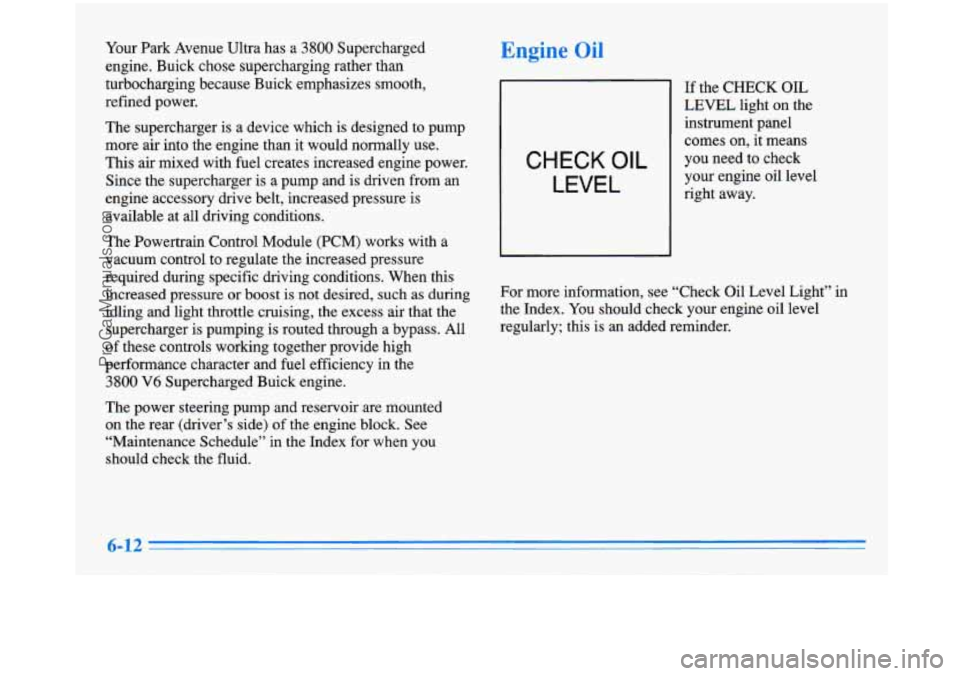
If the CHECK OIL
LEVEL light on the
instrument panel
comes on, it means
CHECK OIL you need to check
LEVEL your engine oil level
right away.
For more information, see “Check Oil Level Light” in
the Index. You should check your engine oil level
regularly; this is an added reminder.
ProCarManuals.com
Page 298 of 388
Cleaning the Top of the Instrument Panel
Use only mild soap and water to clean the top surfaces
of the instrument panel. Sprays containing silicones or
waxes may cause annoying reflections in the windshield
and even make it difficult to see through the windshield
under certain conditions.
Cleaning Speaker Covers
Vacuum around a speaker cover gently, so that the
speaker won’t be damaged. Some spots and stains will
clean off better with just water and mild soap.
If
something gets on one of them and you need to use a
solvent, follow these steps:
0 Gently scrape excess soil from the trim material with
a clean, dull knife or scraper. Use very little cleaner,
light pressure and clean cloths (preferably
cheesecloth). Cleaning should start at the outside
of
the stain, “feathering” toward the center. Keep
changing
to a clean section of the cloth.
When you clean a stain from fabric, immediately
dry the area with a blow dryer to help prevent a
cleaning ring.
Care of Safety Belts
Keep belts clean and dry.
1
Do not bleach or dye safety belts. If you do, it
may severely weaken them. In a crash, they
might not be able to provide adequate protection.
Clean safety belts only with mild soap and
lukewarm water.
6-50
~
ProCarManuals.com
Page 303 of 388
c
ENNUMBER I SIZE 1 DESCRIPTION USAGE
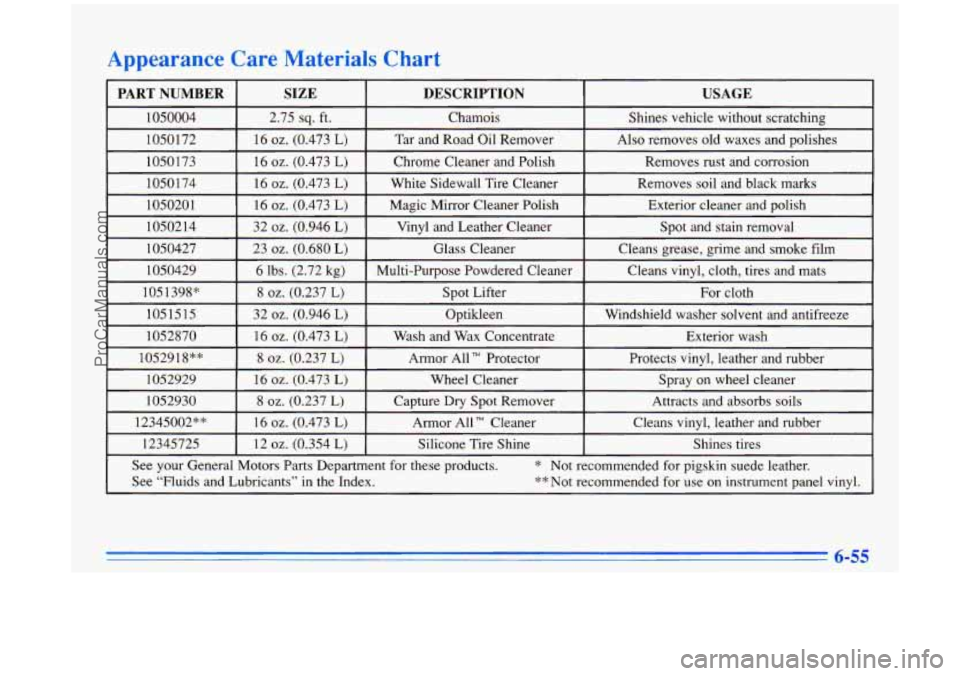
See your General Motors Parts Department for these products. * Not recommended for pigskin suede leather.
See “Fluids and Lubricants” in the Index.
** Not recommended for use on instrument panel vinyl. 1
ProCarManuals.com
Page 304 of 388
Vehicle Identification Number (VIN)
SAMPLE4UXTM072675 P
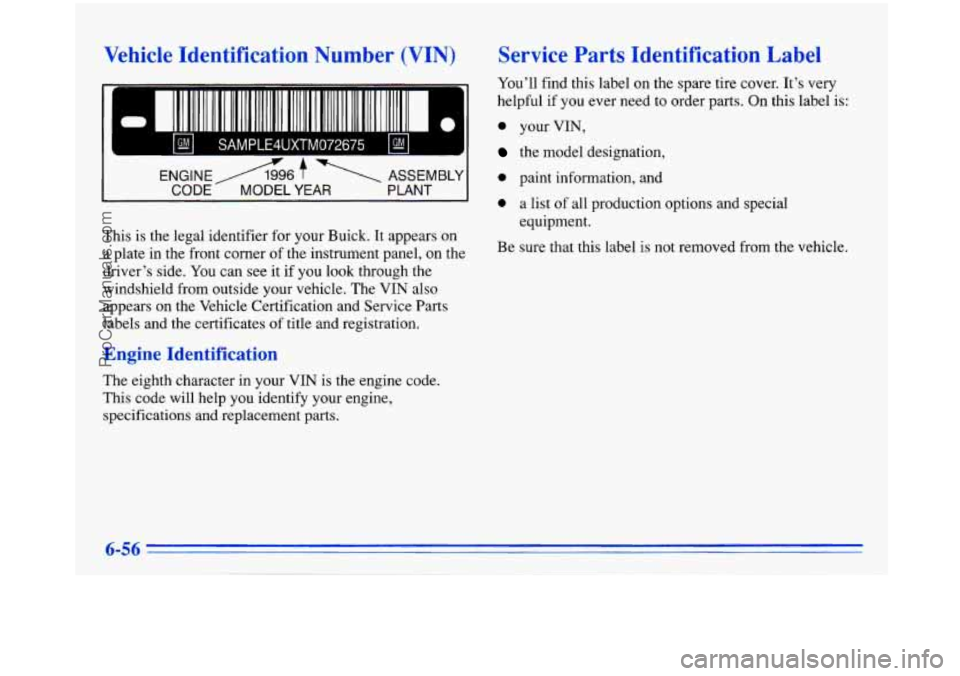
This is the legal identifier for your Buick. It appears on
a plate in the front corner of the instrument panel, on the
driver’s side. You can
see it if you look through the
windshield from outside your vehicle. The VIN also
appears on the Vehicle Certification and Service Parts
labels and the certificates of title and registration.
Engine Identification
The eighth character in your VIN is the engine code.
This code will help you identify your engine,
specifications and replacement parts.
Service Parts Identification Label
You’ll find this label on the spare tire cover. It’s very
helpful if you ever need to order parts. On this label is:
0 your VIN,
the model designation,
0 paint information, and
0 a list of all production options and special
Be sure that this label
is not removed from the vehicle.
equipment.
ProCarManuals.com