1996 BUICK PARK AVENUE ignition
[x] Cancel search: ignitionPage 77 of 388
Key Reminder Warning
If you leave your key in the ignition, in the OFF
position, you will hear a warning chime when you open
the driver’s door.
Retained Accessory Power (Option)
If you have the optional Remote Keyless Entry, after
you turn your ignition off and even remove the key, you
will still have electrical power
to such accessories as the
radio and power windows for up
to 10 minutes. But if
you open a door, power
is shut off.
Starting Your Engine
Move your shift lever to PARK (P) or NEUTRAL (N).
Your engine won’t start in any other position
-- that’s a
safety feature. To restart when you’re already moving,
use NEUTRAL (N) only.
NOTICE:
Don’t try to shift to PARK (P) if your Buick
is moving. If you do, you could damage the
transaxle. Shift
to PARK (p) only when your
vehicle is stopped.
1. Without pushing the accelerator pedal, turn your
ignition key to START. When the engine starts, let
go of the key. The idle speed will
go down as your
engine gets warm.
~~ ~~
Holding your key in START for longer than
15 seconds at a time will cause your battery to be
drained much sooner. And the excessive heat can
damage your starter motor.
I I
2. If it doesn’t start right away, hold your key in
START for about three to five seconds at a time until
your engine starts. Wait about
15 seconds between
each try to help avoid draining your battery.
ProCarManuals.com
Page 80 of 388
Ensure the shift lever is fully in PARK (P) range before
starting the engine. Your Buick has a brake-transaxle
shift interlock.
You have to fully apply your regular
brakes
before you can shift from PARK (P) when the
ignition key is in the RUN position.
If you cannot shift
out
of PARK (P), ease pressure on the shift lever -- push
the shift lever all the way into PARK (P) as
you
maintain brake application. Then move the shift lever
into the gear you wish. See “Shifting Out of PARK (P)”
in the Index.
REVERSE (R): Use this gear to back up.
NOTICE:
Shifting to REVERSE (R) while your vehicle is
moving forward could damage your transaxle.
Shift to
REVERSE (R) only after your vehicle
is stopped.
To rock your vehicle back and forth to get out of snow,
ice
or sand without damaging your transaxle, see “If
You’re Stuck:
In Sand, Mud, Ice or Snow” in the Index.
NEUTRAL (N): In this position, your engine
doesn’t connect with the wheels.
To restart when you’re
already moving, use NEUTRAL
(N) only. Also, use
NEUTRAL
(N) when your vehicle is being towed.
Shifting out of
PARK (P) or NEUTRAL (N) while
your engine is ‘(racing” (running
at high speed) is
dangerous. Unless your foot is firmly on the
brake pedal, your vehicle could move
very
rapidly. You could lose control and hit people or
objects. Don’t shift out
of PARK (P) or
NEUTRAL (N) while your engine is racing.
I NOTICE:
Damage to your transaxle caused by shifting out
of
PARK (P) or NEUTRAL (N) with the engine
racing isn’t covered by your warranty.
ProCarManuals.com
Page 83 of 388
Pal _____
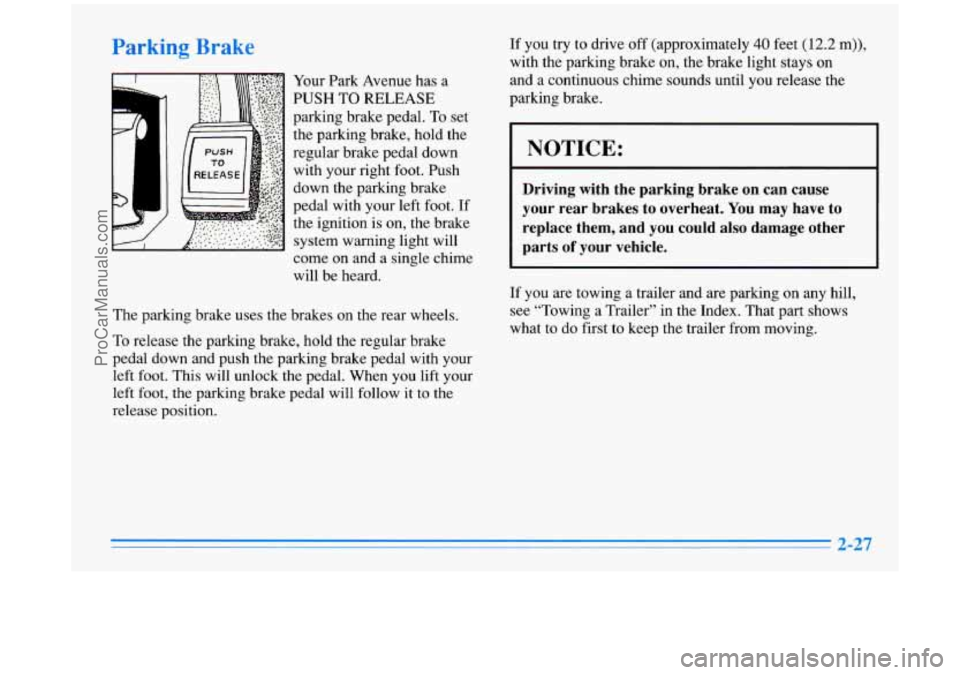
Your Park Avenue has a
PUSHTORELEASE
parking brake pedal.
To set
the parking brake, hold the
regular brake pedal down with your right foot. Push
down the parking brake
pedal with your left foot.
If
the ignition is on, the brake
system warning light will
come on and a single chime
will be heard.
The parking brake uses the brakes on the rear wheels.
To release the parking brake, hold the regular brake
pedal down and push the parking brake pedal with your
left foot. This will unlock the pedal. When you lift your
left foot, the parking brake pedal will follow it to the
release position. If
you try to drive
off (approximately 40 feet (12.2 m)),
with the parking brake on, the brake light stays
on
and a continuous chime sounds until you release the
parking brake.
NOTICE:
Driving with the parking brake on can cause
your rear brakes
to overheat. You may have to
replace them, and you could also damage other
parts
of your vehicle.
If you are towing a trailer and are parking on any hill,
see “Towing a Trailer” in the Index. That part shows
what to do first to keep the trailer from moving.
ProCarManuals.com
Page 85 of 388
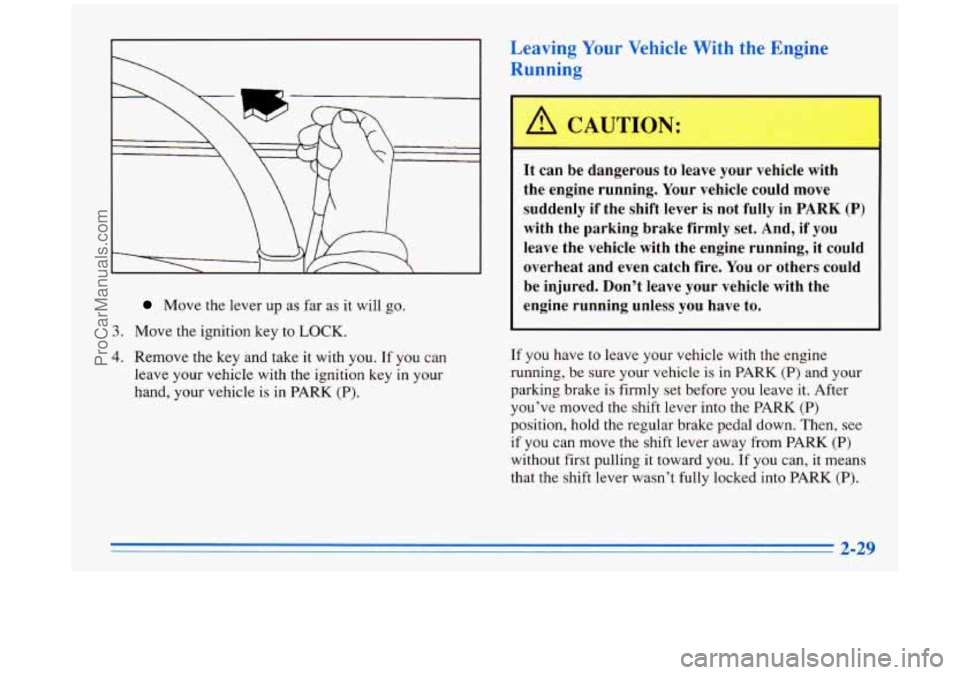
Move the lever up as far as it will go.
3. Move the ignition key to LOCK.
4. Remove the key and take it with you. If you can
leave your vehicle with the ignition key in your
hand, your vehicle is in PARK (P).
Leaving Your Vehicle With the Engine
Running
I
It can be dangerous to leave your vehicle with
the engine running. Your vehicle could move
suddenly if the shift lever is not
fully in PARK (P)
with the parking brake firmly set. And, if you
leave the vehicle with the engine running, it could
overheat and even catch fire. You or others could
be injured. Don’t leave your vehicle with the
engine running unless you have to.
If
you have to leave your vehicle with the engine
running, be sure your vehicle is in PARK (P) and your
parking brake is firmly set before you leave it. After
you’ve moved the shift lever into the PARK
(P)
position, hold the regular brake pedal down. Then, see
if you can move the shift lever away from PARK
(P)
without first pulling it toward you. If you can, it means
that the shift lever wasn’t fully locked into PARK (P).
ProCarManuals.com
Page 86 of 388
Torque Lock
If you are parking on a hill and you don’t shift your
transaxle into PARK (P) properly, the weight of the
vehicle may put too much force on the parking pawl in
the transaxle. You may find
it difficult to pull the shift
lever out of PARK (P). This is called “torque lock.”
To
prevent torque lock, set the parking brake and then shift
into PARK (P) properly before you leave the driver’s
seat.
To find out how, see “Shifting Into PARK (P)”
in the Index.
When you
are ready to drive, move the shift lever out of
PARK (P)
befure you release the parking brake.
If torque lock does occur, you may need to have another
vehicle push yours a little uphill to take some
of the
pressure from the transaxle,
so you can pull the shift
lever out of PARK
(P).
Shifting Out of PARK (P)
Your Buick has a brake-transaxle shift interlock. You
have to fully
apply your regular brake before you can
shift from PARK (P) when the ignition is in the RUN
position. See “Automatic Transaxle” in the Index.
If you cannot shift out
of PARK (P), ease pressure on
the shift lever
-- push the shift lever all the way into
PARK
(P) as you maintain brake application. Then
move the shift lever into the gear you want.
If you ever hold the brake pedal down but still can
I
shift out of PARK (P), try this:
1. Turn the key to OFF. Open and close the driver’s
door to turn off the Retained Accessory Power
feature (if equipped).
2. Apply and hold the brake until the end of Step 4.
3. Shift to NEUTRAL (N).
4. Start the vehicle and then shift to the drive gear
you want.
5. Have the vehicle fixed as soon as you can.
ProCarManuals.com
Page 89 of 388
Windows
Power Windows
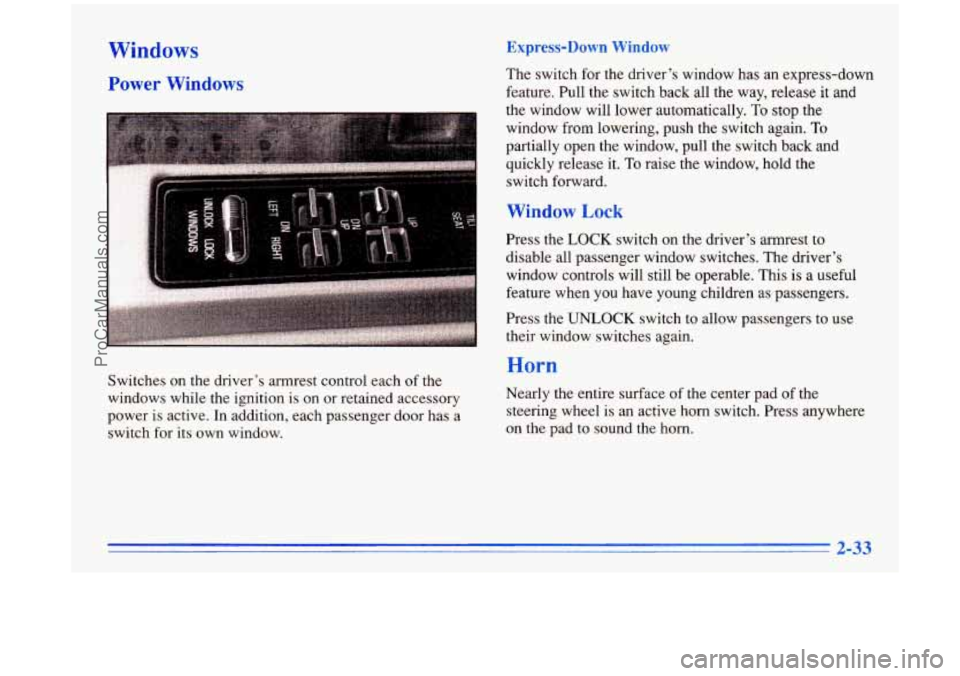
Switches on the driver’s armrest control each of the
windows while the ignition is
on or retained accessory
power is active. In addition, each passenger door has a
switch for its own window.
Express-Down Window
The switch for the driver’s window has an express-down
feature. Pull the switch back all the way, release it and
the window will lower automatically.
To stop the
window from lowering, push the switch again.
To
partially open the window, pull the switch back and
quickly release it. To raise the window, hold the
switch forward.
Window Lock
Press the LOCK switch on the driver’s armrest to
disable all passenger window switches. The driver’s
window controls will still be operable. This is
a useful
feature when you have young children
as passengers.
Press the
UNLOCK switch to allow passengers to use
their window switches again.
Horn
Nearly the entire surface of the center pad of the
steering wheel is an active horn switch. Press anywhere
on the pad to sound the horn.
ProCarManuals.com
Page 99 of 388
Using Cruise Control on Hills
Haw well your cruise control will work on hills depends
upon your speed, load and the steepness of the hills.
When going up steep hills, you may have to step on the
accelerator pedal to maintain your speed. When going
downhill, you may
have to brake or shift to a lower gear
to keep your speed down. Of course, applying the brake
takes you out of cruise control. Many drivers find this
to
be too much trouble and don’t use cruise control on
steep hills.
Ending Cruise Control
There are two ways to turn off the cruise control:
Step lightly on the brake pedal; or
0 Move the cruise switch to OFF. The CRUISE light
will also go
out.
Erasing Speed Memory
When you turn off the cruise control or the ignition,
your cruise control set speed memory is erased.
Lamps
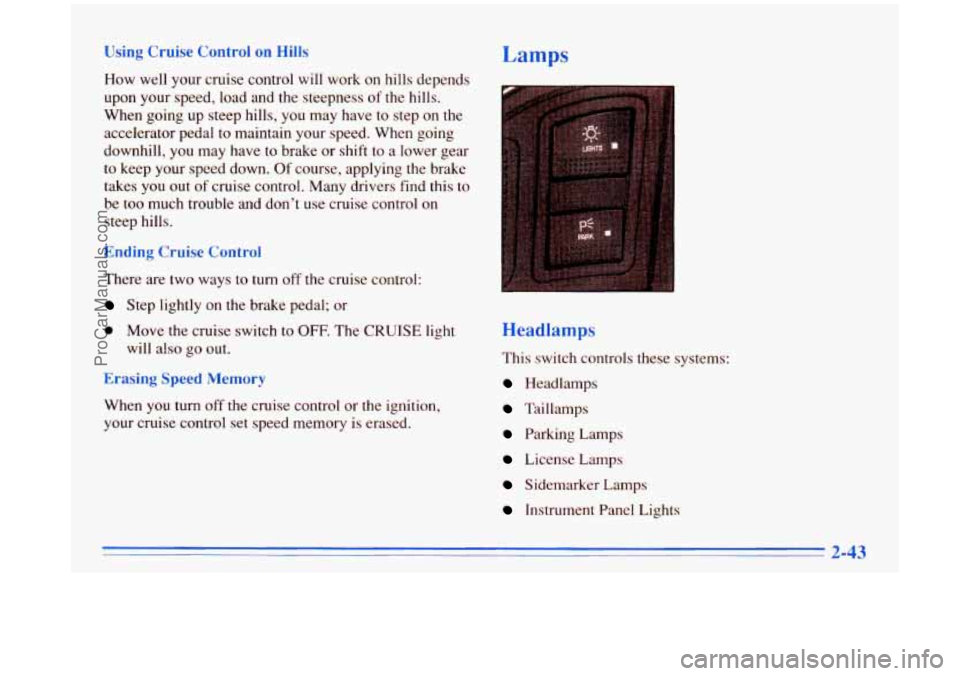
H Adlamps
This switch controls these systems:
Headlamps
Taillamps
Parking Lamps
License Lamps
Sidemarker Lamps
Instrument Panel Lights
ProCarManuals.com
Page 100 of 388
Press the LIGHTS switch to turn the headlamps on.
Press it again to turn them
off.
Press the PARK switch to turn the parking lamps on.
Press it again
to turn them off. (If the parking lamps
were turned on with the PARK switch, they must be
turned off with that switch.)
Lamps On Reminder
If you leave the manual headlamp or parking lamp
switch on, remove the key from the ignition and open
the driver’s door, you will hear a continuous warning
chime. The chime will turn
off when the lamps are
turned
off.
Daytime Running Lamps (Canada Only)
Daytime Running Lamps (DRL) can make it easier for
others to see the front of your vehicle during the day.
DRL can be’helpful in many different driving
conditions, but they can be especially helpful in the
short periods after dawn and before sunset.
A light sensor on top of the instrument panel monitors
the exterior light level
for the operation of DRL and
twilight sentinel,
so be sure it isn’t covered. The
DRL system will make your low-beam headlamps
come on at reduced brightness in daylight when:
The ignition is on,
0 The headlamp switch is off, and
0 The transaxle is not in PARK (P).
When DRL are on, only your low-beam headlamps will
be on. The parking lamps, taillamps, sidemarker and
other lamps won’t be on. Your instrument panel won’t
be lit up either.
When it’s dark enough outside, your low-beam
headlamps will change to full brightness. The other
lamps that turn on with your headlamps, will also turn
on. When it’s bright enough outside, the regular lamps
will turn
off, and your low-beam headlamps change to
the reduced brightness of
DRL.
To idle your vehicle with the DRL off, shift the
transaxle into PARK
(P). The DRL will stay off until
you shift out of PARK (P).
To turn off all exterior lighting at night when you are
parked, turn
off the headlamps and move the twilight
sentinel control all the way toward
MIN.
As with any vehicle, you should turn on the regular
headlamp system when you need it.
ProCarManuals.com