Page 79 of 388
4. After you’ve used the coolant heater,k sure to store
the cord as it was before to keep it away from moving
engine parts.
If you don’t, it could be damaged.
How long should you keep the coolant heater plugged
in? The answer depends on the outside temperature, the
kind of oil you have, and some other things. Instead of
trying to list everything here, we ask that you contact
your Buick dealer in the area where you’ll be parking
your vehicle. The dealer can give you the best advice for
that particular area.
Automatic Transaxle Operation
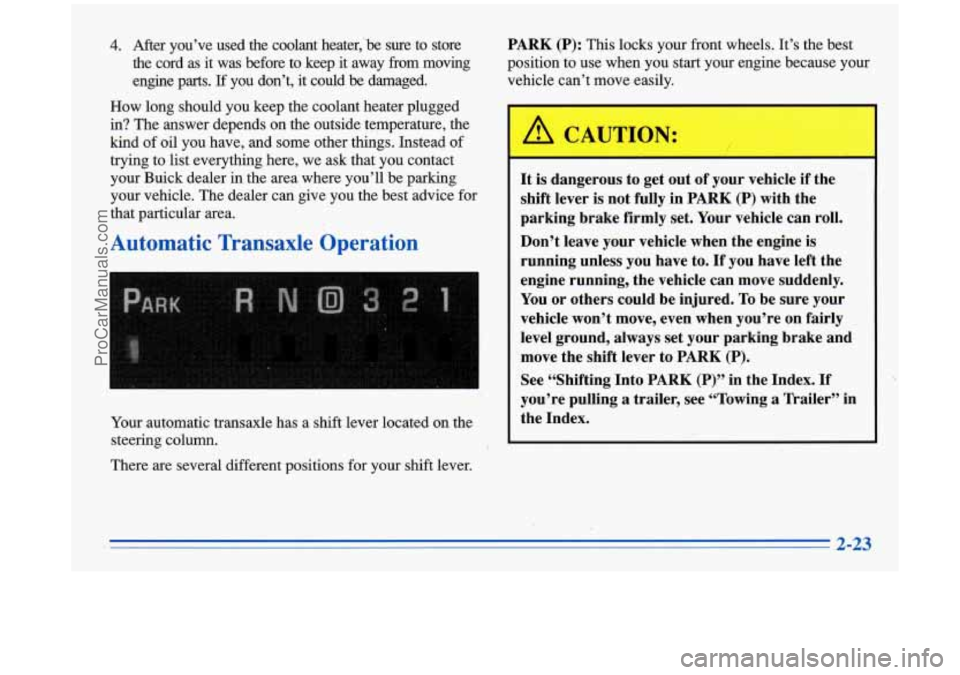
Your automatic transaxle has a shift lever located on the
steering column.
There are several different positions for your shift lever.
PARK (P): This locks your front wheels. It’s the best
position to use when you start your engine because your
vehicle can’t move easily.
’ A CAUTION:
I
It is dangerous to get out of your vehicle if the
shift lever is not fully in
PARK (P) with the
parking brake firmly set. Your vehicle can roll.
Don’t leave your vehicle when the engine
is
running unless you have to. If you have left the
engine running, the vehicle can move suddenly.
You or others could be injured. To.be sure your
vehicle won’t move, even when you’re on fairly
level ground, always set your parking brake and
move the shift lever to
PARK (P).
See “Shifting Into PARK (P)” in the Index. If
you’re pulling
a trailer, see “Towing a Trailer” in
the Index.
2-23
ProCarManuals.com
Page 89 of 388
Windows
Power Windows
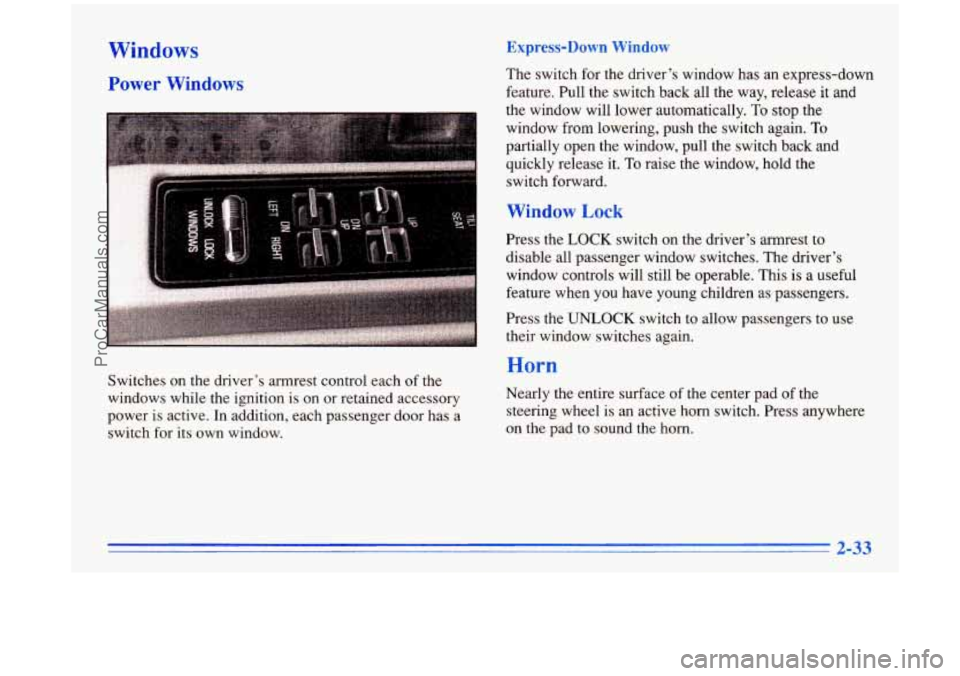
Switches on the driver’s armrest control each of the
windows while the ignition is
on or retained accessory
power is active. In addition, each passenger door has a
switch for its own window.
Express-Down Window
The switch for the driver’s window has an express-down
feature. Pull the switch back all the way, release it and
the window will lower automatically.
To stop the
window from lowering, push the switch again.
To
partially open the window, pull the switch back and
quickly release it. To raise the window, hold the
switch forward.
Window Lock
Press the LOCK switch on the driver’s armrest to
disable all passenger window switches. The driver’s
window controls will still be operable. This is
a useful
feature when you have young children
as passengers.
Press the
UNLOCK switch to allow passengers to use
their window switches again.
Horn
Nearly the entire surface of the center pad of the
steering wheel is an active horn switch. Press anywhere
on the pad to sound the horn.
ProCarManuals.com
Page 90 of 388
ion ever
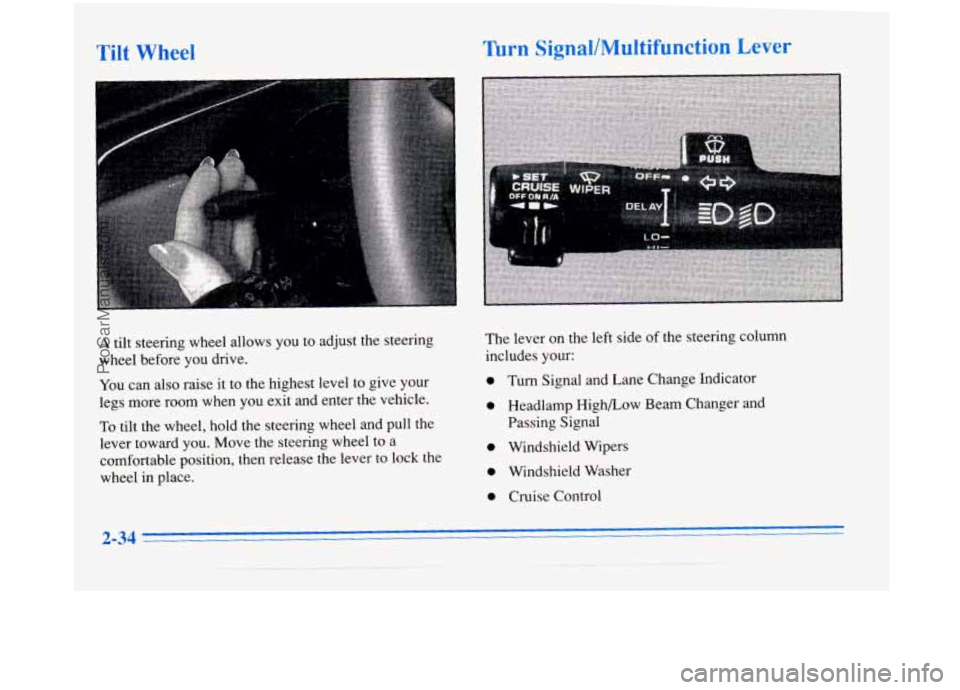
The lever on the left side of the steering column
includes your:
a Turn Signal and Lane Change Indicator
a Headlamp High/Low Beam Changer and
Passing Signal
a Windshield Wipers
a Windshield Washer
0 Cruise Control
ProCarManuals.com
Page 121 of 388
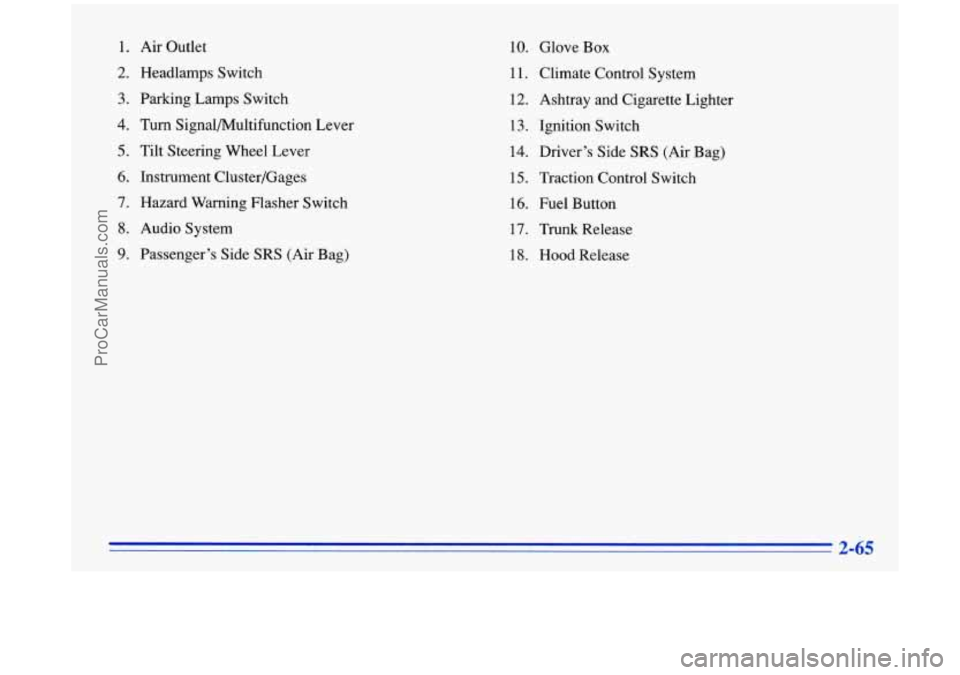
1. Air Outlet
2. Headlamps Switch
3. Parking Lamps Switch
4. Turn Signal/Multifunction Lever
5. Tilt Steering Wheel Lever
6. Instrument Cluster/Gages
7. Hazard Warning Flasher Switch
8. Audio System
9. Passenger’s Side SRS (Air Bag)
10. Glove Box
11. Climate Control System
12. Ashtray and Cigarette Lighter
13. Ignition Switch
14. Driver’s Side
SRS (Air Bag)
15. Traction Control Switch
16. Fuel Button
17.
Trunk Release
18. Hood Release
ProCarManuals.com
Page 129 of 388
Traction Control System Warning Light
(Option)
TRACTION
OFF
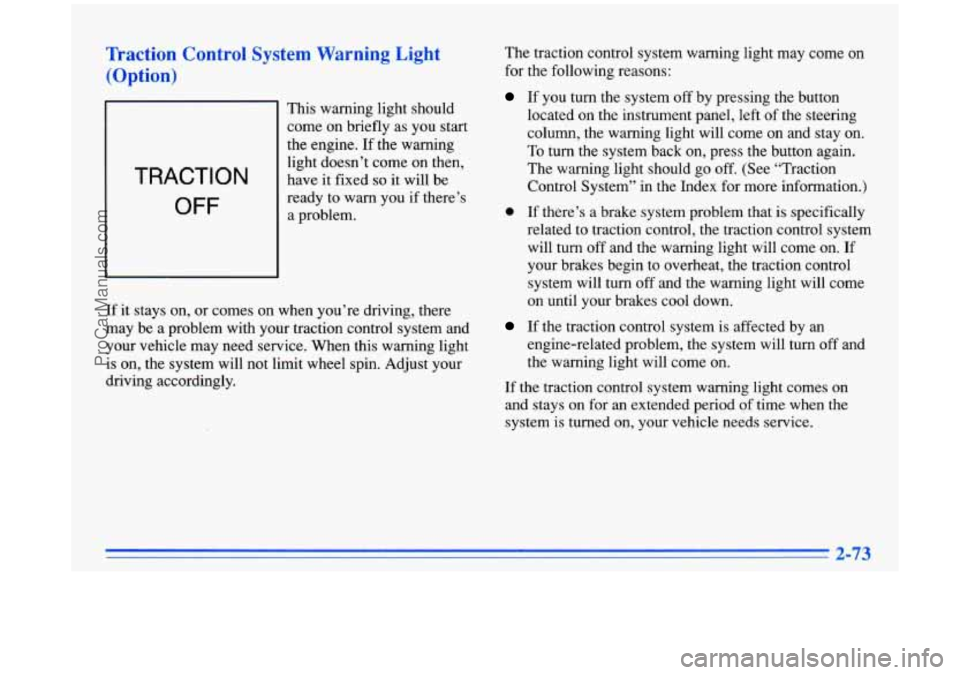
This warning light should
come on briefly as you start
the engine. If the warning
light doesn’t come on then,
have
it fixed so it will be
ready to warn you if there’s
a problem.
If it stays on, or comes on when you’re driving, there
may be a problem with your traction control system and
your vehicle may need service. When this warning light
is on, the system will not limit wheel
spin. Adjust your
driving accordingly. The
traction control system warning light may come on
for the following reasons:
If you turn the system off by pressing the button
located on the instrument panel, left of the steering
column, the warning light will come on and stay on.
To turn the system back on, press the button again.
The warning light should go off. (See “Traction
Control System” in the Index for more information.)
0 If there’s a brake system problem that is specifically
related to traction control, the traction control system will turn off and the warning light will come on. If
your brakes begin to overheat, the traction control
system will turn off and the warning light will come
on until your brakes cool down.
If the traction control system is affected by an
engine-related problem, the system will turn
off and
the warning light will come on.
If the traction control system warning light comes on
and stays on for an extended period of time when the
system is turned on, your vehicle needs service.
2-73
ProCarManuals.com
Page 151 of 388
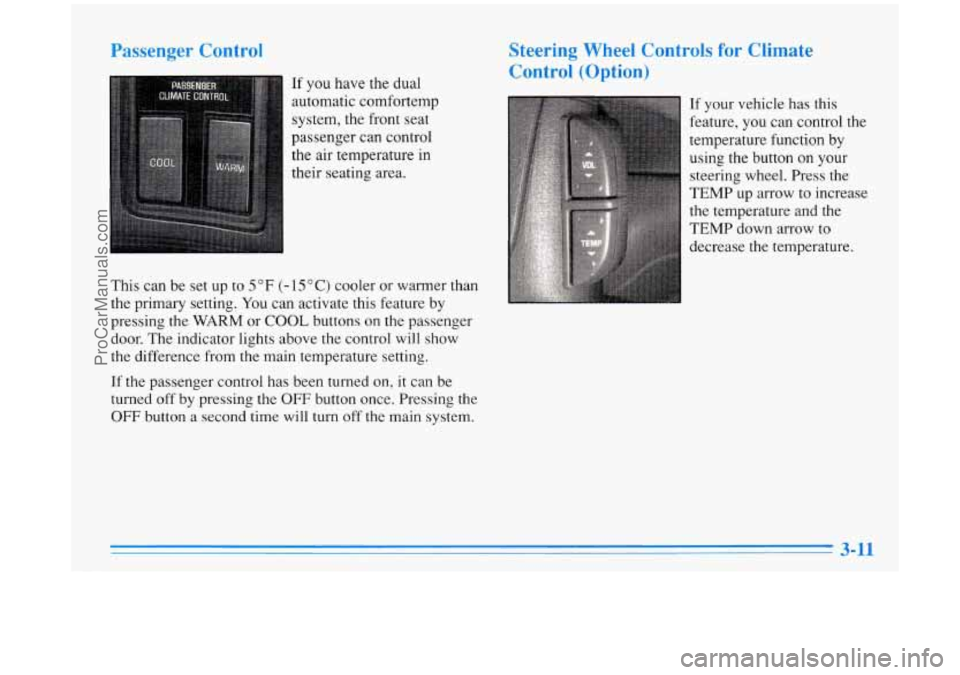
Passenger Control
If you have the dual
automatic cornfortemp
system, the front seat
passenger can control
the
air temperature in
their seating area.
This can be set up to
5 OF (- 15 O C) cooler or warmer than
the primary setting.
You can activate this feature by
pressing the
WARM or COOL buttons on the passenger
door. The indicator lights above the control will show
the difference from
the main temperature setting.
If the passenger control has been turned on,
it can be
turned
off by pressing the OFF button once. Pressing the
OFF button a second time will turn off the main system.
Steering Wheel Controls for Climate
Control (Option)
If your vehicle has this
feature, you can control the
temperature function by
using the button
on your
steering wheel. Press the
TEMP up
arrow to increase
the temperature and the
TEMP down arrow to
decrease the temperature.
ProCarManuals.com
Page 169 of 388
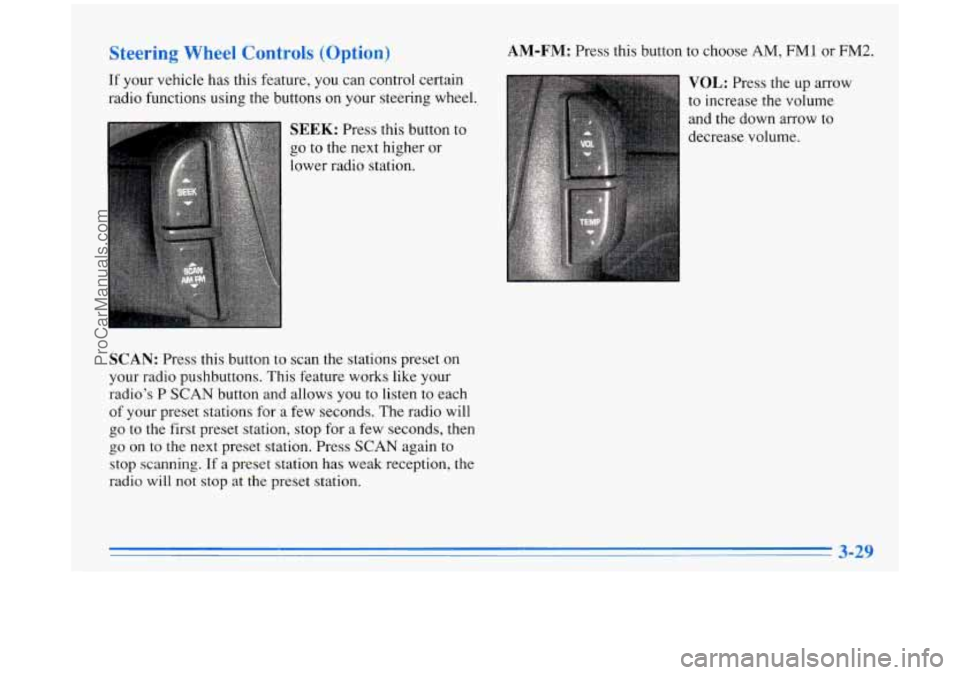
Steering Wheel Controls (Option)
If your vehicle has this feature, you can control certain
radio functions using the buttons on your steering wheel.
SEEK: Press this button to
go to the next higher or
lower radio station.
SCAN: Press this button to scan the stations preset on
your radio pushbuttons. This feature works like your
radio’s
P SCAN button and allows you to listen to each
of your preset stations for a few seconds. The radio will
go
to the first preset station, stop for a few seconds, then
go on to the next preset station. Press SCAN again to
stop scanning.
If a preset station has weak reception, the
radio
will not stop at the preset station.
AM-FM: Press this button to choose AM, FMl or FM2.
VOL: Press the up arrow
to increase the volume
and the down arrow
to
decrease volume.
ProCarManuals.com
Page 179 of 388
Control of a Vehicle
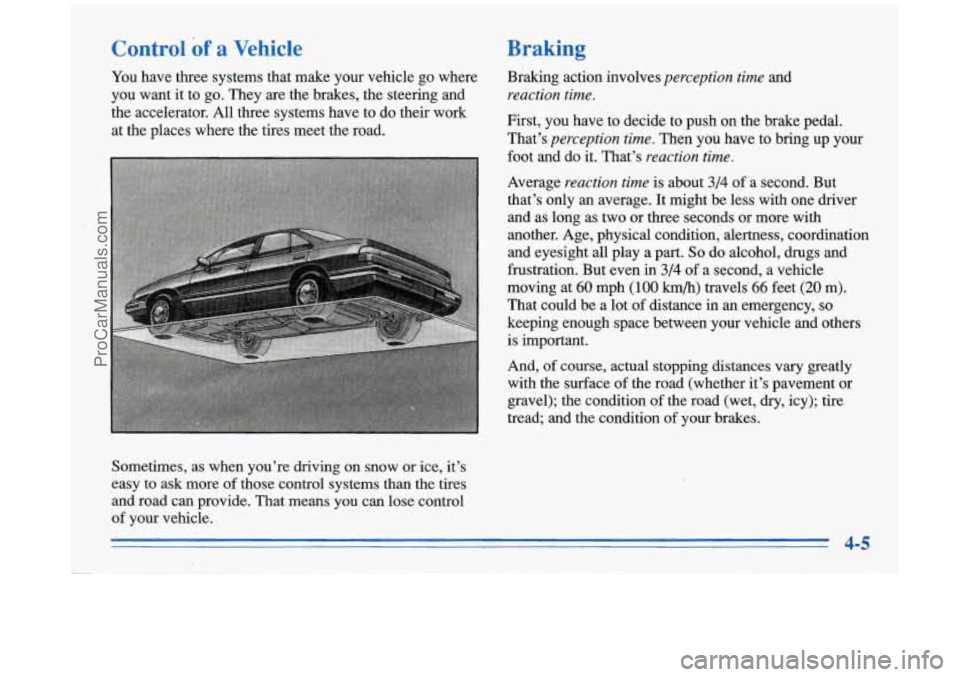
You have three systems that make your vehicle go where
you want it to go. They
are the brakes, the steering and
the acceIerator. All three systems have to do their work
at the places where the tires meet the road.
Sometimes, as when you’re driving on snow or ice, it’s
easy to ask more of those control systems than the tires
and road can provide. That means you can lose control
of your vehicle.
Braking
Braking action involves perception time and
reaction time.
First, you have to decide to push on the brake pedal.
That’s
perception time. Then you have to bring up your
foot and do it. That’s
reaction time.
Average reaction time is about 3/4 of a second. But
that’s only an average. It might be less with one driver
and as long as two or three seconds or more with
another. Age, physical condition, alertness, coordination
and eyesight
all play a part. So do alcohol, drugs and
frustration. But even in 3/4 of a second, a vehicle
moving
at 6O~mph (I00 h/h) travels’ 66 feet (20 m).
That could be a lot of distance in an emergency,
so
keeping enough space between your vehicle and others
is important.
And,
of course, actual stopping distances vary greatly
with the surface of the road (whether it’s pavement or
gravel); the condition
of the road (wet, dry, icy); tire
tread; and the condition
of your brakes.
ProCarManuals.com