Page 234 of 388
If a Tire Goes Flat
It’s unusual for a tire to “blow out” while you’re driving,
especially if
you maintain your tires properly. If air goes
out of a tire, it’s much more likely to leak out slowly.
But
if you should ever have a “blowout,” here are a few
tips about what to expect and what
to do:
If a front tire fails, the flat tire will create a drag that
pulls the vehicle toward that side. Take your foot
off the
accelerator pedal and grip the steering wheel firmly.
Steer to maintain lane position, and then gently brake to
a stop well out of the traffic lane.
A rear blowout, particularly on a curve, acts much like a
skid and may require the same correction you’d
use in a
skid. In any rear blowout, remove your foot from the
accelerator pedal. Get the vehicle under control by
steering the way you want the vehicle to
go. It may be
very bumpy and noisy, but you can still steer. Gently
brake
to a stop -- well off the road if possible.
If a tire goes flat, the next part shows how to use your
jacking equipment to change
a flat tire safely.
Changing a Flat Tire
If a tire goes flat, avoid further tire and wheel damage
by driving slowly to a level place. Turn on your hazard
warning flashers.
Changing
a tire can cause an injury. The vehicle
can slip off the jack and roll over you or other
people.
You and they could be badly injured.
Find
a level place to change your tire. To help
prevent the vehicle from moving:
1. Set the parking brake firmly.
2. Put the shift lever in PARK (P).
3. Turn off the engine.
To be even more certain the vehicle won’t move,
you can put blocks at the front and rear of the
tire farthest away from the one being changed.
That would be the tire
on the other side of the
vehicle,
at the opposite end.
5-22
ProCarManuals.com
Page 247 of 388
If You’re Stuck: In Sand, Mud,
Ice
or Snow
What you don’t want to do when your vehicle is stuck is
to spin your wheels too fast. The method known as
“rocking” can help you get out when you’re stuck, but
you must use caution.
If you let your tires SI at high speed, they can
explode,
and you or others could be injured. And,
the transaxle or other parts
of the vehicle can
overheat. That could cause an engine
compartment fire or other damage. When you’re
stuck, spin the wheels as little as possible. Don’t
spin the wheels above
35 mph (55 km/h) as shown
on the speedometer.
I NOTICE:
Spinning your wheels can destroy parts of your
vehicle as well as the tires.
If you spin the wheels
too fast while shifting your transaxle back and
forth, you can destroy your transaxle.
For information about using tire chains on your vehicle,
see “Tire Chains” in the Index.
Rocking your vehicle
to get it out:
First, turn your steering wheel left and right. That will
clear the area around your front wheels. If your vehicle
has traction control, you should turn the system off. (See
“Traction Control System” in the Index.) Then shift
back and forth between REVERSE (R) and a forward
gear, spinning the wheels
as little as possible. Release
the accelerator pedal while
you shift, and press lightly
on the accelerator pedal when the transaxle is in gear. If
that doesn’t get you out after a few tries, you may need
to be towed out. If you do need to be towed out, see
“Towing Your Vehicle” in the Index.
ProCarManuals.com
Page 254 of 388
--le release button for the
fuel door
is to the left of the
steering column. There
is also a manual fuel
door release. This
mechanism is located in the
top of the trunk
compartment, on the
driver’s side of
the vehicle.
Pull the white tab to release
the fuel
door.
ProCarManuals.com
Page 260 of 388
Your Park Avenue Ultra has a 3800 Supercharged
engine. Buick chose supercharging rather than
turbocharging because Buick emphasizes smooth,
refined power.
The supercharger
is a device which is designed to pump
more air into the engine than it would normally use.
This air mixed with fuel creates increased engine power.
Since the supercharger is a pump and is driven from an
engine accessory drive belt, increased pressure is available at all driving conditions.
The Powertrain Control Module (PCM) works with a
vacuum control to regulate the increased pressure
required during specific driving conditions. When this increased pressure or boost is not desired, such as during
idling and light throttle cruising, the excess air that the
supercharger is pumping is routed through a bypass. All
of these controls working together provide high
performance character and fuel efficiency in the
3800 V6 Supercharged Buick engine.
The power steering pump and reservoir are mounted
on the rear (driver’s side)
of the engine block. See
“Maintenance Schedule” in the Index for when you
should check the fluid.
Engine Oil
If the CHECK OIL
LEVEL light on the
instrument panel
comes on, it means
CHECK OIL you need to check
LEVEL your engine oil level
right away.
For more information, see “Check Oil Level Light” in
the Index. You should check your engine oil level
regularly; this is an added reminder.
ProCarManuals.com
Page 276 of 388
Power Steering Fluid
When to Check Power Steering Fluid
It is not necessary to regularly check power steering fluid
unless you suspect there
is a leak in the system or you hear
an unusual noise. A fluid loss in this system could indicate
a problem. Have the system inspected and repaired. The
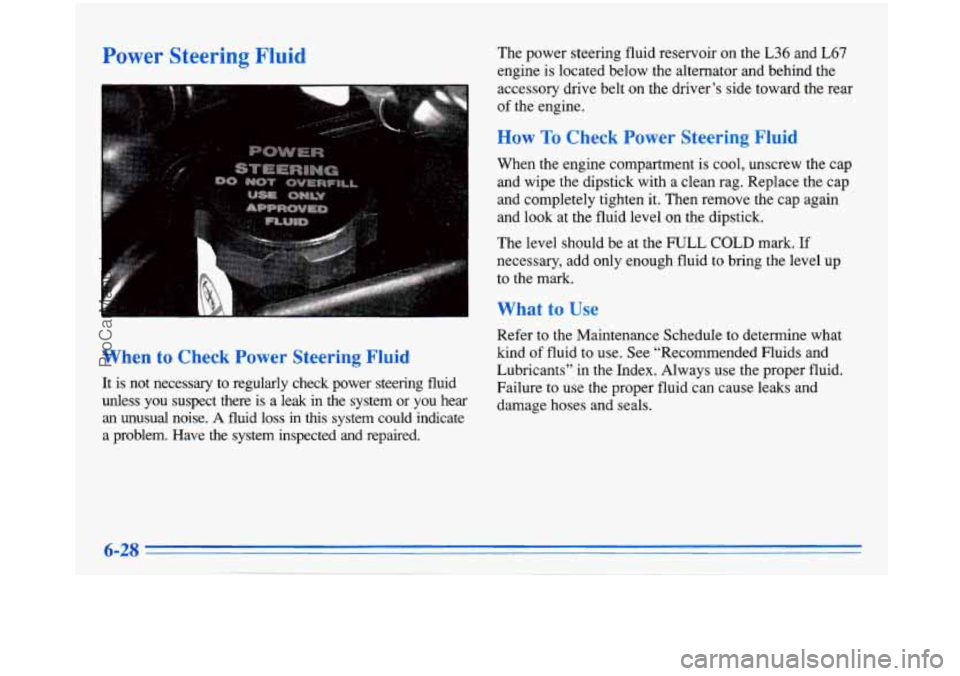
power steering fluid reservoir on the L36 and L67
engine is located below the alternator and behind the
accessory drive belt on the driver’s side toward the rear
of the engine.
How To Check Power Steering Fluid
When the engine compartment is cool, unscrew the cap
and wipe the dipstick with a clean rag. Replace the cap
and completely tighten
it. Then remove the cap again
and look at the fluid level on the dipstick.
The level should be at the FULL COLD mark.
If
necessary, add only enough fluid to bring the level up
to the mark.
What to Use
Refer to the Maintenance Schedule to determine what
kind of fluid
to use. See “Recommended Fluids and
Lubricants” in the Index. Always use the proper fluid.
Failure to use the proper fluid can cause leaks and
damage hoses and seals.
ProCarManuals.com
Page 312 of 388
Capacities and Specifications
Belt Tensions
Automatically controlled by a Self-Tension idler pulley. Tension adjustment should never be necessary.
Automatic Transaxle AT (Overdrive)
When draining or replacing torque converter, more fluid may be needed.
Pan Removal and Replacement
............................................ 6 quarts (5.6 L)
After Complete Overhaul .............................................. 11 quarts (1 0.4 L)
Cooling System ..................................................... 13 quarts (12.3 L)
Oil change with filter change ........................................... 4.5 quarts (4.3 L)
Engine Crankcase
FuelTank
........................................................... 18gallons(68L)
Power Steering
Pump Only ............................................................. 1 pint (0.5 L)
Complete System .................................................... 1 1/2 pints (0.7 L)
Tire Pressures, Sizes ........................... The Tire-Loading Information label, which is
located on the rear edge of the driver’s door,
shows the correct inflation pressures for your tires.
Wheel Nut Torque ................................................. 100 lb-ft (140 N-rn)
Windshield Wiper Blades (6.32 Pin Type) ............................. 22 inches (565 mm)
Refrigerant (R=134a), Air Conditioning ............ See refrigerant charge label under the hood.
NOTE: All capacities are approximate. When adding, be sure to fill to the appropriate level, as recommended
in this manual.
6-64
ProCarManuals.com
Page 315 of 388
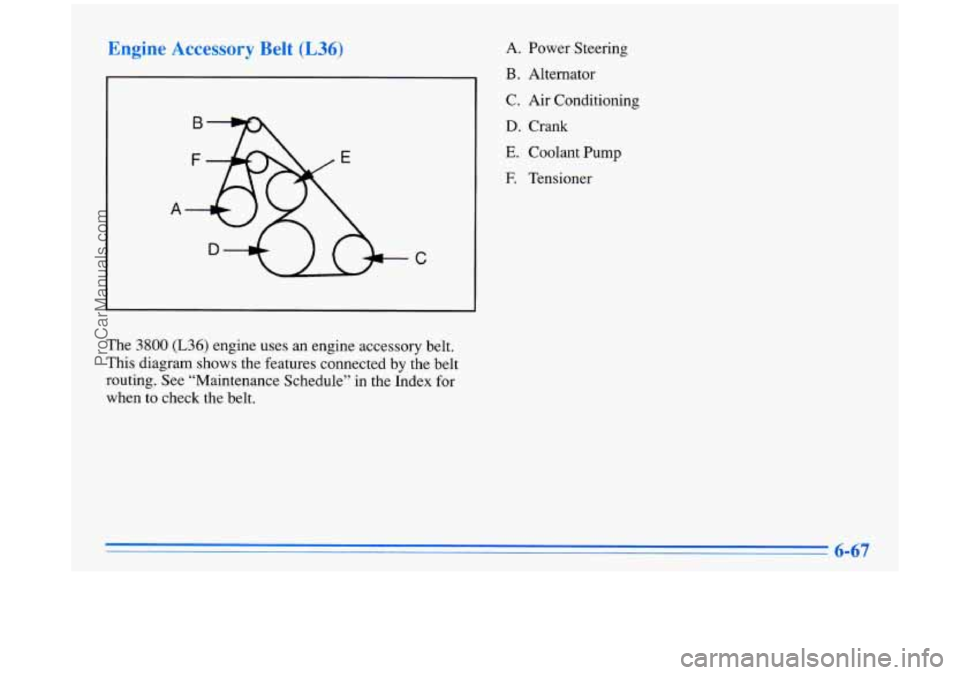
Engine Accessory Belt (L36)
C
I
A. Power Steering
B. Alternator
C. Air Conditioning
D. Crank
E. Coolant Pump
E Tensioner
The
3800 (L36) engine uses an engine accessory belt.
This diagram shows the features connected by the belt
routing. See “Maintenance Schedule” in the Index for
when
to check the belt.
ProCarManuals.com
Page 316 of 388
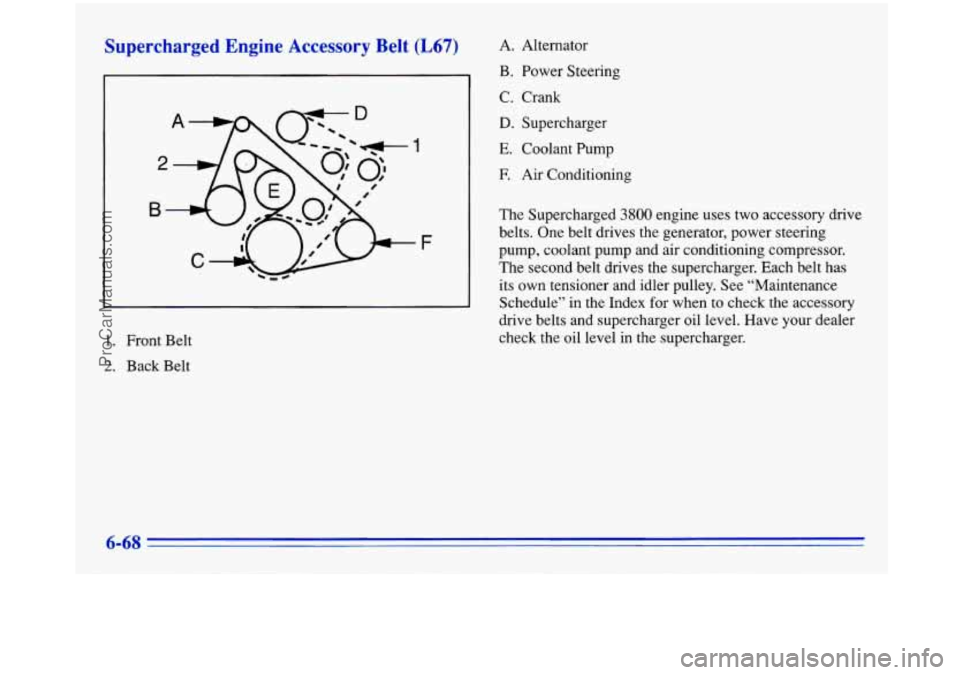
mharged Engine Accessory Belt (L67)
F
1. Front Belt
2. Back Belt A.
B.
C.
D.
E.
E
Alternator
Power Steering
Crank
Supercharger
Coolant Pump
Air Conditioning
The Supercharged
3800 engine uses two accessory drive
belts. One belt drives the generator, power steering
pump, coolant pump and air conditioning compressor.
The second belt drives the supercharger. Each belt has
its own tensioner and idler pulley. See “Maintenance
Schedule” in the Index for when
to check the accessory
drive belts and supercharger oil level. Have your dealer
check the
oil level in the supercharger.
6-68
ProCarManuals.com