Page 227 of 388
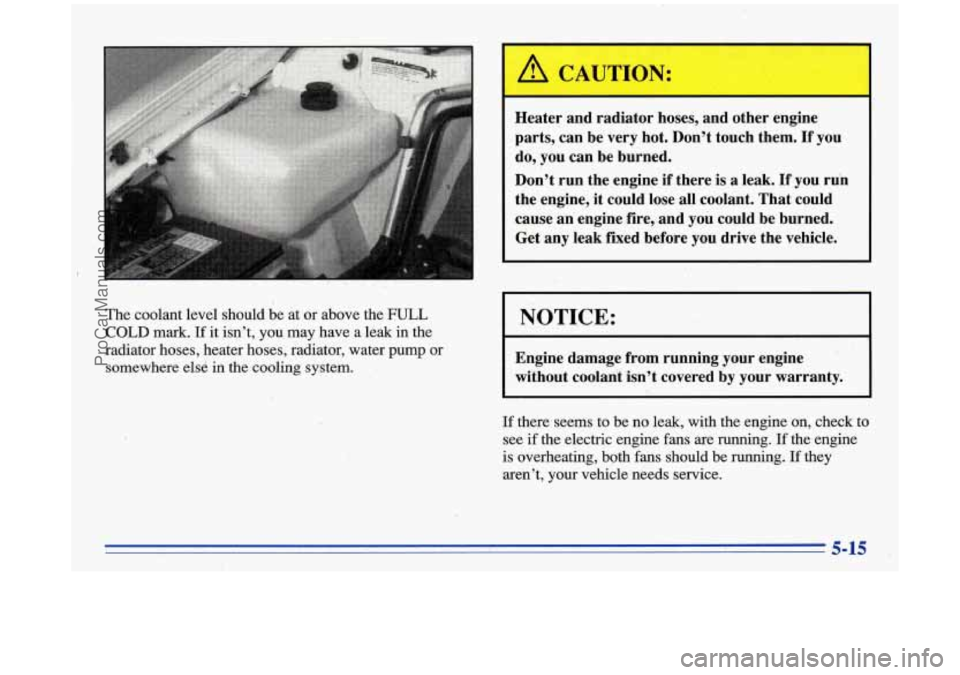
The coolant level should be at or above the FULL
COLD mark. If it isn't, you may have a leak in the
radiator hoses, heater hoses, radiator, water
purnp or
somewhere elsC
in the-cooling system..
I A CAUTION:
I
Heater and radiator hoses, and other engine
parts, can be very hot. Don't touch them.
If you
do, you can be burned.
Don't run the engine
if there is a leak. If you run
the engine, it could lose all coolant. That could
cause an' engine fire, -and you could be burned.
Get any leak fixed before you drive the vehicle.
I NOTICE:
Engine damage from running your engine
without coolant isn't covered
by your warranty.
If there seems to be no leak, with the engine on, check to
see if the electric engine fans are running.
If the engine
is overheating, both fans should be running.
If they
aren't, your vehicle needs service.
5-15 ,
ProCarManuals.com
Page 228 of 388
How to Add Coolant to the Coolant
Recovery Tank
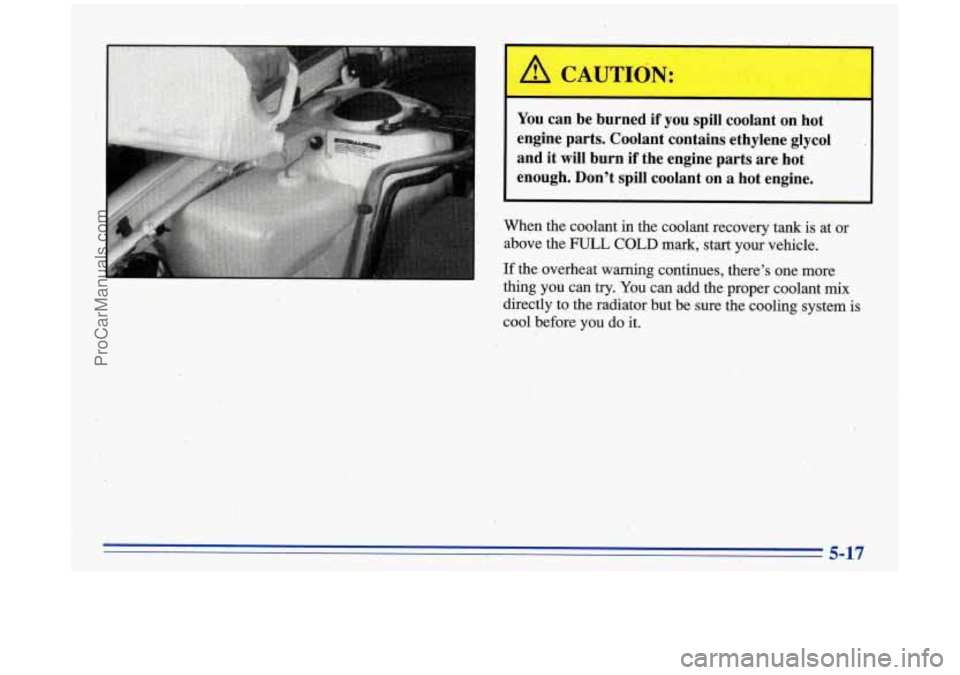
If you haven’t found a problem yet, but the coolant
level isn’t at or above the FULL COLD
mark, add a
50/50 mixture of clean water (preferably distilled) and
DEX-COOL
TM (orange-colored, silicate-free) antifreeze
at the coolant recovery tank.
(See “Engine Coolant” in
the Index for more information.)
Adding only plain water to your cooling system can be dangerous. Plain water, or some other
liquid like alcohol, can boil before the proper
coolant
mix will. Your vehicle’s coolant warning
system
is set for the proper coolant mix. With
plain water or the wrong mix, your engine could
get
too hot but you wouldn’t get the overheat
warning. Your engine could catch fire and you
or
others could be burned. Use a 50/50 mix of clean
water and
DEX-COOL TM antifreeze.
I NOTICE:
In cold weather, water can freeze and crack the
engine, radiator, heater core and other parts.
Use the recommended coolant and the proper
coolant mix.
5-16
ProCarManuals.com
Page 229 of 388
I A CAUTION:
r
You can be burned if you spill coolant on hot
engine parts. Coolant contains ethylene glycol
and it will burn if the engine parts are hot
enough. Don’t spill coolant on a hot engine.
When the coolant in the coolant recovery tank is at or
above the
FULL COLD mark, start your vehicle.
If the overheat warning continues, there’s one more
thing you can try.
You can add the proper coolant mix
directly to the radiator but be sure the cooling system is
cool before you do it.
5-17
ProCarManuals.com
Page 230 of 388
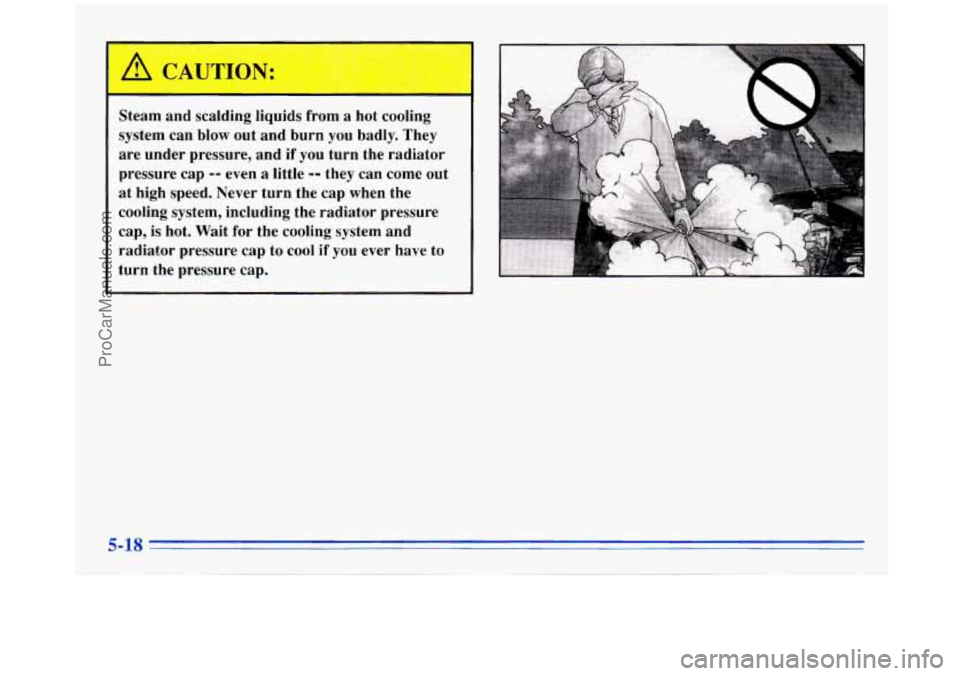
Steam and scalding liquids from a hot cooling
system can blow out and burn you badly. They
are under pressure, and
if you turn the radiator
pressure cap
-- even a little -- they can come out
at high speed. Never turn the cap when the
cooling system, including the radiator pressure
cap, is
hot. Wait for the cooling system and
radiator pressure cap to cool if you ever have to
turn the pressure cap.
5-18
.~
ProCarManuals.com
Page 231 of 388
Horn )., Add CL=-~=- to the Radiator
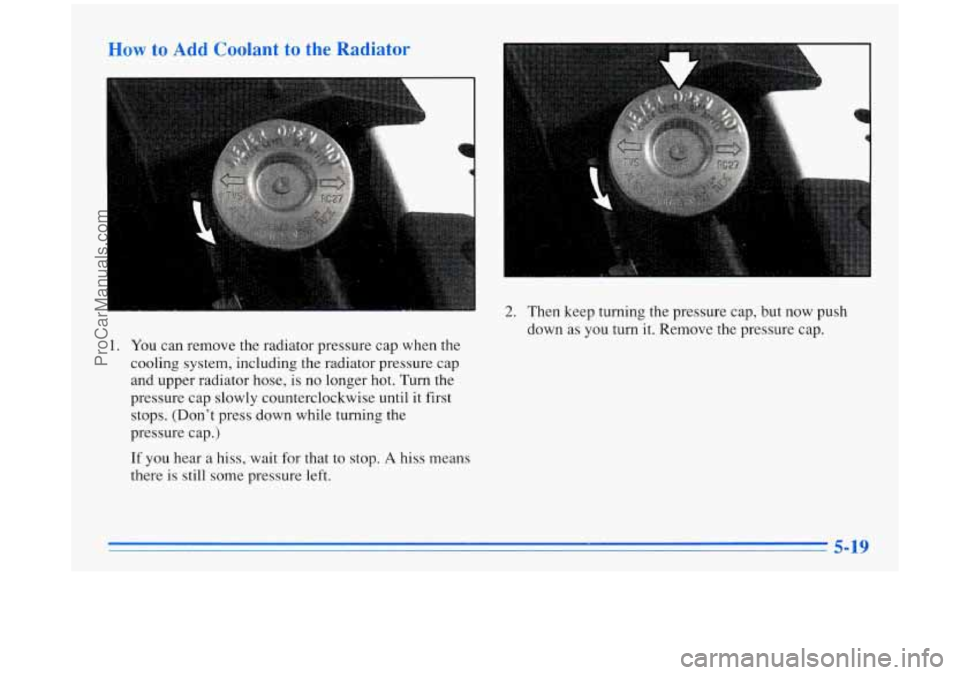
1. You can remove the radiator pressure cap when the
cooling system, including the radiator pressure cap
and upper radiator hose, is no longer hot. Turn the
pressure cap slowly counterclockwise until it first
stops. (Don’t press down while turning the
pressure cap.)
If you hear a hiss, wait for that to stop. A hiss means
there
is still some pressure left.
2. Then keep turning the pressure cap, but now push
down as
you turn it. Remove the pressure cap.
5-19
ProCarManuals.com
Page 271 of 388
How to Add Fluid
Refer to the Maintenance Schedule to determine what
kind of transaxle fluid to use. See “Recommended
Fluids and Lubricants” in the Index.
If the fluid level is low, add only enough
of the proper
fluid to bring the level into the cross-hatched area on
the dipstick.
1. Pull out the dipstick.
2. Using a long-neck funnel, add enough fluid at the
It doesn’t take much fluid, generally less than a pint
(0.5 L). Don’t ovel-fill. We recommend you use only
fluid labeled DEXRON@-111, because fluid with that
label is made especially for your automatic transaxle.
Damage caused by fluid other than DEXRON-I11 is
not covered by your new vehicle warranty.
dipstick hole to
bring it to the proper level.
After adding fluid, recheck the fluid level as
described under “How to Check.”
0 When the correct fluid level is obtained, push the
dipstick back in all the way.
Engine Coolant
The cooling system in your vehicle is filled with new
DEX-COOL
TM (orange-colored, silicate-free) engine
coolant. This coolant is designed to remain in your
vehicle for
5 years or 100,000 miles (166 000 km),
whichever occurs first.
The following explains your cooling system and how
to add coolant when
it is low. If you have a problem
with engine overheating, see “Engine Overheating” in
the Index.
A 50/50 mixture of water and the proper coolant for
your Buick will:
Give freezing protection down to -34°F (-37°C).
9 Give boiling protection up to 265 OF ( 129 O C).
Protect against rust and corrosion.
Help keep the proper engine temperature.
0 Let the warning lights and gages work as they should.
ProCarManuals.com
Page 273 of 388
‘ A CAUTICY:
Adding only plain water to your cooling system
,can be dangerous. Plain water, or some other
liquid like alcohol, can boil before the proper
coolant mix will. Your vehi.cle’s coolant warning
system
is set for the proper coolant mix. With
plain water or the wrong mix, your engine could
get too hot but you wouldn’t get the overheat
warning. Your engine could catch fire
and you or
others could be burned. Use a
50150 mix-of clean
water and
DEX-COOL (orange-colored,
silicate-free) antifreeze.
-
NOTICE:
If you use .an improper coolant mix, your engine
could overheat and be badly damaged. The
repair cost wouldn’t be covered
by your
warranty.
Too much water in the mix can freeze
and crack the engine, radiator, heater core and
other parts.
If you have to add coolant more than four times a year,
have your dealer check your cooling system.
~~
NOTICE:
If you use the proper coolant, you don’t have to
add extra inhibitors or additives which claim to
improve the system. These can be harmful.
6-25
ProCarManuals.com
Page 293 of 388
Wheel Replacement
Replace any wheel that is bent, cracked, or badly rusted
or corroded.
If wheel nuts keep coming loose, the wheel,
wheel bolts and wheel nuts should be replaced. If the
wheel leaks air, replace it (except some aluminum
wheels, which can sometimes be repaired). See
your
Buick dealer if any of these conditions exist.
Your dealer will know the kind
of wheel you need.
Each new wheel should have the same load-carrying
capacity, diameter, width, offset and be mounted the
same way as the one
it replaces.
If you need to replace any of your wheels, wheel bolts
or wheel nuts, replace them only with new
GM original
equipment parts. This way, you will be sure
to have
the right wheel, wheel bolts and wheel nuts for your
Buick model. Using
the wrong replacement wheels, wheel bolts
or wheel nuts on your vehicle can be dangerous.
It could affect the braking and handling of your
vehicle, make your tires lose air and make
you
lose control. You could have a collision in which
you or others could be injured. Always use
the correct wheel, wheel bolts and wheel nuts
for replacement.
NOTICE:
The WtMg wheel can also cause problems with
bearing life, brake cooling, speedometer or
odometer calibration, headlamp aim, bumper
height, vehicle ground clearance and tire or tire
chain‘clearance to the body and chassis.
See “Changing a Flat Tire” in the Index for
more information.
6-45
ProCarManuals.com