1995 PONTIAC PONTIAC change time
[x] Cancel search: change timePage 152 of 354

Braking in Emergencies
At some time, nearly every driver gets into a situation
that requires hard braking.
If you have anti-lock, you can steer and brake at the
same time. However,
if you don’t have anti-lock, your
first reaction
-- to hit the brake pedal hard and hold it
down
-- may be the wrong thing to do. Your wheels can
stop rolling. Once they do, the vehicle can’t respond to
your steering. Momentum will carry it in whatever
direction it was headed when the wheels stopped rolling.
That could be off the road, into the very thing you were
trying to avoid, or into traffic.
If you don’t have anti-lock, use a “squeeze” braking
technique. This will give you maximum braking while
maintaining steering control. You do this by pushing on
the brake pedal with steadily increasing pressure.
In an emergency you will probably want to “squeeze”
the brakes hard without locking the wheels. If you hear
or feel the wheels sliding, ease off the brake pedal. This
will help you retain steering control.
(If you do have
anti-lock, it’s different: see “Anti-Lock Brakes’’ in the
Index.)
In many emergencies, steering can help you more than
even the very best braking.
Steering
Power Steering
If you lose power steering assist because the engine
stops or the system is not functioning, you can steer but
it will take much more effort.
Steering Tips
Driving on Curves
It’s important to take curves at a reasonable speed.
A lot of the “driver lost control” accidents mentioned on
the news happen on curves. Here’s why:
Experienced driver or beginner, each of us is subject to
the same laws of physics when driving on curves. The
traction of the tires against the road surface makes it
possible for the vehicle to change its path when you turn
the front wheels. If there’s no traction, inertia will keep
the vehicle going in the same direction. If you’ve ever
tried to steer a vehicle on
wet ice, you’ll understand this.
The traction you can get in a curve depends on the
condition of your tires and the road surface, the angle
at which the curve is banked, and your speed. While
you’re in a curve, speed is the one factor you can
control.
4-9
ProCarManuals.com
Page 156 of 354
0 Check your mirrors, glance over your shoulder, and
start your left lane change signal before moving out
of the right lane to pass. When you are far enough
ahead of the passed vehicle to see its front in your
inside mirror, activate your right lane change signal
and move back into the right lane. (Remember that
your right outside mirror is convex. The vehicle you
just passed may seem to be farther away from you
than it really
is.)
Try not to pass more than one vehicle at a time on
two-lane roads. Reconsider before passing the next
vehicle.
Don’t overtake a slowly moving vehicle too rapidly.
Even though the brake lights are not flashing,
it may
be slowing down or starting to turn.
If you’re being passed, make it easy for the
following driver to get ahead of you. Perhaps you
can ease a little to the right.
Loss of Control
Let’s review what driving experts say about what
happens when the three control systems (brakes, steering
and acceleration) don’t have enough friction where the
tires meet the road to do what the driver has asked.
In any emergency, don’t give up. Keep trying to steer
and constantly seek an escape route or area of less
danger.
Skidding
In a skid, a driver can lose control of the vehicle.
Defensive drivers avoid most skids by taking reasonable
care suited to existing conditions, and by not
“overdriving” those conditions. But skids are always
possible.
The three types of skids correspond to your Pontiac’s
three control systems. In the braking skid your wheels
aren’t rolling.
In the steering or cornering skid, too
much speed or steering in a curve causes tires to slip and
lose cornering force. And in the acceleration skid too
much throttle causes the driving wheels to spin.
A cornering skid and an acceleration skid are best
handled by easing your foot off the accelerator pedal.
4-13
ProCarManuals.com
Page 172 of 354
Towing a Trailer
NOTICE:
Pulling a trailer improperly can damage your
vehicle and result in costly repairs not covered by
your warranty.
To pull a trailer correctly, follow
the advice in this part, and see your Pontiac
dealer for important information about towing
a
trailer with your vehicle.
Your vehicle can tow a trailer. To identify what the
vehicle trailering capacity is for your vehicle, you should read the information in “Weight
of the Trailer”
that appears later in this section. But trailering is
different than just driving your vehicle by itself.
Trailering means changes in handling, durability, and
fuel economy. Successful, safe trailering takes correct
equipment, and
it has to be used properly.
That’s the reason for this part.
In it are many
time-tested, important trailering tips and safety rules.
Many of these are important for your safety and that
of
your passengers. So please read this section carefully
before you pull a trailer.
Load-pulling components such as the engine, transaxle,
wheel assemblies, and tires are forced to work harder
against the drag of the added weight. The engine is
required to operate at relatively higher speeds and under greater loads, generating extra heat. What’s more, the
trailer adds considerably to wind resistance, increasing
the pulling requirements.
4-29 ProCarManuals.com
Page 229 of 354
~~~ NOTICE:
If the air cleaner is off, a backfire can cause a
damaging
engine fire. And, dirt can easily get
into your engine, which will damage
it. Always
have the
air cleaner in place when you’re driving.
Automatic Transaxle Fluid
When to Check and Change
A good time to check your automatic transaxle fluid
level
is when the engine oil is changed. Refer to the
Maintenance Schedule to determine when to change your fluid. See “Scheduled Maintenance Services” in
the Index.
How to Check
Because this operation can be a little difficult, you may
choose to have this done at your Pontiac dealer Service
Department.
If you do it yourself, be sure to follow all the instructions
here, or you could get a false reading on the dipstick.
NOTICE:
Too much or too little fluid can damage your
transaxle.
Too much can mean that some of the
fluid could
come out and fall on hot engine parts
or exhaust system parts, starting
a fire. Be sure to
get an accurate reading if you check your
transaxle fluid.
6-16
ProCarManuals.com
Page 240 of 354
Some driving conditions or climates may cause a brake
squeal when the brakes are first applied or lightly
applied. This does not mean something is wrong with
your brakes.
Brake linings should always be replaced as complete
axle sets.
Brake Pedal Travel
See your dealer if the brake pedal does not return to
normal height, or
if there is a rapid increase in pedal
travel. This could be a sign
of brake trouble.
Brake Adjustment
Every time you make a moderate brake stop, your disc
brakes adjust for wear.
If you rarely make a moderate or
heavier stop, then your brakes might not adjust correctly.
If you dnve in that way, then -- very carefully -- make
a few moderate brake stops about every 1,000 miles
(1 600 km), so your brakes will adjust properly.
Replacing Brake System Parts
The braking system on a modern vehicle is complex.
Its many parts have to be
of top quality and work well
together
if the vehicle is to have really good braking.
Vehicles we design and test have top-quality
GM brake
parts in them, as your Pontiac does when it is new.
When you replace parts
of your braking system -- for
example, when your brake linings wear down
and you
have to have new ones put in
-- be sure you get new
genuine
GM replacement parts. If you don’t, your
brakes may no longer work properly.
For example, if
someone puts in brake linings that are wrong for your
vehicle, the balance between your front and rear brakes
can change
-- for the worse. The braking performance
you’ve come to expect can change in many other ways
if
someone puts in the wrong replacement brake parts.
6-27
ProCarManuals.com
Page 347 of 354
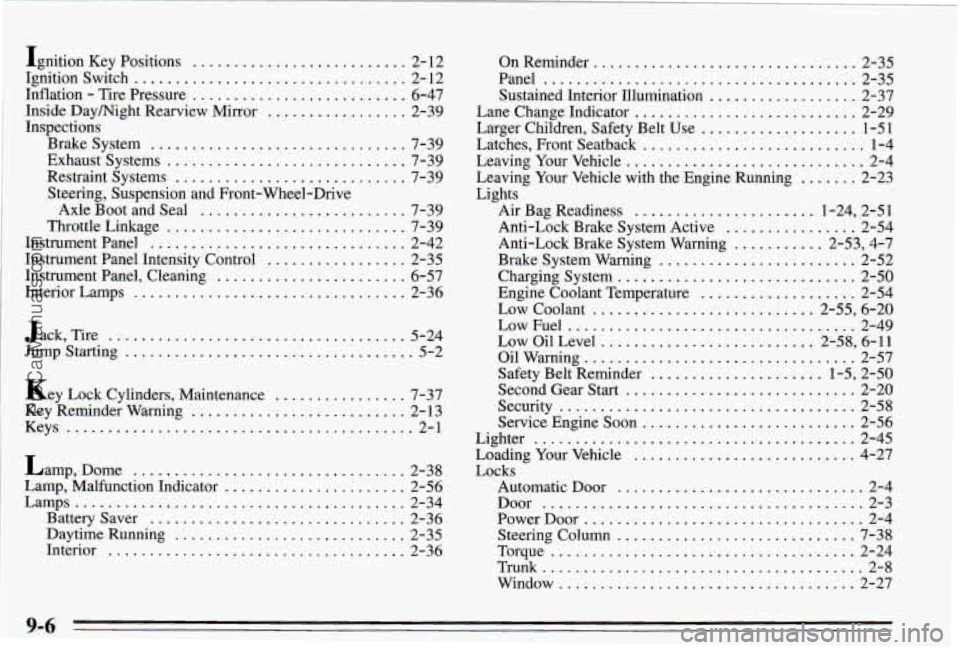
Ignition Key Positions .......................... 2-12
Ignition Switch
................................. 2- 12
Inflation
- Tire Pressure .......................... 6-47
Inside Daymight Rearview Mirror ................. 2-39
Brake System
............................... 7-39
Exhaust Systems
............................. 7-39
Restraint Systems
............................ 7-39
Axle Boot and Seal
......................... 7-39
Instrument Panel
............................... 2-42
Instrument Panel Intensity Control
................. 2-35
Instrument Panel, Cleaning
....................... 6-57
Interior Lamps
................................. 2-36
Jack, Tire
.................................... 5-24
Jump Starting
................................... 5-2
Key Lock Cylinders, Maintenance
................ 7-37
Key Reminder Warning
.......................... 2- 13
Lamp, Dome
................................. 2-38
Inspections
Steering. Suspension and Front-Wheel-Drive
ThrottleLinkage
............................. 7-39
Keys
.......................................... 2-1
Lamp, Malfunction Indicator
...................... 2-56
Daytime Running
............................ 2-35
Lamps
........................................ 2-34
Battery Saver
............................... 2-36
Interior
.................................... 2-36 OnReminder
................................ 2-35
Sustained Interior Illumination
.................. 2-37
Lane Change Indicator
........................... 2-29
Larger Children. Safety Belt Use
................... 1-51
Latches, Front Seatback
........................... 1-4
Leaving Your Vehicle
............................. 2-4
Air Bag Readiness
...................... 1-24, 2-51
Anti-Lock Brake System Active
................ 2-54
Brake System Warning
........................ 2-52
Charging System
............................. 2-50
Engine Coolant Temperature
................... 2-54
Low Coolant
........................... 2-55, 6-20
Low Oil Level
.......................... 2-58, 6- 11
Oil Warning
................................. 2-57
Safety Belt Reminder
..................... 1-5, 2-50
Second Gear Start
............................ 2-20
Service Engine Soon
.......................... 2-56
Loading Your Vehicle ........................... 4-27
Automatic Door
.............................. 2-4
PowerDoor
.................................. 2-4
Steering Column
............................. 7-38
Torque
..................................... 2-24
Window
.................................... 2-27
...................................... Panel 2-35
Leaving Your Vehicle with the Engine Running
....... 2-23
Lights
Anti-Lock Brake System Warning
........... 2-53, 4-7
LowFuel
................................... 2-49
Security
.................................... 2-58
Lighter
....................................... 2-45
Locks Door
....................................... 2-3
Trunk
....................................... 2-8
9-6 ProCarManuals.com