1995 PONTIAC BONNEVILLE power steering
[x] Cancel search: power steeringPage 63 of 338
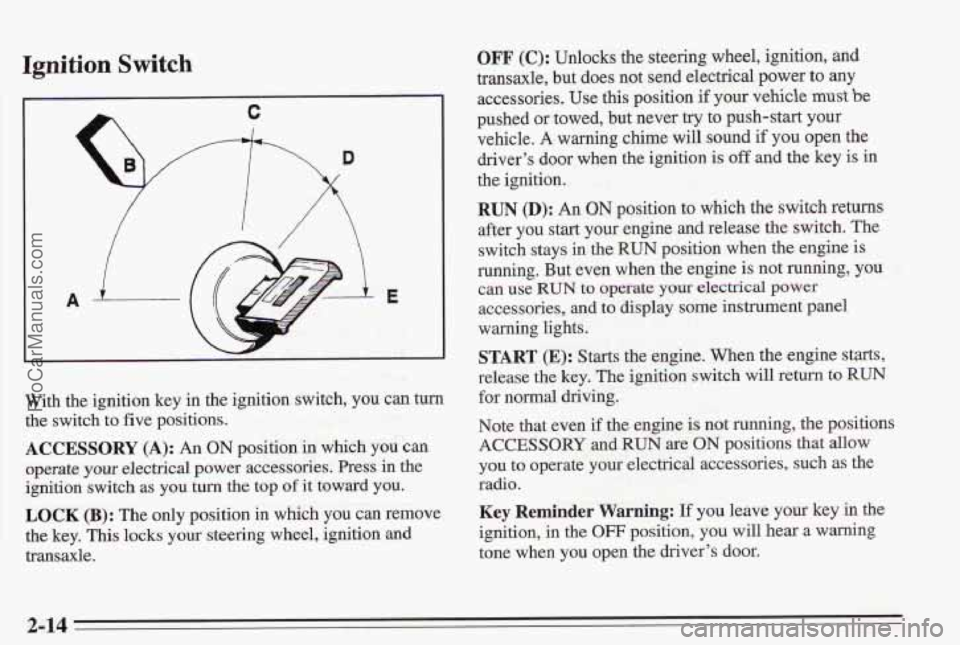
Ignition Switch
With the ignition key in the ignition switch, you can turn
the switch to five positions.
ACCESSORY (A): An ON position in which you can
operate your electrical power accessories. Press in the
igniti’on switch as you turn the top of it toward you.
LOCK (B): The only position in which you can remove
the key, This locks your steering wheel, ignition and
transaxle.
OFF (e): Unlocks the steering wheel, ignition, and
transaxle, but does not send electrical power to any
accessories.
Use this position if your vehicle me be
pushed or towed, but never try to push-start your
vehicle.
A warning cbime will sound if you open the
driver’s door when the ignition
is off and the key is in
the ignition.
RUN 0): An ON position to which the switch returns
after you start your engine and release the switch. The
switch stays in the RUN position when the engine is
running. But even when the engine is not running, you
accessories,
and to display some instrument panel
warning lights.
§TART (E): Starts the engine. When the engine starts,
release de key. The ignition switch will return to
RUN
for normal driving.
Note that even if
the engine is not running, the positions
ACCESSORY and RUN are ON positions that allow
you to operate
yom electrical accessories, such as the
radio.
Key Reminder Warning: If you leave your key in the
ignition, in the OFF position, you will hear a warning
tone when you open the driver’s door.
CEUl Use Rm to QPe3Tit.e yOlar &C!T’kd power
2-14 ProCarManuals.com
Page 64 of 338
Retained Accessory Power: If you have ths option,
after you turn your ignition
off and even remove the key,
you will still have electrical power to such accessories
as the radio and power windows for up to ten minutes.
But if you open
a door, power is turned off.
NOTICE:
If your key seems stuck in LOCK and you can’t
turn it, be sure it is all the way in.
If it is, then
turn the steering wheel left and right while you
turn the key hard. But turn the key only with
your hand. Using a tool to force it could break
the key
or the ignition switch. If none of this
works, then your vehicle needs service.
Starting Your Engine
Move your shift lever to PARK (P) or NEUTRAL (N).
Your engine won’t start in any other position -- that’s a
safety feature.
To restart when you’re already moving,
use
NEUTRAL (N) only.
NOTICE:
Don’t try to shift to PARK (P) if your Pontiac is
moving. If you do, you could damage the
transaxle. Shift to PARK
(P) only when your
vehicle is stopped.
To start your 3.8 Liter engine:
1. Without pushing the accelerator pedal, turn your
ignition key to
START. When the engine starts, let
go of the key. The idle speed will go down as your
engine gets
warm.
NOTICE:
Holding your key in START for longer than 15
seconds at a time will cause your battery to be
drained much sooner.
And the excessive heat can
damage your starter motor.
2-15
ProCarManuals.com
Page 152 of 338
Braking in Emergencies
Use your anti-lock braking system when you need to.
With anti-lock, you can steer and brake at the same
time. In many emergencies, steering can help you more
than even the very best braking.
Steering
Power Steering
If you lose power steering assist because the engine
stops or the system is not functioning, you can steer but
it will take much more effort.
Variable Effort Steering
If your vehicle is equipped with this option, you have a
variable
effort steering system that eases steering effort
at speeds less than 20 mph (32 km/h). This is
particularly useful when parking your vehicle.
Steering Tips
Driving on Curves
It’s important to take curves at a reasonable speed.
A lot of the “driver lost control” accidents mentioned on
the news happen on curves. Here’s why: Experienced driver
or beginner, each
of us is subject to
the same laws
of physics when driving on curves. The
traction of the tires against the road surface makes it
possible for the vehicle to change its path when you turn
the front wheels. If there’s no traction, inertia will keep
the vehicle going in the same direction.
If you’ve ever
tried
to steer a vehicle on wet ice, you’ll understand this.
The traction you can get in a curve depends
on the
condition
of your tires and the road surface, the angle at
which the curve is banked, and your speed. While you’re
in a curve, speed is the one factor you can control.
Suppose you’re steering through a sharp curve. Then you
suddenly accelerate. Both control systems
-- steering and
acceleration
-- have to do their work where the tires meet
the road. Unless you have traction control and the system
is on, adding the sudden acceleration can demand too
much of those places. You can lose control.
What should you do
if this ever happens? Ease up on the
accelerator pedal, steer the vehicle the way you want
it
to go, and slow down.
Speed limit signs near curves warn that you should
adjust your speed. Of course, the posted speeds are
based on good weather and road conditions. Under less
favorable conditions you’ll want to go slower.
4-9
ProCarManuals.com
Page 224 of 338

Engine Accessory Belt
A
C
The 3800 (L36) engine uses an engine accessory belt.
This diagram shows the features connected by the belt
routing. See “Maintenance Schedule” in the Index for
when to check the belt.
A. Power Steering
B . Alternator
C. Air Conditioning
D. Crank
E. Coolant Pump
E Tensioner
3800 Supercharged (L67) Engine
(Option)
Your Bonneville may have a 3800 Supercharged engine.
The Supercharger is
a device which is designed to pump
more air into the engine than it would normally
use.
This air mixed with fuel, creates increased engine
power. Since the Supercharger is a pump and is driven
from an engine accessory drive belt, increased pressure
is available at all driving conditions.
The powertrain control module
(PCM), works with a
vacuum control to regulate the increased pressure
required during specific driving conditions. When this
increased pressure or boost is not desired, such as during
idling
and light throttle cruising, the excess air that the
Supercharger is pumping is routed through a bypass.
All
of these controls, working together provide high
performance character
and fuel efficiency in the
3800 V6 Supercharged engine.
The power steering pump uses a remote reservoir
mounted on the throttle and cruise control cable bracket.
See “Maintenance Schedule”
in the Index for when you
should check the fluid.
6-11
ProCarManuals.com
Page 225 of 338

Engine Accessory Belt coolant pump and air conditioning compressor. Each
belt has its own tensioner and idler pulley.
1. Front Belt C. Crank
2. Back Belt D. Supercharger
A. Alternator
E. Coolant Pump
B. Power Steering E Air Conditioning
The Supercharged
38800 engine uses two accessory drive
belts. One belt drives the generator and the power
steering pump. The second belt drives the supercharger, See
“Maintenance Schedule” in
the Index for when to
check the accessory drive belts and Supercharger oil
level. Have your dealer check the oil level in the
Supercharger.
Engine Oil
CHECK OIL
LEVEL
If the CHECK QIL LEVEL light on the instrument
panel comes
on, it means you need to check your engine
oil level
right away. for more information, see “Check
Oil Level Light” in
the Index. You should check your
engine
oil level regularly; this is an added reminder.
6-12
ProCarManuals.com
Page 238 of 338

Power Steering Fluid
How To Check Power Steering Fluid
When the engine compartment is cool, unscrew the cap
and wipe the dipstick with a clean rag. Replace the cap
and completely tighten it. Then remove the cap again
and look
at the fluid level on the dipstick.
The level should be at the FULL
COLD mark. Add
enough fluid to bring the level up to the mark.
A fluid loss in this system could indicate a problem.
Have the system inspected and repaired. The
power steering fluid reservoir on the
L67 engine is
to the right
of the supercharger and in front of the
transaxle dipstick.
The power steering fluid reservoir on the
L36 engine is
located below the alternator and behind the accessory
drive belt.
What to Add
Refer to the Maintenance Schedule to determine what
kind
of fluid to use. See “Recommended Fluids and
Lubricants” in the Index.
I
NOTICE:
When adding power steering fluid or making a
complete fluid change, always use the proper
fluid. Failure
to use the proper fluid can cause
leaks and damage hoses and seals.
ProCarManuals.com
Page 262 of 338

Fuses and Circuit Breakers
The wiring circuits in your vehicle are protected from
short circuits by a combination of fuses and circuit
breakers.
The main fuse panel is located to the left of the steering
wheel, under the instrument panel. that
explains the features and controls governed by each
fuse and relay.
Headlamp Wiring
The headlamp wiring is protected by a circuit breaker in
the lamp switch. An electrical overload will
cause the
lamps to
go on and off, or in some cases to remain off. If
Snap off the cover to reveal the fuses. You’ll find
a fuse this happens,
have your headlamp system checked right
puller clipped to the inside of the cover. Place the wide away.
end of the fuse puller over the plastic end of the fuse.
Squeeze the ends over the fuse and pull it out.
Spare fuses
are located in the slots labeled “Spare” on
the chart on the next page.
Look at the silver-colored band inside the fuse. If the
band is broken or melted, replace the fuse. Be sure you
replace a bad fuse with a new one of the correct size.
When finished, replace the cover and pinch the release
levers again
to unlock the panel. Press it back up into
place.
Maxifusemelay Center
To check the fuses in this underhood fuse center, turn
the two knobs 1/4 turn counterclockwise and loosen the
metal wing nut on the passenger side of the cover. Then
remove the cover. The inside of the cover has a chart
Windshield Wipers
The windshield wiper motor is protected by a circuit
breaker and a fuse. If the motor overheats due to heavy
snow, etc., the wiper will stop until the motor cools.
If
the overload is caused by some electrical problem, have
it fixed.
Power Windows and Other Power Options
Circuit breakers in the fuse panel protect the power
windows and other power accessories. When the current
load is too heavy, the circuit breaker opens and closes,
protecting the circuit until the problem is fixed.
6-49
ProCarManuals.com
Page 263 of 338
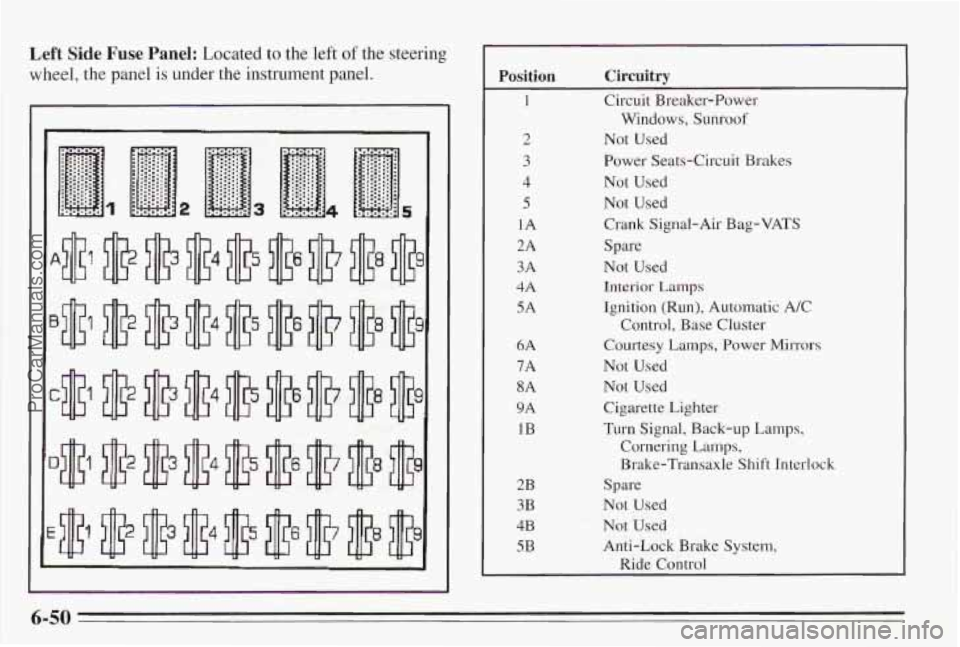
Left Side Fuse Panel: Located to the left of the steering
wheel, the panel
is under the instrument panel. Position Circuitry
1 Circuit Breaker-Power
2 Not Used
3 Power Seats-Circuit Brakes
4 Not Used
5 Not Used
1A Crank Signal-Air Bag-VATS
2A Spare
3A Not Used
4A Interior Lamps
5A Ignition (Run), Automatic A/C
6A Courtesy Lamps, Power Mirrors
7A Not Used
8A Not Used
9A Cigarette Light.er
1B Turn Signal, Back-up Lamps,
Windows, Sunroof
Control, Base Cluster
Cornering
Lamps,
Brake-Transaxle Shift Interlock
2B Spare
3B Not Used
4B Not Used
5B Anti-Lock Brake System,
Ride
Control
6-50
ProCarManuals.com