Page 66 of 338
Driving Through Deep Standing Water
NOTICE:
If you drive too quickly through deep puddles or
standing water, water can come in through your
engine's air intake and badly damage your
engine. Never drive through water that is slightly
lower than the underbody
of your vehicle. If you
can't avoid deep puddles
or standing water, drive
through them very slowly.
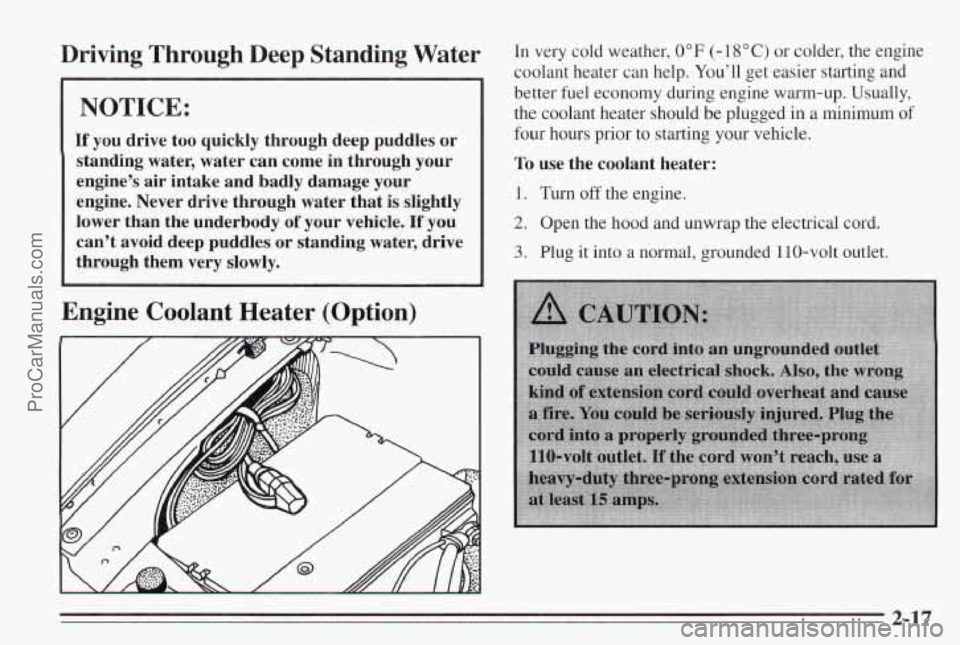
Engine Coolant Heater (Option)
In very cold weather, 0°F (- 18 "C) or colder, the engine
coolant heater can help.
You'll get easier starting and
better fuel economy during engine warm-up.
Usually,
the coolant heater should be plugged in a minimum of
four hours prior
to starting your vehicle.
To use the coolant heater:
1. Turn off the engine.
2. Open the hood and unwrap the electrical cord.
3. Plug it into a normal, grounded 110-volt outlet.
2-17
ProCarManuals.com
Page 67 of 338
1 NOTICE:
After you’ve used the coolant heater, be sure to
store the cord
as it was before to keep it away
from moving engine parts. If you don’t, it could
be damaged.
How long should you keep the coolant heater plugged
in? The answer depends on the weather, the kind
of oil
you have, and some other things. Instead of trying to list
everything here, we ask that you contact your Pontiac
dealer in the area where you’ll be parking your vehicle.
The dealer can give
you the best advice for that
particular area.
Shifting the Automatic Transaxle
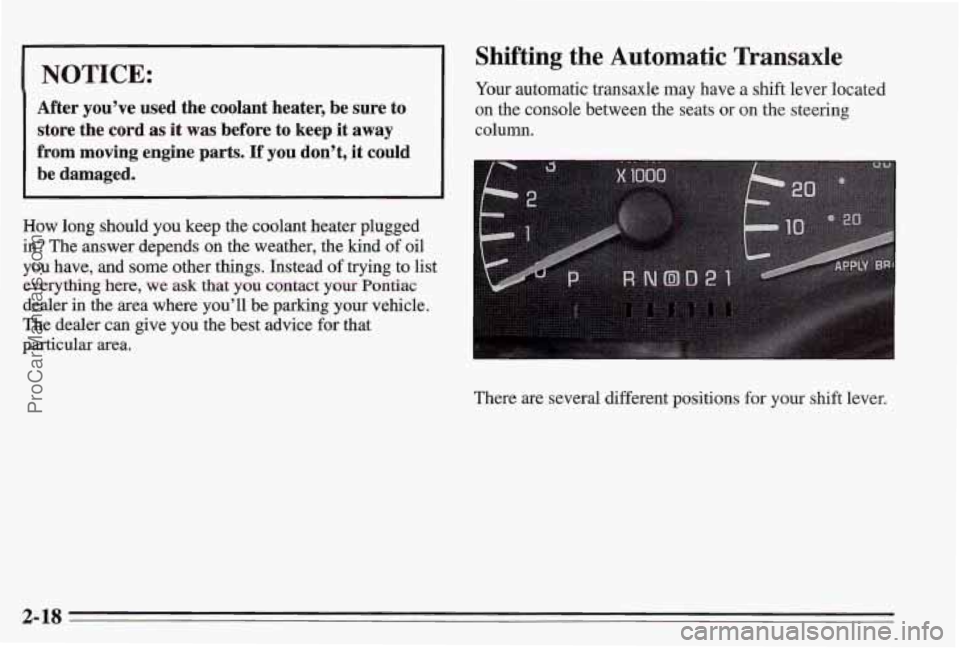
Your automatic transaxle may have a shift lever located
on the console betwe’en the seats
or on the steering
column.
There are several different positions for your shift lever.
2-18
ProCarManuals.com
Page 122 of 338
Section 3 Comfort Controls and Audio Systems
In this section you’ll find out how to operate the comfort
control systems and audio systems offered with your
Pontiac. Be sure to read about the particular system
supplied with your vehicle.
This section tells you how to make your air system work
for you. Your Comfort Control System uses the new
ozone-friendly R134a refrigerant.
Fresh air
from outside your vehicle flows through your
Pontiac when the car is moving. When the vehicle
is not
moving, you can get outside air
to flow through by
selecting any
air choice (except the rear window
defogger) and any fan speed. The air conditioner and
heater work best if you keep your windows closed while
using them. If
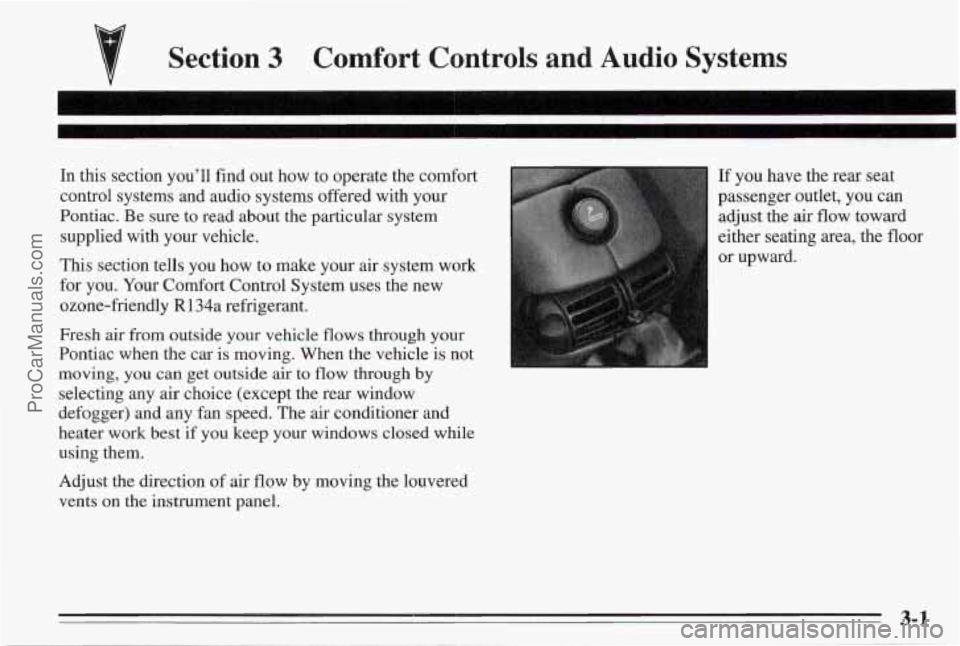
you have the rear seat
passenger outlet, you can
adjust the
air flow toward
either seating area, the floor
or upward.
Adjust the direction
of air flow by moving the louvered
vents on the instrument panel.
ProCarManuals.com
Page 124 of 338
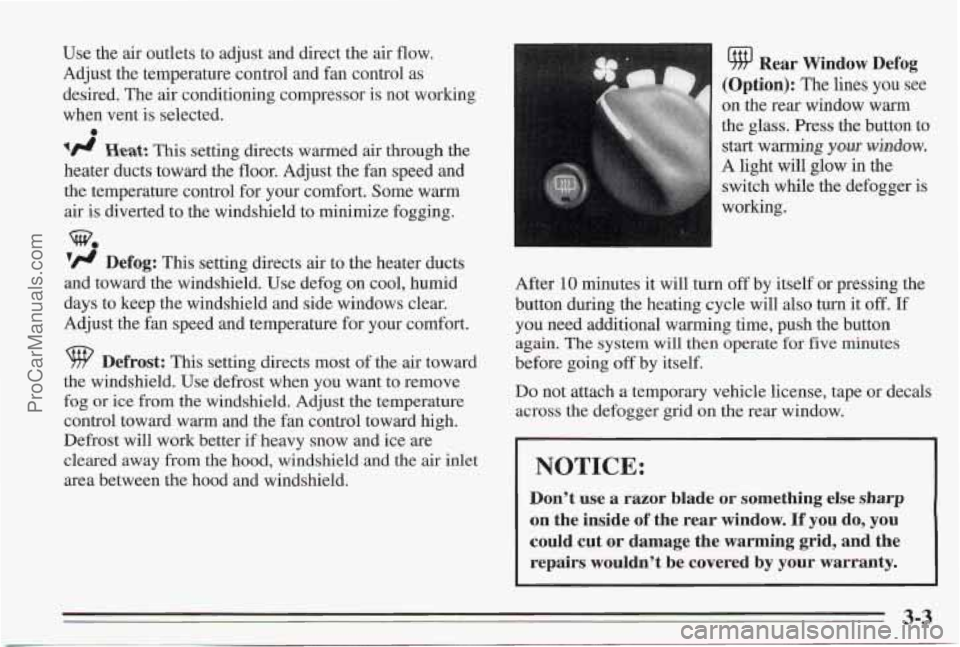
Use the air outlets to adjust and direct the air flow.
Adjust the temperature control and fan control as
desired. The air conditioning compressor is not working
when vent is selected.
I# Heat: This setting directs warmed air through the
heater ducts toward the floor. Adjust the fan speed and
the temperature control for your comfort. Some warm
air is diverted to the windshield to minimize fogging.
'fl Defog: This setting directs air to the heater ducts
and toward the windshield. Use defog on cool, humid
days to keep the windshield and side windows clear.
Adjust the fan speed and temperature for your cornfort.
9 Defrost: This setting directs most of the air toward
the windshield. Use defrost when you want to remove
fog or ice from the windshi'eld. Adjust the temperature
control toward
warm and the fan control toward high.
Defrost will work better if heavy snow and ice
are
cleared away from the hood, windshield and the air inlet
area between the hood and windshield.
0
w.
u/HI Rear Window Defog
(Option): The lines you see
on the rear window warm
the glass. Press the button to
A light
will glow in the
switch while the defogger is
working. start
warming ymr wlndow.
After 10 minutes it
will turn off by itself or pressing the
button during the heating cycle will
also turn it off. If
you need additional warming time, push the button
again. The system will then operate for five rninutes
before going off by itself.
Do not attach a temporary vehicle license, tape or decals
across the defogger grid
on the rear window.
NOTICE:
Don't use a razor blade or something else sharp
on the inside of the rear window. If you do, you
could cut or damage the warming grid, and the
repairs wouldn't be covered
by your warranty.
3-3
ProCarManuals.com
Page 127 of 338
After 10 minutes, it will go off by itself, or pressing the Ventilation Tips
button again during the heating cycle will turn it off. If
you need additional warming time, push the button
again. The system will then operate for five minutes
before going
off by itself.
Do not attach a temporary vehicle license, tape or decals
across the defogger grid on the rear window.
Keep the hood and front air inlet free of ice, snow, or
any other obstruction (such as leaves). The heater
and defroster will work better, reducing the chance
of fogging your windows.
Control
in cold weather, select a heater function that
0 When you enter a vehicle with Standad Climate
NOTICE:
Don't use a razor blade or something else sharp
on the inside
of the rear window. If you do, you
could cut
or damage the warming grid, and the
repairs wouldn't be covered by your warranty.
OF /"C: Press this button to read the temperature in
degrees Fahrenheit or Celsius.
., .. .
provides air through the floor ducts, then turn the fan
to
HI for a few moments before driving away. This
will blow moist air from the intake ducts toward the
floor, not the windshield. It reduces the chance of
fogging your windows.
If you have the Electronic
Climate Control, the
AUTO setting does this for you.
0 Keep the air path under the fbnt seats clear of objects.
This helps air to circulate throughout your vehicle.
When the engine idles for a long time, the exterior
temperature sensor may cause
the system to blow air
that is too cool. Once the vehicle is moving again the
system
will try to maintain the set temperature inside
your vehicle.
0 When you start your vehicle and the EXT TEMP
display flashes for some time, the system may need
repair. See your Pontiac dealer.
3-6
ProCarManuals.com
Page 170 of 338
clo'th to your vehicle to alert police that you've been
stopped by the snow. Put
on extra clothing or wrap a
blanket around you. If you have no blankets or extra
clothing, make body insulators from newspapers, burlap
bags, rags, floor mats
-- anything you can wrap around
yourself
or tuck under your clothing to keep warm.
You can run the engine to keep warm, but be careful.
Run your engine only as long as you must.
This saves
fuel. When
you run the engine, make it go a little faster
than just idle. That is, push the accelerator slightly. This
uses less fuel
for the heat that you get and it keeps the
battery charged. You will need a well-charged battery
to
restart the vehicle, and possibly for signaling later on
with your headlamps. Let the heater run for awhile.
ProCarManuals.com
Page 192 of 338

If you get the overheat warning with no sign of steam,
try
this for a minute or so:
1. Turn off your air conditioner.
2. Turn on your heater to full hot at the highest fan
speed and open the window as necessary.
3. If you’re in a traffic jam, shift to NEUTRAL (N);
otherwise, shift to the highest gear while driving --
AUTOMATIC OVERDRIVE (@) or DRIVE (D).
If y’ou no longer have the overheat warning, you can
drive. Just to be safe, drive slower for about ten minutes.
If the warning doesn’t come back
on, you can drive
normally.
If the warning continues, pull over, stop, and park your
vehicle right away.
If there’s still
no sign of steam, you can idle the engine
for two or three minutes while you’re parked, to see if
the warning stops. But then, if you still have the
warning,
turn off the engine and get everyone out of the
vehicle until it cools down.
You may decide not to lift the hood but to get service
help right away.
Cooling System
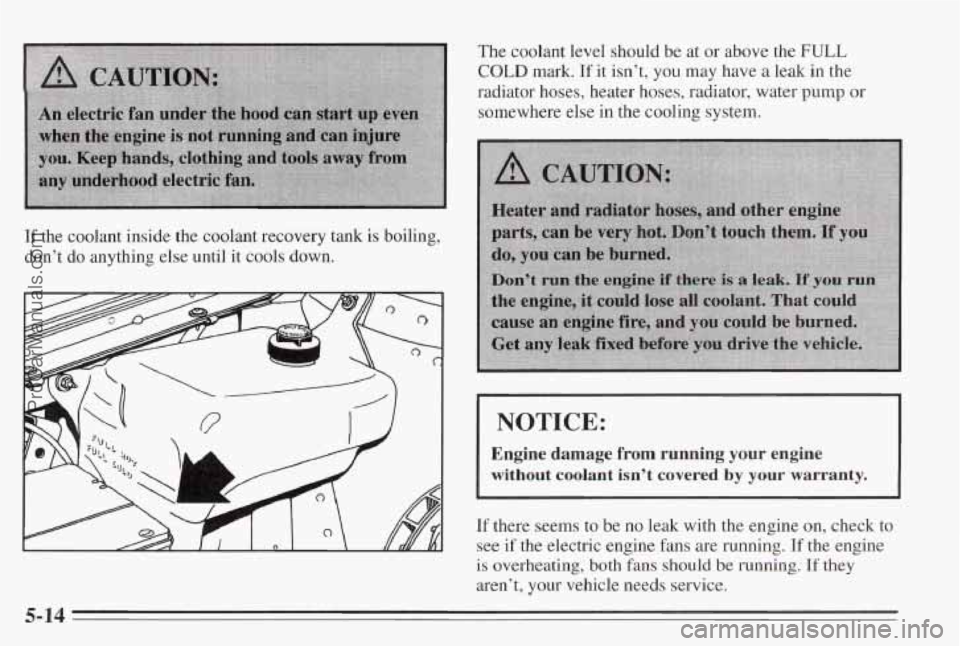
When you decide it’s safe to lift the hood, here’s what
you’ll see:
Coolant recovery tank
0 Radiator pressure cap
0 Electric engine fans
5-13
ProCarManuals.com
Page 193 of 338
If the coolant inside the coolant recovery tank is boiling,
don’t
do anything else until it cools down.
The coolant level should be at or above the FULL
COLD mark. If it isn’t, you may have a leak in the
radiator hoses, heater hoses, radiator, water
pump or
somewhere else in the cooling system.
NOTICE:
Engine damage from running your engine
without coolant isn’t covered by your warranty.
If there seems to be no leak with the engine an, check to
see if the electric engine fans are running. If the engine
is overheating, both fans should be running. If they
aren’t,
your vehicle needs service.
5-14
ProCarManuals.com