Page 149 of 390
If the anti-lock brake system warning light stays on
longer than normal after you’ve started your engine,
turn
the ignition off. Or, if the light comes on and stays on
when you’re driving, stop as soon as possible and turn
the ignition
off. Then start the engine again to reset the
system. If the light still stays on, or comes on again
while you’re driving, your Oldsmobile needs service.
If
the light is on but not flashing and the regular brake
system warning light isn’t on, you still have brakes, but
you don’t have ahti-lock brakes.
Traction Control System Warning Light
(Option)
TCS
This warning light should
come on briefly as you start
the engine.
If the warning light doesn’t come on then, have it fixed
so it will be ready to warn you if there’s a problem. If it
stays on, or comes on when you’re driving, there may be
a problem with your traction control system and your
vehicle may need service. When this warning light
is on,
the system will not limit wheel spin. Adjust your driving
accordingly.
If your brakes begin to overheat, the traction control
system will
turn off and the warning light will come on
until your brakes cool down. If the traction control
system warning light comes on and stays on for an
extended period
of time, your vehicle needs service.
2-79
ProCarManuals.com
Page 153 of 390
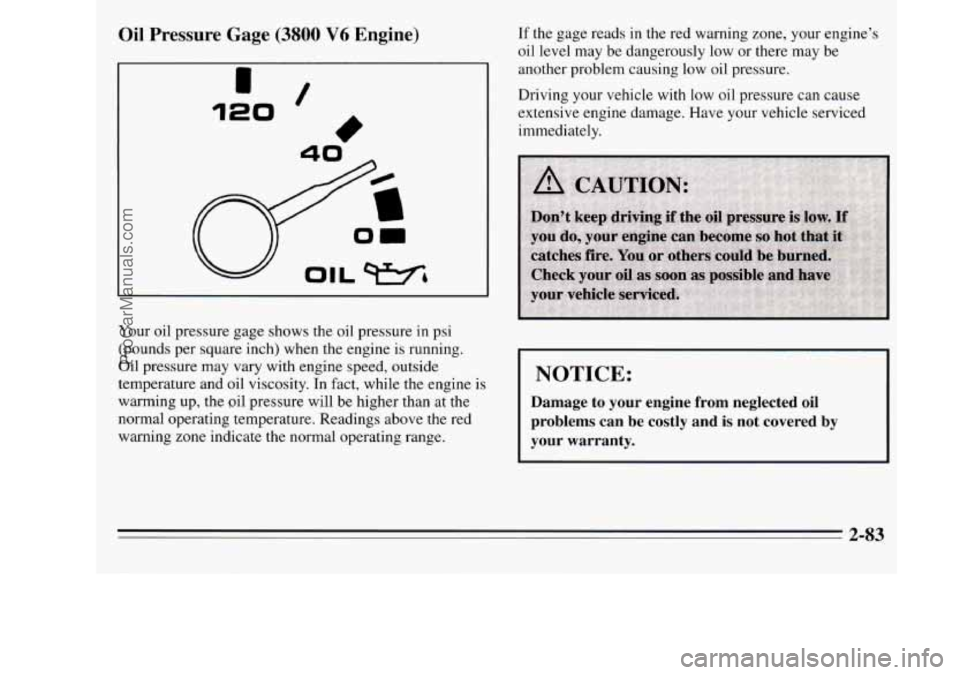
Oil Pressure Gage (3800 V6 Engine)
120 '/
40-
If the gage reads in the red warning zone, your engine's
oil level may be dangerously low or there may be
another problem causing low oil pressure.
Driving your vehicle with low
oil pressure can cause
extensive engine damage. Have your vehicle serviced
immediately.
Your oil pressure gage shows the oil pressure in psi
(pounds per square inch) when the engine is running.
Oil pressure may vary with engine speed, outside
temperature and oil viscosity. In fact, while the engine is
warming up, the oil pressure will be higher than at the
normal operating temperature. Readings above the red
warning zone indicate the normal operating range.
I
I NOTICE:
Damage to your engine from neglected oil
problems can be costly and is not covered by
your warranty.
2-83
ProCarManuals.com
Page 154 of 390
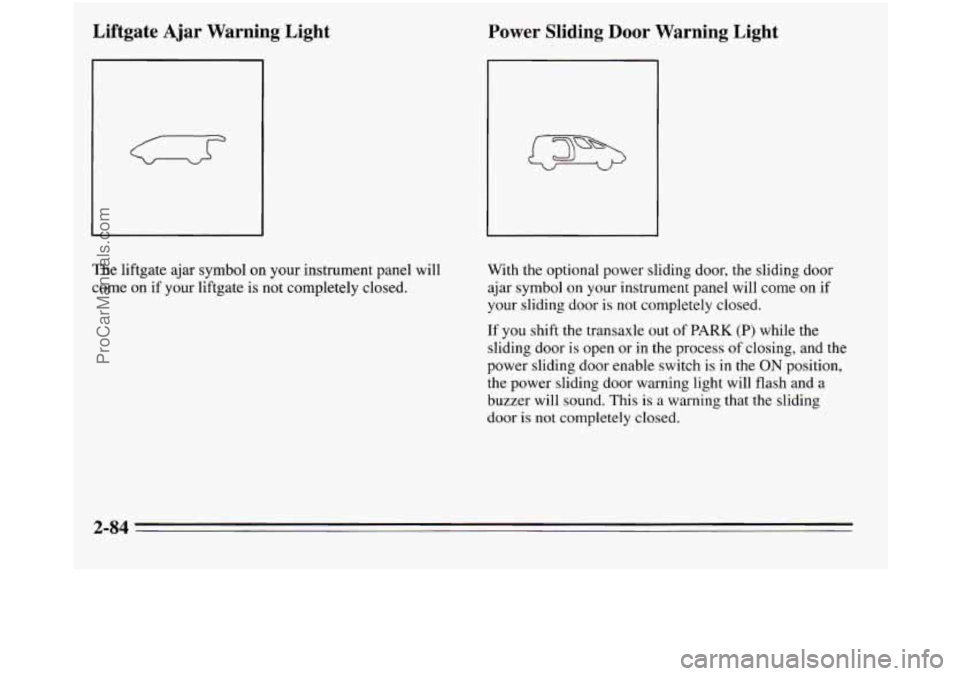
The liftgate ajar symbol on your instrument panel will
come
on if your liftgate is not completely closed.
Power Sliding Door Warning Light
With the optional power sliding door, the sliding door
ajar symbol
on your instrument panel will come on if
your sliding door is not completely closed.
If you shift the transaxle out of PARK (P) while the
sliding door is open or in the process
of closing, and the
power sliding door enable switch is
in the ON position,
the power sliding door warning light will flash and a
buzzer will sound.
This is a warning that the sliding
door is not completely closed.
2-84
ProCarManuals.com
Page 155 of 390
If you manually slam the power sliding door shut when
the ignition is on, the power sliding door warning light
may come on and stay on.
To turn the light off, reopen
and close the
door using either power door switch, or
manually open and close the door again more slowly.
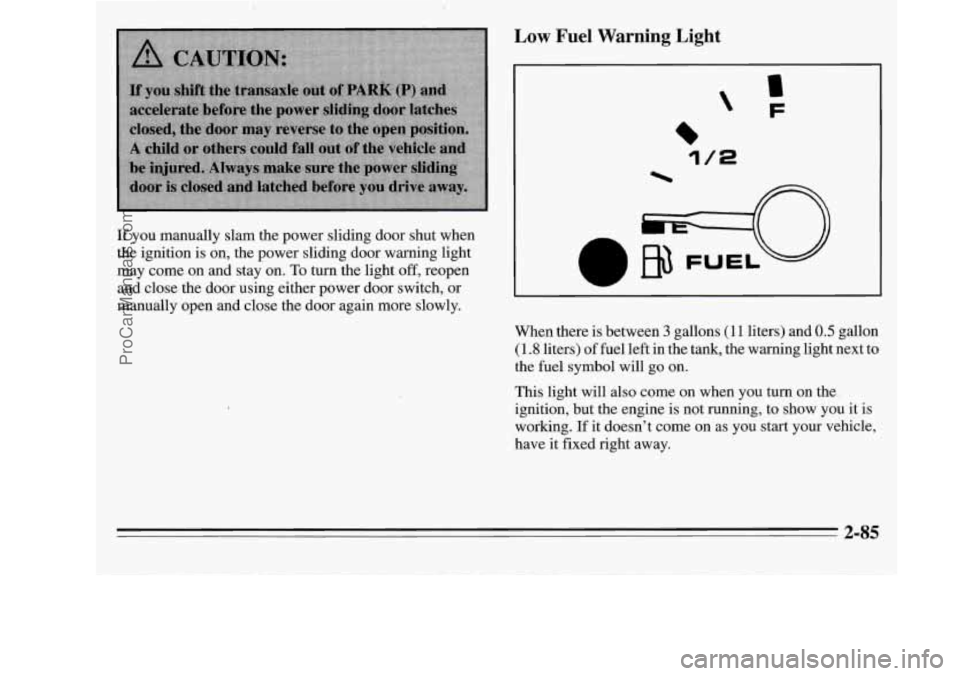
Low Fuel Warning Light
L
F
When there is between 3 gallons (1 1 liters) and 0.5 gallon
(1.8 liters) of fuel left in the tank, the warning light next to
the fuel symbol will go on.
This light will also come on when you turn on the,
ignition, but the engine is not running, to show you
it is
working. If it doesn’t come on as you start your vehicle,
have it fixed right away.
2-85
ProCarManuals.com
Page 189 of 390
When you start your vehicle, or when you begin to drive
away, you may hear
a momentary motor or clicking
noise. And
you may even notice that your brake pedal I
moves a little while this is going on. This is the ABS
system testing itself. (You may also hear a clicking noise
if you leave the ignition in the
RUN position for about
four seconds before starting the vehicle.) If there’s
a
problem with the anti-lock brake system, the anti-lock
brake system warning light will stay on or flash.
See “Anti-Lock Brake System Warning Light’’ in the
Index. Here’s
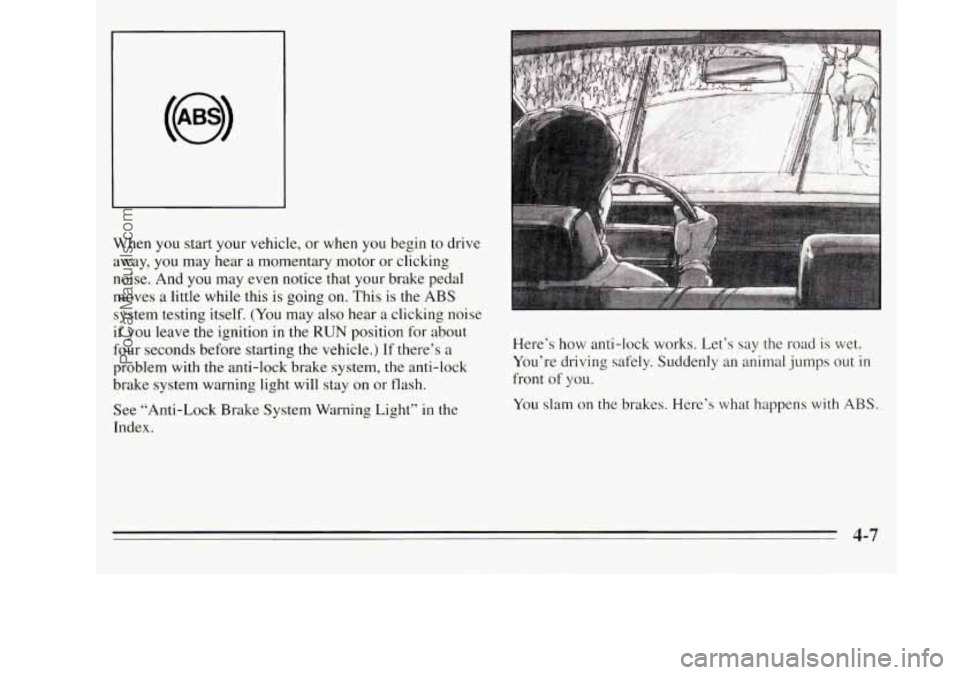
how anti-lock works. Let’s say the road
is wet.
You’re driving safely. Suddenly an animal jumps out
in
front of you.
You slam on the brakes. Here’s what happens with
ABS.
4-7
ProCarManuals.com
Page 191 of 390
Traction Control System
(Option:
3800 V6 Engine)
Your vehicle may have a traction control system that
limits wheel spin. This is especially useful in slippery
road conditions. The system operates only if it senses
that one or both of the front wheels are spinning or
beginning to lose traction.
When this happens, the system works the front brakes
and reduces engine power to limit wheel spin.
The LOW TRACTION light will come on when your
traction control system is limiting wheel spin. See
“Low Traction Light” in the Index. You may feel the
system working, or you may notice some noise, but this
is normal.
If your vehicle is in cruise control when the traction
control system begins to limit wheel spin, the cruise
control will automatically disengage. When road
conditions allow you
to safely use it again, you may
re-engage the cruise control. (See “Cruise Control” in
the Index.)
TCS
The TCS warning light will come on to let you know if
there’s a problem with your traction control system.
See “Traction Control System Warning Light’’ in the
Index. When this warning light is on, the system will not
limit wheel spin. Adjust your driving accordingly.
4-9
ProCarManuals.com
Page 197 of 390
is off, then an acceleration skid is also best handled by
easing your foot
off the accelerator pedal.
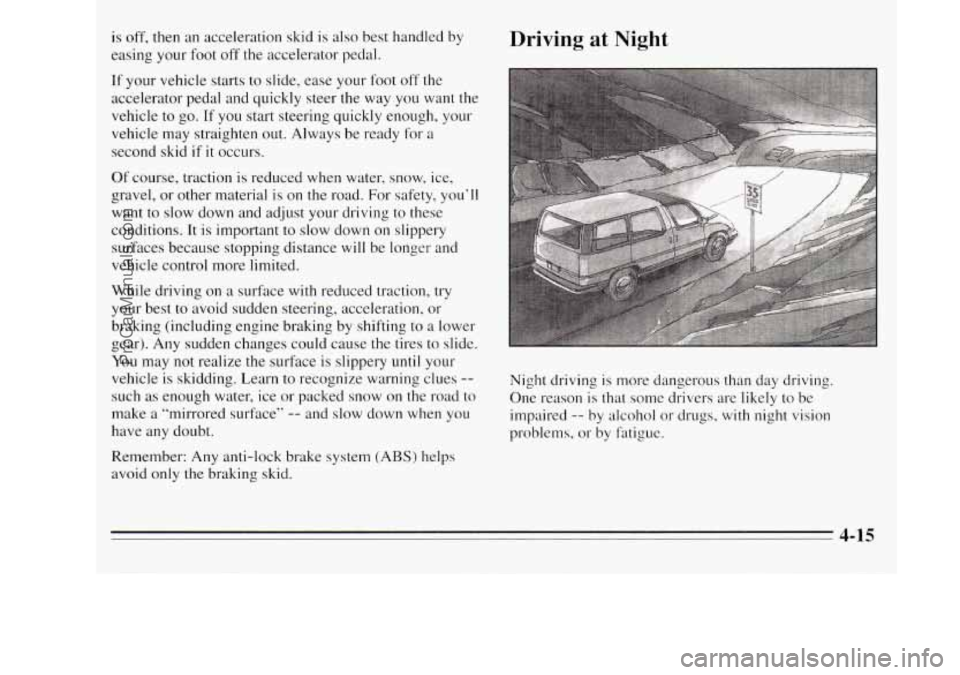
Driving at Night
If your vehicle starts to slide, ease your foot off the
accelerator pedal and quickly steer the way you want the
vehicle to go. If you start steering quickly enough, your
vehicle may straighten out. Always be ready for a
second
skid if it occurs.
Of course, traction is reduced when water, snow, ice,
gravel, or other material
is on the road. For safety, you’ll
want to slow down and adjust your driving
to these
conditions. It is important to slow down on slippery
surfaces because stopping distance
will be longer and
vehicle control more limited.
While driving on
a surface with reduced traction, try
your best
to avoid sudden steering, acceleration, or
braking (including engine braking by shifting
to a lower
gear). Any sudden changes could cause the tires to slide.
You may not realize the surface is slippery until your
vehicle is skidding. Learn to recognize warning clues
--
such as enough water, ice or packed snow on the road to
make
a “mirrored surface” -- and slow down when you
have any doubt.
Remember: Any anti-lock brake system
(ABS) helps
avoid
only the braking skid. Night
driving
is more dangerous than day driving.
One reason is that some drivers are likely to be
impaired
-- by alcohol or drugs, with night vision
problems, or by fatigue.
4-15
ProCarManuals.com
Page 202 of 390
Here are ways to increase your safety in city driving:
Know the best way to get to where you are going.
Get
a city map and plan your trip into an unknown
part
of the city just as you would for a cross-country
trip.
Freeway Driving
Try to use the freeways that rim and crisscross most
large cities. You’ll save time and energy. (See the
next part, “Freeway Driving.”)
Treat a green light as a warning signal. A traffic light
is there because the corner is busy enough
to need it.
When a light turns green, and just before you start
to move, check both ways for vehicles that have
not cleared the intersection or may be running the
red light.
Mile for
mile, freeways (also called thruways, parkways,
expressways, turnpikes. or superhighways) are the safest
of all roads. But they have their own special rules.
4-20
ProCarManuals.com