Page 188 of 372
Driving on Snow or Ice
Most of the time, those places where your tires meet the
road probably have
good traction.
Include an ice scraper,
a small brush or broom, a supply
of windshield washer fluid, a rag, some winter outer
clothing,
a small shovel, a flashlight, a red cloth, and a
couple of reflective warning triangles. And, if you will
be driving under severe conditions, include a small bag
of sand, a piece of old carpet or a couple of burlap bags
to help provide traction. Be sure you properly secure
these items
in your vehicle. However,
if there is snow
or ice between your tires and the
road, you can have a very slippery situation. You’ll have
a
lot less traction or ”grip” and will need to be very careful.
4-24
ProCarManuals.com
Page 192 of 372

Loading Your Vehicle
TIRE-LOADING INFORMATION
OCCUPANTS VEHICLE CAP. WT
FRT. CTR. RR. TOTAL
LBS. KG
MAX. LOADING & GVWR SAME AS VEHICLE
CAPACITY
WEIGHT XXX COLD TIRE
TIRE SIZE SPEED PRESSURE
RTG PSI;KPa
FRT.
RR.
SPA.
IF TIRES ARE HOT, ADD 4PSI.'28KPa
SEE OWNER'S MANUAL FOR ADDITIONAL
[ INFORMATION
Two labels on your vehicle show how much weight it
may properly carry. The Tire-Loading Information label
found on the rear edge of the driver's door tells
you the
proper size, speed rating and recommended inflation
pressure for the tires on your vehicle.
It also gives YOLI
important information about the number of people that
can be
in your vehicle and the total weight that you can
carry. This weight is called the Vehicle Capacity Weight
and includes the weight of
all occupants, cargo, and all
nonfactory-installed options.
MFD BY GENERAL MOTORS CORP
DATE GVWR GAWR
FRT GAWR RR
THIS VEHICLE CONFORMS TO ALL APPLI-
CABLE U.S. FEDERAL MOTOR VEHICLE
SAFETY, BUMPER, AND THEFT PREVENTION
STANDARDS IN EFFECT
ON THE DATE OF
MANUFACTURE SHOWN ABOVE.
The other label is the Certification label, found on the
rear edge of the driver's door.
It tells you the gross
weight capacity
of your vehicle, called the GVWR
(Gross Vehicle Weight Rating). The GVWR includes
the weight of the vehicle, all occupants, f~~el and cargo.
Never exceed the GVWR for your vehicle, or the Gross
Axle Weight Rating (GAWR) for either the
front of rear
axle.
And,
if you do have a heavy load, you should spread
it out. Don't carry more than I76 lbs. (80 kg) in your
trunk.
ProCarManuals.com
Page 194 of 372

Towing a Trailer
NOTICE:
Pulling a trailer improperly can damage your
vehicle and result in costly repairs not covered by
your warranty.
To pull a trailer correctly, follow
the advice in this part, and see your Aurora
retailer for important information about towing
a trailer with your vehicle.
Your vehicle can tow a trailer. To identify what the
vehicle trailering capacity is for your vehicle,
you
should read the information in "Weight of the Trailer"
that appears later
in this section. But trailering is
different
than just driving your vehicle by itself.
Trailering means changes
in handling, durability, and
fuel economy. Successful, safe trailering takes correct
equipment, and
it has to be used properly.
That's the reason for this part.
In it are many
time-tested, important trailering tips and safety rules.
Many
of these are important for your safety and that of
your passengers. So please read this section carefully
before
you pull a trailer.
Load-pulling components such as the engine, transaxle,
wheel assemblies, and tires are forced to work harder
against the drag
of the added weight. The engine is
required to operate at relatively higher speeds and under
greater loads, generating extra heat. What's more, the
trailer adds considerably
to wind resistance, increasing
the pulling requirements.
4-30
ProCarManuals.com
Page 196 of 372
Weight of the Trailer Tongue
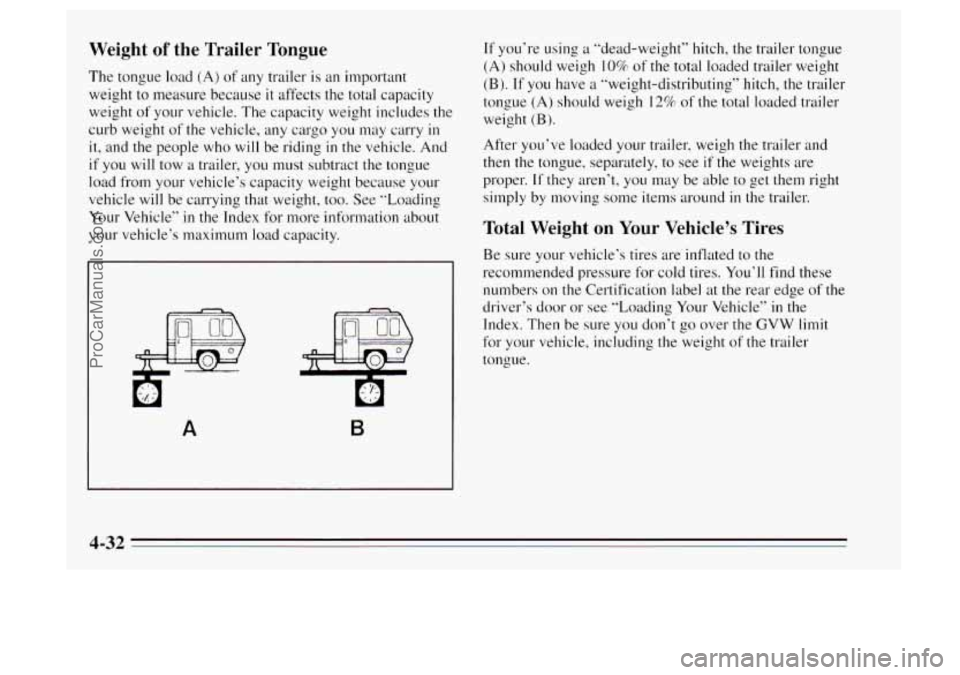
The tongue load (A) of any trailer is an important
weight to measure because
it affects the total capacity
weight of your vehicle. The capacity weight includes the
curb weight of the vehicle, any cargo you may carry
in
it, and the people who will be riding in the vehicle. And
if you will tow a trailer, you must subtract the tongue
load from your vehicle’s capacity weight because your
vehicle will be carrying that weight, too. See “Loading
Your Vehicle”
in the Index for more information about
your vehicle’s maximum load capacity.
B A
If you’re using a “dead-weight” hitch, the trailer tongue
(A) should weigh 10% of the total loaded trailer weight
(B). If you have a “weight-distributing” hitch, the trailer
tongue
(A) should weigh 12% of the total loaded trailer
weight (B).
After you’ve loaded your trailer, weigh the trailer and
then the tongue, separately, to see
if the weights are
proper.
If they aren’t, YOLI may be able to get them right
simply by moving some items around
in the trailer.
Total Weight on Your Vehicle’s Tires
Be sure your vehicle’s tires are inflated to the
recommended pressure for cold tires. You’ll find these
numbers on the Certification label at the rear edge of the
driver’s door or see “Loading Your Vehicle”
in the
Index. Then be sure you don’t go over the
GVW limit
for your vehicle, including the weight of the trailer
tongue.
4-32
ProCarManuals.com
Page 198 of 372

Driving with a Trailer
Towing a trailer requires a certain amount of experience.
Before setting out for the open road,
you'll want to get
to know your rig. Acquaint yourself with the feel of
handling and braking with the added weight
of the
trailer. And always keep
in mind that the vehicle you are
driving is now a good deal longer and not nearly as
responsive as your vehicle is by itself.
Before
you start, check the trailer hitch and platform
(and attachments), safety chains, electrical connector,
lights, tires and mirror adjustment.
If the trailer has
electric brakes, start your vehicle and trailer moving and
then apply the trailer brake controller by Imnd to be sure
the brakes are working. This lets you check your
electrical connection at the same time.
During your
trip, check occasionally to be sure that the
load is secure, and that the lights and any trailer brakes
are still working.
Following Distance
Stay at least twice as far behind the vehicle ahead as you
would when driving your vehicle without a trailer. This
can help you avoid situations that require heavy braking
and sudden turns.
Passing
You'll need more passing distance up ahead when
you're towing a trailer. And, because you're a good deal
longer, you'll need to go much farther beyond the
passed vehicle before
you can return to your lane.
Backing Up
Hold the bottom of the steering wheel with one hand.
Then, to move the trailer to the left, just move that hand
to the left. To move the trailer to the right, move yo~~r
hand to the right. Always back
up slowly and, if
possible. have someone guide you.
4-34
ProCarManuals.com
Page 208 of 372
Towing Your Vehicle
I
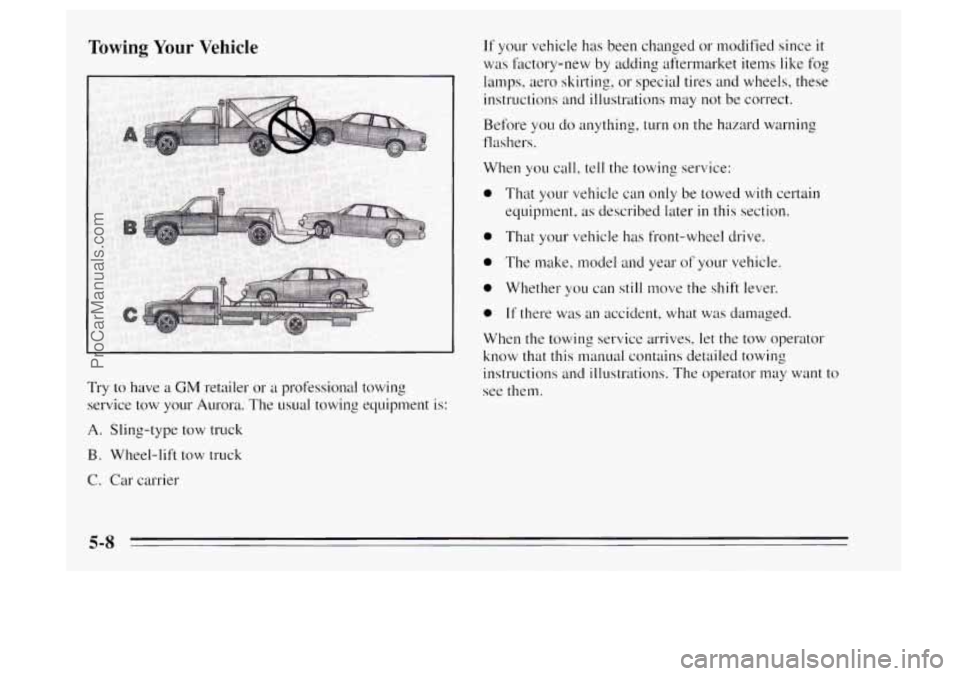
Try to have a GM retailer or a professional towing
service tow your Aurora. The usual towing equipment
is:
A. Sling-type tow truck
B. Wheel-lift tow truck
C. Car carrier
If your vehicle has been changed or modified since it
was factory-new
by adding aftermarket items like fog
lamps, aero skirting, or special tires and wheels, these
instructions and illustrations may
not be correct.
Before you do anything, turn
on the hazard warning
flashers.
When
you call, tell the towing service:
0
0
0
e
0
That your vehicle can only be towed with certain
equipment, as described later
in this section.
That your vehicle has front-wheel drive.
The make, model and year of your vehicle.
Whether you can still n~ove the shift lever.
If there was an accident, what was damaged.
When the towing service arrives, let the tow operator
know that this manual contains detailed towing
instructions and illustrations. The operator may want to
see them.
5-8
ProCarManuals.com
Page 221 of 372

If a Tire Goes Flat
It’s unusual for a tire to “blow out” while you’re driving.
especially
if you maintain your tires properly. If air goes
out of a tire, it‘s much more likely to leak out slowly.
But
if you should ever have a “blowout,” here are a few
tips about what to expect and what to do:
If a front tire fdils, the flat tire will create a drag that
pulls
the vehicle toward that side. Take your foot off the
accelerator pedal and grip the steering wheel firmly.
Steer to maintain lane position, then gently brake to a
stop well out
of the traffic lane.
A rear blowout, particularly on a curve, acts much like a
skid and may require the same correction you’d use in a
skid. In any rear blowout, remove your foot from the
accelerator pedal. Get the vehicle under control by
steering the way you want the vehicle to go.
It may be
very bumpy and noisy, but you can still steer. Gently
brake to a stop, well off the road
if possible.
If a tire goes flat, the next part shows how to use your
jacking equipment to change
a flat tire safely.
Changing a Flat Tire
If a tire goes flat, avoid further tire and wheel damage
by driving slowly to a level place. Turn on your hazard
warning flashers.
5-21
ProCarManuals.com
Page 222 of 372
The following steps will tell you how to use the jack and
change a tire.
The equipment you’ll need is
in the trunk.
Instructions for changing your tires are on the inside of
the tire cover.
You can rest the cover near you for easy
reference while
you change the tire.
1. Turn the center retainer
bolt on the spare tire
cover counterclockwise
to remove
it, then lift the
tire cover.
2. The jack container is labeled PRESS SIDES LIFT
TOP. Do this, then remove the jack and wrench.
5-22
ProCarManuals.com