Page 109 of 240
Gasoline
The following are the EPA-approved percentages of oxygenates:
ETHANOL (ethyl or grain alcohol)
You may use gasoline containing up to 10% ethanol by volume. Gasolinecontaining ethanol may be marketed
under the name "Gasohol."
MTBE (Methyl Tertiary Butyl
Ether)
You may use gasoline containing up to 15% MTBE by volume. METHANOL (methyl or wood
alcohol)
You may use gasoline containing up to 5% methanol by volume as long as
it also contains cosolvents andcorrosion inhibitors to protect the
fuel system. Gasoline containing more than 5% methanol by volume
may cause starting and/or perform-
ance problems. It may also damage
metal, rubber and plastic parts of
your fuel system.
If you notice any undesirable
operating symptoms, try anotherservice station or switch to another
brand of gasoline.
Fuel system damage or performance
problems resulting from the use of
an oxygenated fuel containing more
than the percentages of oxygenates
given above are not covered under
warranty. Driving in Foreign Countries
Using any type of leaded gasoline in
your Honda will affect performance
and damage its emission controls.
Unleaded gasoline may not be
available in other countries. If you
are planning to take your car outside
the U.S. or Canada, write to Honda at
the address shown for information about any modifications your car
may need. Be sure to include the
year and model of your car.
U.S. Owners:
American Honda Motor Co., Inc. Consumer Affairs
1919 Torrance Blvd.
Torrance, CA 90501-2746
Canadian Owners:
Honda Canada Inc.
715 Milner Ave.
Scarborough, Ontario M1B 2K8
Before DrivingProCarManuals.comMain Menu Table of Contents s t
Page 110 of 240
Service Station Procedures
Filling the Fuel Tank
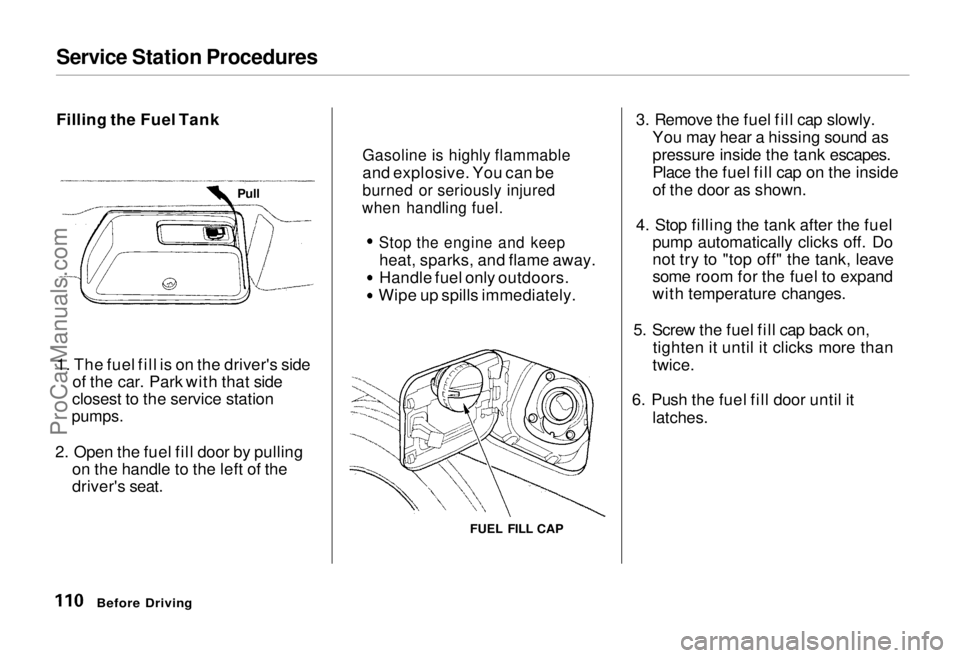
1. The fuel fill is on the driver's side
of the car. Park with that side
closest to the service station
pumps.
2. Open the fuel fill door by pulling on the handle to the left of the
driver's seat.
FUEL FILL CAP3. Remove the fuel fill cap slowly.
You may hear a hissing sound as
pressure inside the tank escapes.
Place the fuel fill cap on the inside
of the door as shown.
4. Stop filling the tank after the fuel pump automatically clicks off. Do
not try to "top off" the tank, leave
some room for the fuel to expand
with temperature changes.
5. Screw the fuel fill cap back on, tighten it until it clicks more than
twice.
6. Push the fuel fill door until it
latches.
Before Driving
Gasoline is highly flammable
and explosive. You can be
burned or seriously injured
when handling fuel.
Stop the engine and keep
heat, sparks, and flame away.
Handle fuel only outdoors.
Wipe up spills immediately.
PullProCarManuals.comMain Menu Table of Contents s t
Page 111 of 240
Service Station Procedures
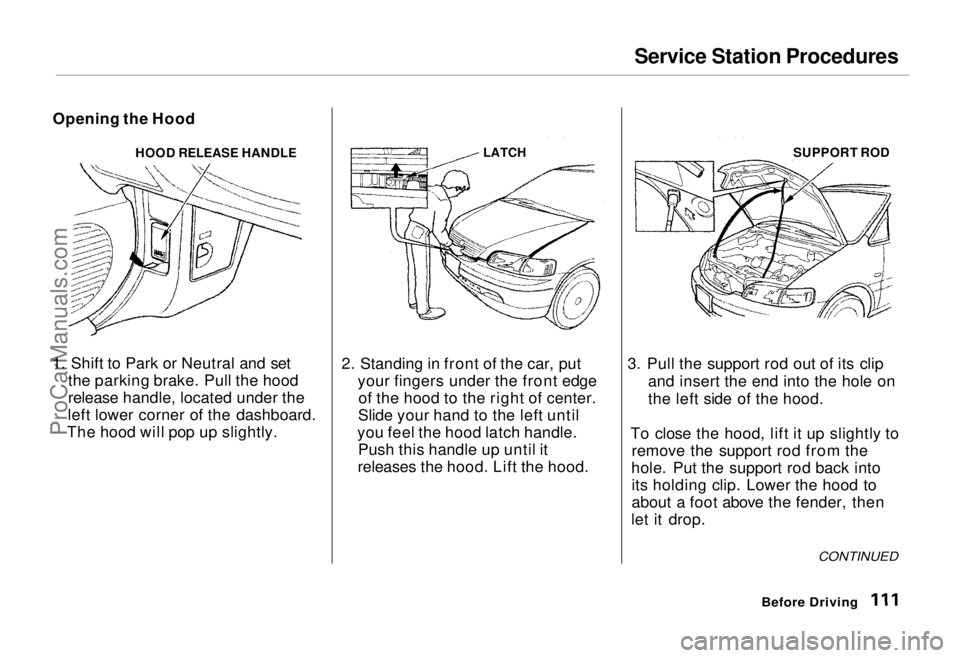
Opening the Hood HOOD RELEASE HANDLE
1. Shift to Park or Neutral and set the parking brake. Pull the hood
release handle, located under the
left lower corner of the dashboard.
The hood will pop up slightly.
LATCH
2. Standing in front of the car, put your fingers under the front edgeof the hood to the right of center.
Slide your hand to the left until
you feel the hood latch handle. Push this handle up until it
releases the hood. Lift the hood. SUPPORT ROD
3. Pull the support rod out of its clip and insert the end into the hole on
the left side of the hood.
To close the hood, lift it up slightly to remove the support rod from the
hole. Put the support rod back into its holding clip. Lower the hood to
about a foot above the fender, then
let it drop.
Before Driving
CONTINUEDProCarManuals.comMain Menu Table of Contents s t
Page 112 of 240
Service Station Procedures
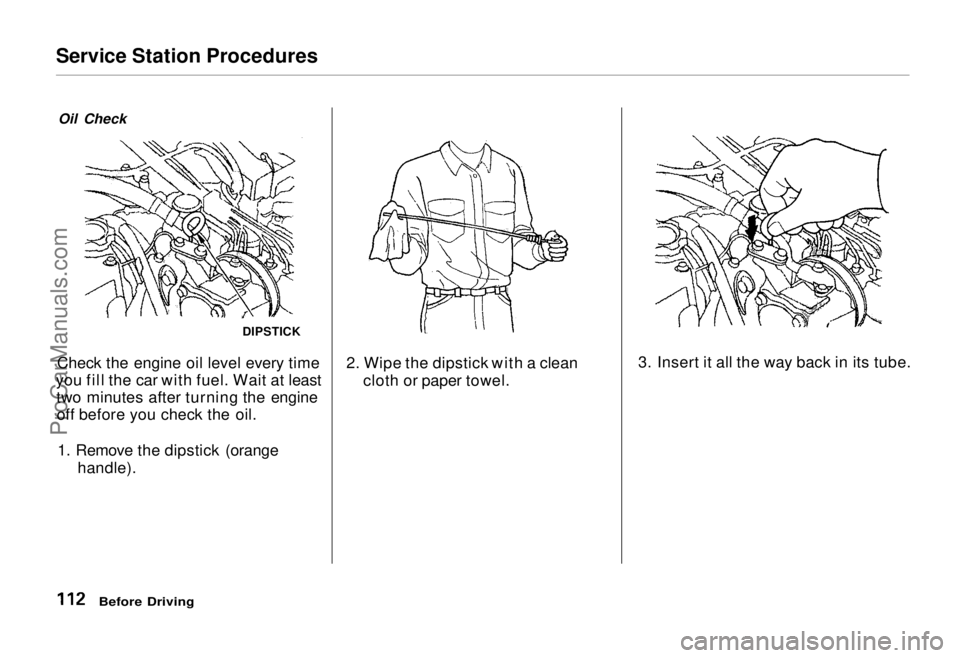
Oil Check
Check the engine oil level every time
you fill the car with fuel. Wait at least two minutes after turning the engineoff before you check the oil.
1. Remove the dipstick (orange handle). 2. Wipe the dipstick with a clean
cloth or paper towel. 3. Insert it all the way back in its tube.
Before Driving
DIPSTICKProCarManuals.comMain Menu Table of Contents s t
Page 113 of 240
Service Station Procedures
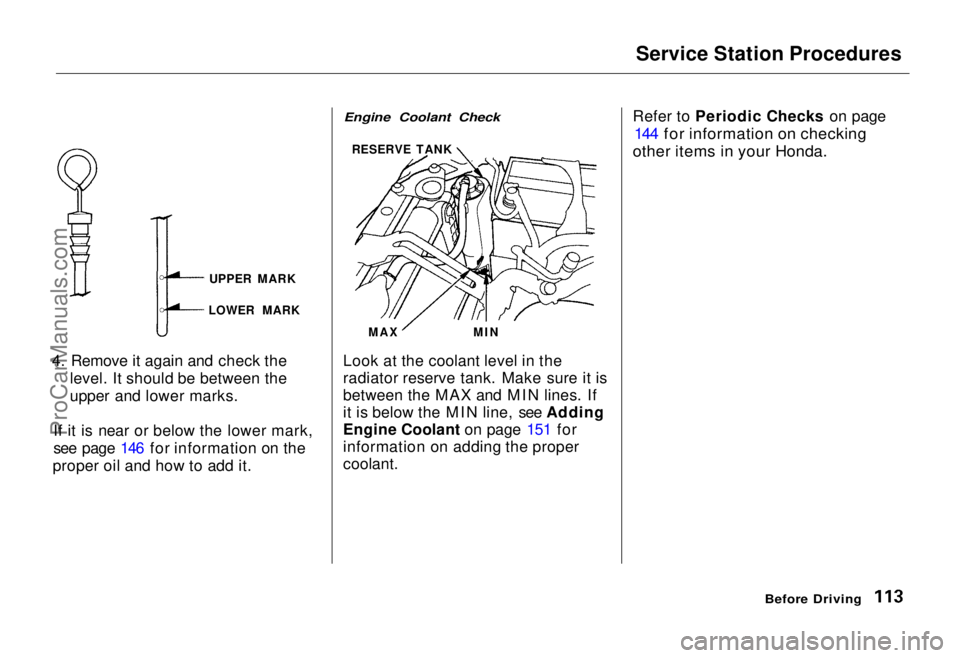
4. Remove it again and check the level. It should be between the
upper and lower marks.
If it is near or below the lower mark,
see page 146 for information on the
proper oil and how to add it. Look at the coolant level in the
radiator reserve tank. Make sure it is
between the MAX and MIN lines. If
it is below the MIN line, see Adding
Engine Coolant on page 151 for
information on adding the proper
coolant.Refer to Periodic Checks on page
144 for information on checking
other items in your Honda.
Before Driving
UPPER MARK
Engine Coolant Check
RESERVE TANK
MAX MIN
LOWER MARKProCarManuals.comMain Menu Table of Contents s t
Page 132 of 240
Towing a Trailer
Towing Safety
Your car will not stop as quickly witha trailer in tow. Leave extra distance
between your car and other vehicles.
Avoid braking or turning suddenly.
This could cause the trailer to
jackknife or possibly turn over.
Keep in mind that your total vehicle
is now much longer. Leave more
room when making turns. The trailer
tracks a smaller arc than the car and can hit or run over something that
the car misses. When passing another vehicle, make sure the
trailer is clear before changing lanes. The car/trailer combination is more
affected by crosswinds and buffeting.
When being passed by a large
vehicle, keep a constant speed and steer straight ahead. If there is too
much wind buffeting, slow down to
get out of the other vehicle's air
turbulence.
Towing a trailer puts an extra load on your car. You should have your
car serviced according to the "Maintenance schedule under severe
driving conditions" on page 141. This extra load is magnified when
you are driving in hilly terrain.
Watch the temperature gauge closely when climbing hills. If it gets
near the hot area, turn off the air
conditioning (if it is on). If this does
not reduce the heat, it may be
necessary to pull to the side of the
road and wait for the engine to cool.If the automatic transmission shifts
frequently between 3rd and 4th gears, put it in D3. This will help
prevent the transmission from overheating. Help keep the brakes
from overheating by shifting to a lower gear when going downhill.
DrivingProCarManuals.comMain Menu Table of Contents s t
Page 134 of 240
Maintenance
This section explains why it is important to keep your car well
maintained and to follow basic
maintenance safety precautions.
This section also includes Maintenance Schedules for normal
driving and severe driving conditions,
a Maintenance Record, and
instructions for simple maintenance
tasks you may want to take care of
yourself.
If you have the skills and tools
required to perform more complex
maintenance tasks on your Honda,
you may want to purchase the Service Manual. See page 233 for
information on how to obtain a copy, or see your Honda dealer.
Maintenance Safety....................... 136
Maintenance Schedule.................. 138
Maintenance Record..................... 142
Periodic Checks............................. 144
Fluid Locations............................... 145
Engine Oil....................................... 146
Checking Engine Oil................. 146
Adding......................................... 146
Recommended Oil..................... 147
Additives..................................... 148
Oil and Filter Changes.............. 148
Cooling System.............................. 150
Checking the Engine Coolant
Level........................................ 150
Adding Engine Coolant............. 151
Replacing Engine Coolant........ 152
Windshield Washers..................... 154
Automatic Transmission Fluid..... 155
Brake Fluid..................................... 156
Brake System............................. 156
Anti-lock Brake System............ 157
Power Steering............................... 157
Air Cleaner..................................... 158
Spark Plugs..................................... 160
Replacement............................... 160
Specification............................... 161
Battery............................................ 162
Windshield Wipers........................ 165
Air Conditioning............................. 168 Drive Belts...................................... 169
Tires................................................ 169 Inflation....................................... 170
Inspection................................... 171
Maintenance............................... 171
Tire Rotation.............................. 172 Replacing Tires and Wheels .... 172
Wheels and Tires....................... 173
Winter Driving........................... 173 Snow Tires.............................. 174
Tire Chains............................. 174
Lights.............................................. 175 Headlight Aiming...................... 175
Replacing Bulbs......................... 177
Storing Your Car............................ 182
MaintenanceProCarManuals.comMain Menu s t
Page 135 of 240
Maintenance Safety
Regularly maintaining your car is the
best way to protect your investment.
Proper maintenance is essential to
your safety and the safety of your passengers. It will also reward you
with more economical, trouble-free driving and help reduce air pollution. This section includes instructions for
simple maintenance tasks, such as
checking and adding oil. Any service
items not detailed in this section should be performed by a Honda
technician or other qualified mechanic. Some of the most important safety
precautions are given in the next
page. However, we cannot warn you of every conceivable hazard that can
arise in performing maintenance.Only you can decide whether or not
you should perform a given task.
Maintenance
Failure to properly follow
maintenance instructions and
precautions can cause you to
be seriously hurt or killed.
Always follow the procedures and precautions in this owner'smanual.
Improperly maintaining this car
or failing to correct a problem
before driving can cause a
crash in which you can be
seriously hurt or killed.
Always follow the inspection
and maintenance recommendations and
schedules in this owner's manual.ProCarManuals.comMain Menu Table of Contents s t