1995 GMC SIERRA flat tire
[x] Cancel search: flat tirePage 6 of 488
To Restore Spare or Flat Tire:
1. Lay the tire on the ground at the rear of the vehicle. Position the tire so
2. Tilt the retainer downward and through the wheel opening. Make sure the
that
the valve stem is pointed down and to the rear.
retainer
is fully seated across the underside of the wheel.
3. Attach the ratchet, with the UP marking facing you, near the hook at the
end of the jack handle as illustrated. Insert the other end,
on an angle,
through the hole in the rear bumper and into the hoist shaft.
4. Raise the tire fully against the underside of vehicle. Continue turning the
ratchet until there
are two “clicks” or “ratchets.” The spare tire hoist
cannot be over-tightened.
5. Grasp and push against the tire to be sure it is stored securely and does
not move.
4
ProCarManuals.com
Page 7 of 488
Table of Contents
Introduction - How to Use this Manual
This section tells you how to use your manual and includes safety
and vehicle damage warnings and symbols.
Section 1 - Seats and Restraint Systems
This section tells you how to use your seats and safety belts
properly.
It also explains the air ba, 0 s -y stem.
Section 2 - Features & Controls
This section explains how to start and operate your vehicle.
Section 3 - Comfort Controls & Audio Systems
This section tells you how to adjust the ventilation and comfort
controls and how to operate your audio system.
Section 4 - Your Driving and the Road
Here you’ll find helpful information and tips about the road and
how to drive under different conditions.
Section 5 - Problems on the Road
This section tells you what to do if you have a problem while
driving, such
as a flat tire or engine overheating. etc.
Section 6 - Service & Appearance Care
Here the manual tells you how to keep your vehicle running
properly and looking good.
Section 7 - Maintenance Schedule
This section tells you when to perform vehicle maintenance and
what fluids and lubricants to use.
Section 8 - Customer Assistance Information
L get service publications. It also gives you information on
This
section tells you how to contact
GM for assistance and how to
“Reporting Safety Defects” on page
8-4.
Index
Here’s an alphabetical listing of almost every subject in this
manual. You can use
it to quickly find something you want to read.
i
ProCarManuals.com
Page 23 of 488
Head Restraints
Slide the head restraint up or down so that the top of the restraint is closest
to the top of your ears. This position reduces the chance
of a neck injury in a
crash.
Rear Folding Seat (Extended Cab)
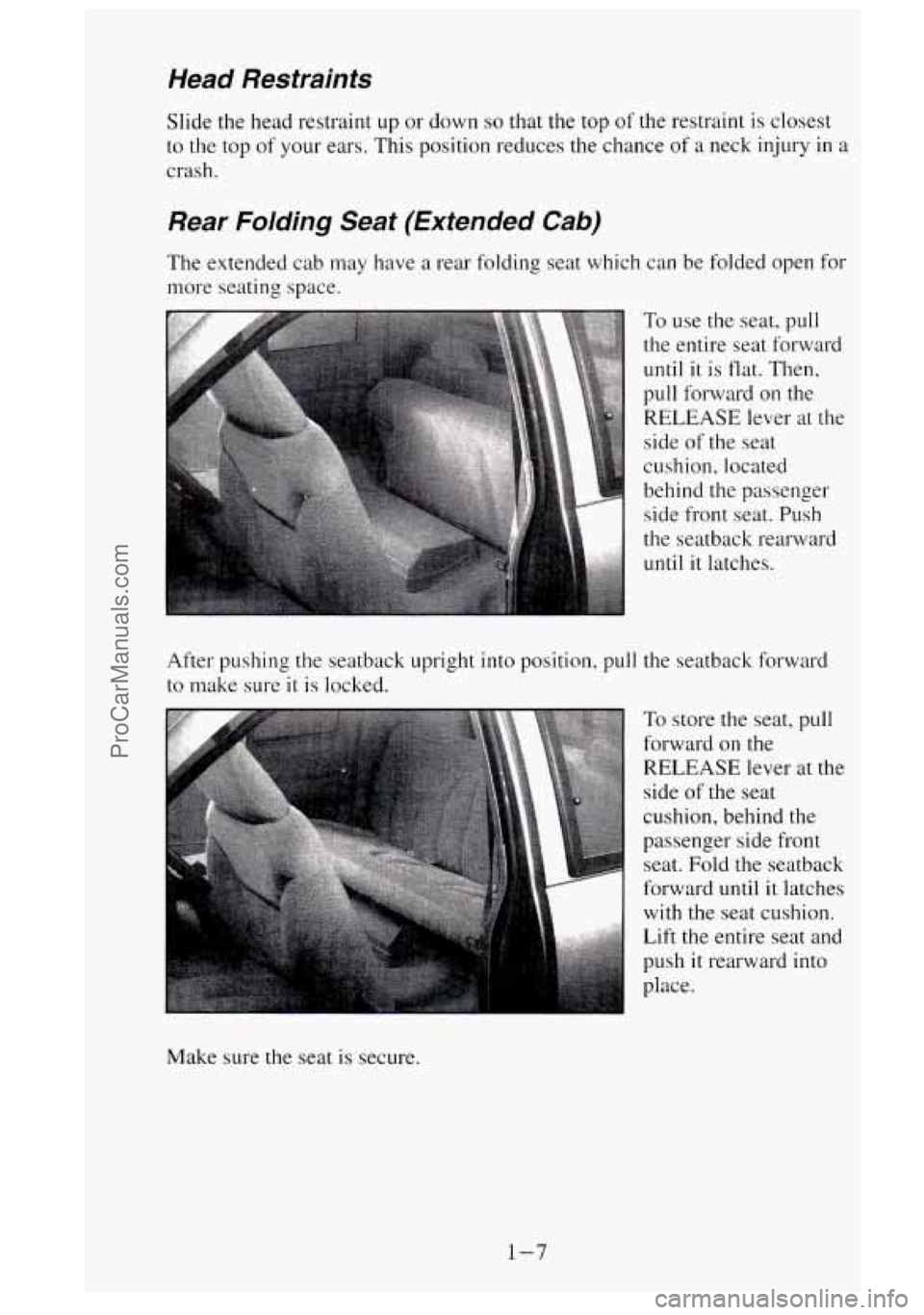
The extended cab may have a rear folding seat which can be folded open for
more seating space.
To use the seat, pull
the entire seat forward
until it is flat. Then,
pull forward on the
RELEASE lever at the
side
of the seat
cushion, located
behind the passenger side front seat. Push
the seatback rearward
until it latches.
To store the seat, pull
forward on the
RELEASE lever at the
side
of the seat
cushion, behind the
After pushing the
seatback upright into position, pull the seatback forward
to make
sure it is locked.
passenger side front
seat.
Fold the seatback
forward
until it latches
with the seat cushion.
Lift the entire seat and
push
it rearward into
place.
Make sure the seat
is secure.
1-7
ProCarManuals.com
Page 186 of 488
Driving Guidelines
Off-Road Driving with Your Four-wheel Drive
Vehicle
This off-road guide is for vehicles that have four-wheel drive.
Also, see “Anti-Lock Brakes”
in the Index.
If your vehicle doesn’t have four-wheel drive, you shouldn’t drive off-road
unless you’re
on a level, solid surface.
Off-road driving can be great fun. But it does have some definite hazards.
The greatest of these
is the terrain itself.
“Off-roading” means you’ve left the great North American road system
behind. Traffic lanes aren’t marked. Curves aren’t banked. There are no
road signs. Surfaces can
be slippery. rough, uphill or downhill. In short,
you’ve gone right back to nature.
Off-road driving involves some new skills. And that’s why it’s very
important that
you read this guide. You’ll find many driving tips and
suggestions. These will help make your off-road driving safer and more
enjoyable.
Before You Go Off-Roading
There are some things to do before you go out. For example, be sure to have
all necessary maintenance and service work done. Check to make sure all
underbody shields
(if so equipped) are properly attached. Be sure you read
all the information about your four-wheel drive vehicle in this manual.
Is
there enough fuel? Is the spare tire fully inflated? Are the fluid levels up
where they should be? What are
the local laws that apply to off-roading
where you’ll be driving?
If you don’t know, you should check with law
enforcement people in the area. Will you be
on someone’s private land? If
so, be sure to get the necessary permission.
Loading Your Vehicle for Off-Road Driving
There are some important things to remember about how to load your
vehicle.
The heaviest things should be on the load floor and forward of your
rear axle. Put heavier items as far forward
as you can.
doesn’t toss things around.
Be sure the load is secured properly, so driving on the off-road terrain
4- 12
ProCarManuals.com
Page 202 of 488
When you want to leave the freeway, move to the proper lane well in
advance. If
you miss your exit do not, under any circumstances, stop and
back up. Drive on
to the next exit.
The exit ramp can be curved, sometimes quite sharply.
The
exit speed is usually posted.
Reduce your speed according to your speedometer, not to your sense
of
motion. After driving for any distance at higher speeds, you may tend to
think you are going slower than you actually are.
Before Leaving on a Long Trip
Make sure you’re ready. Try to be well rested. If you must start when you’re
not fresh
- such as after a day’s work - don’t plan to make too many
miles that first part
of the journey. Wear comfortable clothing and shoes you
can easily drive
in.
Is your vehicle ready for a long trip‘? If you keep it serviced and maintained,
it’s ready to go.
If it needs service, have it done before starting out. Of
course, you’ll find experienced and able service experts
in GM dealers all
across North America. They’ll be ready and willing to help if you need it.
Here are some things you can check before a trip:
0
0
0
0
0
a
0
Windshield Washer Fluid: Is the reservoir full? Are all windows clean
inside and outside?
Wiper Blades: Are they in good shape?
FueZ, Engine Oil, Other Fluids: Have you checked all levels?
Lamps: Are they all working? Are the lenses clean?
Tires: They are vitally important to a safe, trouble-free trip. Is the tread
good enough for long-distance driving? Are
the tires all inflated to the
recommended pressure?
Weather Forecasts: What’s the weather outlook along your route?
Should
you delay your trip a short time to avoid a major storm system?
Maps: Do you have up-to-date maps?
Highway Hypnosis
Is there actually such a condition as “highway hypnosis”? Or is it just plain
falling asleep at the wheel? Call it highway hypnosis, lack of awareness, or
whatever.
There
is something about an easy stretch of road with the same scenery,
along with the
hum of the tires on the road, the drone of the engine, and the
rush
of the wind against the vehicle that can make you sleepy. Don’t let it
happen
to you! If it does, your vehicle can leave the road in less than a
second, and you could crash and be injured.
4-28
ProCarManuals.com
Page 203 of 488
What can you do about highway hypnosis? First, be aware that it can
happen.
Then here are some tips:
0 Make sure your vehicle is well ventilated, with a comfortably cool
Keep your eyes moving. Scan the road ahead and to the sides. Check
interior.
your mirrors and your instruments frequently.
If you get sleepy, pull off the road into a rest, service, or parking area
and take a nap, get some exercise, or both. For safety, treat drowsiness
on the highway as an emergency.
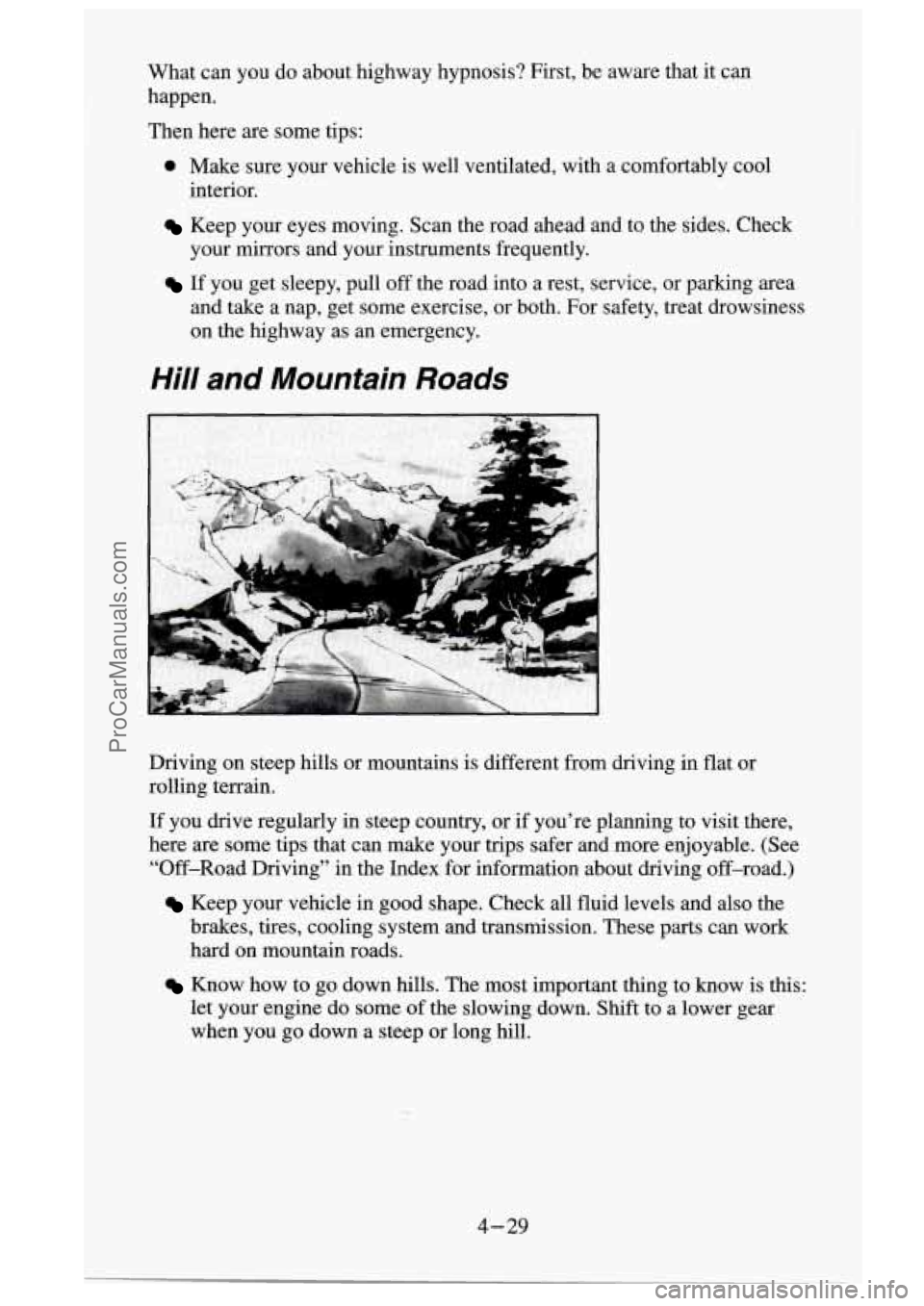
Hill and Mountain Roads
I
Driving on steep hills or mountains is different from driving in flat or
rolling terrain.
If you drive regularly in steep country, or
if you’re planning to visit there,
here are some tips that can make your trips safer and more enjoyable. (See
“Off-Road Driving” in the Index for information about driving off-road.)
Keep your vehicle in good shape. Check all fluid levels and also the
brakes, tires, cooling system and transmission. These parts can \
work
hard on mountain roads.
Know how to go down hills. The most important thing to know is this:
let your engine do some of the slowing down. Shift to a lower gear
when you go down a steep or long hill.
4-29
ProCarManuals.com
Page 211 of 488
Loading Your Vehicle
-
DSI/KPA (COL3)
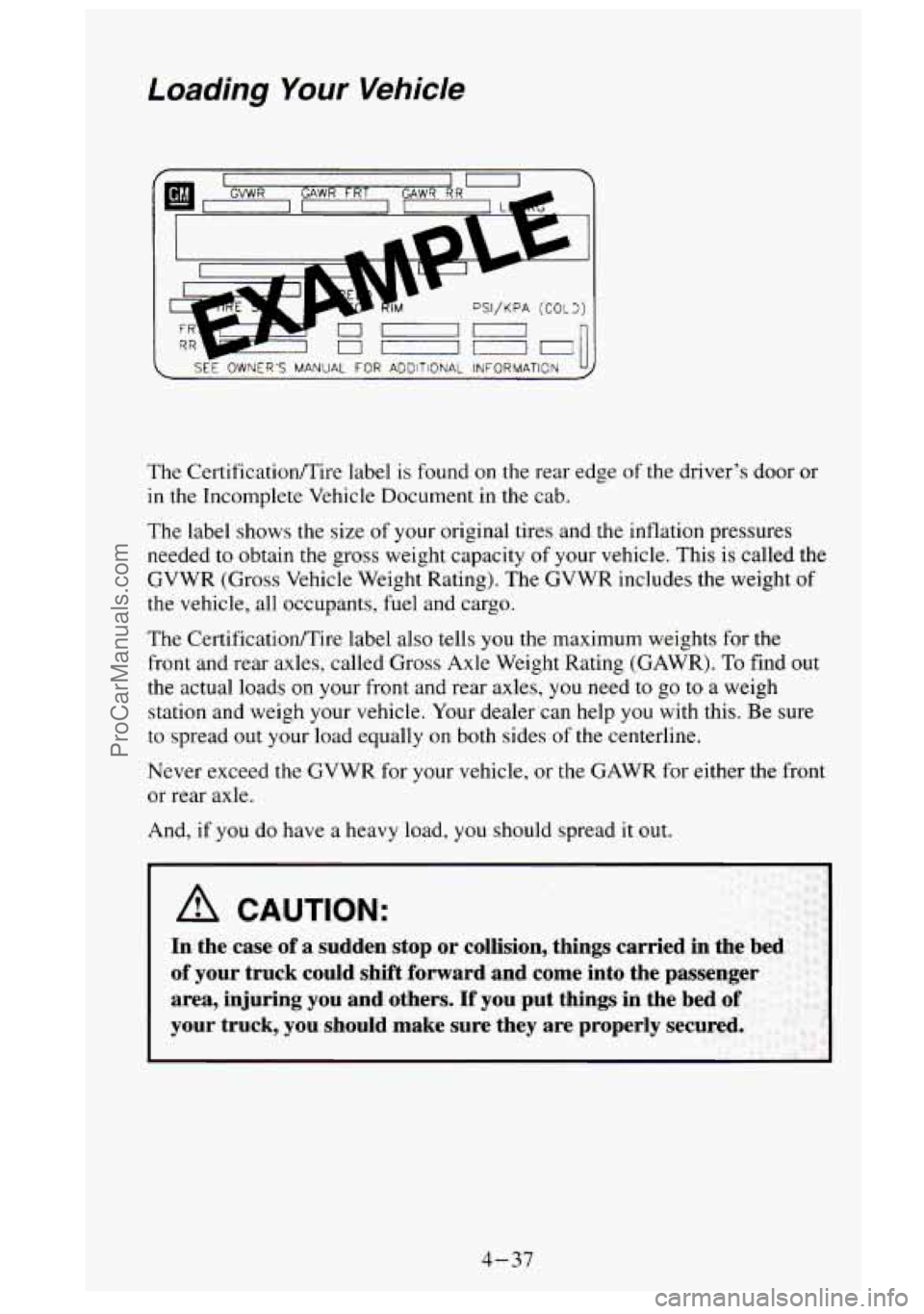
The Certification/Tire label is found on the rear edge of the driver’s door or
in the Incomplete Vehicle Document in the cab.
The label shows the size of your original tires and the inflation pressures
needed to obtain
the gross weight capacity of your vehicle. This is called the
GVWR (Gross Vehicle Weight Rating). The
GVWR includes the weight of
the vehicle, all occupants, fuel and cargo.
The CertificatiodTire label also tells you the maximum weights for the
front and rear axles, called Gross Axle Weight Rating (GAWR).
To find out
the actual loads
on your front and rear axles, you need to go to a weigh
station and weigh your vehicle. Your dealer can help
you with this. Be sure
to spread out your load equally on both sides of the centerline.
Never exceed the GVWR for your vehicle, or the GAWR for either the front
or rear axle.
And,
if you do have a heavy load, you should spread it out.
A CAUTION-:
In the case of a sudden stop or collision, things carried in the bed
of your truck could shift forward and come into the passenger \
area, injuring you and
others. If you put things in the bed of
your truck, you
should make sure they are properly secured.
4-37
ProCarManuals.com
Page 219 of 488
Total Weight on Your Vehicle’s Tires
Be sure your vehicle‘s tires are inflated to the limit for cold tires. You’ll find
these numbers on the Certification label at the rear
edge of the driver’s door
or see “Tire Loading“
in the Index. Then be sure you don‘t go over the
GVW limit for your vehicle, includins the weight of the trailer tongue.
Hitches
It’s important to have the correct hitch equipment. Crosswinds, large trucks
going by, and rough roads are
a few reasons why you’ll need the right hitch.
Here are some rules to follow:
e
e
If you use a step bumper hitch, and your trailer tongue has a V-shaped
foot. your bumper could be damaged
in sharp turns. Check the distance
from the front edge
of the foot to the middle of the hitch ball socket. If
the distance is less than 12 inches, take the foot off the trailer tongue.
If you‘ll be pulling a trailer that, when loaded,
will weigh more than
4,000 pounds
( 1 8 14 kg) be sure to use a properly mounted,
weight-distributing hitch and sway control
of the proper size. This
equipment is very important for proper vehicle loading and good
handling when you’re driving.
Safety Chains
You should always attach chains between your vehicle and your trailer.
Cross the safety chains under the tongue
of the trailer so that the tongue will
not drop to the road if it becomes separated from the hitch. Instructions
about safety chains may be provided by the hitch manufacturer or by the
trailer manufacturer. Follow the manufacturer’s recommendation for
attaching safety chains and do not attach them to the bumper. Always leave
just enough slack
so you can turn with your rig. And, never allow safety
chains to drag on the ground.
Trailer Brakes
If your trailer weighs more than 1,000 pounds (450 kg) loaded, then it needs
its own brakes
- and they must be adequate. Be sure to read and follow the
instructions for the trailer brakes
so you’ll be able to install. adjust and
maintain them properly.
Your trailer brake system can tap into your vehicle’s hydraulic brake system,
but consider the following:
Don’t tap into your vehicle’s brake system if the trailer’s brake system
will use more than 0.02 cubic inch (0.3~~)
of fluid from your vehicle’s
master cylinder.
Tf it does, both braking systems won’t work well. You
could even lose your brakes.
4-45
ProCarManuals.com