1995 GMC SIERRA flat tire
[x] Cancel search: flat tirePage 327 of 488
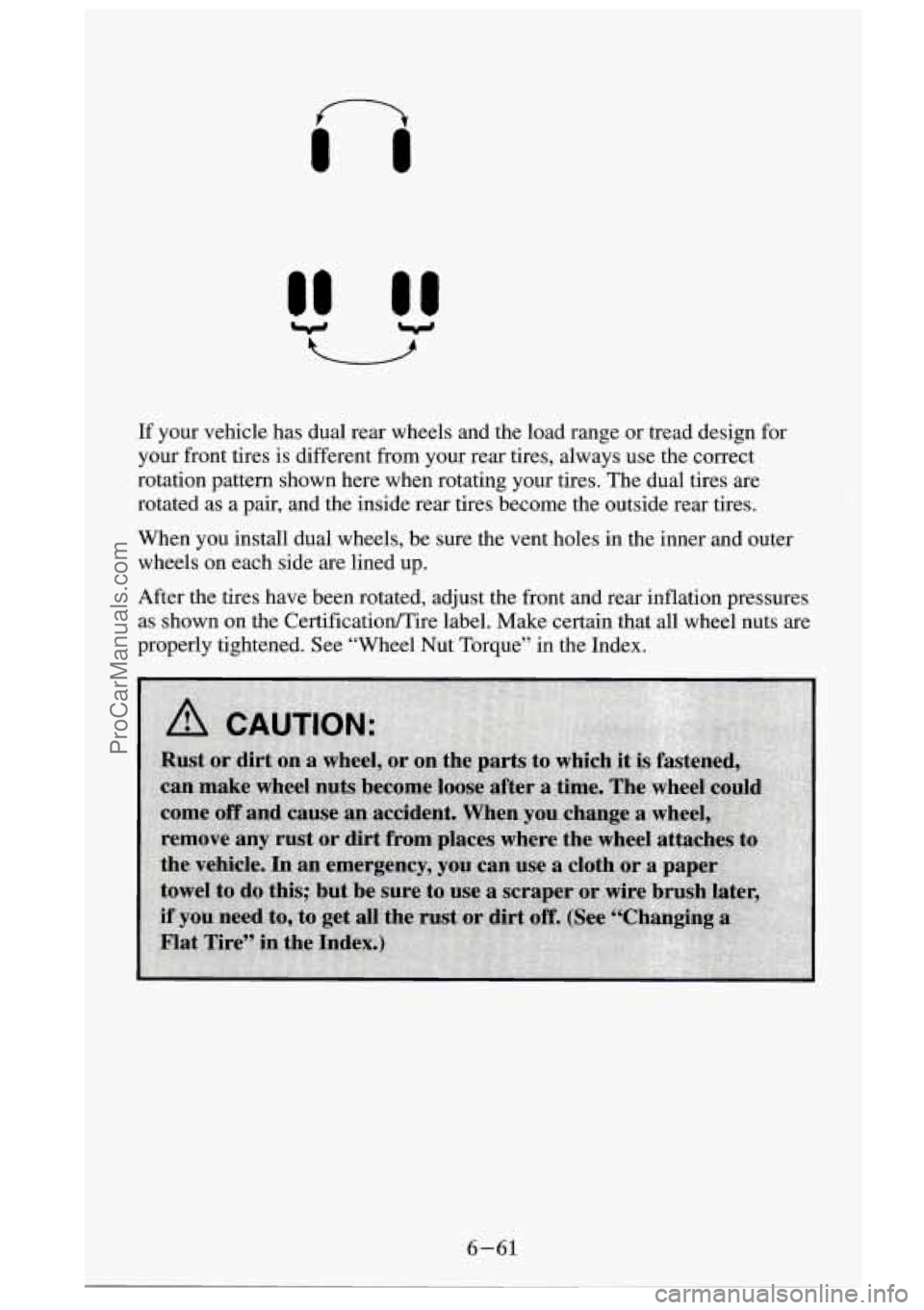
If your vehicle has dual rear wheels and the load range or tread design for
your front tires is different from your rear tires, always use the correct
rotation pattern shown here when rotating your tires. The dual tires are
rotated as a pair, and the inside rear tires become the outside rear tires.
When you install dual wheels, be sure the vent holes in the inner and outer
wheels
on each side are lined up.
After the tires have been rotated, adjust the front and rear inflation pressures
as shown on the Certificatioflire label. Make certain that all wheel nuts are
properly tightened. See “Wheel Nut Torque” in the Index.
6-61
ProCarManuals.com
Page 329 of 488
A CAUTION:
If you operate your vehicle with a tire that is badly
underinflated, the tire can overheat. An overheated tire
can lose
air suddenly or catch fire. You or others could be injured. Be
sure all tires (including the spare, if any) are properly inflated.
Buying New Tires
To find out what kind and size of tires you need, look at the
CertificationRire label.
The tires installed on your vehicle when
it was new a Tire Performance
Criteria Specification (TPC Spec) number on each tire’s sidewall. When you
get new tires, get ones with that same TPC Spec number. That way, your
vehicle will continue to have tires that are designed to give proper
endurance, handling, speed rating, traction, ride and other things during
normal service on your vehicle.
If your tires have an all-season tread
design, the TPC number will be followed by an
“MS” (for mud and snow).
If you ever replace your tires with those not having a TPC Spec number,
make sure they are the same. size, load range, speed rating and construction
type (bias, bias-belted or radial) as your original tires.
I A CAUTION:
Mixing tires could cause you to lose control while driving. If you
mix tires of different sizes or types (radial and bias-belted tires),
the vehicle may not handle properly, and you could have
a crash.
Be sure to use the same size and type tires on all four wheels.
Uniform Tire Quality Grading
The following information relates to the system developed by the United
States National Highway Traffic Safety Administration which grades tires
by treadwear, traction and temperature performance.
(This applies only to
vehicles sold in the United States.)
6-63
ProCarManuals.com
Page 330 of 488
Treadwear
The treadwear grade is a comparative rating based on the wear rate of the
tire when tested under controlled conditions on
a specified government test
course. For example,
a tire graded 150 would wear one and a half (1 1/2)
times as well on the government course as a tire graded 100. The relative
performance
of tires depends upon the actual conditions of their use,
however, and may depart significantly from the norm due to variations
in
driving habits, service practices and differences in road characteristics and
climate.
Traction - A, B, C
The traction grades, from highest to lowest are: A, B, and C. They represent
the tire’s ability to stop on wet pavement
as measured under controlled
conditions on specified government test surfaces of asphalt and concrete.
A
tire marked C may have poor traction performance.
Warning: The traction grade assigned to this tire
is based on braking
(straight-ahead) traction tests and does not include cornering (turning)
traction.
Temperature - A, B, C
The temperature grades are A (the highest), B, and C, representing the tire’s
resistance to the generation
of heat and its ability to dissipate heat when
tested under controlled conditions on a specified indoor laboratory test
wheel. Sustained high temperature can cause the material
of the tire to
degenerate and reduce tire life, and excessive temperature can lead
to
sudden tire failure. The grade C corresponds to a level of performance
which all passenger car tires must meet under the Federal Motor Vehicle
Safety Standard
No. 109. Grades B and A represent higher levels of
performance
on the laboratory test wheel than the minimum required by
law.
Warning: The temperature grade for this tire is established for a tire that is
properly inflated and
not overloaded. Excessive speed, underinflation, or
excessive loading, either separately or in combination, can cause heat
buildup and possible tire failure.
These grades are molded on the sidewalls of passenger car tires.
While the tires available as standard or optional equipment on General
Motors vehicles may vary with respect to these grades, all such tires meet
General Motors performance standards and have been approved for use on
General Motors vehicles.
All passenger type (P Metric) tires must conform
to Federal safety requirements in addition to these grades.
6-64
ProCarManuals.com
Page 357 of 488
Scheduled Maintenance Services
KEEP ENGINE OIL
AT THE PROPER
LEVEL AND CHANGE
AS RECOMMENDED
Section
This section covers the maintenance required for your vehicle. Your vehicle
needs these services to retain its safety, dependability and emission control
performance.
I protection
Plan
I
Introduction
Your Vehicle and the Environment
Proper vehicle maintenance not only helps to keep your vehicle in good
working condition, but also helps the environment. All recommended
maintenance procedures are important. Improper vehicle maintenance or the
removal
of important components can significantly affect the quality of the
air we breathe. Improper
fluid levels or even the wrong tire inflation can
increase the level of emissions from your vehicle.
To help protect our
environment, and
to help keep your vehicle in good condition, please
maintain your vehicle properly.
7-1
ProCarManuals.com
Page 449 of 488
Part B: Owner Checks and Services
Listed below are owner checks and services which should be performed at
the intervals specified to help ensure the safety, dependability and emission
control performance of your vehicle.
Be sure any necessary repairs are completed at once. Whenever any fluids
or lubricants are added to your vehicle, make sure they are the proper ones,
as shown in Part D.
At the First 100, 1,000 and 6,000 Miles (160, I 600 and
IO 000 km)
For vehicles with dual wheels, check dual wheel nut torque. For proper
torque, see “Wheel
Nut Torque’’ in the Index.
At Each Fuel Fill
Engine Oil Level
Check the engine oil level and add the proper oil if necessary. See “Engine
Oil”
in the Index for further details.
Engine Coolant Level
Check the engine coolant level and add the proper coolant mix if necessary.
See ”Coolant”
in the Index for further details.
Windshield Washer Fluid Level
Check the windshield washer fluid level in the windshield washer tank and
add the proper fluid if necessary. See ”Windshield Washer Fluid” in the
Index for further details.
At Least Once a Month
Tire Inflation
Check tire inflation. Make sure tires are inflated to the pressures specified
on the Certification/Tire label which is located on the rear edge of the
driver’s door or on the incomplete vehicle document in the cab. See “Tires”
in the Index for further details.
7-93
ProCarManuals.com
Page 465 of 488
REPORTING SAFETY DEFECTS TO THE
CANADIAN GOVERNMENT
If you live in Canada, and you believe that your vehicle has a safety defect,
you should immediately notify Transport Canada, in addition
to notifying
General Motors of Canada Limited.
You may write to:
Transport Canada
Box 8880
Ottawa, Ontario K1 G 352.
REPORTING SAFETY DEFECTS TO GENERAL MOTORS
In addition to notifying NHTSA (or Transport Canada) in a situation like
this, we certainly hope
you’ll notify us. Please call us at
1-800-GMC-TRUCK (1-800-462-8782), or write:
GMC Truck Consumer Relations
3
1 E. Judson Street 1607-04
Pontiac, MI 48342-2230
In Canada, please call
us at 1-800-263-3777 (English) or 1-800-263-7854
(French). Or, write:
General Motors of Canada Limited
Customer Assistance Center
1908 Colonel Sam Drive
Oshawa, Ontario
LlH 8P7
Roadside Assistance
GMC Truck’s Roadside Assistance provides stranded owners with
over-the-phone roadside repairs, location of the nearest GMC Truck dealer,
or the following special services:
Flat Tire Change: Installation of spare tire will be covered at no charge
(customer
is responsible for repair or replacement of tire).
Fuel Delivery: Delivery of enough fuel for the customer to get to the
nearest service station (up to $4.00).
Jump Start: No-start situations which require a battery jump start will be
covered at
no charge.
Lock Out: Replacement keys or locksmith service will be covered at no
charge if you are unable to gain entry into your vehicle. Delivery of the
replacement key will be covered at no charge within a 10-mile radius.
8-5
ProCarManuals.com
Page 474 of 488
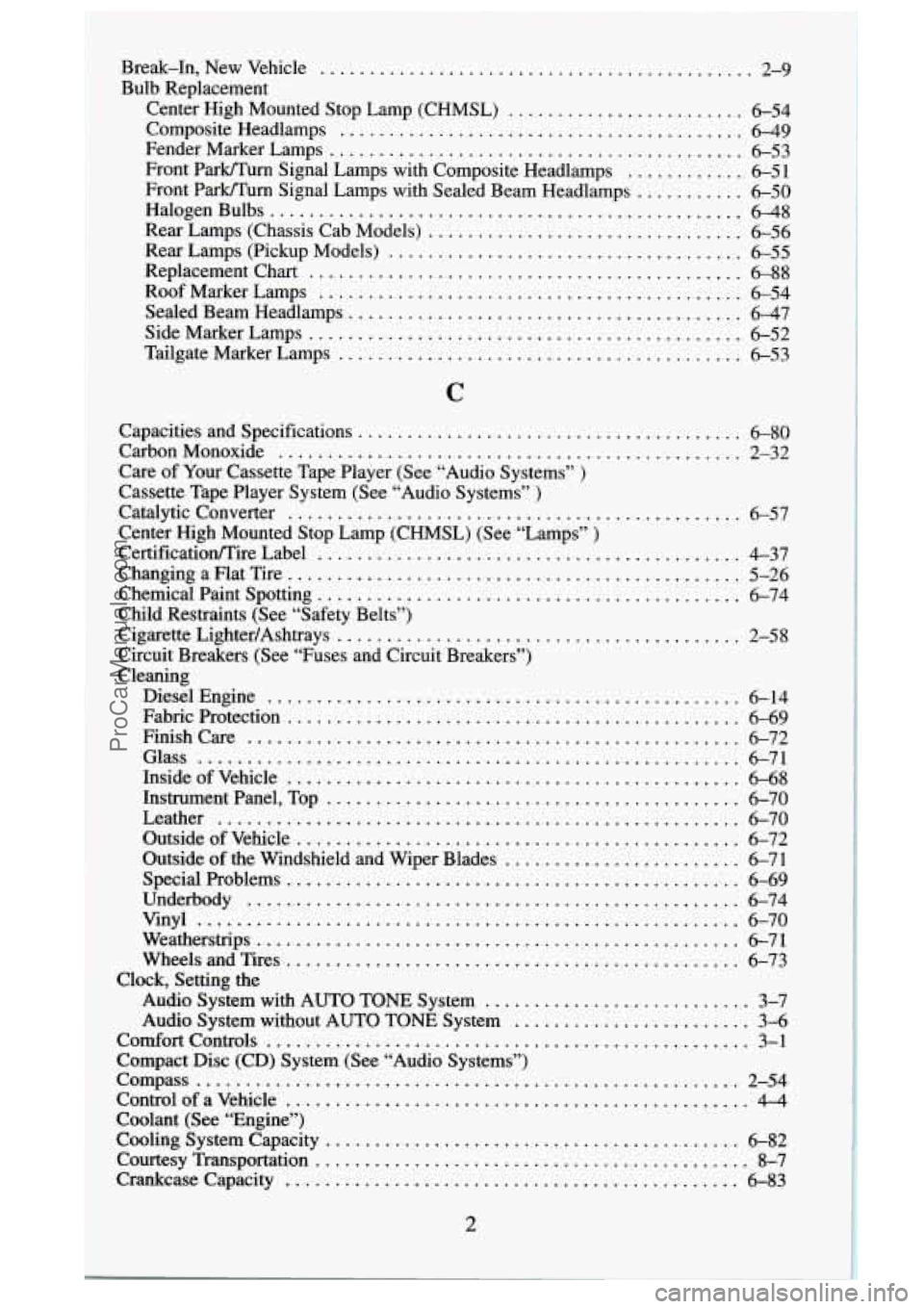
Break.In. New Vehicle ............................................ 2-9
Composite Headlamps ......................................... 6-49
Bulb Replacement Center
High Mounted Stop Lamp (CHMSL) ........................ 6-54
Fender Marker Lamps .......................................... 6-53
Front Park/Turn Signal Lamps with Composite Headlamps ............ 6-51
Front Park/Turn Signal Lamps with Sealed Beam Headlamps ........... 6-50
HalogenBulbs ................................................ 6-48
Rear Lamps (Chassis Cab Models) ................................ 6-56
Rear Lamps (Pickup Models) .................................... 6-55
Replacement Chart ............................................. 6-88
Roof Marker Lamps ........................................... 6-54
Sealed Beam Headlamps ........................................ 6-47
Side Marker Lamps ............................................ 6-52
Tailgate Marker Lamps ......................................... 6-53
C
Capacities and Specifications ....................................... 6-80
CarbonMonoxide ............................................... 2-32
Care of Your Cassette Tape Player (See “Audio Systems” )
Cassette Tape Player System (See “Audio Systems” )
Catalyticconverter .............................................. 6-57
Center High Mounted Stop Lamp (CHMSL) (See “Lamps” )
Certificatioflire Label ........................................... 4-37
Changing a Flat Tire .............................................. 5-26
Chemical Paint Spotting ........................................... 6-74
Cigarette LightedAshtrays ......................................... 2-58
Child Restraints (See “Safety Belts”)
Circuit Breakers (See “Fuses and Circuit Breakers”)
Cleaning DieselEngine
................................................ 6-14
Fabric Protection .............................................. 6-69
Finishcare .................................................. 6-72
Glass ....................................................... 6-71
InsideofVehicle .............................................. 6-68
Leather ..................................................... 6-70
Instrument Panel, Top .......................................... 6-70
Outside of Vehicle ............................................. 6-72
Outside of the Windshield and Wiper Blades ........................ 6-71
Special Problems .............................................. 6-69
Vinyl ....................................................... 6-70
Weatherstrips ................................................. 6-71
Audio System with AUTO TONE System ........................... 3-7
Audio System without AUTO TONE System ........................ 3-6
Underbody .................................................. 6-74
WheelsandTires .............................................. 6-73
Clock, Setting the
ComfortControls
................................................. 3-1
Compact Disc (CD) System (See “Audio Systems”)
Compass
....................................................... 2-54
Control of a Vehicle ............................................... 4-4
Coolant (See “Engine”)
Cooling System Capacity
.......................................... 6-82
Courtesy Transportation ............................................ 8-7
CrankcaseCapacity .............................................. 6-83
2
ProCarManuals.com
Page 481 of 488

Seats (continued) Reclining Front Seatbacks
....................................... 1-3
Seatback Latches
........................................... 14. 1-8
Doing Your Own Service Work ................................... 6-1
Parts Identification Label
.....................
Service
Publications
.................................
Replacement Parts and Filter Recommendations ....
Service Engine Soon Light (See “Lights”)
Servicing Your Air Bag-Equipped Vehicle (See “Supple
System (SIR)”)
Shift Indicator Light (See *‘Lights“)
Shifting Into Park (P)
...........................
Shifting Out of Park .............................
Shock Absorbers (Front) .........................
.................. 6-78
.................. 8-8
....... 6-80.6-84,6-85
:r nental Inflatable Restraint
................. 2-28
................. 2-29
................. 6-45
Specifications Chart (See “Service . Replacement Parts and Filter
Recommendations“) SpareTire
................................................. 5-28.5-29
Speedometer and Odometer (See “Gages”)
Starting Your Engine (See ”Engine-Starting”)
Steering
........................................................ 4-7
Column Shift Lever
............................................ 2-29
InEmergencies
................................................ 4-8
Tips
......................................................... 4-7
Step-Bumperpad ................................................ 2-84
Storage Compartments
............................................ 2-59
Sunvisors
..................................................... 2-57
Supplemental Inflatable Restraint System (SIR)
........................ 1-19
Adding Equipment to Your Facial Air Bag-Equipped Vehicle
.......... 1-23
How the Air Bag System Works .................................. 1-20
Servicing Your Air Bag-Equipped Vehicle
......................... 1-23
Surge Tank Pressure Cap
.......................................... 6-39
T
Tachometer (See “Gages”)
Tail~ate
......................................................... 2-4
Removal ..................................................... 2-4
TIleft ........................................................... 2-8
Thermostat
..................................................... 6-40
Tilt Wheel (Option) .............................................. 2-38
Tires
.......................................................... 6-58
Balancing (See “Wheel Alignment and Tire Balance”)
Chains
...................................................... 6-66
Dual Tire Operation ........................................... 6-62
Flat (See ”Changing
a Flat Tire”)
Inspection and Rotation
........................................ 6-59
Loading (See “Loading Your Vehicle”)
New
........................................................ 6-63
Pressure
..................................................... 6-58
Spare (See ”Spare Tire”)
Uniform Tire Quality Grading
................................... 6-63
Top Strap (See “Safety Belts-Child Restraints“)
Torque Lock (See “Transmission-Torque Lock“)
9
ProCarManuals.com