Page 329 of 488
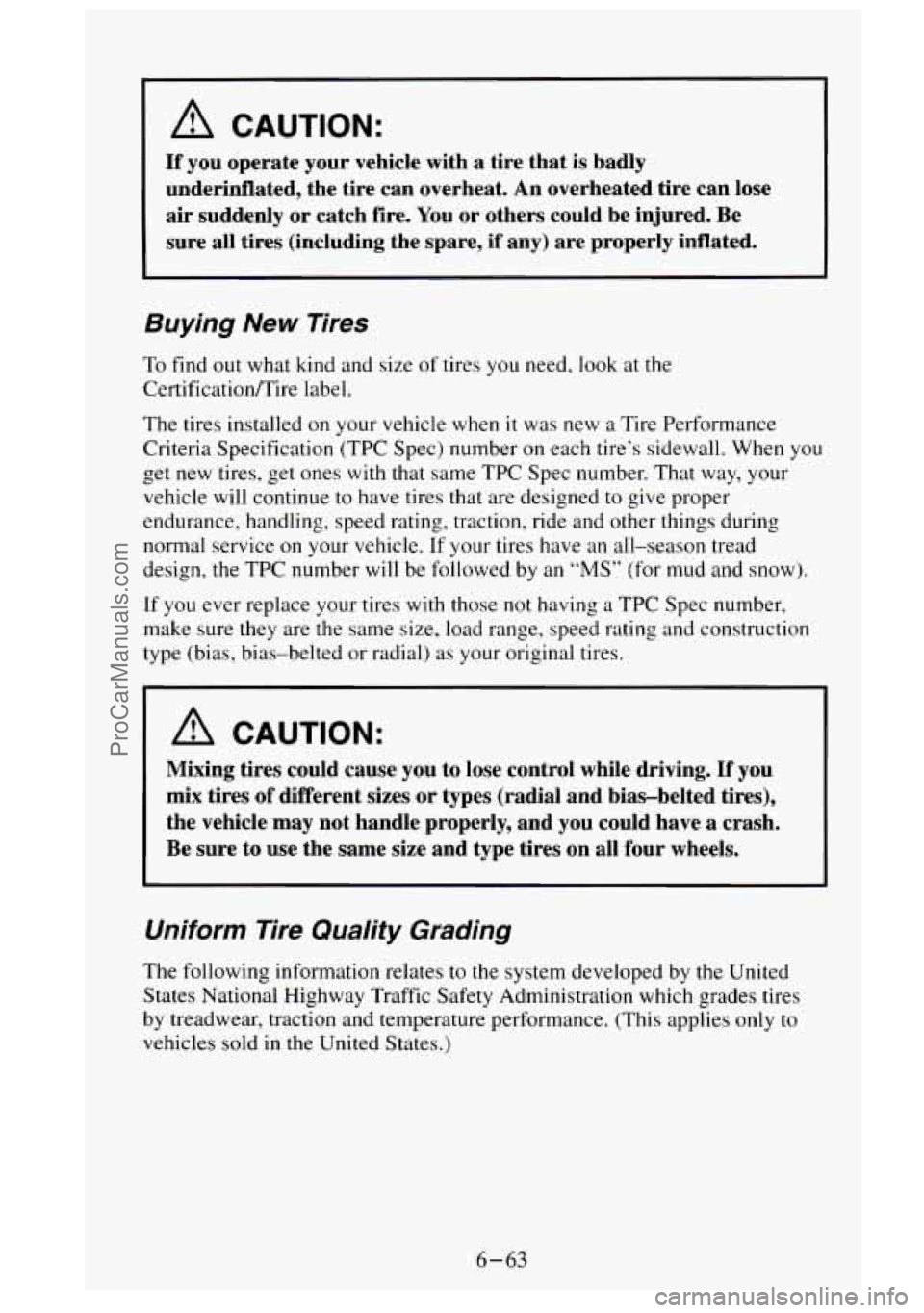
A CAUTION:
If you operate your vehicle with a tire that is badly
underinflated, the tire can overheat. An overheated tire
can lose
air suddenly or catch fire. You or others could be injured. Be
sure all tires (including the spare, if any) are properly inflated.
Buying New Tires
To find out what kind and size of tires you need, look at the
CertificationRire label.
The tires installed on your vehicle when
it was new a Tire Performance
Criteria Specification (TPC Spec) number on each tire’s sidewall. When you
get new tires, get ones with that same TPC Spec number. That way, your
vehicle will continue to have tires that are designed to give proper
endurance, handling, speed rating, traction, ride and other things during
normal service on your vehicle.
If your tires have an all-season tread
design, the TPC number will be followed by an
“MS” (for mud and snow).
If you ever replace your tires with those not having a TPC Spec number,
make sure they are the same. size, load range, speed rating and construction
type (bias, bias-belted or radial) as your original tires.
I A CAUTION:
Mixing tires could cause you to lose control while driving. If you
mix tires of different sizes or types (radial and bias-belted tires),
the vehicle may not handle properly, and you could have
a crash.
Be sure to use the same size and type tires on all four wheels.
Uniform Tire Quality Grading
The following information relates to the system developed by the United
States National Highway Traffic Safety Administration which grades tires
by treadwear, traction and temperature performance.
(This applies only to
vehicles sold in the United States.)
6-63
ProCarManuals.com
Page 337 of 488
Care of Safety Belts
Keep belts clean and dry.
A CAUTION:
Do not bleach or dye safety belts. If you do, it may severely
weaken them. In a crash they might not be able to provide
adequate protection. Clean safety belts only with mild soap and\
lukewarm water.
Glass
Glass should be cleaned often. GM Glass Cleaner (GM Part No. 1050427)
or a liquid household glass cleaner will remove normal tobacco smoke and
dust films.
Don’t use abrasive cleaners
on glass, because they may cause scratches.
Avoid placing decals on the inside rear window, since they may have to be
scraped off later. If abrasive cleaners are used on the inside
of the rear
window, an electric defogger element may be damaged. Any temporary
license should not be attached across the defogger grid.
Cleaning the Outside of the Windshield and
Wiper Blades
If the windshield is not clear after using the windshield washer, or if the
wiper blade chatters when running, wax or other material may be on the
blade or windshield.
Clean the outside of the windshield with GM Windshield Cleaner, Bon-Ami
Powder@ (GM
Part No. 105001 1). The windshield is clean if beads do not
form when
you rinse it with water.
Clean
the blade by wiping vigorously with a cloth soaked in full strength
windshield washer solvent. Then rinse the blade with water.
Wiper blades should be checked
on a regular basis and replaced when worn.
Weatherstrips
Silicone grease on weatherstrips will make them last longer, seal better, and
not stick or squeak. Apply silicone grease with a clean cloth at least every
six months. During very cold, damp weather more frequent application may
be required. (See “Recommended Fluids and Lubricants” in the Index.)
6-71
ProCarManuals.com
Page 356 of 488
LAMP OR BULB
INSTRUMENT
PANEL
Daytime Running
Lamps Indicator?
Charging System
Indicator Lamp
Instrument Cluster
Illumination
Headlamp Beam
Indicator
Directional Signal
Indicator
Brake Warning
Indicator
SIR (Air Bag)
Safety Belt Warning
Check Gages Indicator
Malfunction Indicator
(“Service Engine
Soon”) Lamp
Upshift Indicator Glow Plugs Lamp**
Low Coolant Lamp**
Water in Fuel Lamp**
Service Throttle Soon
Lamp**
**Diesel only
“fanadian Vehicles only
TRADE NO.
74
74
194
74
74
74
74
74
74
74
74
74
74
74
74
1
I
6
1
2
1
6-90
ProCarManuals.com
Page 361 of 488
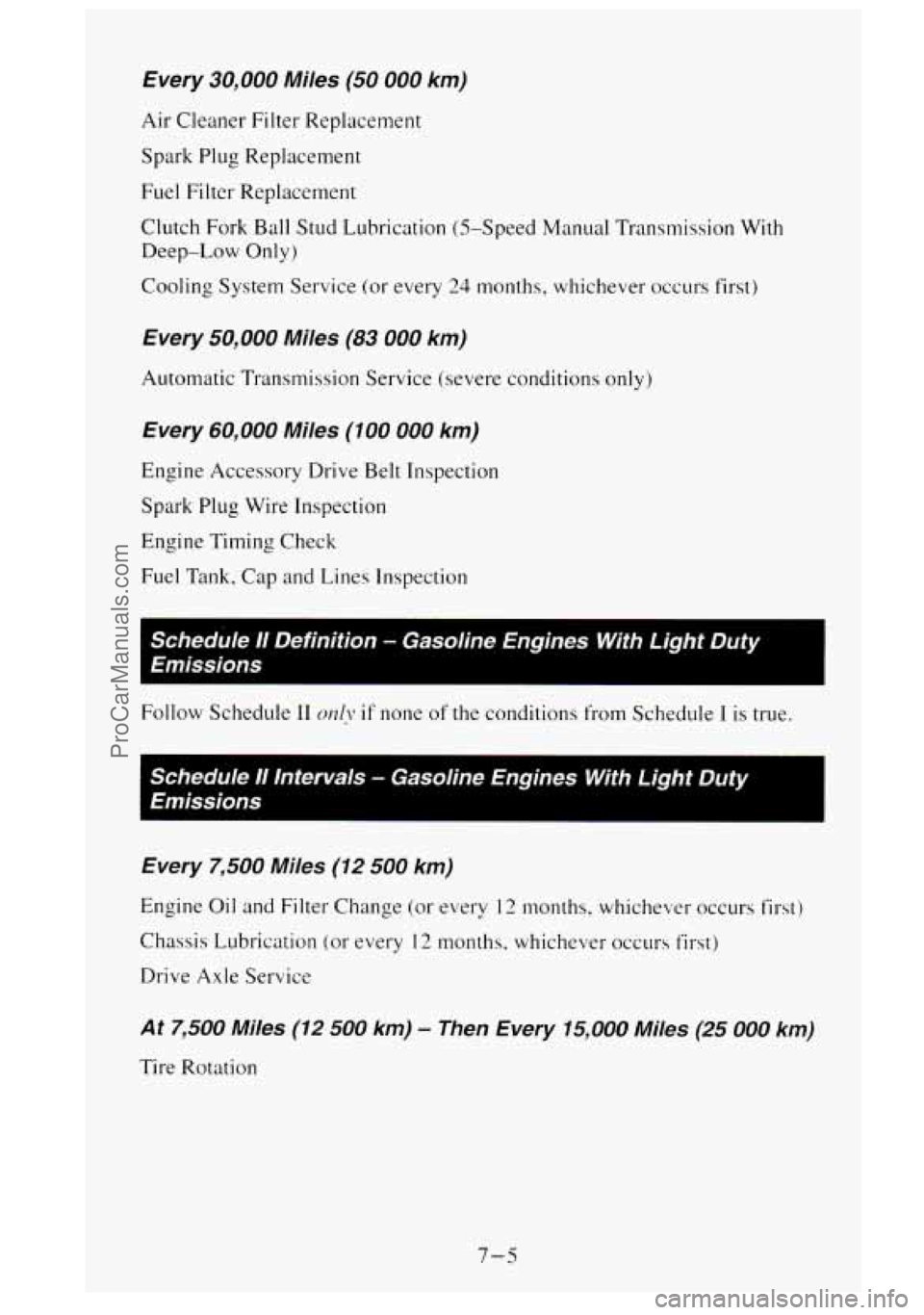
Every 30,000 Miles (50 000 km)
Air Cleaner Filter Replacement
Spark Plug Replacement
Fuel Filter Replacement
Clutch
Fork Ball Stud Lubrication (5-Speed Manual Transmission With
Deep-Low Only)
Cooling System Service (or every
24 months, whichever occurs first)
Every 50,000 Miles (83 000 km)
Automatic Transmission Service (severe conditions only)
Every 60,000 Miles (100 000 km)
Engine Accessory Drive Belt Inspection
Spark Plug Wire Inspection
Engine Timing Check
Fuel Tank, Cap and Lines Inspection
Schedule 11 Definition - Gasoline Engines With Light Duty
Emissions
Follow Schedule I1 only if none of the conditions from Schedule I is true.
Schedule I1 Intervals - Gasoline Engines With Light Duty
Emissions
Every
7,500 Miles (12 500 km)
Engine Oil and Filter Change (or every 12 months, whichever occurs first)
Chassis Lubrication (or every
12 months, whichever occurs first)
Drive Axle Service
At 7,500 Miles (12 500 km) - Then Every 15,000 Miles (25 000 km)
Tire Rotation
7-5
ProCarManuals.com
Page 362 of 488
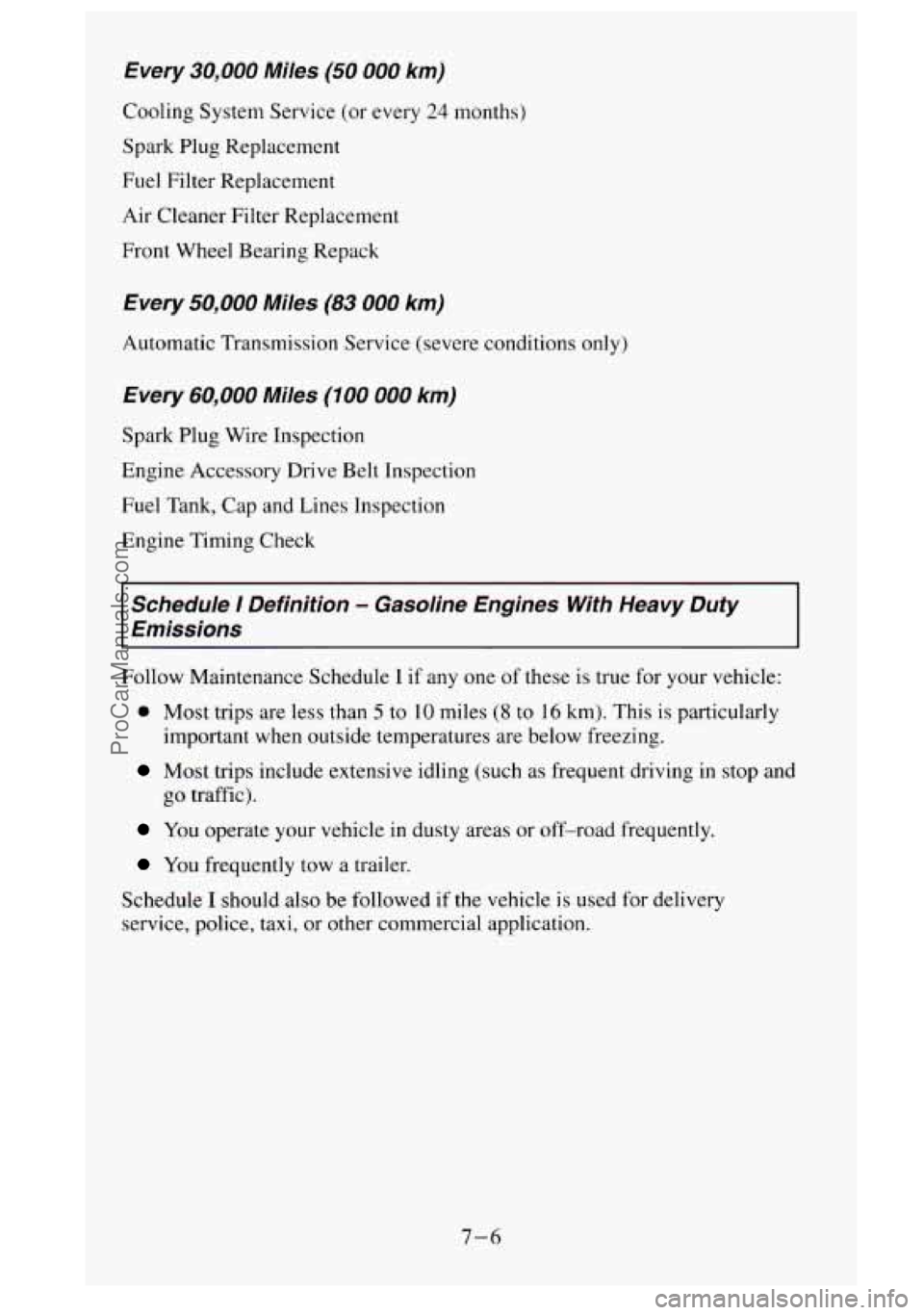
Every 30,000 Miles (50 000 km)
Cooling System Service (or every 24 months)
Spark Plug Replacement
Fuel Filter Replacement
Air Cleaner Filter Replacement
Front Wheel Bearing Repack
Every 50,000 Miles (83 000 km)
Automatic Transmission Service (severe conditions only)
Every 60,000 Miles (100 000 km)
Spark Plug Wire Inspection
Engine Accessory Drive Belt Inspection
Fuel Tank,
Cap and Lines Inspection
Engine Timing Check
Schedule 1 Definition - Gasoline Engines With Heavy Duiy
Emissions
I
Follow Maintenance Schedule I if any one of these is true for your vehicle:
0 Most trips are less than 5 to 10 miles (8 to 16 km). This is particularly
important when outside temperatures are below freezing.
Most trips include extensive idling (such as frequent driving in stop and
go traffic).
You operate your vehicle in dusty areas or off-road frequently.
You frequently tow a trailer.
Schedule
I should also be followed if the vehicle is used for delivery
service, police, taxi, or other commercial application.
7-6
ProCarManuals.com
Page 363 of 488

Schedule I Intervals - Gasoline Engines with Heavy Duty
Emissions
Every
3,000 Miles (5 000 km)
Engine Oil and Filter Change (or every 3 months, whichever occurs first)
Chassis Lubrication (or every
3 months, whichever occurs first)
Drive Axle Service
At 6,000 Miles (10 000 km) - Then Every 12,000 Miles (25 000 km)
Tire Rotation
Every 12,000 Miles (20 000 km)
Air Cleaner Filter Inspection, if Driving in Dusty Conditions
Front Wheel Bearing Repack (or at Each Brake Relining) (2-Wheel Drive
Only
1
Fuel Filter Replacement
Engine Accessory Drive Belt Inspection
Shields
and Underhood Insulation Inspection
Thermostatically Controlled Engine Cooling Fan Check (or every
12
months, whichever occurs first)
Every 24,000 Miles (40 000 km)
Cooling System Service (or every 24 months, whichever occurs first)
Air Cleaner Filter Replacement
Engine Timing Check
Thermostatically Controlled Air Cleaner Inspection
Air Intake System Inspection
Every 27,000 Miles (45 000 km)
Spark Plugs Replacement
Every 30,000 Miles (50 000 km)
Clutch Fork Ball Stud Lubrication (%Speed Transmission with Deep-Low
Only)
7-7
ProCarManuals.com
Page 364 of 488
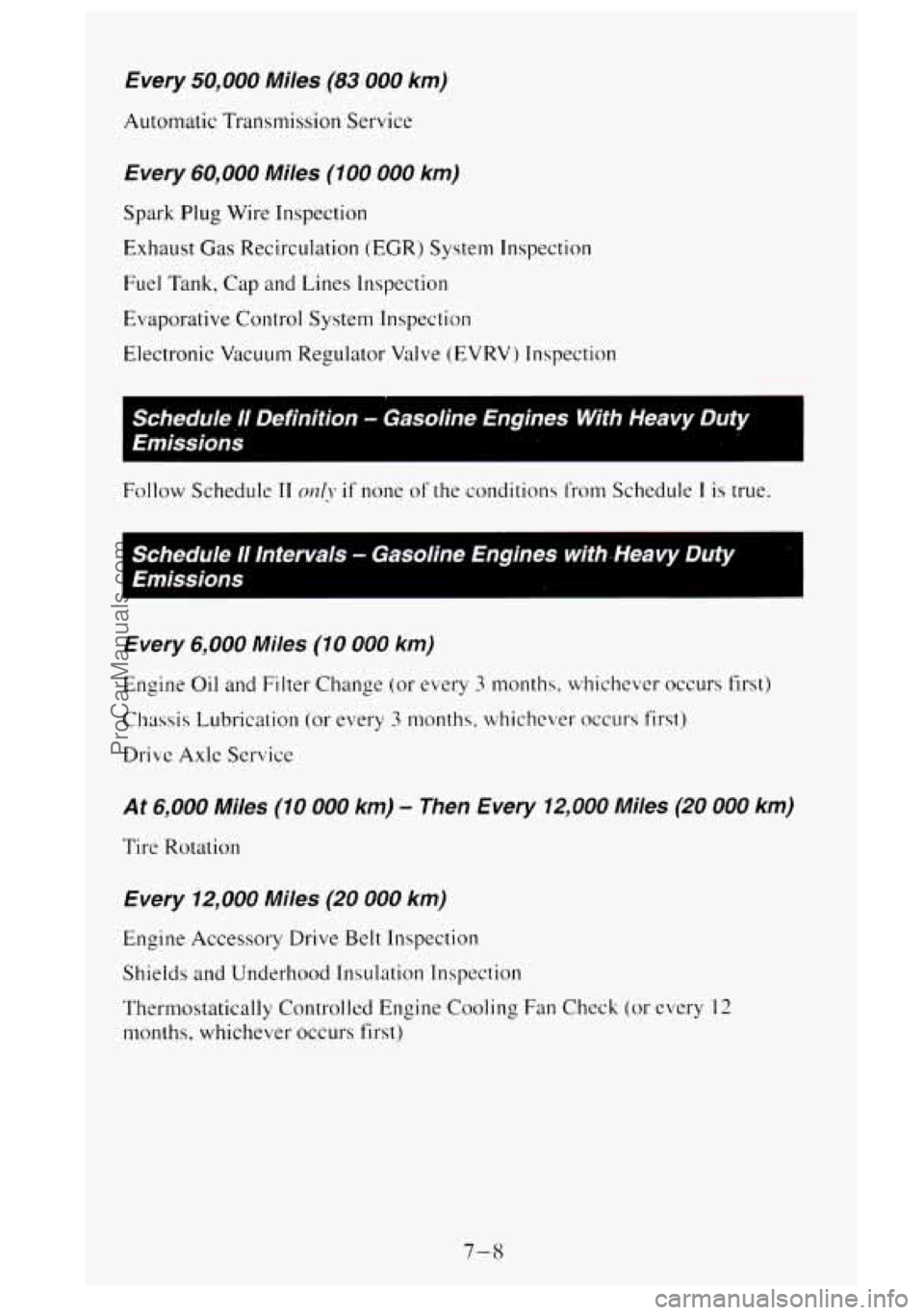
Every 50,000 Miles (83 000 km)
Automatic Transinission Service
Every 60,000 Miles (100 000 km)
Spark Plug Wire Inspection
Exhaust Gas Recirculation (EGR) System Inspection
Fuel Tank, Cap and Lines Inspection
Evaporative Control System Inspection
Electronic Vacuum Regulator Valve
(EVRV j Inspection
Schedule I1 Definition - Gasoline Engines With Heavy Duty
Emissions
Follow Schedule TI only if none of the conditions from Schedule I is true.
Schedule I1 Intervals - Gasoline Engines with-Heavy Duty
Emissions
Every
6,000 Miles (10 000 km)
Engine Oil and Filter Change (or every 3 months. whichever occurs first)
Clussis Lubrication (or every 3 months, whichever occurs first)
Drivc Axle Scrvice
At 6,000 Miles (10 000 km) - Then Every 12,000 Miles (20 000 km)
Tire Rotation
Every 12,000 Miles (20 000 km)
1
Engine Accessory Drive Belt Inspection
Shields and Underhood Insulation Inspection
Thermostatically Controlled Engine Cooling
Fan Check (or every 12
months, whichever occurs first)
7-8
ProCarManuals.com
Page 367 of 488
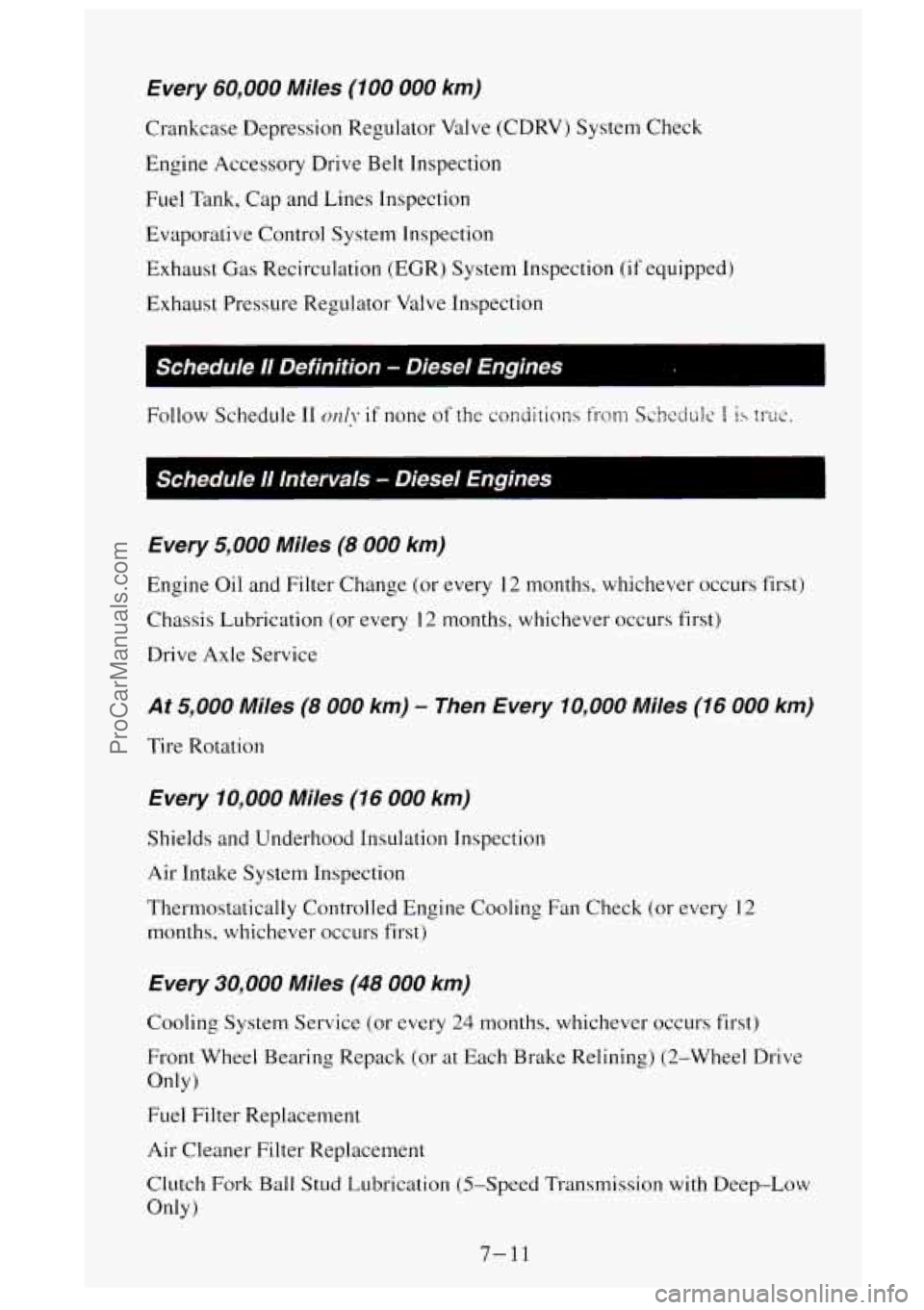
Every 60,000 Miles (100 000 km)
Crankcase Depression Regulator Valve (CDRV) System Check
Engine Accessory Drive Belt Inspection
Fuel Tank, Cap and Lines Inspection
Evaporative Control System Inspection
Exhaust Gas Recirculation (EGR) System Inspection
(if equipped)
Exhaust Pressure Regulator Valve Inspection
I Schedule 11 Definition - Diesel Engines
Follow Schedule II on!\- if none ofrhe conditions i'wm Schcdtilc I Is truc.
--
I Schedule I1 lntervals - Diesel Engines 1
Every 5,000 Miles (8 000 km)
Engine Oil and Filter Change (or every 12 months, whichever occurs first)
Chassis Lubrication
(or every 12 months, whichever occurs first)
Drive Axle Service
At 5,000 Miles (8 000 km) - Then Every 10,000 Miles (16 000 km)
Tire Rotation
Every 10,000 Miles (16 000 km)
Shields and Underhood insulation Inspection
Air Intake System Inspection
Thermostatically Controlled Engine Cooling Fan Check (or every
I2
months, whichever occurs first)
Every 30,000 Miles (48 000 km)
Cooling System Service (or every 24 months, whichever occurs first)
Front Wheel Bearing Repack (or
at Each Brake Relining) (2-Wheel Drive
Fuel Filter Replacement
Air Cleaner Filter Replacement
Clutch Fork Ball Stud Lubrication (5-Speed Transmission with Deep-Low
Only)
Only)
7-11
ProCarManuals.com
