1995 GMC SIERRA ECU
[x] Cancel search: ECUPage 187 of 488
A CAUTION:
0
0
0
Cargo on the load floor piled higher than the seatbacks can be
thrown forward during a sudden stop.
You or your passengers
could be injured. Keep cargo below the top of the seatbacks.
Unsecured cargo on the load floor can be tossed about when
driving over rough terrain.
You or your passengers can be
struck by flying objects. Secure the cargo properly.
Heavy loads on the roof raise the vehicle’s center of gravity,
making it more likely to roll over. You can be seriously or
fatally injured if the vehicle rolls over. Put heavy loads inside
the cargo area, not on the roof. Keep cargo in the cargo area
as far forward and low as possible.
You’ll find other important information in this manual. See “Vehicle
Loading,” “Luggage Carrier” and “Tires”
in the Index.
Traveling to Remote Areas
It makes sense to plan your trip, especially when going to a remote area.
Know the terrain and plan your route. You are much less likely to get bad
surprises. Get accurate maps
of trails and terrain. Try to learn of any
blocked or closed roads.
It’s also a good idea to travel with at least one other vehicle. If something
happens to one of them, the other can help quickly.
Does your vehicle have a winch‘?
If so, be sure to read the winch
instructions. In
a remote area, a winch can be handy if you get stuck. But
you’ll want to know how to use it properly.
Getting Familiar with Off-Road Driving
It’s a good idea to practice in an area that’s safe and close to home before
you go into the wilderness. Off-road driving does require some new and
different driving
skills. Here’s what we mean.
Tune your senses to different kinds
of signals. Your eyes, for example, need
to constantly sweep the terrain for unexpected obstacles. Your ears need to
listen for unusual tire or engine sounds. With your arms, hands, feet, and
body you’ll need
to respond to vibrations and vehicle bounce.
4-13
ProCarManuals.com
Page 205 of 488
Winter Driving
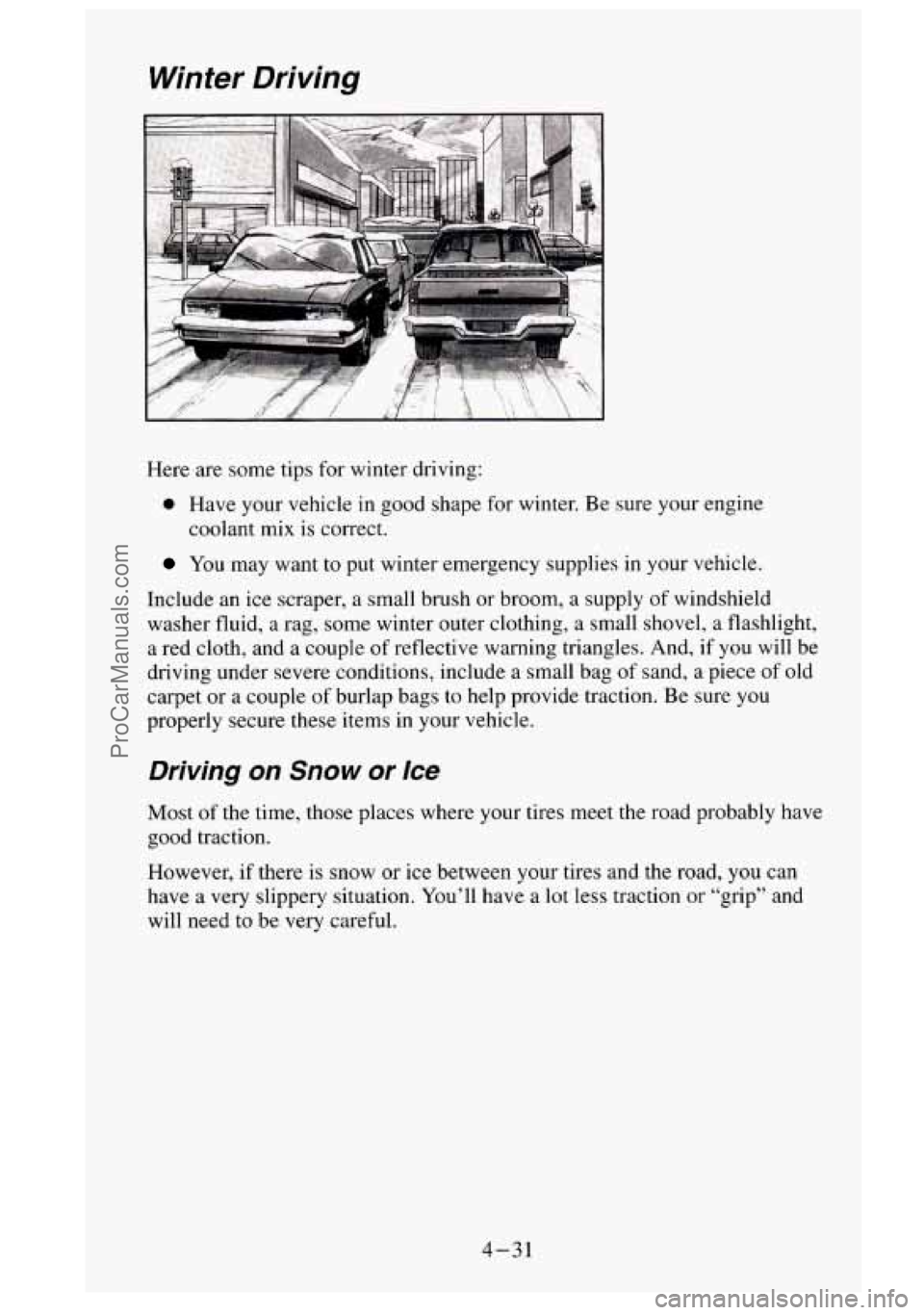
Here are some tips for winter driving:
0 Have your vehicle in good shape for winter. Be sure your engine
coolant mix is correct.
You may want to put winter emergency supplies in your vehicle.
Include an ice scraper, a small brush or broom, a supply of windshield
washer fluid, a rag, some winter outer clothing, a small shovel,
a flashlight,
a red cloth, and a couple of reflective warning triangles. And, if you will be
driving under severe conditions, include a small bag
of sand, a piece of old
carpet or a couple
of burlap bags to help provide traction. Be sure you
properly secure
these items in your vehicle.
Driving on Snow or Ice
Most of the time, those places where your tires meet the road probably have
good traction.
However, if there is snow
or ice between your tires and the road, you can
have a very slippery situation. You’ll have a lot less traction
or “grip” and
will need to be very careful.
4-31
ProCarManuals.com
Page 211 of 488
Loading Your Vehicle
-
DSI/KPA (COL3)
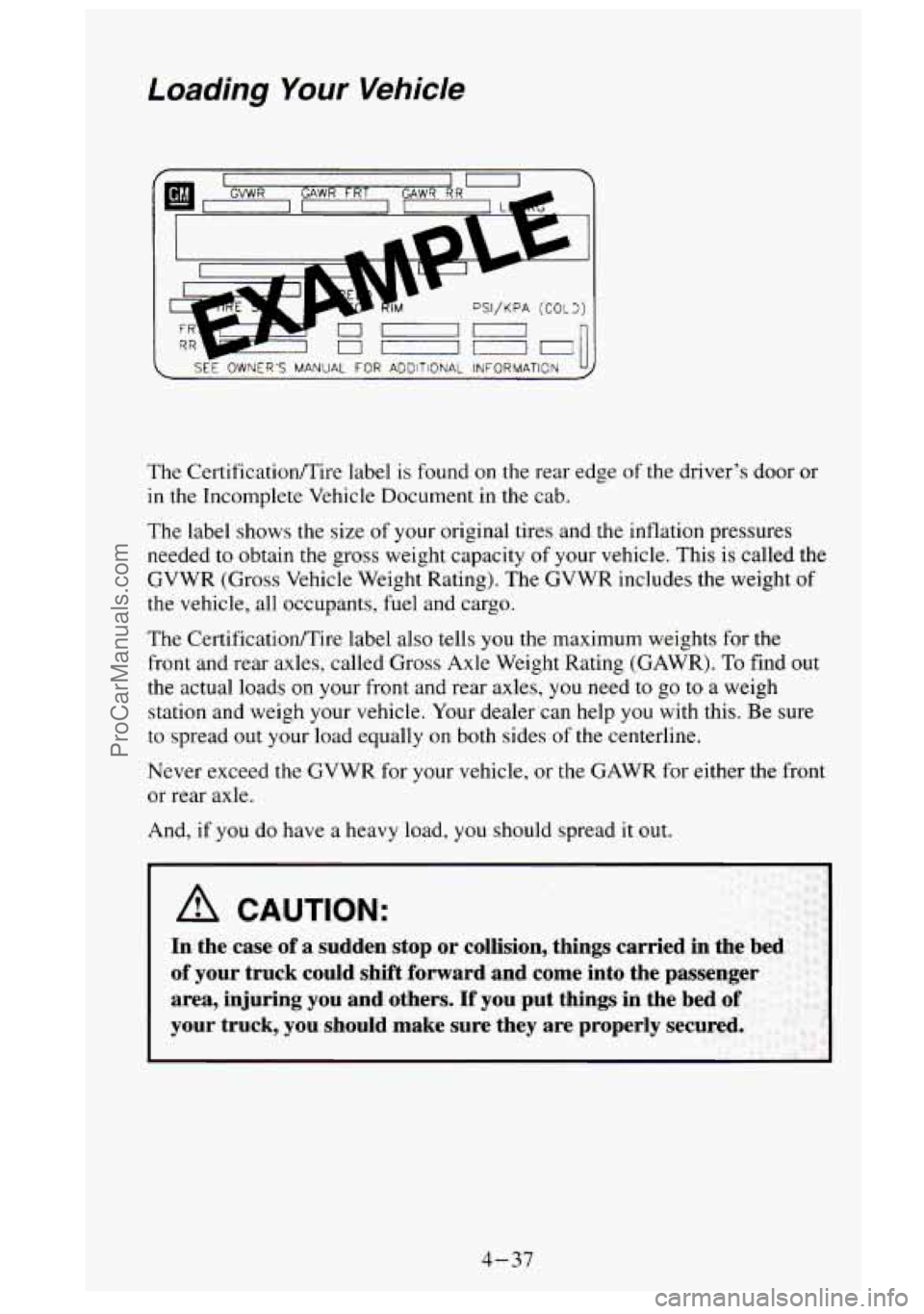
The Certification/Tire label is found on the rear edge of the driver’s door or
in the Incomplete Vehicle Document in the cab.
The label shows the size of your original tires and the inflation pressures
needed to obtain
the gross weight capacity of your vehicle. This is called the
GVWR (Gross Vehicle Weight Rating). The
GVWR includes the weight of
the vehicle, all occupants, fuel and cargo.
The CertificatiodTire label also tells you the maximum weights for the
front and rear axles, called Gross Axle Weight Rating (GAWR).
To find out
the actual loads
on your front and rear axles, you need to go to a weigh
station and weigh your vehicle. Your dealer can help
you with this. Be sure
to spread out your load equally on both sides of the centerline.
Never exceed the GVWR for your vehicle, or the GAWR for either the front
or rear axle.
And,
if you do have a heavy load, you should spread it out.
A CAUTION-:
In the case of a sudden stop or collision, things carried in the bed
of your truck could shift forward and come into the passenger \
area, injuring you and
others. If you put things in the bed of
your truck, you
should make sure they are properly secured.
4-37
ProCarManuals.com
Page 220 of 488
Will the trailer brake parts take 3,000 psi (20 650 Wa) of Ijressure? If
not, the trailer brake system must not be used with your vehicle.
Driving with a Trailer
Towing a trailer requires a certain amount of experience. Before setting out
for the open road, you’ll want to get to know your rig. Acquaint yourself
with the feel of handling and braking with the added weight of the trailer.
And always keep in mind that the vehicle you
are driving is now a good
deal longer and not nearly as responsive as your vehicle is by itself.
Before you start, check the trailer hitch and platform (and attachments),
safety chains, electrical connector, lamps, tires and mirror adjustment. If the
trailer has electric brakes, start your vehicle and trailer moving and then
apply the trailer brake controller by hand to be sure the brakes
are working.
‘This lets you check your electrical connection at the same \
time.
During your trip, check occasionally to be sure that the load is secure, and
that the lamps and any trailer brakes
are still working.
Following Distance
Stay at least twice as far behind the vehicle ahead as you would when
driving your vehicle without a trailer.
This can help you avoid situations that
require heavy braking and sudden turns.
Passing
You’ll need more passing distance up ahead when you’re towing a trailer.
And, because you’re a good deal longer, you’ll need to go much farther
beyond the passed vehicle before you can return to your lane.
.
Backing Up
Hold the bottom of the steering wheel with one hand. Then, to move the
trailer to the left, just move that hand to the left.
To move the trailer to the
right, move your hand to the right. Always back
up slowly and, if possible,
have someone guide you.
4-46
ProCarManuals.com
Page 231 of 488
To wing Your Vehicle
Try to have your GM dealer or a professional towing service tow your
vehicle. They can provide the right equipment and know how to tow
it
without damage.
If your vehicle has been changed since
it was factory-new. by adding such
things like fog lamps, aero skirting,
or special tires and wheels, these things
could be damaged during towing.
Before you do anything,
turn on the hazard warning flashers.
When you call, tell the towing service:
0 That your vehicle has rear-wheel drive, or that it has the four-wheel
drive option.
The make, model, and year of your vehicle.
0 Whether you can move the shift lever for the transmission and transfer
case,
if you have one.
If there was an accident. what was damaged.
A CAUTION:
To help avoid injury to you or others:
Never let passengers ride in a vehicle that is being towed.
0 Never tow faster than safe or posted speeds.
0 Never tow with damaged parts not fuIly secured.
0 Never get under your vehicle after it has been lifted by the
tow truck.
0 Always use separate safety chains on each side when towing a
vehicle.
0 For pickups (except cab chassis models), use T-hooks on front
. of vehicle, J-hooks on rear.
For cab chassis models, use J-hooks on front and rear of
vehicle.
When your vehicle is being towed, have the ignition key off. The steering
wheel should be clamped
in a straight-ahead position, with a clamping
device designed for towing, service.
Do not use the vehicle’s steering
column lock for this. The transmission and transfer case, if
you have one,
should be
in NEUTRAL (N) and the parking brake released.
5-7
ProCarManuals.com
Page 232 of 488
A CAUTION:
A vehicle can fall from a car carrier if it isn’t adequately
secured. This can cause
a collision, serious personal injury and
vehicle damage. The vehicle should be tightly secured with
chains or steel cables before it is transported.
Don’t use substitutes (ropes, leather straps, canvas webbing,
etc.) that can be cut by sharp edges underneath the towed
vehicle.
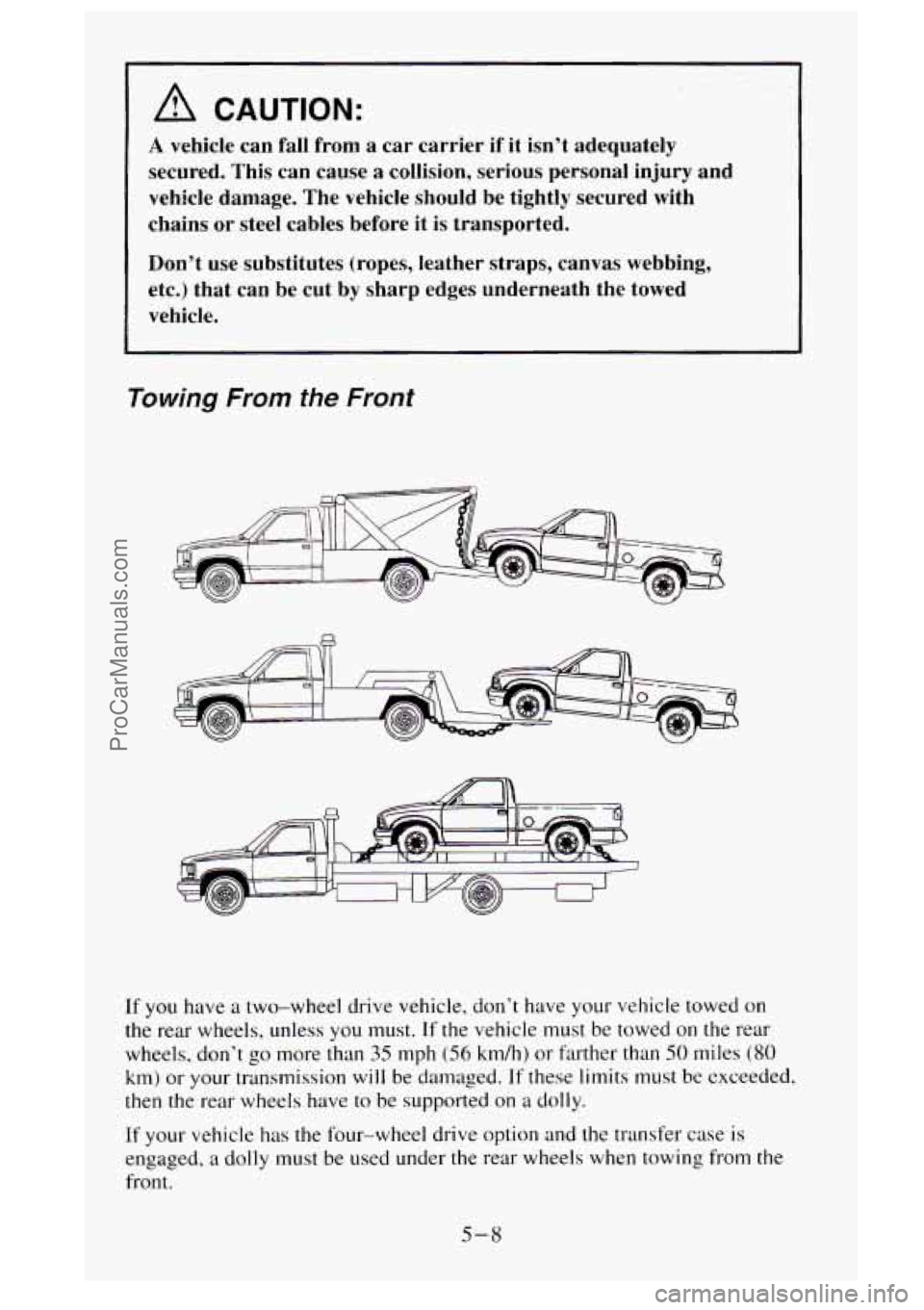
Towing From the Front
If you have a two-wheel drive vehicle, don’t have your vehicle towed on
the rear wheels, unless
you must. If the vehicle must be towed on the rear
wheels, don’t
go more than 35 mph (56 km/h) or farther than 50 miles (80
km) or your transmission will be damaged. If these limits must be exceeded,
then
the rear wheels have to be supported on a dolly.
If your vehicle has the four-wheel drive option and
the transfer case is
engaged, a dolly must be used under the rear wheels when towing from the
front .
5-8
ProCarManuals.com
Page 262 of 488
I
A ,CAUTION:
Storing a jack, a tire or other equipment in the passenger
compartment
of the vehicle could cause injury. In a sudden stop
or collision, loose equipment could strike someone. Store all
these
in the proper place.
Stowing the
Tire - Under-Body Carrier
Stow the flat tire under the rwr of the vehicle in spare tire carrier. To stow
the flat tire:
1.
AI 3
3.
4.
5.
Put the tire on the ground at the rear of the vehicle with the valve stern
pointed down.
Pull the wheel retainer through thc wheel opening.
Attach the ratchet
to the urheel n'rench with the UP marking Facing
you.
Put the other end of the whcel wrench through the rcar bumper access
hole, located at the passenger side edge
of the license plate. Be sure the
wheel wrench connects into the hoist
shaft.
Turn the ratchet clockwise to raise the tire. Keep turning the ratchet
until the tire is all the way up. You will hear two "clicks" when the tire
is secure. Pull on the tire to nuke sure it is tightly secured.
Stowing the Jack and Jacking Tools
Return the jack, ratchet, wheel wrench and jack extensions to their location
behind the passenger's
seat. Stow thc jack and jacking tools as shown in the
illustrations earlier
in this part. Secure the items and replace the jack cover,
if there is one.
5-38
ProCarManuals.com
Page 312 of 488
Windshield Wiper Blade Inserts
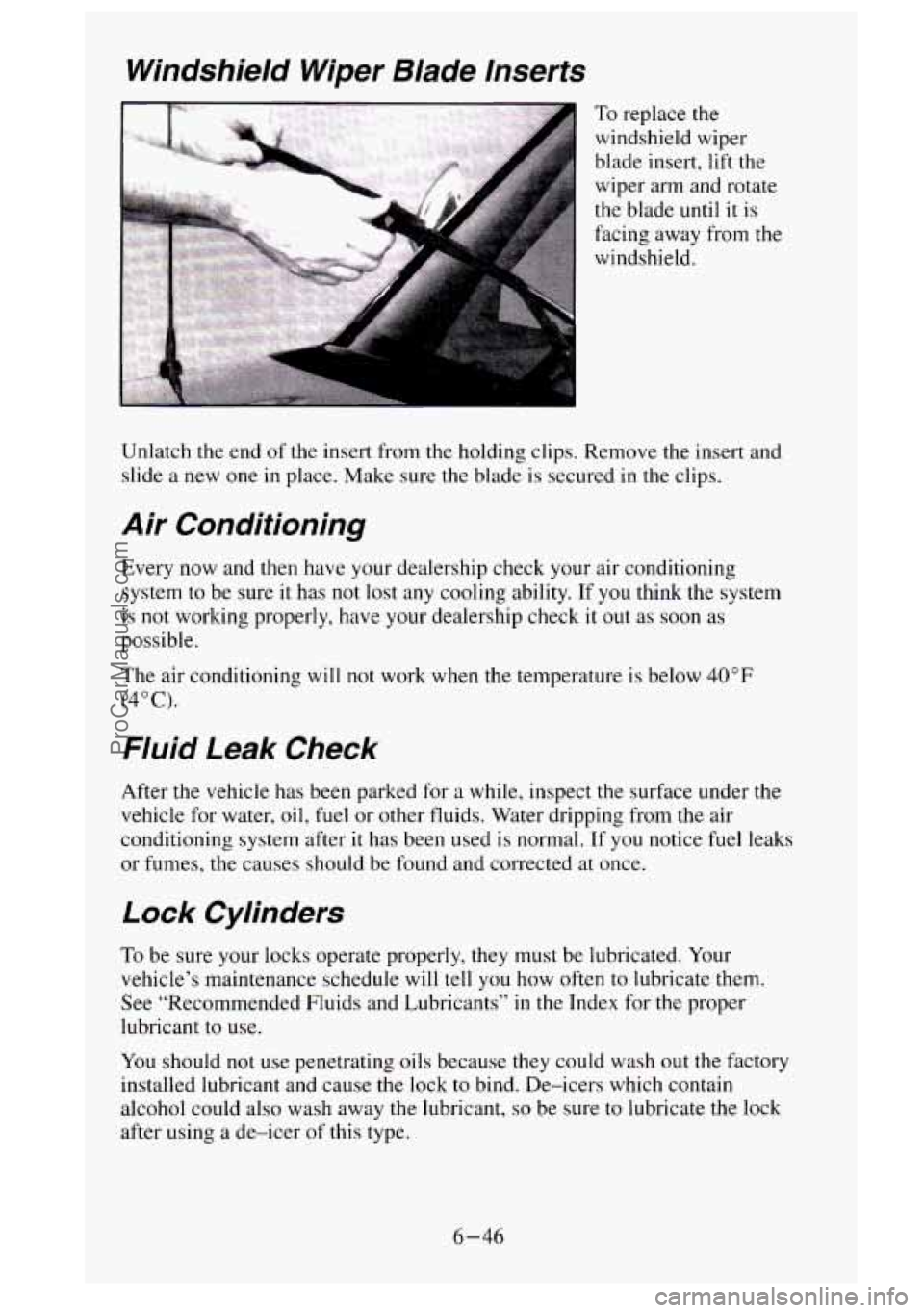
To replace the
windshield wiper
blade insert, lift
the
wiper arm and rotate
the blade until
it is
facing away from the
windshield.
Unlatch the end
of the insert from the holding clips. Remove the insert and
slide
a new one in place. Make sure the blade is secured in the clips.
Air Conditioning
Every now and then have your dealership check your air conditioning
system to be sure it
has not lost any cooling ability. If you think the system
is not working properly, have your dealership check it out as soon as
possi bleb
The air conditioning will
not work when the temperature is below 40°F
(4°C).
Fluid Leak Check
After the vehicle has been parked for a while, inspect the surface under the
vehicle for water, oil, fuel
or other fluids. Water dripping from the air
conditioning system after it has been used is normal.
If you notice fuel leaks
or fumes, the causes should be found and corrected at once.
Lock Cylinders
To be sure your locks operate properly, they must be lubricated. Your
vehicle’s maintenance schedule will tell you how often to lubricate them.
See “Recommended Fluids and Lubricants” in the Index for
the proper
lubricant to use.
You should
not use penetrating oils because they could wash out the factory
installed lubricant and cause
the lock to bind. De-icers which contain
alcohol could also
wash away the lubricant, so be sure to lubricate the lock
after using
a de-icer of this type.
6-46
ProCarManuals.com