1995 GMC SIERRA change time
[x] Cancel search: change timePage 189 of 488
When you drive over bumps, rocks, or other obstacles, your wheels can
leave the ground. If this happens, even with
one or two wheels, you can’t
control
the vehicle as well or at all.
Because
you will be on an unpaved surface, it’s especially important to
avoid sudden acceleration, sudden turns, or sudden braking.
In a way, off-road driving requires a different kind
of alertness from driving
on paved roads and highways. There are
no road signs, posted speed limits
or signal lights. You have to use your own good judgment about what is safe
and what isn’t.
Drinking and driving can be very dangerous on any road. And this is
certainly true for off-road driving. At the very time
you need special
alertness and driving skills, your reflexes, perceptions and judgment can be
affected by even a small amount of alcohol.
You could have a serious - or
even fatal
- accident if you drink and drive or ride with a driver who has
been drinking. (See “Drunken Driving” in the Index.)
Driving On Off-Road Hills
Off-road driving often takes you up, down, or across a hill. Driving safely
on hills requires good judgment and an understanding
of what your vehicle
can and can’t do. There are some hills that simply can’t be driven, no matter
how well built the vehicle.
A CAUTION:
Many hills are simply too steep for any vehicle, If you drive up
them, you will stall, If you drive
down them, you can’t control
your speed. If you drive across them, you will roll over. You
could be seriously injured
or killed. If you have any doubt about
the steepness, don’t drive the hill.
Approaching a Hill
When you approach a hill, you need to decide if it’s one of those hills that’s
just
too steep to climb, descend, or cross. Steepness can be hard to judge.
On
a very small hill, for example, there may be a smooth, constant incline
with only a small change in elevation where you can easily see all the way
to the top. On
a large hill, the incline may get steeper as you near the top,
but you may
not see this because the crest of the hill is hidden by bushes,
grass, or shrubs.
4-15
ProCarManuals.com
Page 217 of 488
Most vehicles are ready for some trailer towing. If yours was built with
trailering options,
as many are, it’s ready for heavier trailers. But trailering
is different than just driving your vehicle by itself. Trailering means changes
in handling, durability, and fuel economy. Successful, safe trailering takes
correct equipment, and
it has to be used properly.
That’s the reason for this part.
In it are many time-tested, important
trailering tips and safety rules. Many of these are important for your safety
and that of your passengers.
So please read this section carefully before you
pull a trailer.
If You Do Decide To Pull A Trailer
If you do, here are some important points.
e
e
a
0
a
There are many different laws, including speed limit restrictions,
having to do with trailering. Make sure your rig will be legal, not only
where you live but also where you’ll be driving.
A good source for this
information can be state or provincial police.
Consider using
a sway control if your trailer will weigh 4,000 pounds
(I 800 kg) or less. You should always use a sway control if your trailer
will weigh more than
4,000 pounds (1 800 kg). You can ask a hitch
dealer about sway controls.
Don’t tow
a trailer at all during the first 500 miles (800 km) your new
vehicle
is driven. Your engine, axle or other parts could be damaged.
Then, during the first
500 miles (800 km) that you tow a trailer, don‘t
drive over
50 mph (80 kdh) and don’t make starts at full throttle. This
helps your engine and other parts of your vehicle wear
in at the heavier
loads.
If you have an automatic transmission, you should use DRIVE (3) (or,
as you need to, a lower gear) when towing a trailer. Operating your
vehicle in DRIVE
(3) when towing a trailer will minimize heat
build-up and extend the life
of your transmission. If you have a manual
transmission and you are towing
a trailer, it’s better not to use FIFTH
(5) gear. Just drive in FOURTH (4) gear (or, as you need to, a lower
gear).
Three important considerations have
to do with weight:
Weight of the Trailer
How heavy can a trailer safely be?
It depends on how you plan to use your rig. For example, speed, altitude,
road grades, outside temperature and how much your vehicle is used
to pull
a trailer are all important. And, it can
also depend on any special equipment
that you have on your vehicle.
4-43
ProCarManuals.com
Page 259 of 488
Front rosluon Rear Position
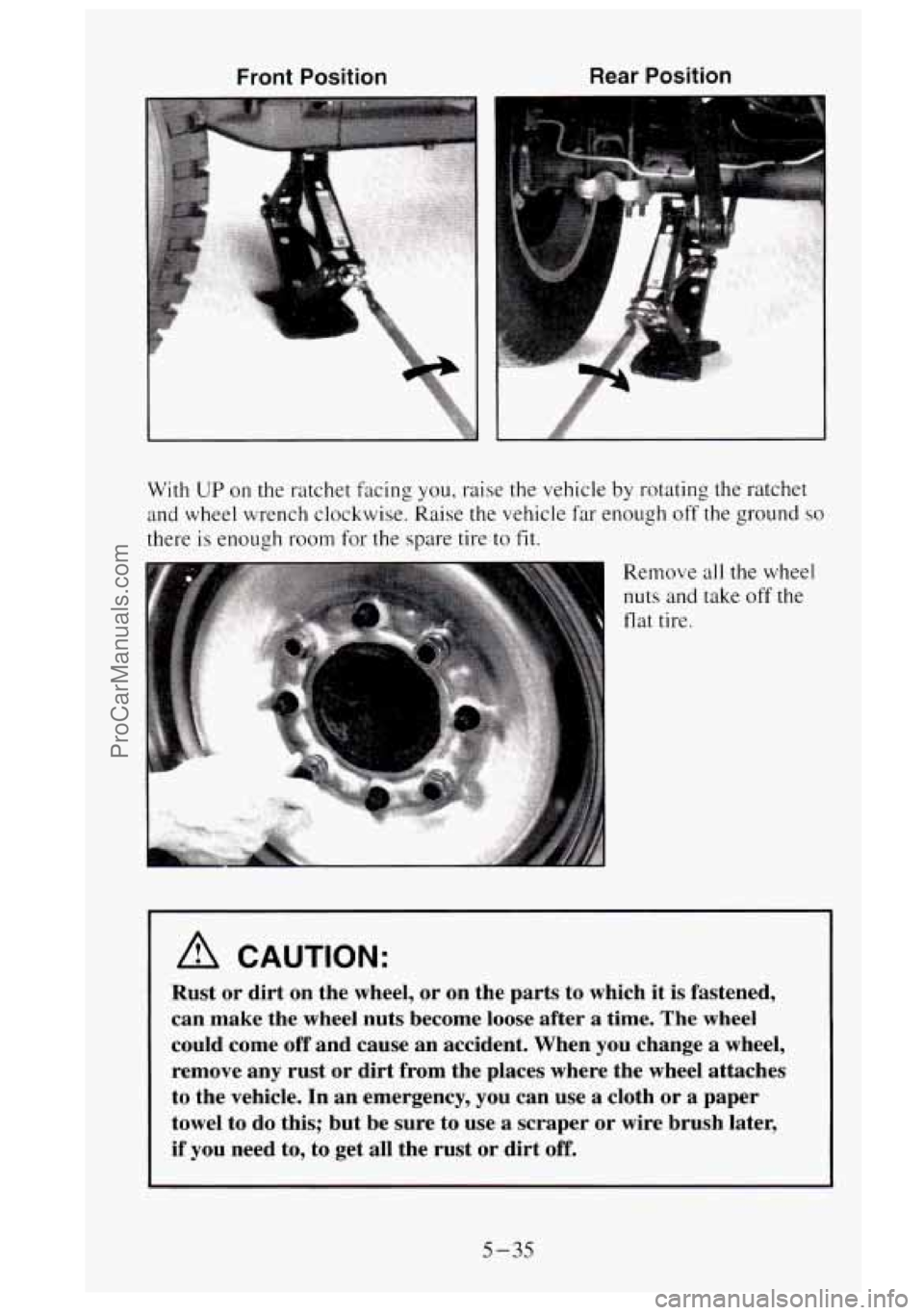
With UP on the ratchet facing you, raise the vehicle by rotating the ratchet
and wheel wrench clockwise. Raise the vehicle
far enough off the ground so
there is enough room for the spare tire to fit.
Remove
all the wheel
nuts and take
off the
flat tire,
A CAUTION:
Rust or dirt on the wheel, or on the parts to which it is fastened,
can make the wheel nuts become loose after a time. The wheel
could come
off and cause an accident. When you change a wheel,
remove any rust or dirt from the places where the wheel attaches
to the vehicle. In an emergency, you can use a cloth or a paper
towel
to do this; but be sure to use a scraper or wire brush later,
if you need to, to get all the rust or dirt off.
5-35
ProCarManuals.com
Page 275 of 488
A CAUTION:
Diesel fuel is flammable. It could start a fire if it gets on hot
engine parts. You could be burned. Don't let too much fuel flow
from the air bleed
valve, and wipe up any spilled fuel with a
cloth.
3. Close the air bleed valve.
4. Turn the ignition key to START for 10 to 15 seconds at a time until
your engine starts.
Fuel Filter Replacement (Diesel Engines)
If you want to change the fuel filter yourself, here's how to do it:
A CAUTION:
Diesel fuel is flammable. It could start a fire if something ignites
it, and you could be burned. Don't let it get on hot engine parts,
and keep matches or other ignition sources away.
First. drain any water from the filter following the procedure for draining
water listed previously.
Your vehicle's engine should be off until the end
of the following procedure.
1. Apply the parking brake.
2. Take off the fuel tank cap. This releases vacuum in the tank.
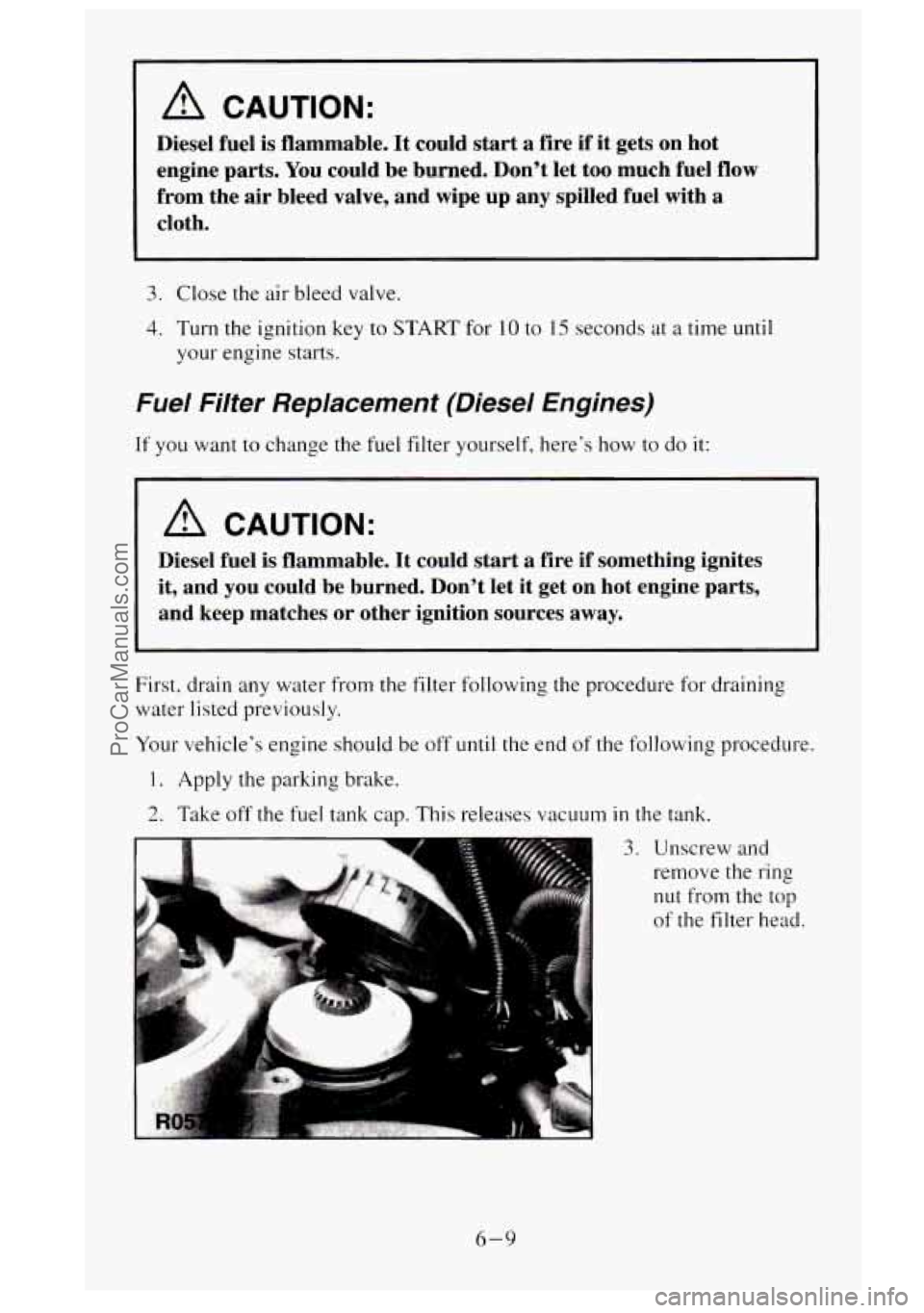
3. Unscrew and
remove the ring
nut from the top
of the
filter head.
6-9
ProCarManuals.com
Page 287 of 488
Engine Coolant Heater
An engine coolant heater can be a big help if you have to park outside in
very cold weather, 0°F (-1 8OC) or colder. If your vehicle has this option,
see “Engine Coolant Heater’’ in the Index.
What to Do with Used Oil
Did you know that used engine oil contains certain elements that may be
unhealthy for your skin and could even cause cancer? Don’t let used oil stay
on your skin for very long. Clean your skin and nails with soap and water,
or a good hand cleaner. Wash or properly throw away clothing or rags
containing used engine oil. (See the manufacturer‘s warnings about the use
and disposal of
oil products.)
Used oil can be a real threat to
the environment. If you change your own oil,
be sure to drain all free-flowing oil from the filter before disposal. Don’t
ever dispose
of oil by putting it in the trash, pouring it on the ground, into
sewers, or into streams or bodies
of water. Instead. recycle it by taking it to
a place that collects used oil. If you have a problem properly disposing of
your used oil, ask your dealer, a service station or a local recycling center
for help.
Engine Oil (Diesel Engines)
It’s a good idea to check your engine oil level every time you get fuel. In
order to get an accurate reading, the oil must be warm and
the vehicle must
be on level ground.
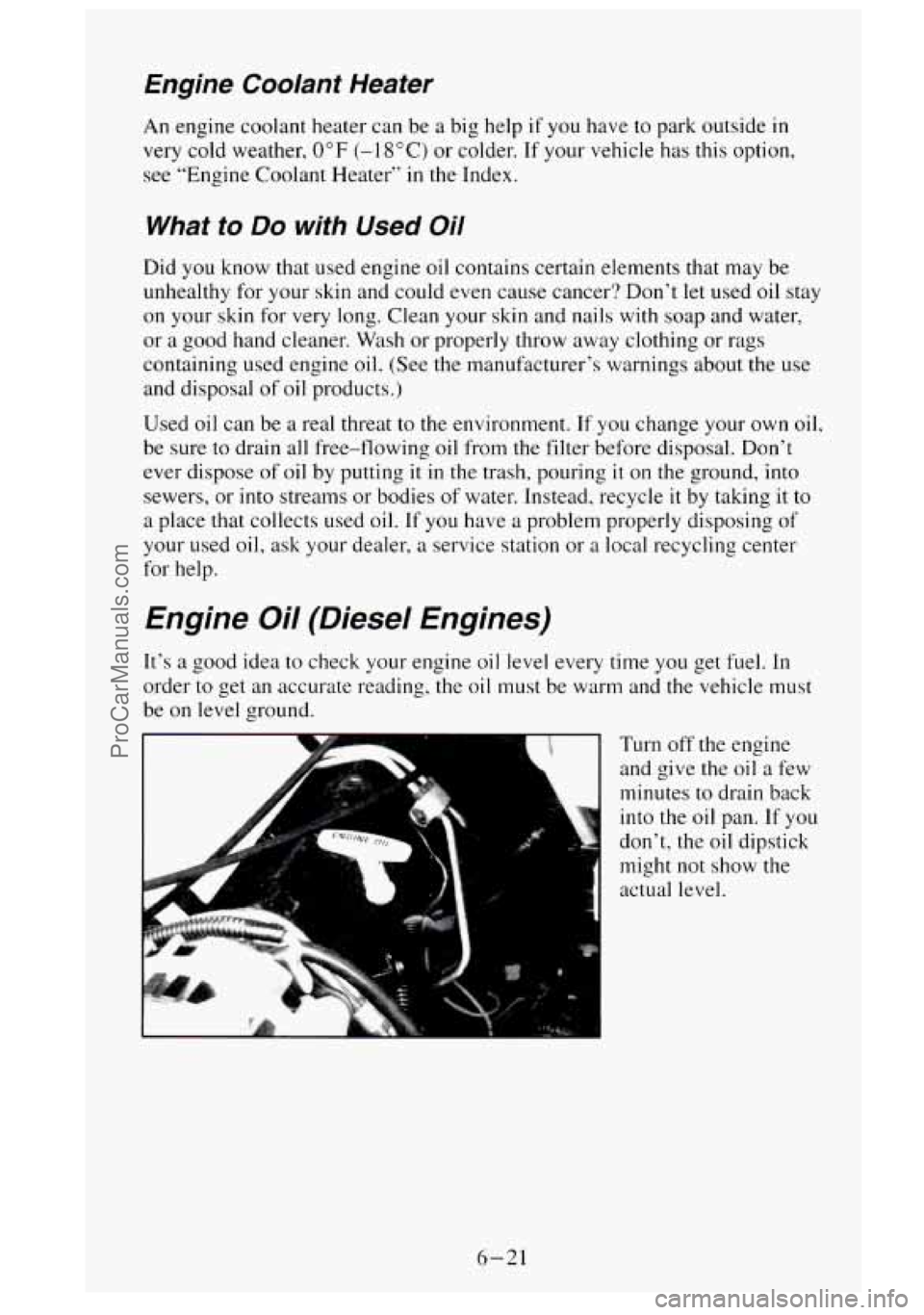
Turn off the engine
and give the oil
a few
minutes
to drain back
into the
oil pan. If you
don’t, the oil dipstick
might not show the
actual level.
6-21
ProCarManuals.com
Page 293 of 488
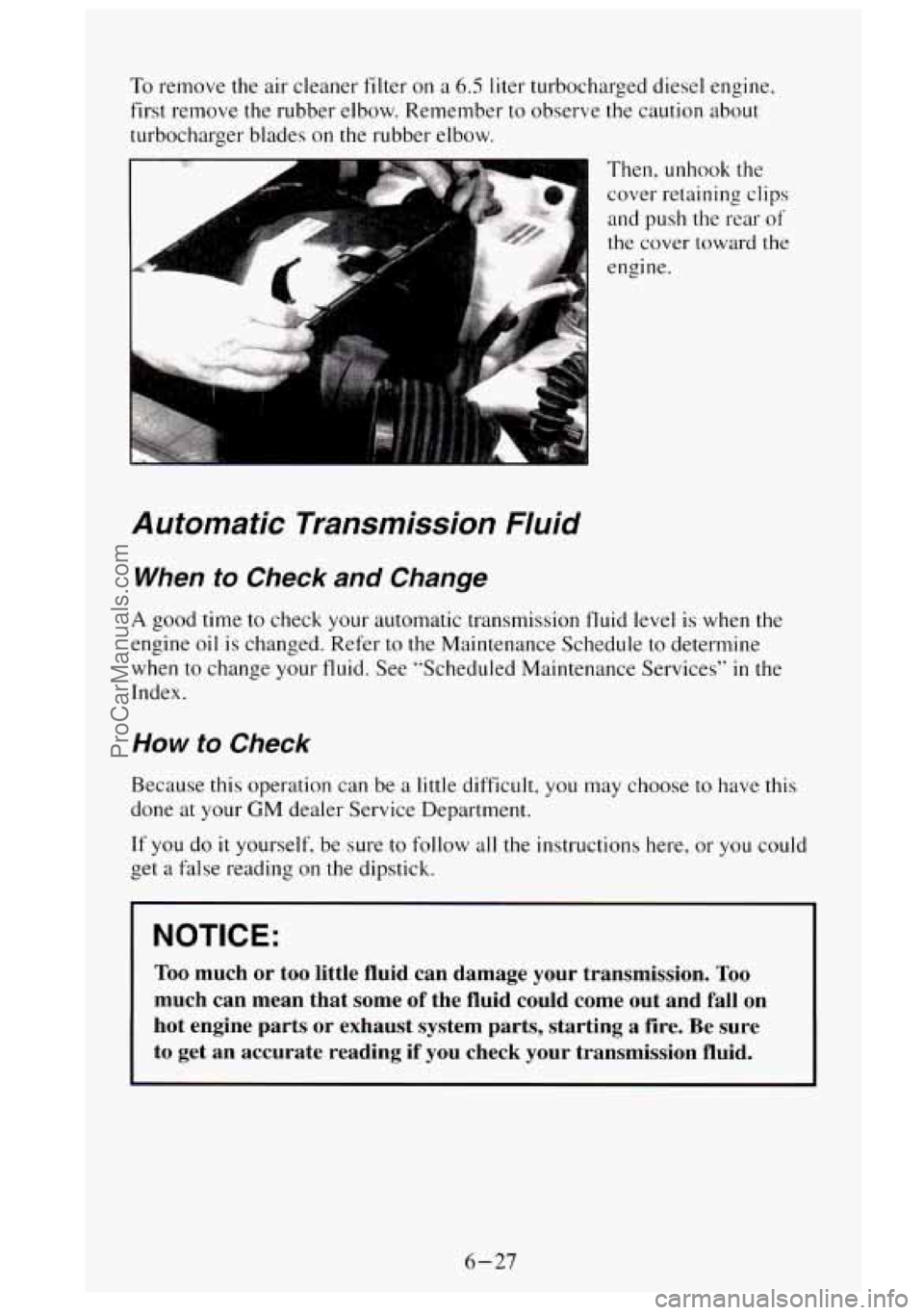
To remove the air cleaner filter on a 6.5 liter turbocharged diesel engine,
first remove the rubber elbow. Remember to observe the caution about
turbocharger blades on the rubber elbow.
Then, unhook the
cover retaining clips
and push the rear
of
the cover toward the
engine.
Automatic Transmission Fluid
When to Check and Change
A good time to check your automatic transmission fluid level is when the
engine
oil is changed. Refer to the Maintenance Schedule to determine
when to change your fluid. See "Scheduled Maintenance Services''
in the
Index.
How to Check
Because this operation can be a little difficult, you may choose to have this
done at your
GM dealer Service Department.
If you do
it yourself, be sure to follow all the instructions here, or you could
get
a false reading on the dipstick.
NOTICE:
Too much or too little fluid can damage your transmission. Too
much can mean that some of the fluid could come out and fall on
hot engine parts or exhaust system parts, starting a fire. Be \
sure
to get an accurate reading if you check your transmission fluid.
6-27
ProCarManuals.com
Page 296 of 488
How to Add Fluid
Refer to the Maintenance Schedule to determine what kind of transmission
fluid
to use. See “Recommended Fluids and Lubricants” in the Index.
Add fluid only after checking the transmission fluid
HOT. (A COLD check
is used
only as a reference.) If the fluid level is low, add only enough of the
proper fluid to bring the level up
to the HOT area for a hot check. It doesn’t
take much fluid, generally less than a
int. Don ’t overfill. We recommend
you use only fluid labeled DEXRON
-111, because fluid with that label is
made especially for your automatic transmission. Damage caused by fluid
other than DEXRON@-I11 is not covered by your
new vehicle warranty.
8
0 After adding fluid, recheck the fluid level as described under “How to
Check.”
0 When the correct fluid level is obtained, push the dipstick back in all
the way; then flip the handle down
to lock the dipstick in place.
Manual Transmission Fluid
When to Check
A good time to have it checked is when the engine oil is changed. However,
the fluid
in your manual transmission doesn’t require changing.
How to Check
Because this operation can be a little difficult, you may choose to have this.
done at your
GM dealer Service Department.
If you do it yourself, be sure to follow all the instructions here, or you could
get a false reading.
NOTICE:
Too much or too little fluid can damage your transmission. Too
much can mean that some of the fluid could come out and fall on
hot engine parts or exhaust system parts, starting a fire.
Be sure
to get an accurate reading if you check your transmission fluid.
Check the fluid level only when your engine is off, the vehicle is parked on
a level place and the transmission is cool enough for you to rest your fingers
on the transmission case.
6-30
ProCarManuals.com
Page 299 of 488
What to Use
Refer to the Maintenance Schedule to determine what kind of lubricant to
use. See “Recommended Fluids and Lubricants”
in the Index.
C3 (3500 H.D.) Trucks Equipped with Dana Rear Axle
Additional rear axle scheduled maintenance is required on 3500 H.D.
models equipped with Dana rear axles when they are driven under the
following conditions:
0 Extreme loading (at or near GVWR) or trailer towing, and:
Operation above 45 mph for extended periods of time
Vehicles used
in any of these conditions require the rear axle lubricant (SAE
8OW-90 - GL-5) be changed every 3 months or 3,000 miles, whichever
comes first.
To reduce required maintenance, SAE 75W-140 synthetic gear lubricant
may be used. With the use of synthetic
SAE 75W-140 lubricant, the fluid
change intervals may be increased to 30,000 miles. Before using SAE
75W-140, it is important to drain and flush the axle with clean mineral
based (non-synthetic) axle lubricant. Fluid capacity is 4.12 qts. (3.9L).
Four- Wheel Drive
Most lubricant checks in this section also apply to four-wheel-drive
vehicles. However, they have two additional systems that need lubrication.
Transfer Case
When to Check Lubricant
Refer to the Maintenance Schedule to determine how often to check the
lubricant. See “Periodic Maintenance Inspections”
in the Index.
6-33
ProCarManuals.com