1995 GMC SIERRA brake light
[x] Cancel search: brake lightPage 228 of 488
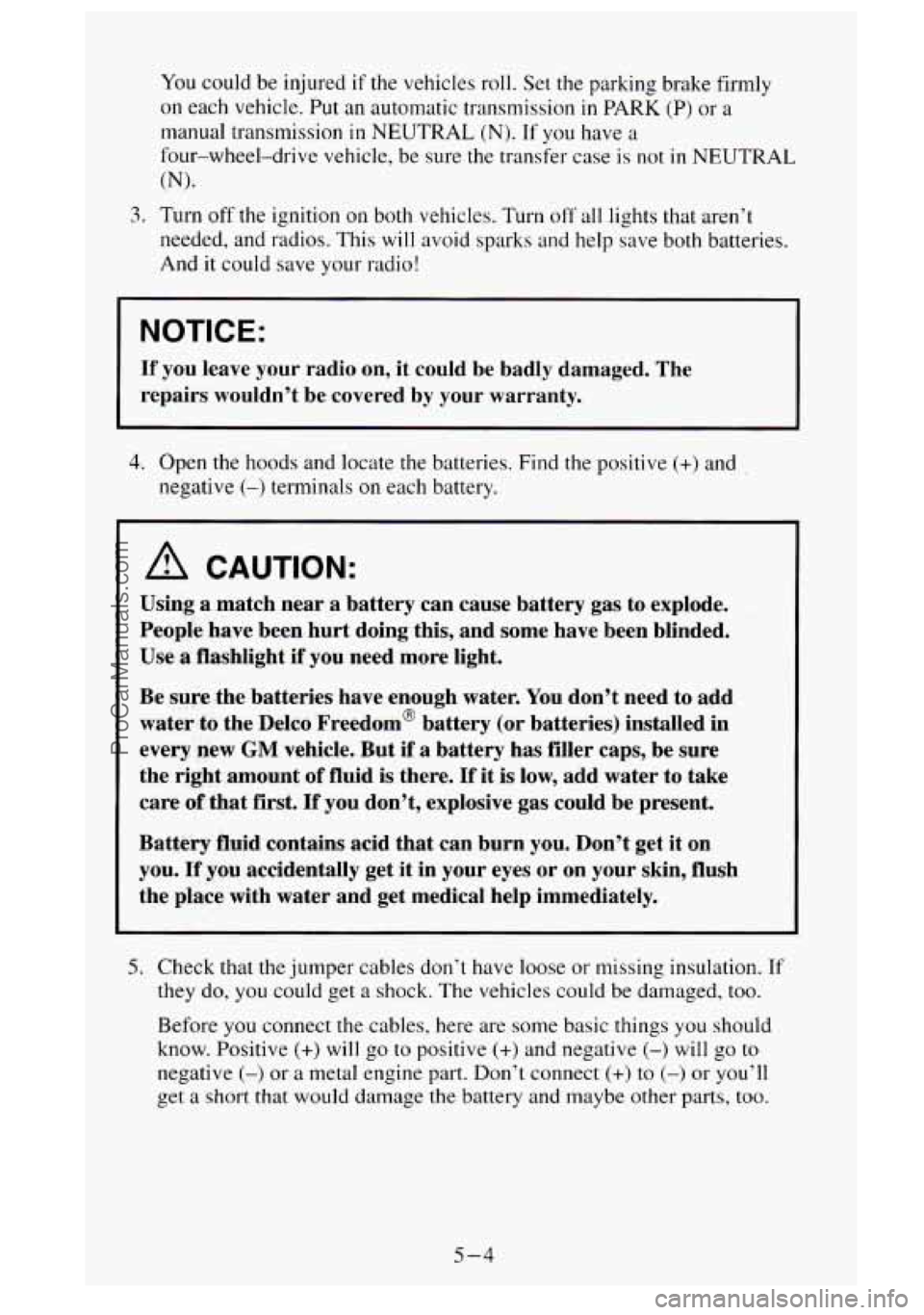
You could be injured if the vehicles roll. Set the parking brake firmly
on each vehicle. Put an automatic transmission in PARK (P) or a
manual transmission in NEUTRAL (N). If you have a
four-wheel-drive vehicle, be sure the transfer case is not in NEUTRAL
(N).
3. Turn off the ignition on both vehicles. Turn off all lights that aren’t
needed, and radios. This
will avoid sparks and help save both batteries.
And it could save your radio!
NOTICE:
If you leave your radio on, it could be badly damaged. The
repairs wouldn’t be covered by your warranty.
4. Open the hoods and locate the batteries. Find the positive (+) and
negative
(-) terminals on each battery.
A CAUTION:
Using a match near a battery can cause battery gas to explode.
People have been hurt doing this, and some have been blinded.
Use
a flashlight if you need more light.
Be sure the batteries have enough
water. You don’t need to add
water to the Delco Freedom@ battery (or batteries) installed in
every new
GM vehicle. But if a battery has filler caps, be sure
the right amount of fluid is there.
If it is low, add water to take
care
of that first. If you don’t, explosive gas could be present.
Battery fluid contains acid that can burn you. Don’t get
it on
you.
ff you accidentally get it in your eyes or on your skin, flush
the place with water and get medical help immediately.
5. Check that the jumper cables don’t have loose or missing insulation. If
they do,
you could get a shock. The vehicles could be damaged, too.
Before you connect the cables, here are some basic things you should
know. Positive
(+) will go to positive (+) and negative (-) will go to
negative
(-) or a metal engine part. Don’t connect (+) to (-) or you’ll
get
a short that would damage the battery and maybe other parts, too.
5-4
ProCarManuals.com
Page 273 of 488

Hesitation or “flat” performance at high speed or during \
hard acceleration
may be an indication of premature fuel filter plugging due to dirty or
contaminated fuel. The fidter element may need to be changed
if this
happens. See your dealer for assistance.
To drain water:
1. Stop and park the vehicle in a safe place. Turn off the engine and apply
2. Remove the fuel tank cap.
the parking brake.
3. Place a
fuel-resistant container under the filter drain hose.
5.
6.
7.
8.
4. With the engine
off, open the
water drain valve
2 to 3 turns.
When standing in
front of the
vehicle, the valve
is located on the
right side of the
thermostat
housing.
Start the engine and allow it to idle until clear fuel is ob\
served.
Stop the engine and close the water drain valve.
Remove the fuel-resistant container and properly dispose of the
contaminated fuel.
To find out how to properly dispose of contaminated
diesel fuel see “What to Do with Used Oil” in the “E\
ngine Oil (Diesel
Engines)” part, later in this section.
Install the fuel tank cap.
If the WATER IN FUEL light comes on again after driving a short distance
or the engine runs rough or stalls-a large amount of water has probably
been pumped into the
fuel tank. The fuel tank should be purged.
6-7
ProCarManuals.com
Page 310 of 488

Brake Wear
Your vehicle has front disc brakes and rear drum brakes. If you have a C
3500 HD model, it has four-wheel disc brakes.
Disc brake pads have built-in wear indicators that make
a high-pitched
warning sound when the brake pads are worn and new pads are needed. The
sound may come and
go or be heard all the time your vehicle is moving
(except when you are pushing on the brake pedal firmly).
I A CAUTION:
The brake wear warning sound means that sooner or later your
brakes won’t work well. That could lead to an accident. Whe\
n
you hear the brake wear warning sound, have your vehicle
serviced.
NOTICE:
Continuing to drive with worn-out brake pads could result in
costly brake repair.
Some driving conditions or climates may cause a brake squeal when the
brakes are first applied or lightly applied. This does not mean something is
wrong with your brakes.
If you have rear drum brakes, they don’t have wear indicators, but if you
ever hear
a rear brake rubbing noise, have the rear brake linings inspected.
Also, the rear brake drum should be removed and inspected each time the
tires are removed for rotation
or changing. When you have the front brakes
replaced, have the rear brakes inspected, too.
Brake linings should always be replaced as complete axle sets.
Brake Pedal Travel
See your dealer if the brake pedal does not return to normal height, or if
there is a rapid increase in pedal travel. This could be a sign of brake
trouble.
6-44
ProCarManuals.com
Page 353 of 488
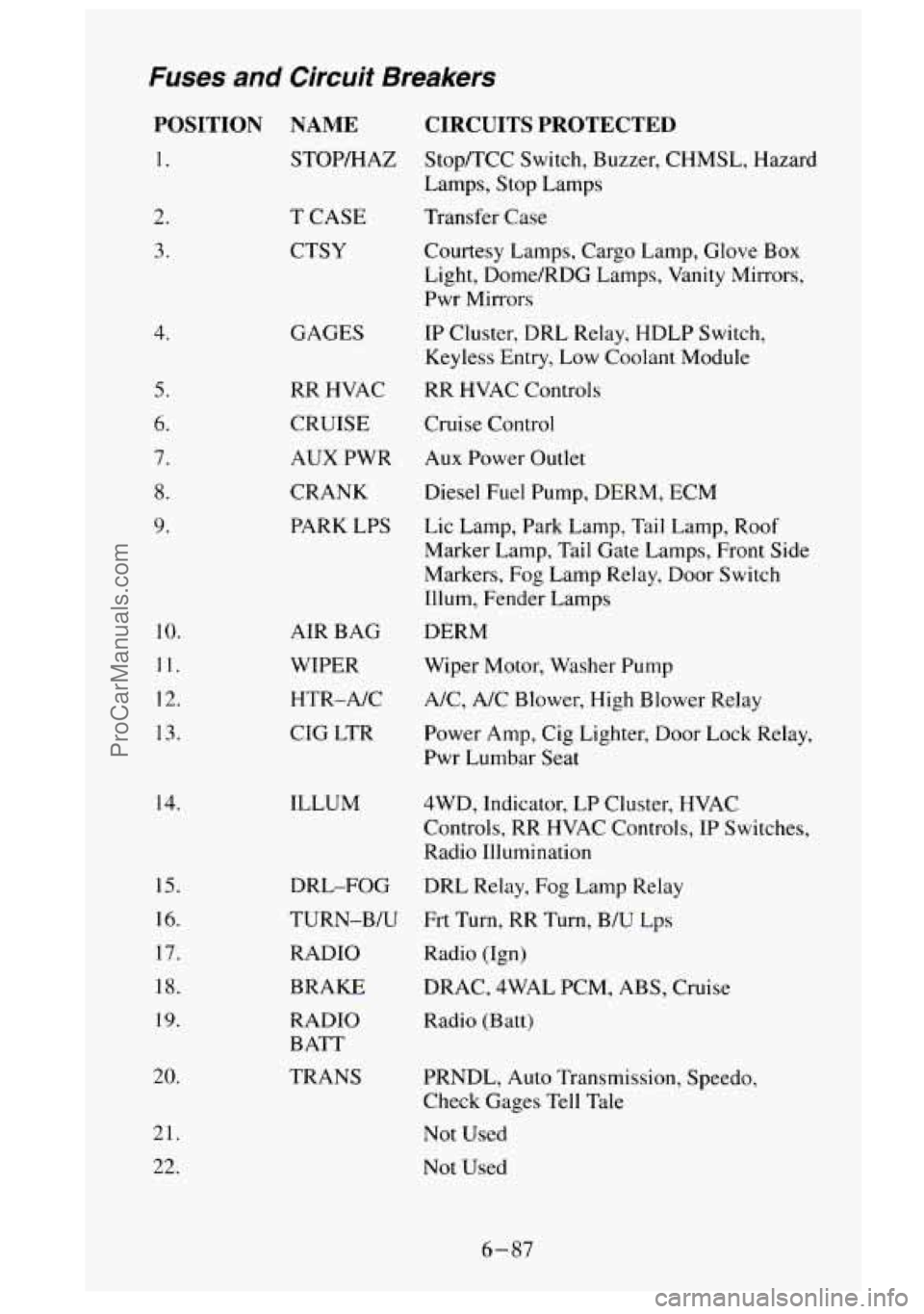
Fuses and Circuit Breakers
POSITION NAME
1. STOP/HAZ
2.
3.
4.
5.
6.
7.
8.
9.
10.
11.
12.
13.
14.
IS.
16.
17.
18.
19.
20.
21. 22.
T CASE
CTSY
GAGES
RR HVAC
CRUISE
AUX PWR
CRANK
PARK LPS
AIR BAG
WIPER HTR-A/C
CIG LTR
ILLUM
DRL-FOG
TURN-B/U RADIO
BRAKE RADIO
BATT
TRANS
CIRCUITS PROTECTED
Stop/TCC Switch, Buzzer, CHMSL, Hazard
Lamps, Stop Lamps
Transfer Case
Courtesy Lamps, Cargo Lamp, Glove Box
Light, Dome/RDG Lamps, Vanity Mirrors,
Pwr Mirrors
IP Cluster, DRL Relay, HDLP Switch,
Keyless Entry, Low Coolant Module
RR HVAC Controls
Cruise Control
Aux Power Outlet
Diesel Fuel Pump, DERM, ECM
Lic Lamp, Park Lamp, Tail Lamp, Roof
Marker Lamp, Tail Gate Lamps, Front Side
Markers, Fog Lamp Relay, Door Switch
Illum, Fender Lamps
DERM
Wiper Motor, Washer Pump
A/C, A/C Blower, High Blower Relay
Power Amp, Cig Lighter, Door Lock Relay,
Pwr Lumbar Seat
4WD, Indicator, LP Cluster, HVAC
Controls,
RR HVAC Controls, IP Switches,
Radio Illumination
DRL Relay, Fog Lamp Relay
Frt Turn, RR Turn, B/U Lps
Radio (Ign)
DRAC, 4WAL PCM, ABS, Cruise
Radio (Batt)
PRNDL, Auto Transmission, Speedo,
Check Gages
Tell Tale
Not Used
Not Used
6-87
ProCarManuals.com
Page 360 of 488
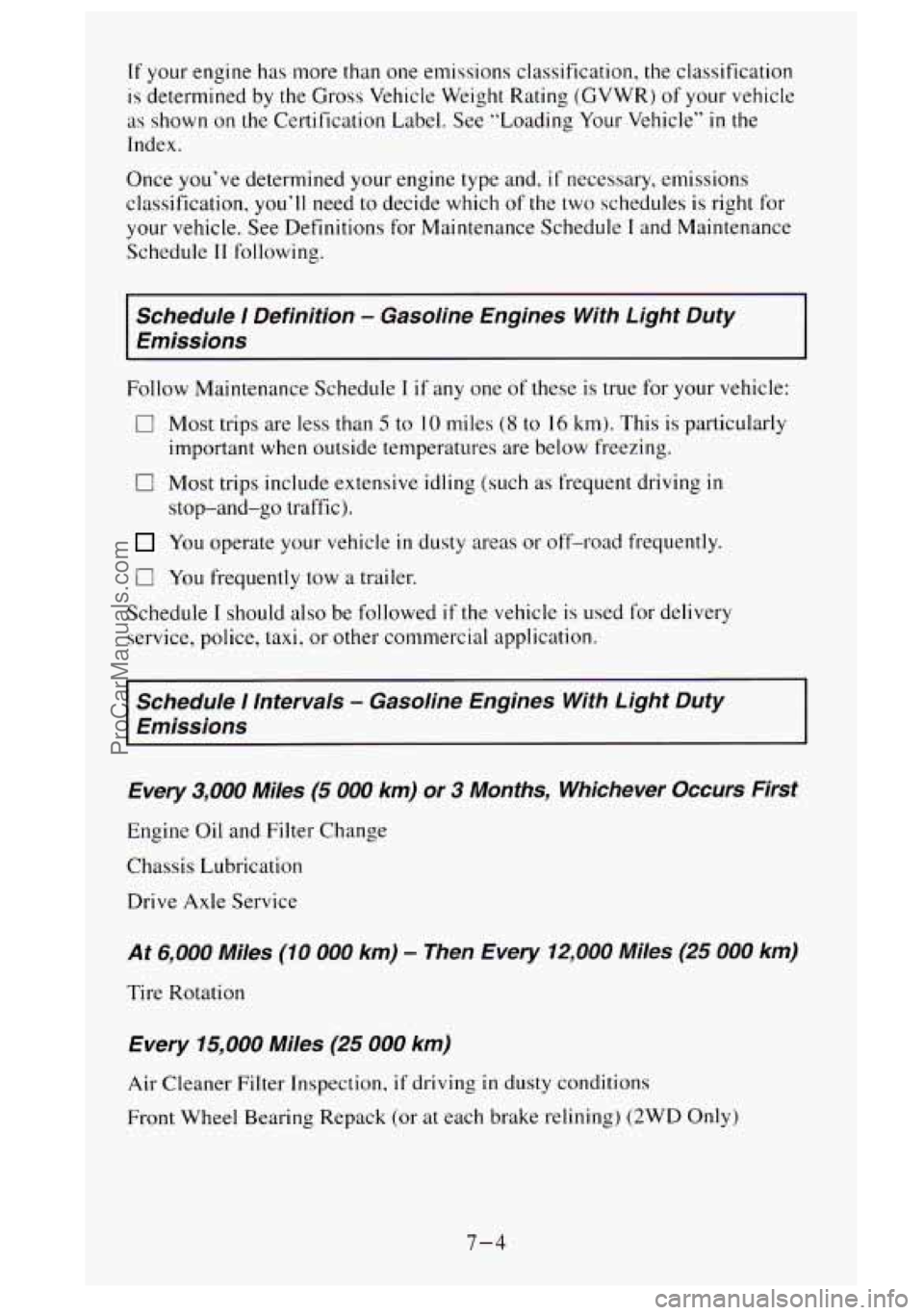
If your engine has more than one emissions classification, the classification
is determined by the Gross Vehicle Weight Rating (GVWR) of your vehicle
as shown on the Certification Label. See “Loading Your Vehicle”
in the
Index.
Once you’ve determined your engine type and,
if necessary, emissions
classification, you’ll need to decide which of the two schedules is right for
your vehicle. See Definitions for Maintenance Schedule
I and Maintenance
Schedule
I1 following.
Schedule I Definition - Gasoline Engines With Light Duty
Emissions
Follow Maintenance Schedule I if any one of these is true for your vehicle:
iII Most trips are less than 5 to 10 miles (8 to 16 km). This is particularly
important when outside temperatures are below freezing.
0 Most trips include extensive idling (such as frequent driving in
stop-and-go traffic).
You operate your vehicle in dusty areas or off-road frequently.
0 You frequently tow a trailer.
Schedule
I should also be followed if the vehicle is used for delivery
service, police, taxi, or other commercial application.
Schedule I Intervals - Gasoline Engines With Light Duty
Emissions
Every
3,000 Miles (5 000 km) or 3 Months, Whichever Occurs First
Engine Oil and Filter Change
Chassis Lubrication
Drive Axle Service
At 6,000 Miles (10 000 km) - Then Every 12,000 Miles (25 000 km)
Tire Rotation
Every 75,000 Miles (25 000 km)
Air Cleaner Filter Inspection, if driving in dusty conditions
Front Wheel Bearing Repack
(or at each brake relining) (2WD Only)
7-4
ProCarManuals.com
Page 369 of 488
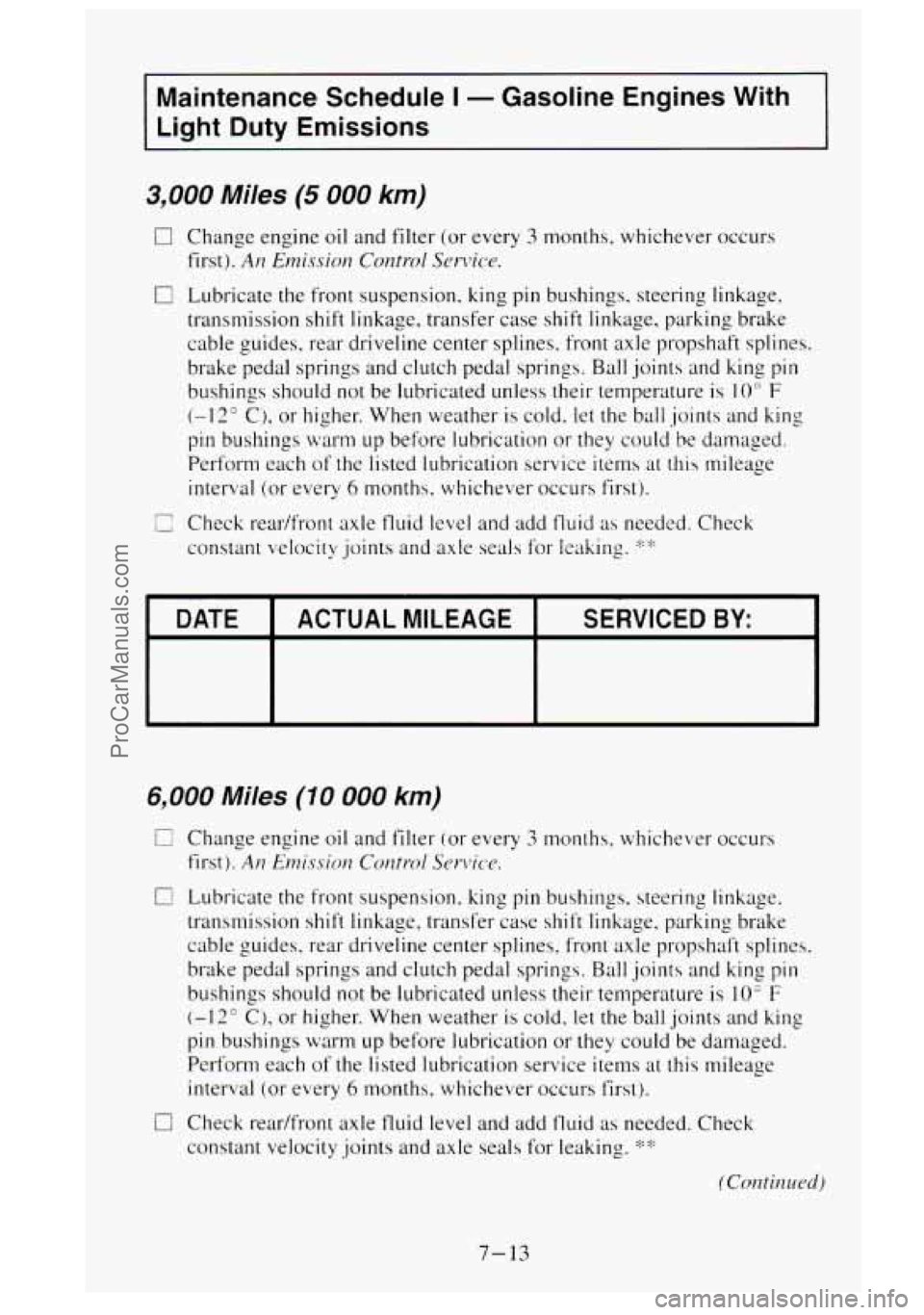
Maintenance Schedule I - Gasoline Engines With
Light Duty Emissions
3,000 Miles (5 000 km)
[7 Change engine oil and filter (or every 3 months, whichever occurs
first).
An Emission Control Sen7ic.e.
0 Lubricate the front suspension, king pin bushings, steering linkage,
transmission shift linkage. transfer case shift linkage, parking brake
cable guides, rear driveline center splines. front axle propshaft splines.
brake pedal springs and clutch pedal springs. Ball joints and king pin
bushings should not be lubricated unless their temperature is
10" F
(-1 2" C), or higher. When weather is cold, let the ball -joints and king
pin bushings warm up before lubrication or they could be damaged.
Perform each of the listed lubrication service items at this mileage
interval (or every
6 months, whichever occurs first).
C Check rear/front axle fluid level and add -fluid as needed. Check
constant velocity joints and
axle seals for leaking. *'*
DATE SERVICED BY: ACTUAL MILEAGE I
6,000 Miles (10 000 km)
iI Change engine oil and filter (or every 3 months, whichever occurs
first).
AI? Emission Confro1 Ser\lic.e.
Lubricate the front suspension, king pin bushings, steering linkage,
transmission shift linkage, transfer case shift linkage, parking brake
cable guides, rear driveline center splines, front axle propshaft splines.
brake pedal springs and clutch pedal springs. Ball joints and king pin
bushings should not be lubricated unless their temperature
is 10" E
(,-12" C), or higher. When weather is cold, let the ball joints and king
pin bushings warm up before lubrication
or they could be damaged.
Perform each of the listed lubrication service items at this mileage
interval (or every
6 months, whichever occurs first).
0 Check readfront axle fluid level and add fluid as needed. Check
constant velocity joints and axle seals for leaking.
*'$
(Contiwed)
7-13
ProCarManuals.com
Page 370 of 488
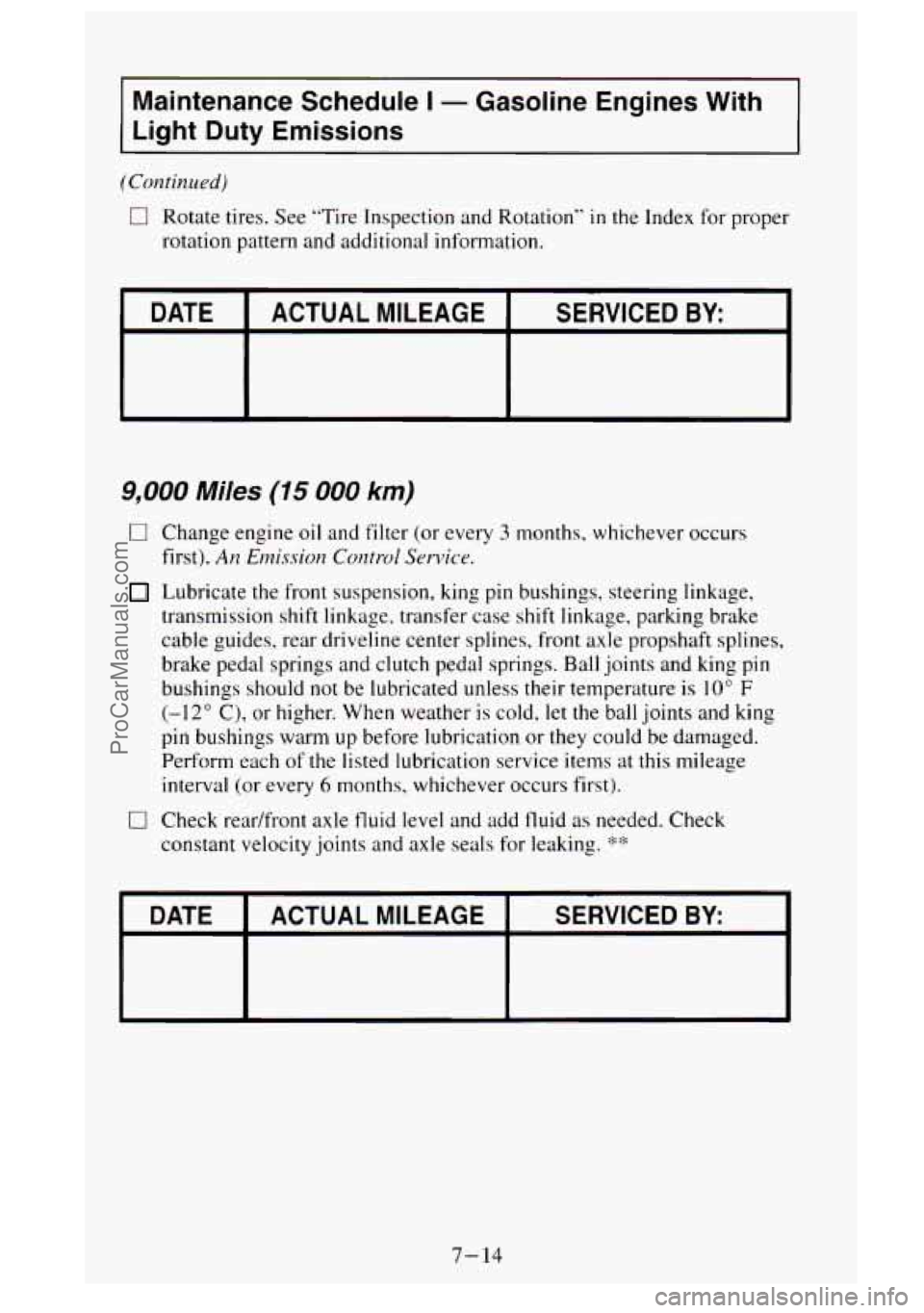
Maintenance Schedule I - Gasoline Engines With
Light
Duty Emissions ~~~~ ~~ ~ ~
(Continued)
0 Rotate tires. See "Tire Inspection and Rotation" in the Index for proper
rotation pattern and additional information.
I DATE I ACTUAL MILEAGE I SERVICED BY:
9,000 Miles (15 000 km)
0 Change engine oil and filter (or every 3 months, whichever occurs
first).
An Emission Control Service.
Lubricate the front suspension, king pin bushings, steering linkage,
transmission shift linkage, transfer case shift linkage, parking brake
cable guides, rear driveline center splines, front axle propshaft splines,
brake pedal springs and clutch pedal springs. Ball joints and king pin
bushings should
not be lubricated unless their temperature is IO" F
(-12" C), or higher. When weather is cold, let the ball joints and king
pin bushings warm up before lubrication or they could be damaged.
Perform each of the listed lubrication service items at this mileage
interval
(or every 6 months, whichever occurs first).
0 Check readfront axle fluid level and add fluid as needed. Check
constant velocity joints and axle seals for leaking.
*'g
DATE SERVICED BY: ACTUAL MILEAGE
7-14
ProCarManuals.com
Page 371 of 488
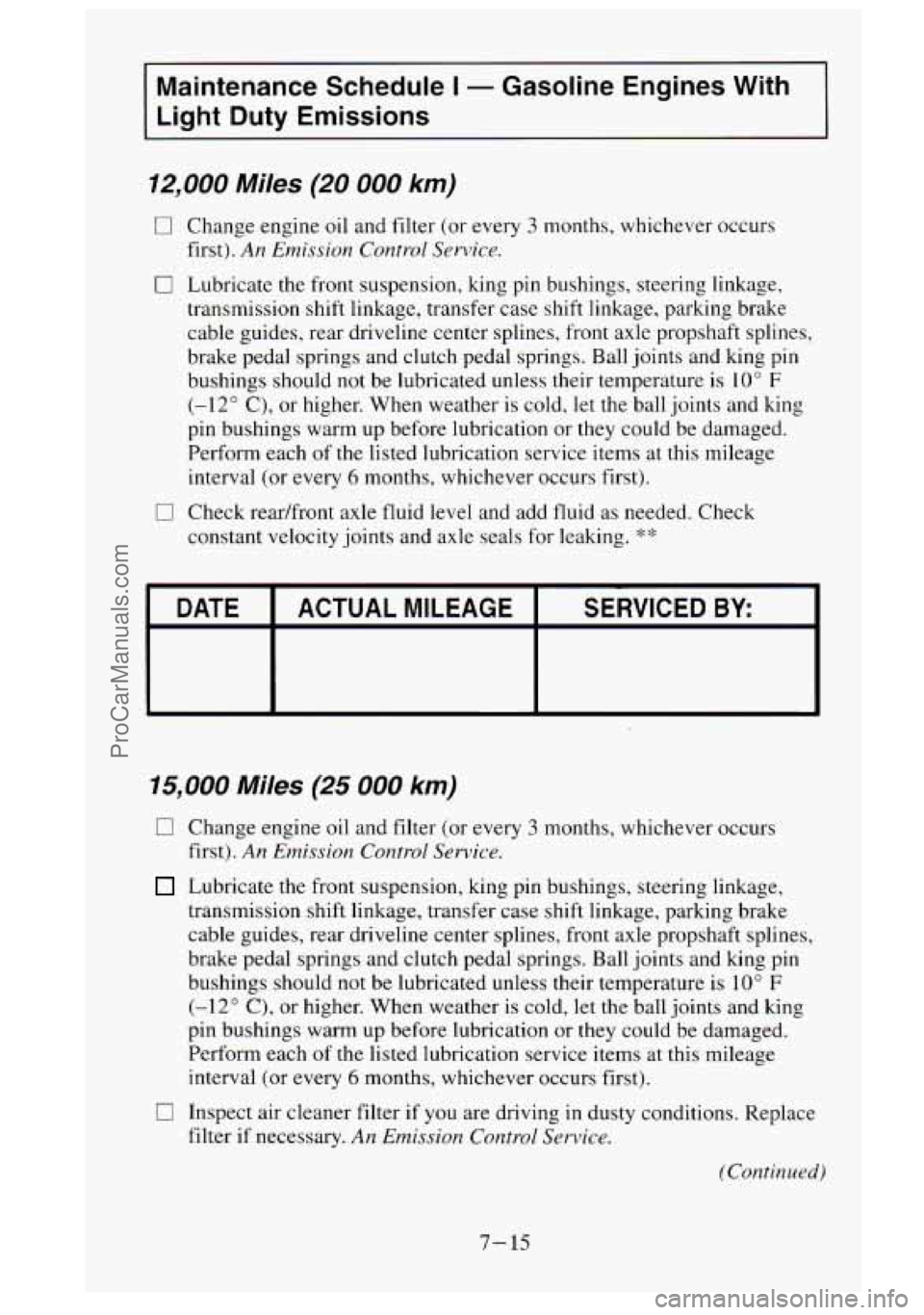
Maintenance Schedule I - Gasoline Engines With
Light Duty Emissions
12,000 Miles (20 000 km)
0 Change engine oil and filter (or every 3 months, whichever occurs
first).
An Emission Control Sewice.
0 Lubricate the front suspension, king pin bushings, steering linkage,
transmission shift linkage, transfer case shift linkage, parking brake
cable guides, rear driveline center splines, front axle propshaft splines,
brake pedal springs and clutch pedal springs. Ball joints and lung pin
bushings should not be lubricated unless their temperature is
10" F
(-12" C), or higher. When weather is cold, let the ball joints and king
pin bushings warm up before lubrication or they could be damaged.
Perform each of the listed lubrication service items at this mileage
interval (or every
6 months, whichever occurs first).
0 Check readfront axle fluid level and add fluid as needed. Check
constant velocity joints and axle seals for leaking.
**
I DATE I ACTUALMILEAGE I SERVICED BY: I
15,000 1 Ies (25 000 km)
0 Change engine oil and filter (or every 3 months, whichever occurs
first).
An Emission Control Service.
Lubricate the front suspension, king pin bushings, steering linkage,
transmission shift linkage, transfer case shift linkage, parking brake
cable guides, rear driveline center splines, front axle propshaft splines,
brake pedal springs and clutch pedal springs. Ball joints and king pin
bushings should not be lubricated unless their temperature is 10"
F
(-1 2 O C), or higher. When weather is cold, let the ball joints and king
pin bushings warm up before lubrication or they could be damaged.
Perform each
of the listed lubrication service items at this mileage
interval (or every
6 months, whichever occurs first).
0 Inspect air cleaner filter if you are driving in dusty conditions. Replace
filter if necessary.
An Emission Control Service.
(Continued)
7-15
ProCarManuals.com