Page 189 of 488
When you drive over bumps, rocks, or other obstacles, your wheels can
leave the ground. If this happens, even with
one or two wheels, you can’t
control
the vehicle as well or at all.
Because
you will be on an unpaved surface, it’s especially important to
avoid sudden acceleration, sudden turns, or sudden braking.
In a way, off-road driving requires a different kind
of alertness from driving
on paved roads and highways. There are
no road signs, posted speed limits
or signal lights. You have to use your own good judgment about what is safe
and what isn’t.
Drinking and driving can be very dangerous on any road. And this is
certainly true for off-road driving. At the very time
you need special
alertness and driving skills, your reflexes, perceptions and judgment can be
affected by even a small amount of alcohol.
You could have a serious - or
even fatal
- accident if you drink and drive or ride with a driver who has
been drinking. (See “Drunken Driving” in the Index.)
Driving On Off-Road Hills
Off-road driving often takes you up, down, or across a hill. Driving safely
on hills requires good judgment and an understanding
of what your vehicle
can and can’t do. There are some hills that simply can’t be driven, no matter
how well built the vehicle.
A CAUTION:
Many hills are simply too steep for any vehicle, If you drive up
them, you will stall, If you drive
down them, you can’t control
your speed. If you drive across them, you will roll over. You
could be seriously injured
or killed. If you have any doubt about
the steepness, don’t drive the hill.
Approaching a Hill
When you approach a hill, you need to decide if it’s one of those hills that’s
just
too steep to climb, descend, or cross. Steepness can be hard to judge.
On
a very small hill, for example, there may be a smooth, constant incline
with only a small change in elevation where you can easily see all the way
to the top. On
a large hill, the incline may get steeper as you near the top,
but you may
not see this because the crest of the hill is hidden by bushes,
grass, or shrubs.
4-15
ProCarManuals.com
Page 200 of 488
Hydroplaning doesn’t happen often. But it can if your tires haven’t much
tread or
if the pressure in one or more is low. It can happen if a lot of water
is standing on
the road. If you can see reflections from trees, telephone
poles, or other vehicles, and raindrops “dimple” the water’s surface, there
could be hydroplaning.
Hydroplaning usually happens at higher speeds. There just isn’t
a hard and
fast rule about hydroplaning. The best advice is
to slow down when it is
raining.
Some Other Rainy Weather Tips
Turn on your low-beam headlights - not just your parking lights - to
help make
you more visible to others.
Besides slowing down, allow some extra following distance. And be
especially careful when you pass another vehicle. Allow yourself more
clear room ahead, and be prepared to have your view restricted by road
spray.
Have good tires with proper tread depth. (See “Tires” in the Index.)
City Driving
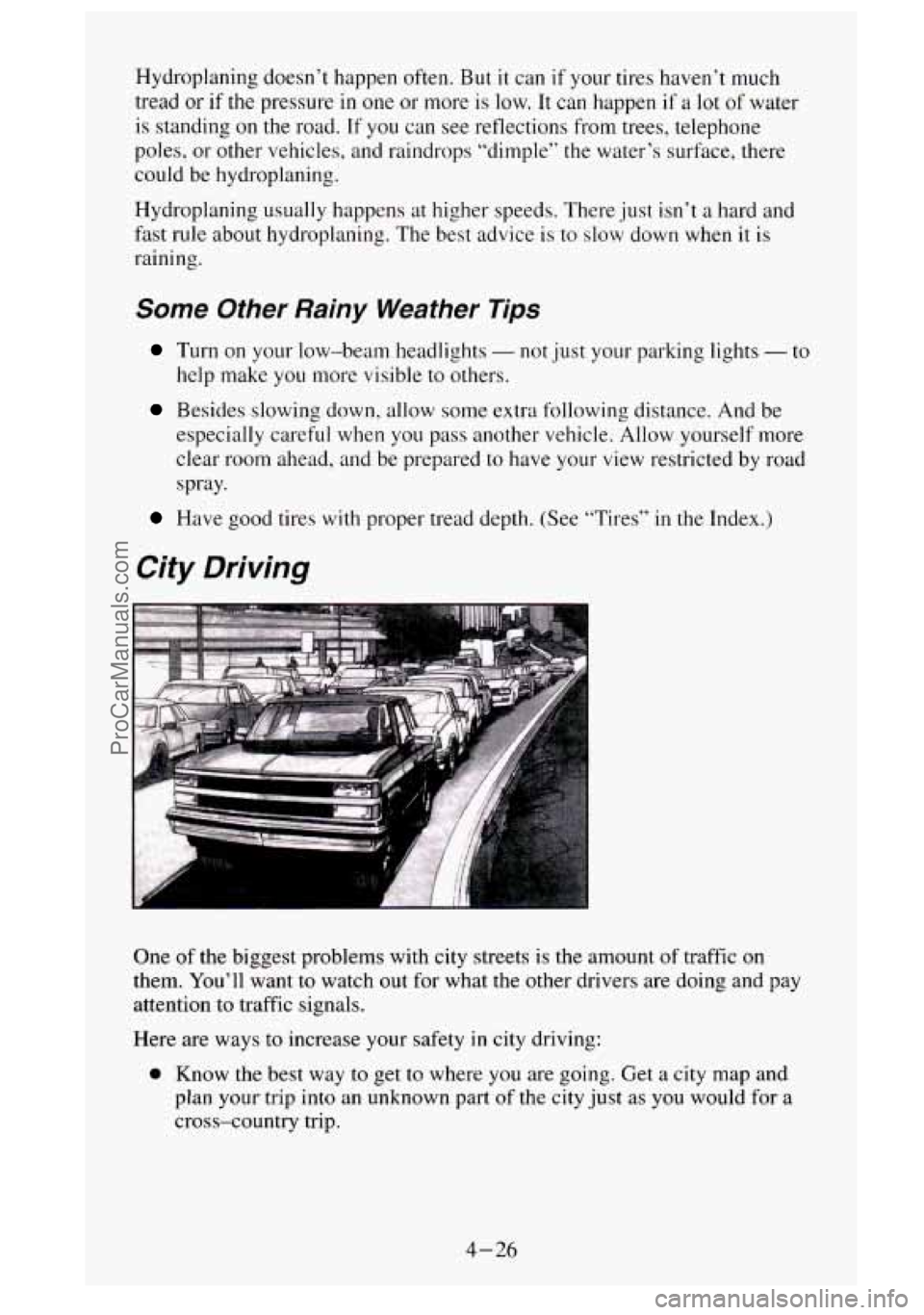
One of the biggest problems with city streets is the amount of traffic on
them. You’ll want
to watch out for what the other drivers are doing and pay
attention to traffic signals.
Here
are ways to increase your safety in city driving:
0 Know the best way to get to where you are going. Get a city map and
plan your trip into an unknown part of the city just as you would for a
cross-country trip.
4-26
ProCarManuals.com
Page 201 of 488
0 0 Try to use the freeways that rim and crisscross most large cities. You’ll
save time and energy. (See the next part, “Freeway Driving.”)
Treat
a green light as a warning signal. A traffic light is there because
the corner is busy enough to need it. When a light turns green, and just
before you start to move, check both ways for vehicles that have not
cleared the intersection or may be running the red light.
Freeway Driving
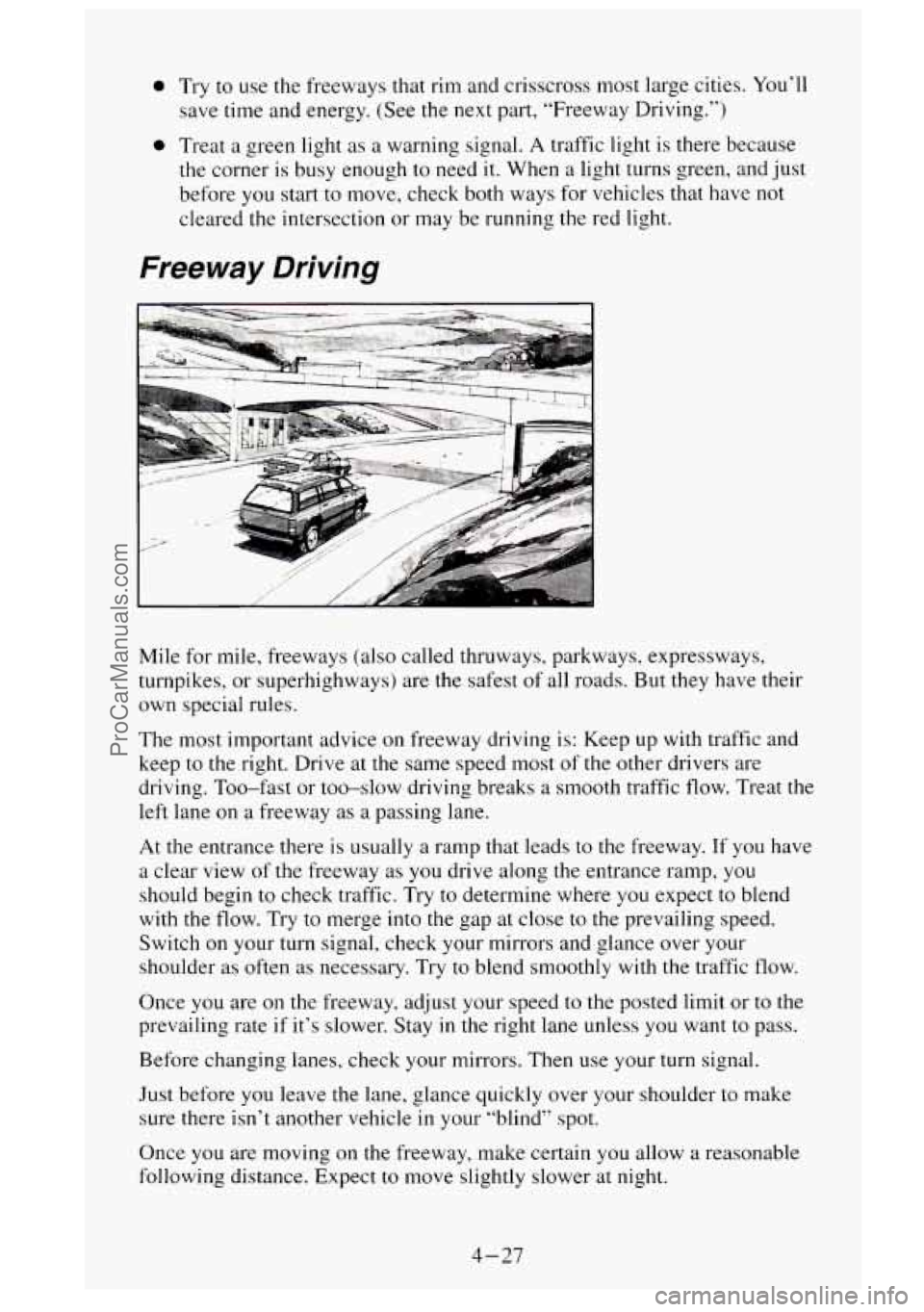
Mile for mile, freeways (also called thruways, parkways. expressways,
turnpikes, or superhighways) are the safest of all roads. But they have their
own special rules.
The most important advice on freeway driving is: Keep up with traffic and
keep to the right. Drive at
the same speed most of the other drivers are
driving. Too-fast or too-slow driving breaks
a smooth traffic flow. Treat the
left lane on a freeway as a passing lane.
At the entrance there is usually
a ramp that leads to the freeway. If you have
a clear view of the freeway
as you drive along the entrance ramp, you
should begin to check traffic. Try to determine where
you expect to blend
with the flow. Try to merge into the gap at close to the prevailing speed.
Switch on your turn signal, check your mirrors and glance over your
shoulder as often
as necessary. Try to blend smoothly with the traffic flow.
Once you are on the freeway, adjust your speed to the posted limit or to the
prevailing rate
if it’s slower. Stay in the right lane unless you want to pass.
Before changing lanes, check your mirrors.
Then use your turn signal.
Just before you leave the lane, glance quickly over your shoulder to make
sure there
isn’t another vehicle in your “blind” spot.
Once you are moving on the freeway, make certain you allow
a reasonable
following distance. Expect
to move slightly slower at night.
4-27
ProCarManuals.com
Page 221 of 488

Making Turns
I NOTICE:
Making very sharp turns while trailering could cause the traile\
r to come in contact with the vehicle. Your vehicle could be
damaged. Avoid making very sharp turns while trailering.
When you’re turning with a trailer, make wider turns than normal. Do this
so your trailer won’t strike soft shoulders, curbs, road signs, trees, or other
objects. Avoid jerky or sudden maneuvers. Signal well in advance.
Turn Signals When Towing a Trailer
When you tow a trailer, your vehicle has to have extra wiring (included in
the optional trailering package). The green arrows
on your instrument panel
will flash whenever
you signal a turn or lane change. Properly hooked up,
the trailer lamps will also flash, telling other drivers you’re about to turn,
change lanes or stop.
When towing a trailer, the green arrows on your instrument panel will flash
for
turns even if the bulbs on the trailer are burned out. Thus, you may think
drivers behind
you are seeing your signal when they are not. It’s important
to check occasionally to be sure the trailer bulbs are still working.
Driving On Grades
Reduce speed and shift to a lower gear before you start down a long or steep
downgrade. If
you don’t shift down, you might have to use your brakes so
much that they would get hot and no longer work well.
On
a long uphill grade, shift down and reduce your speed to around 45 mph
(70 kmh) to reduce the possibility of engine and transmission overheating.
If you have an automatic transmission
you should use DRIVE (3) (or, as
you need to, a lower gear) when towing a trailer. Operating your vehicle in
DRIVE (3) when towing a trailer will minimize heat build-up and extend
the life
of your transmission.
If you have a manual transmission and
you are towing a trailer, it’s better
not to use FIFTH (5) gear. Just drive in FOURTH (4) gear (or, as you need
to, a lower gear).
4-47
ProCarManuals.com
Page 225 of 488
Problems on the Road
Section
Here you’ll find what to do about some problems that can occur on the road.
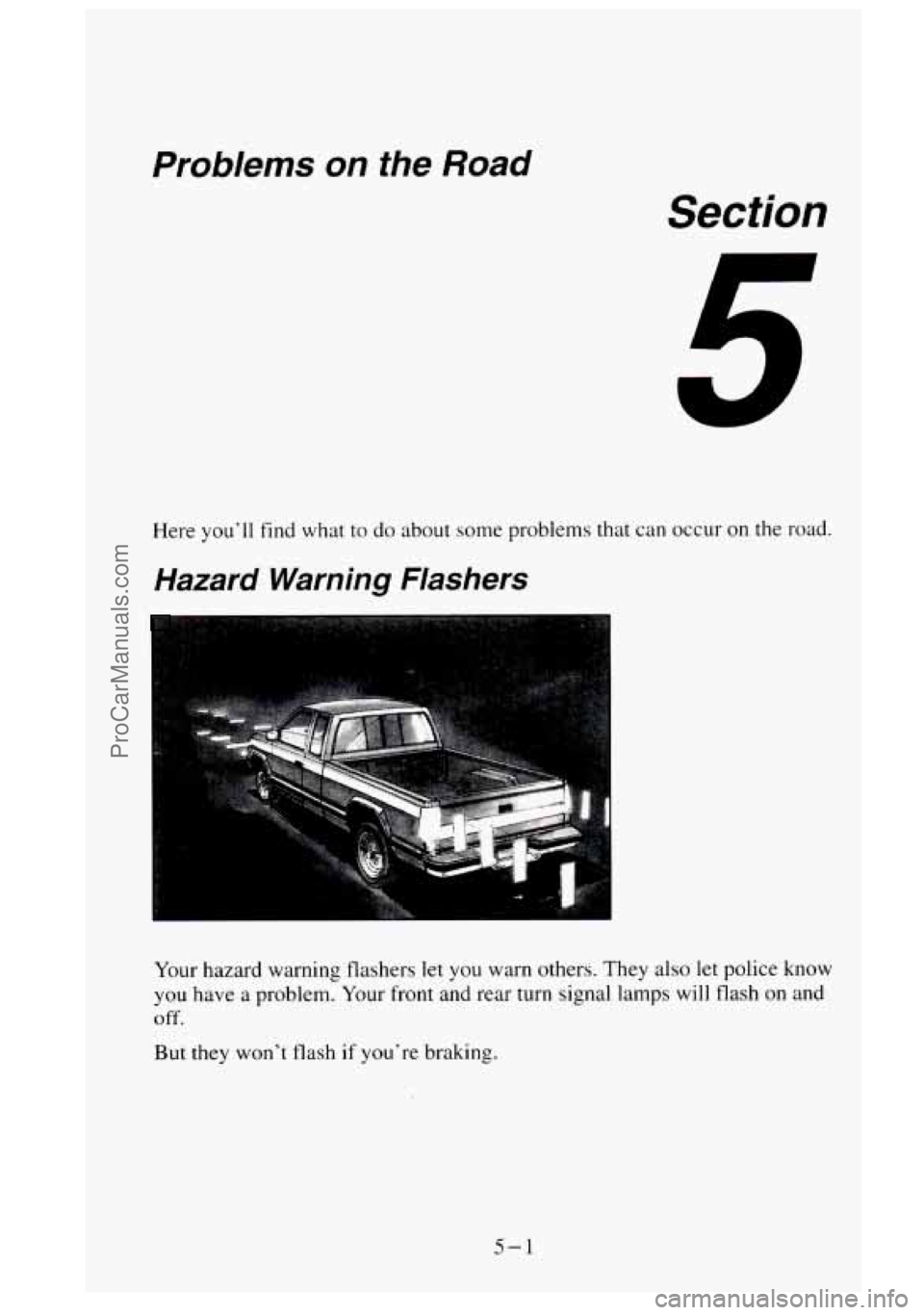
Hazard Warning Flashers
Your hazard warning flashers let you warn others. They also let police know
you have a problem. Your front and rear turn signal lamps will flash on and
off.
But they won’t flash if you’re braking.
5-1
ProCarManuals.com
Page 226 of 488
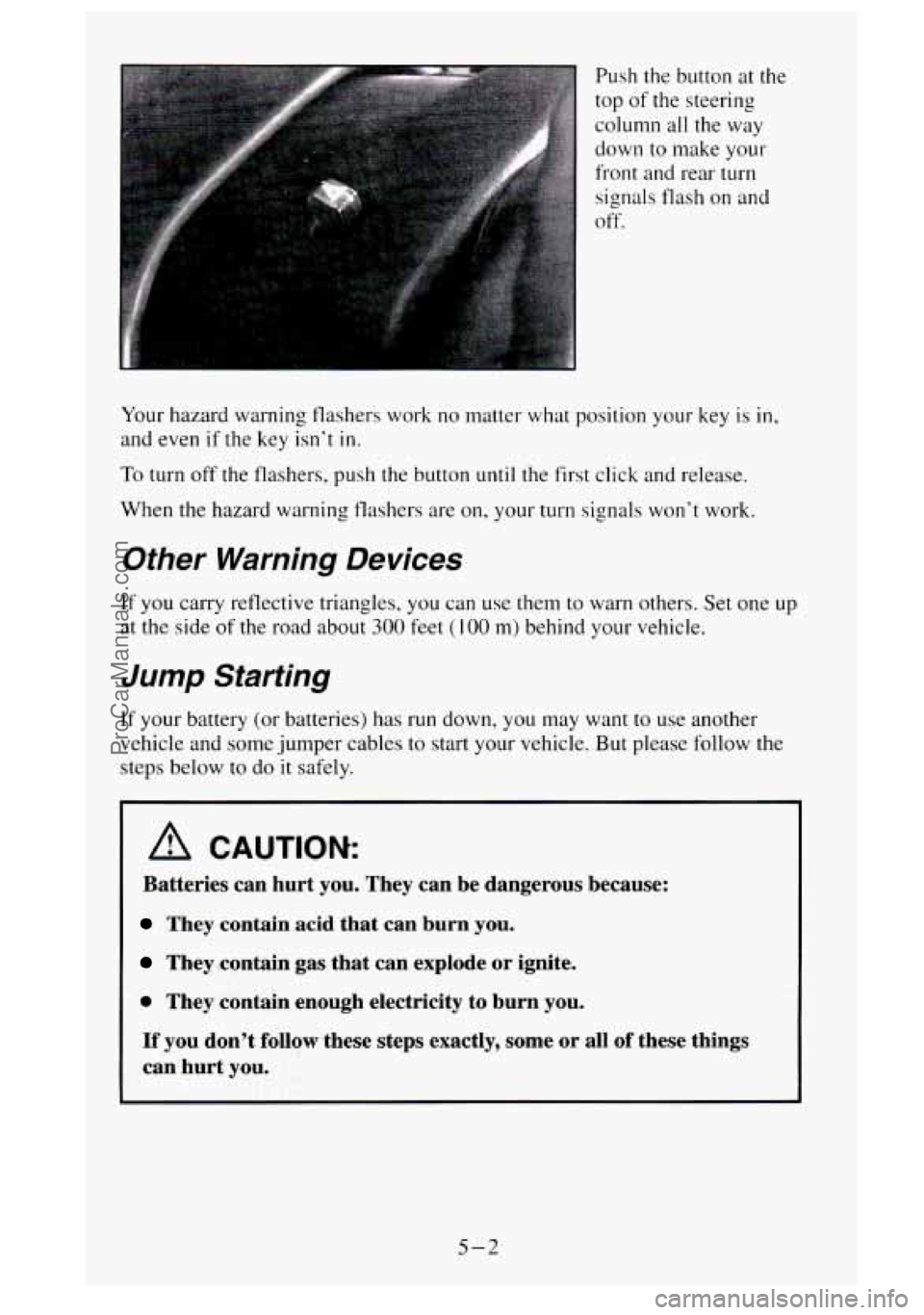
Push the button at the
top of the steering
column all the way
down to make
your
front and rear turn
signals flash on and
off.
Your hazard warning flashers work no matter what position your key is in,
and even if the key isn’t in.
To turn off the flashers, push the button until the first click and release.
When the hazard warning flashers are on, your turn signals won’t work.
Other Warning Devices
If you carry reflective triangles, you can use them to warn others. Set one up
at the side of the road about
300 feet (100 m) behind your vehicle.
Jump Starting
If your battery (or batteries) has run down, you may want to use another
vehicle and some jumper cables
to start your vehicle. But please follow the
steps below to do it safely.
A CAUTION:
Batteries can hurt you. They can be dangerous because:
They contain acid that can burn you.
They contain gas that can explode or ignite.
0 They contain enough electricity to burn you.
If you don’t follow these steps exactly, some or all of these things
can hurt you.
5-2
ProCarManuals.com
Page 316 of 488
Front Parkingnurn Signal Lamps with Sealed Beam
Headiamps
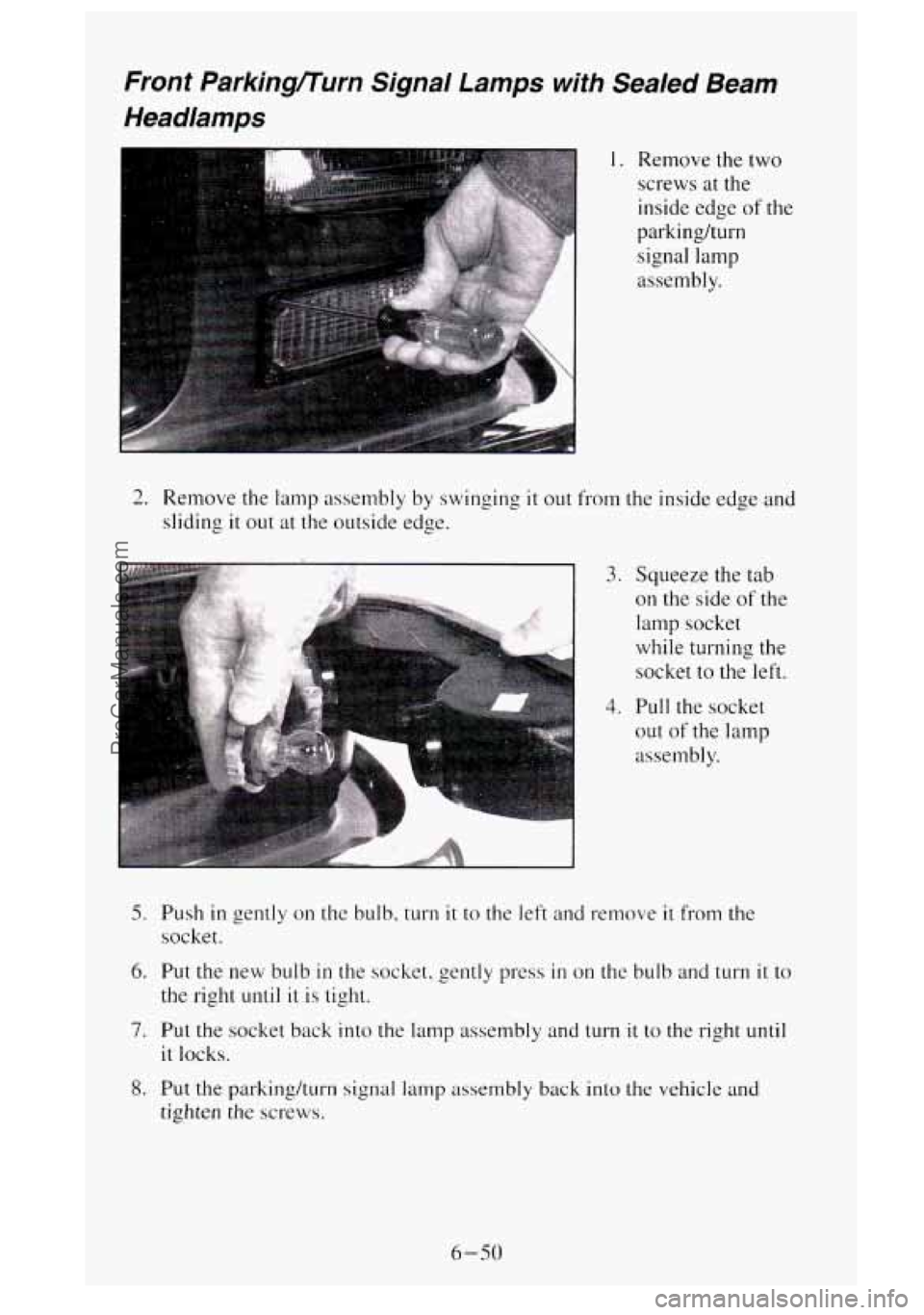
1. Remove the two
screws at the
inside edge
of the
parkinghrn
signal lamp
assembly.
2. Remove the lamp assembly by swinging it out from the inside edge and
sliding
it out at the outside edge.
3. Squeeze the tab
on the side
of the
lamp socket
while turning the
socket
to the left.
4. Pull the socket
out
of the lamp
assembly.
5. Push in gently on the bulb, turn it to the left and remove it from the
socket.
6. Put the new bulb in the socket, gently press in on the bulb and turn it to
the right until it is tight.
7. Put the socket back into the lamp assembly and turn it to the right until
it locks.
8. Put the parking/turn signal lamp assembly back inlo the vehicle and
tighten the screws.
4-50
ProCarManuals.com
Page 317 of 488
Front Parkingflurn Signal Lamps with Composite
Headlamps
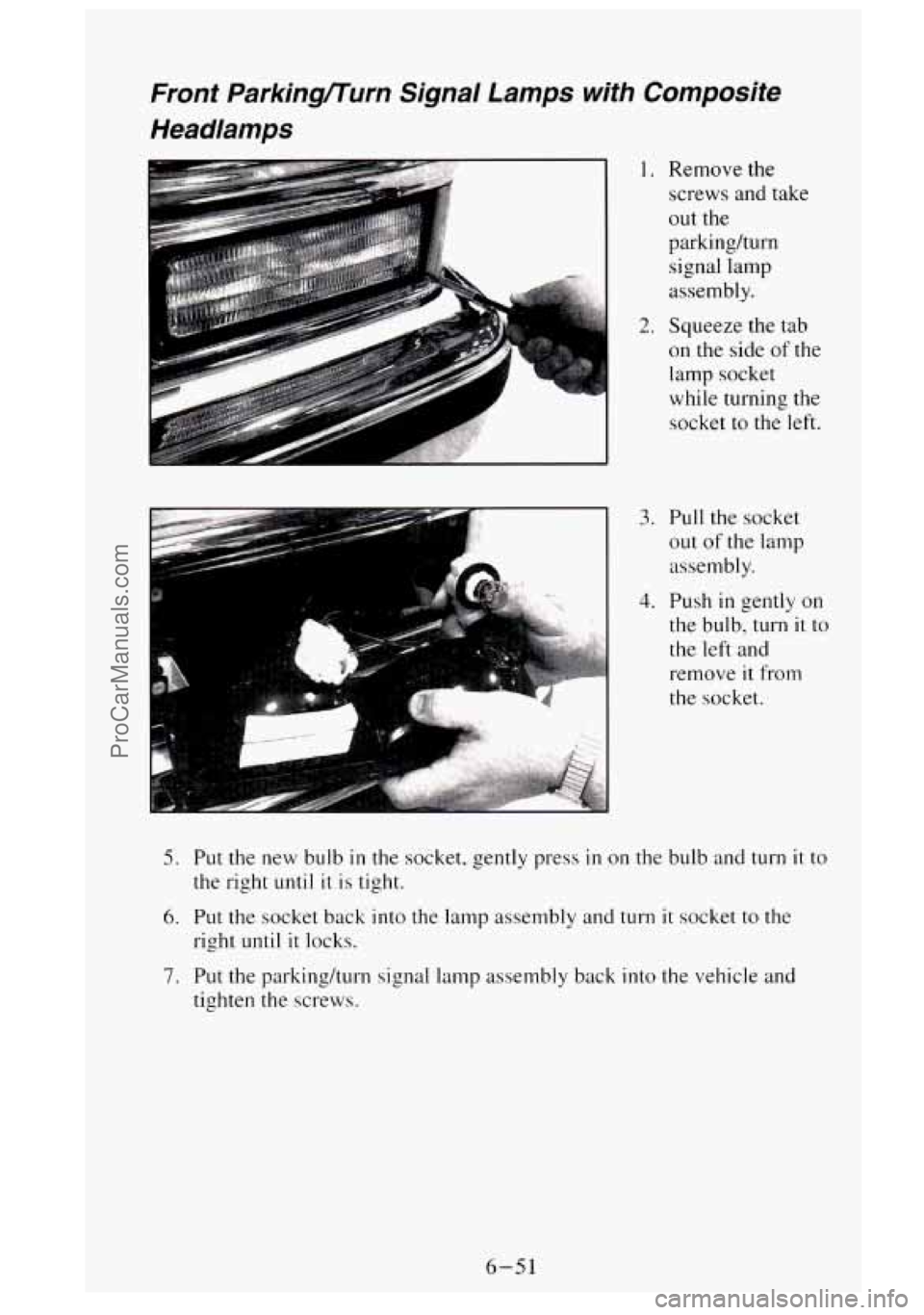
1. Remove the
screws and take
out the
parkinghum
signal lamp
assembly.
2. Squeeze the tab
on the side of the
lamp socket
while turning the
socket to the left.
3. Pull the socket
out: of the lamp
assembly.
4. Push in gently on
the bulb, turn
it to
the left and
remove
it from
the socket.
5. Put the new bulb in the socket, gently press in on the bulb and turn it to
the right until it is tight.
6. Put the socket back into the lamp assembly and turn it socket to the
right
until it locks.
7. Put the parkinghurn signal lamp assembly back into the vehicle and
tighten the screws.
6-51
ProCarManuals.com