1995 CHEVROLET TRACKER weight
[x] Cancel search: weightPage 171 of 354
Three important considerations have to do with weight:
Weight of the Trailer
How heavy can a trailer safely be?
It should never weigh more than
1,000 pounds (450 kg).
But even that can be too
heavy.
It depends on how you plan to use your rig. For
example, speed, altitude, road grades, outside
temperature and how much your vehicle
is used to pull a
trailer are all important. And, it can also depend on any
special equipment that you have on your vehicle.
You can ask your dealer for our trailering information or
advice, or you can write us at:
Customer Assistance Department
ChevroletlGeo
P.O. Box 7047
Troy,
MI 48007-7047
In Canada, write to:
General Motors of Canada Limited
Customer Assistance Center
1908 Colonel Sam Drive
Oshawa, Ontario
L1H 8P7
Weight of the Trailer Tongue
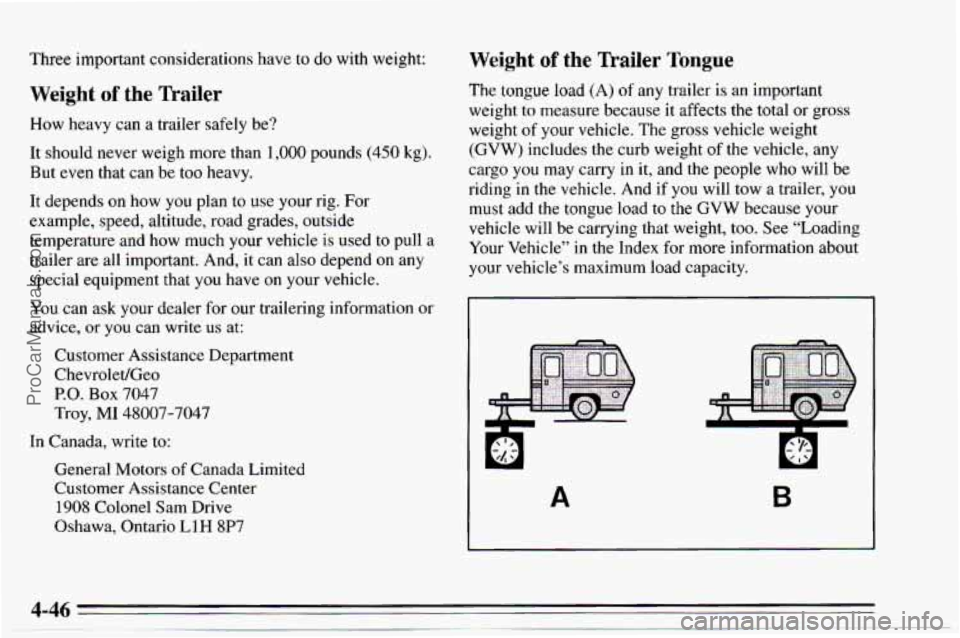
The tongue load (A) of any trailer is an important
weight
to measure because it affects the total or gross
weight
of your vehicle. The gross vehicle weight
(GVW) includes the curb weight
of the vehicle, any
cargo
you may carry in it, and the people who will be
riding
in the vehicle. And if you will tow a trailer, you
must add the tongue load to the GVW because your
vehicle will be carrying that weight, too. See “Loading
Your Vehicle”
in the Index for more information about
your vehicle’s maximum load capacity.
A B
ProCarManuals.com
Page 172 of 354
If you’re using a “dead-weight” hitch, the trailer tongue
(A) should weigh 10% of the total loaded trailer weight
(B). If you have a “weight-distributing” hitch, the trailer
tongue
(A) should weigh 12% of the total loaded trailer
weight
(B).
After you’ve loaded your trailer, weigh the trailer and
then the tongue, separately,
to see if the weights are
proper. If they aren’t, you may be able to get them right
simply by moving some items around in the trailer.
Total Weight on Your Vehicle’s Tires
Be sure your vehicle’s tires are inflated to the limit for
cold tires. You’ll find these numbers on the Certification
label at the rear edge of the driver’s door or see “Tire
Loading” in the Index. Then be sure you don’t go over
the
GVW limit for your vehicle, including the weight of
the trailer tongue.
Hitches
It’s important to have the correct hitch equipment.
Crosswinds, large trucks going by, and rough roads are
a
few reasons why you’ll need the right hitch. Here are
some rules
to follow:
If you use a step bumper hitch, and your trailer
tongue has a V-shaped foot, your bumper could be
damaged in sharp turns. Check the distance from the
front edge of the foot to the middle of the hitch ball
socket. If the distance is less than 12 inches, take the
foot off the trailer tongue.
Safety Chains
You should always attach chains between your vehicle
and your trailer.
Cross the safety chains under the tongue
of the trailer
so that the tongue will not drop to the road
if it becomes separated from the hitch. Instructions
about safety chains may be provided by the hitch
manufacturer or by
the trailer manufacturer. Follow the
manufacturer’s recommendation for attaching safety
chains and
do not attach them to the bumper. Always
leave just enough slack
so you can turn with your rig.
And, never allow safety chains to drag on the ground.
ProCarManuals.com
Page 173 of 354
nailer Brakes
If your trailer weighs more than 1,000 pounds (450 kg)
loaded, then it needs its own brakes -- and they must be
adequate. Be sure to read and follow the instructions for
the trailer brakes
so you’ll be able to install, adjust and
maintain them properly.
Driving with a Trailer
0
0
0
Don’t tap into your vehicle’s brake system if the
trailer’s brake system will use more than
0.02 cubic
inch
(0.3 cc) of fluid from your vehicle’s master
cylinder.
If it does, both systems won’t work well.
You could even lose your brakes.
Will the trailer brake parts take
3,000 psi
(20 650 kPa) of pressure? If not, the trailer brake
system must not be used with your vehicle.
If everything checks out this far, then make the brake
fluid tap at the port on the master cylinder that sends
fluid to the rear brakes. But don’t use copper tubing
for this.
If you do, it will bend and finally break off.
Use steel brake tubing. Towing
a trailer requires a certain amount of experience.
Before setting out for the open road, you’ll
want to get
to know your rig. Acquaint yourself with the feel of
handling and braking with the added weight
of the
trailer. And always keep in mind that the vehicle you
are
driving is now a good deal longer and not nearly as
responsive as your vehicle
is by itself.
Before you start, check the trailer hitch and platform
(and attachments), safety chains, electrical connector,
lamps, tires and mirror adjustment.
If the trailer has
electric brakes, start your vehicle and trailer moving and
then apply the trailer brake controller by hand to be sure
the brakes are working. This lets
you check your
electrical connection at the same time.
During your trip, check occasionally to be sure that the
load is secure, and that the lamps and any trailer brakes
are still working.
ProCarManuals.com
Page 348 of 354

GAWR (Gross Axle Weight Rating) ................ 4-43
Gear Positions
................................. 2- 12
GloveBox
..................................... 2-5
GVWR (Gross Vehicle Weight Rating) .............. 4-43
Halogen Bulbs
................................ 6-35
Hazard Warning Flashers
.......................... 5-1
Head Restraints
................................. 1-4
Headlamp High-Low Beam Changer
............... 2-30
Headlamps
.................................... 2-30
Headlamps. Bulb Replacement
.................... 6-35
Hearing or Speech Impaired. Customer Assistance
...... 8-2
Heater Controls
................................. 3-1
Heating
........................................ 3-2
High Beam Lamps. How
to Change ................ 2-30
Highway Hypnosis
.............................. 4-33
Hill and Mountain Roads
......................... 4-34
Glass. Cleaning
................................ 6-52
Hitches. Trailer
................................. 4-47
HoodProp
..................................... 6-7
Hood Release
................................... 6-6
Horn ......................................... 2-27
Hubs. Freewheeling
............................. 2- 17
Hydroplaning
.................................. 4-30
If You’re Stuck: In Sand. Mud. Ice or Snow ......... 5-31
Ignition Key Positions
............................ 2-8
Inside Daymight Rearview Mirror
................. 2-34
Inside Rearview Mirror
.......................... 2-34
Inspections
Brakesystem
............................... 7-53
Ignition Switch
.................................. 2-8 Exhaust Systems
............................. 7-52
Restraint Systems
............................ 7-52
Steering. Suspension and Front-Wheel-Drive
Axle Boot and Seal
......................... 7-52
Throttle Linkage
............................. 7-53
Instrument Panel
............................... 2-38
Cleaning
................................... 6-52
Cluster. Optional
............................. 2-41
Cluster. Standard
............................. 2-40
Fuse Block
................................. 6-62
InteriorLamps
................................. 2-33
.................................... J ack. Tire 5-23
Jump Starting
................................... 5-2
Key Lock Cylinders ............................ 7-49
Keys
.......................................... 2-1
Lamps Daytime Running
............................ 2-32
Dome
..................................... 2-33
Interior
.................................... 2-33
Lamp. Malfunction Indicator
...................... 2-46
LampsOnReminder
............................ 2-30
Larger Children. Safety Belt Use
................... 1-31
Leaving Your Vehicle
............................. 2-3
Leaving Your Vehicle With the Engine Running
....... 2-22
Lever AirIntake
................................... 3-2
Airflow ..................................... 3-1
Fancontrol
.................................. 3-2
9-5
ProCarManuals.com
Page 353 of 354
Front ....................................... 5-8
Rear ....................................... 5-10
Towing. Recreational Vehicle ..................... 4-40
Trailer Tongue Weight ........................... 4-46
Trailer Towing
................................. 4-44
Brakes
..................................... 4-48
Driving on Grades
............................ 4-50
Driving with a Trailer
......................... 4-48
Hitches
.................................... 4-47
Maintenance
................................ 4-51
Parking on Hills
............................. 4-50
Safety Chains
............................... 4-47
Turn Signals ................................ 4-49
Total Weight
on Your Vehicle’s Tires ............. 4-47
Towing a Trailer
............................. 4-44
Weight
of a Trailer ........................... 4-46
Transmission Fluid. Automatic
.................... 6- 19
Transmission Fluid. Manual ....................... 6-22
Transfer Case
.................................. 2- 19
Turn Signal and Lane Change Indicator ............. 2-28
Turn SignalLamps Control/Headlamp Beam Lever
.... 2-28
Turn Signals When Towing a Trailer
................ 4-49
Trip Odometer
................................. 2-42
Underbody Flushing
........................... 7-5 1
Underbody Maintenance ......................... 6-57
Using the Recovery
Hooks ....................... 5-32
Vehicle Damage Warnings
......................... iv
Vehicle Dimensions Chart ........................ 6-66
Vehicle Identification Number
(VIN) ............... 6-59
Vehicle Loading ................................ 4-42
Vehicle Storage ................................ 6-34
Vehicle Symbols ................................... v
Vehicle. Control of a ............................. 4-5
Vehicle. Leaving Your
............................ 2-3
Vehicles First Sold
in Canada 11
Ventilation System. Flow-Through .................. 3-4
Ventilation Tips
................................. 3-4
Vision. Night
.................................. 4-27
Visors. Sun
.................................... 2-35
.. ........................
warning Devices ............................... 5-2
Warning Lights. Gages and Indicators
............... 2-43
Washing Your Vehicle
........................... 6-53
Water. Driving Through Deep Standing ............. 2-11
Wheel
Nut Torque ......................... 5-29. 6-66
Wheel Replacement
............................. 6-47
Wheel Replacement. Used
........................ 6-48
Windows
..................................... 2-26
Windows. Manual
.............................. 2-26
Windows. Rear Swing-Out Side
................... 2-26
Windshield Washer Fluid
.................... 2-3 1. 6-30
Windshield Washers ............................. 2-31
Windshield WasherlWiper Lever
................... 2-30
Windshield Wipers
.............................. 2-30
Winter. Driving
in .............................. 4-36
WiperNasher. Rear Window
...................... 2-32
Warning Flashers. Hazard
......................... 5-1
Warnings. Battery ................................ 5-2
Weatherstrips
.................................. 6-53
WreckerTowing
................................. 5-6
9-10 .. ~ .. . .. ---~‘-.”.‘- ^1 ___.-___-__ ProCarManuals.com