1995 CHEVROLET TRACKER tire pressure
[x] Cancel search: tire pressurePage 253 of 354
Inflation - Tire Pressure
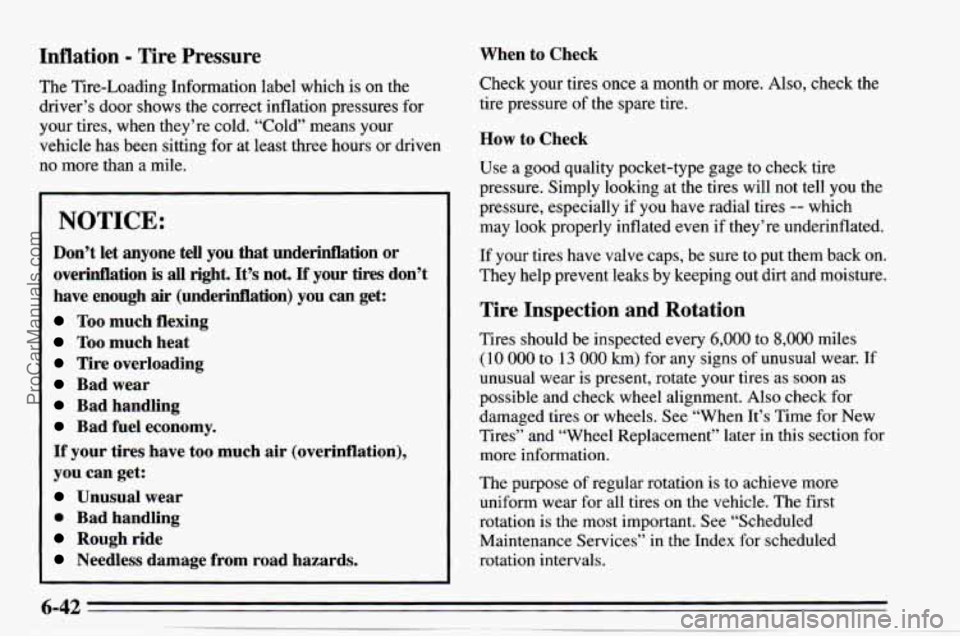
The Tire-Loading Information label which is on the
driver’s door shows the correct inflation pressures for
your tires, when they’re cold.
“Cold” means your
vehicle has been sitting for at least three hours or driven
no more than
a mile.
I
’ NOTICE:
Don’t let anyone tell you that underidation or
~ overinflation is all right. It’s not. If your tires don’t
~ have enough air (underinflation) you can get:
Too much flexing
Too much heat
Tire overloading
Bad wear
Bad handling
Bad fuel economy.
If your tires have too much air (overinflation),
you can get:
Unusual wear
0 Bad handling
Rough ride
Needless damage from road hazards. When to Check
Check your
tires once a month or more. Also, check the
tire pressure of
the spare tire.
How to Check
Use a good quality pocket-type gage to check tire
pressure. Simply looking at the tires will
not tell you the
pressure, especially if you have radial tires
-- which
may look properly inflated even
if they’re underinflated.
If your tires have valve caps, be sure to put them back on.
They help prevent leaks by keeping out dirt and moisture.
Tire Inspection and Rotation
Tires should be inspected every 6,000 to 8,000 miles
(10 000 to 13 000 km) for any signs of unusual wear. If
unusual wear is present, rotate your tires as
soon as
possible and check wheel alignment. Also check for
damaged tires or wheels. See “When It’s Time for New
Tires” and “Wheel Replacement” later in this section for
more information.
The purpose
of regular rotation is to achieve more
uniform wear for all tires on the vehicle. The first
rotation is the most important. See “Scheduled
Maintenance Services” in
the Index for scheduled
rotation intervals.
ProCarManuals.com
Page 254 of 354
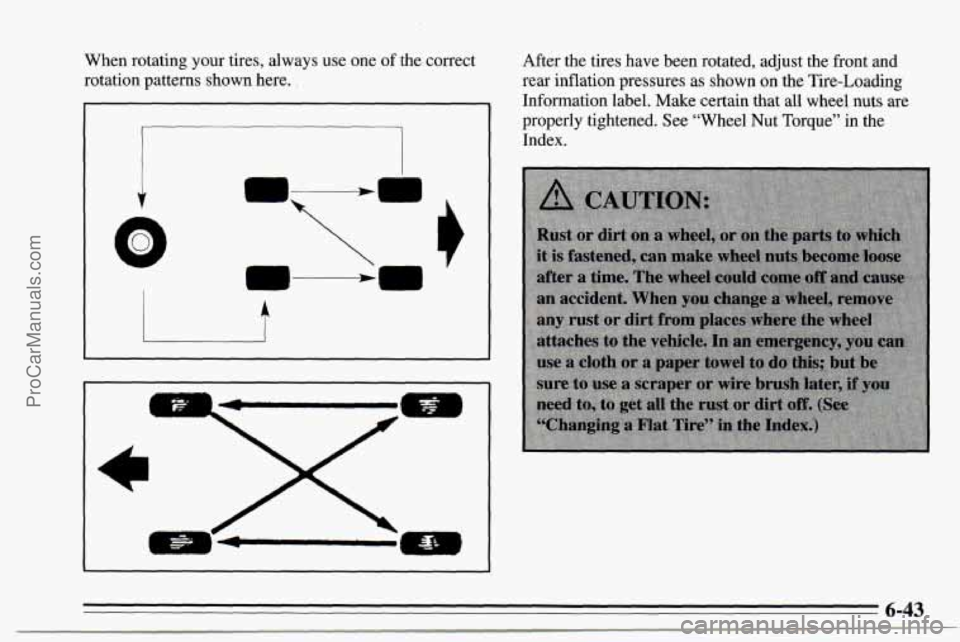
When rotating your tires, always use one of the correct
rotation patterns shown here.
,
c
t
ri . e1
After the tires have Deen rotated, adjust the front and
rear inflation pressures as shown on the Tire-Loading
Information label. Make certain that all wheel nuts are
properly tightened. See “Wheel
Nut Torque” in the
Index.
6-43
ProCarManuals.com
Page 299 of 354

Maintenance Schedule I
60,000 Miles (100 000 km) (Continued)
test the cooling system and pressure cap.
An Emission Control Service.
0 Replace spark plugs. An Emission Control
Replace spark plug wires (or every
60 months, whichever occurs first).
0 Replace fuel filter (or every 30 months,
Service.
An Emission Control Service.
whichever occurs first, or sooner if filter is
clogged). An Emission Control Service.
0 Inspect the underhood wiring harness for
loose connections, chafed wires and
damage
(or every 60 months, whichever
occurs first).
An Emission Control Service.
0 Drain, refill and bleed the brake system.
0 Replace air cleaner filter. Replace filter
more often under dusty conditions.
An Emission Control Service.
0 Inspect fuel tank, cap and lines for damage
or leaks. Inspect fuel cap gasket
for any
damage. Replace parts as needed.
0 Rotate tires. See “Tire Inspection and
Rotation” in the Index for proper rotation
pattern
and additional information.
Change manual transmission fluid (or
every
15 months, whichever occurs first).
0 Inspect the valve lash and adjust if
necessary.
An Emission Control Service.
0 Check engine idle speed and adjust it to
underhood label specifications.
An Emission Control Service.?
An Emission Control Service. 3-
0 Inspect the locking front hubs (if equipped)
for correct operation (or every
3 months,
whichever occurs first). Repair or replace as
necessary.
7-22
ProCarManuals.com
Page 306 of 354

I Maintenance Schedule I 1
0 Drain, flush and refill cooling system (or
every
30 months, whichever occurs first).
See “Engine Coolant” in the Index for what
to use. Inspect hoses. Clean radiator,
condenser, pressure cap and neck. Pressure
test the cooling system and pressure cap.
An Emission Control Service.
0 Replace spark plugs. An Emission Control
0 Replace air cleaner filter. Replace filter
Service.
more often under dusty conditions.
An Emission Control Service.
0 Inspect fuel tank, cap and lines for damage
or leaks. Inspect fuel cap gasket for any
damage. Replace parts as needed.
An Emission Control Service.
0 Rotate tires. See “Tire Inspection and
Rotation” in the Index for proper rotation
pattern and additional information.
0 Change manual transmission fluid (or every
15 months, whichever occurs first).
0 Inspect the valve lash and adjust if
necessary.
An Emission Control Service.
0 Replace fuel filter (or every 30 months,
whichever occurs first, or sooner if filter is
clogged).
An Emission Control Service.
underhood label specifications. An Emission
Control Service.
0 Inspect the locking front hubs (if equipped)
for correct operation (or every
3 months,
whichever occurs first). Repair or replace as
necessary.
0 Check engine idle speed and adjust it to
(Continued)
ProCarManuals.com
Page 317 of 354

52,500 Miles (87 500 km)
Change engine oil and filter (or every
7.5 months, whichever occurs first).
An Emission Control Service.
0 Rotate tires. See “Tire Inspection and
Rotation”
in the Index for proper rotation
pattern and additional information.
0 Inspect the locking front hubs (if equipped)
for correct operation (or every
3 months,
whichever occurs first). Repair or replace
if
necessary.
DATE
SERVICED BY ACTUAL MILEAGE
60,000 Miles (100 000 km)
0 Change engine oil and filter (or every
7.5 months, whichever occurs first).
An Emkyiolq Control Service.
0 Clean and repack the front wheel bearings (or at
each brake relining, whichever occurs first).
0 Rotate tires. See “Tire Inspection and
Rotation” in the Index for proper rotation
pattern and additional information.
every
24 months, whichever occurs first).
An Emission Control Service.
0 Drain, flush and refill cooling system (or
every
30 months, whichever occurs first).
See “Engine Coolant” in the Index for what
to use. Inspect hoses. Clean radiator,
condenser, pressure cap and neck. Pressure
test the cooling
system and pressure cap.
An E1??issinn Control Service.
Inspect engine accessory drive belts (or
7-40
.- ProCarManuals.com
Page 325 of 354

Part B: Owner Checks and Services
Listed below are owner checks and services which
should be performed at the intervals specified to help
ensure the safety, dependability and emission control
performance
of your vehicle.
Be sure any necessary repairs are completed at once.
Whenever any fluids or lubricants are added
to your
vehicle, make sure they are the proper ones, as shown in
Part
D.
At Each Fuel Fill
It is important for you or a service station attendant to
per3cot-m these underhood checks at each fuel fill.
Engine Oil Level
Check the engine oil level and add the proper oil if
necessary. See “Engine Oil” in the Index for further
details.
Engine Coolant Level
Check the engine coolant level and add the proper
coolant mix if necessary. See “Coolant” in the Index for
further details.
Windshield Washer Fluid Level
Check the windshield washer fluid level in the
windshield washer tank and add the proper fluid if
necessary. See “Windshield Washer Fluid” in the Index
for further details.
Hood Latch Operation
Pull the primary hood latch release handle inside the
vehicle. The secondary latch should keep the hood from
opening all
the way when the primary latch is released.
Make sure the hood closes firmly. See “Hood Release”
in the Index for further details.
At Least Once a Month
Tire Inflation
Check tire inflation. Make sure tires are inflated to the
pressures specified on the Tire-Loading Information
label located on the driver’s door lock pillar. See “Tires”
in the Index for further details.
Cassette Deck
Clean cassette deck. Cleaning should be done every
50 hours of tape play. See “Audio Systems” in the Index
for further details.
ProCarManuals.com
Page 347 of 354

Easy-Entry Seat ................................ I -4
Electrical Equipment. Adding
................ 2-10. 6-59
Enginecoolant
................................. 6-25
Adding
.................................... 6-26
Checking
................................... 6-26
Temperature Gage
............................ 2-46
Exhaust
.................................... 2-25
Identification
................................ 6-59
Overheating
................................. 5- 1 1
Running it While You’re Parked ................. 2-25
Specifications
............................... 6-64
Starting
..................................... 2-9
16-Valve
................................... 6-10
8-Valve
..................................... 6-8
Engineoil
.................................... 6-12
Adding
.................................... 6-13
Additives
................................... 6-15
Checking ................................... 6-12
Pressure Light
............................... 2-47
What Kind to Use
............................ 6- 14
What to do with Used Oil
...................... 6- I6
Whentochange
............................. 6-15
Ethanol(InFue1)
................................ 6-3
Exhaust. Engine
................................ 2-25
Expectant Mothers. Use
of Safety Belts ............. 1-20
Extender. Safety Belt ............................ 1-34
Fabric Cleaning
............................... 6-50
Fan Control Lever ............................... 3-2
Feature. Theft-Deterrent
.................... 3- 10. 3- 15
Fifth (5). Manual Transmission .................... 2- 15
FillingYourTank ................................ 6-4
Engine
Filter. Air Cleaner
.............................. 6-18
Finish Care
.................................... 6-54
Finish Damage
................................. 6-56
First
(1). Manual Transmission .................... 2-14
Flashers. Hazard Warning
......................... 5-1
Flat Tire. Changing
............................. 5-21
Flow-Through Ventilation System
................... 3-4
Fluid Capacities Chart ........................... 6-65
Flushing. Underbody
............................ 7-51
Folding Rear Seat
................................ 1-5
Foreign Countries. Fuel
........................... 6-4
Four-wheel Drive
......................... 2-17. 6-24
Fourth (4). Manual Transmission
................... 2-15
Freewheeling
Hubs ............................. 2-17
FrenchLanguage Manual
11
Front Ashtray .................................. 2-36
FrontAxle
.................................... 6-25
Front Parking and Turn Signal. Replacement
......... 6-37
Front Seat Side Pockets
........................... 2-6
Front Towing Hook-Ups
.......................... 5-8
Fuel
.......................................... 6-2
Gage
...................................... 2-48
Fuse Block. Instrument Panel
..................... 6-42
Fuse Block. Main
............................... 6-62
Fuseusage
.................................... 6-62
Fuses and Circuit Breakers
....................... 6-60
Gage
.. ...........................
FillingYourTank ............................. 6-4
In Foreign Countries
........................... 6-4
Engine Coolant Temperature
................... 2-46
Fuel
....................................... 2-48
Gasolines for Cleaner Air
......................... 6-3
9-4
-.-- .- _____ ..... .... --.-_Y_I____N___W___l~~=,,ll--C. ~~ ~ ProCarManuals.com