Page 29 of 486
Downloaded from www.Manualslib.com manuals search engine ,
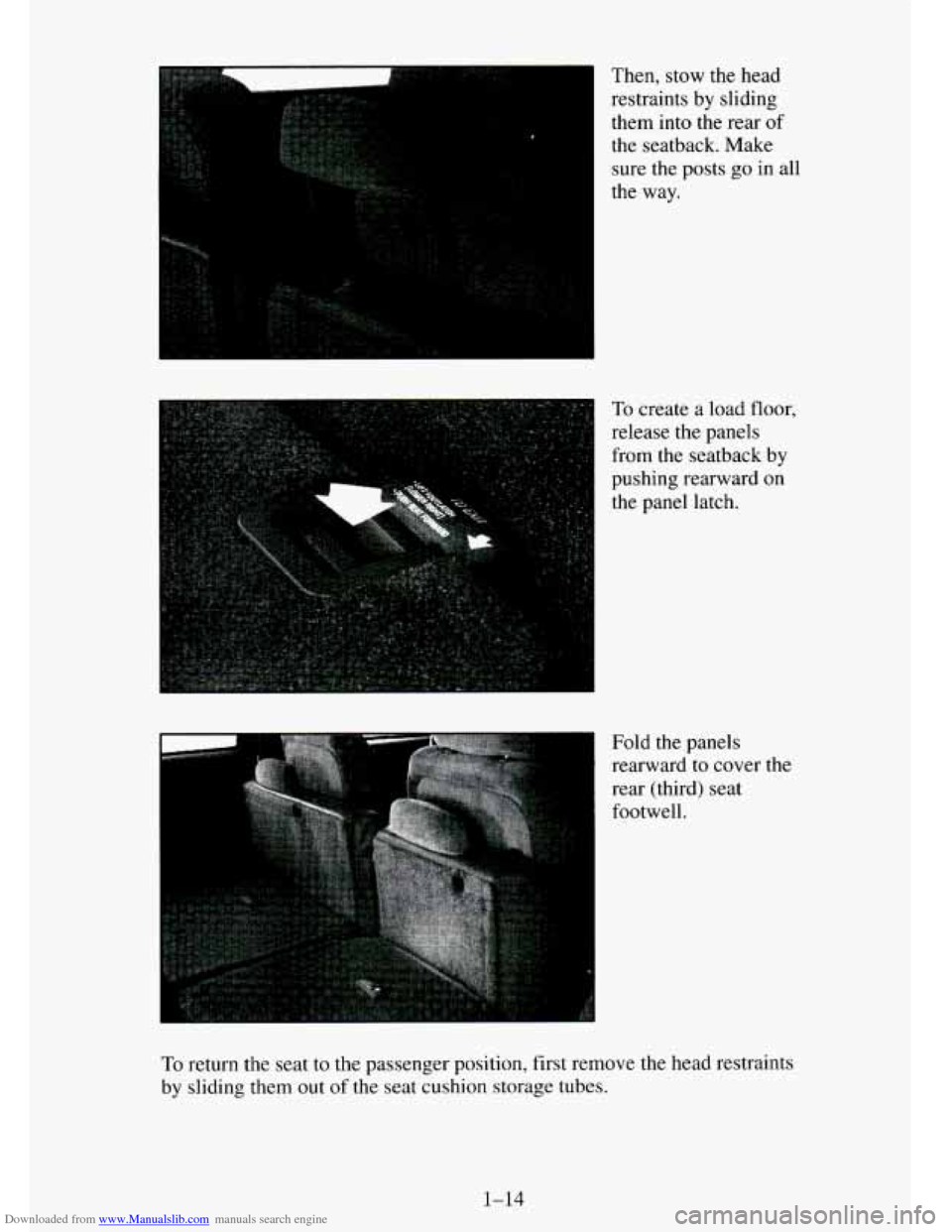
Then, stow the head restraints
by sliding
them into the rear
of
the seatback. Make
sure the posts go in all
the way.
To create a load floor,
release the panels
from the seatback by
pushing rearward
on
the panel latch.
Fold the panels
rearward
to cover the
rear (third) seat
footwell.
To return the seat to the passenger position, first remove the head restraints
by sliding them out of the seat cushion storage tubes.
1-14
Page 31 of 486
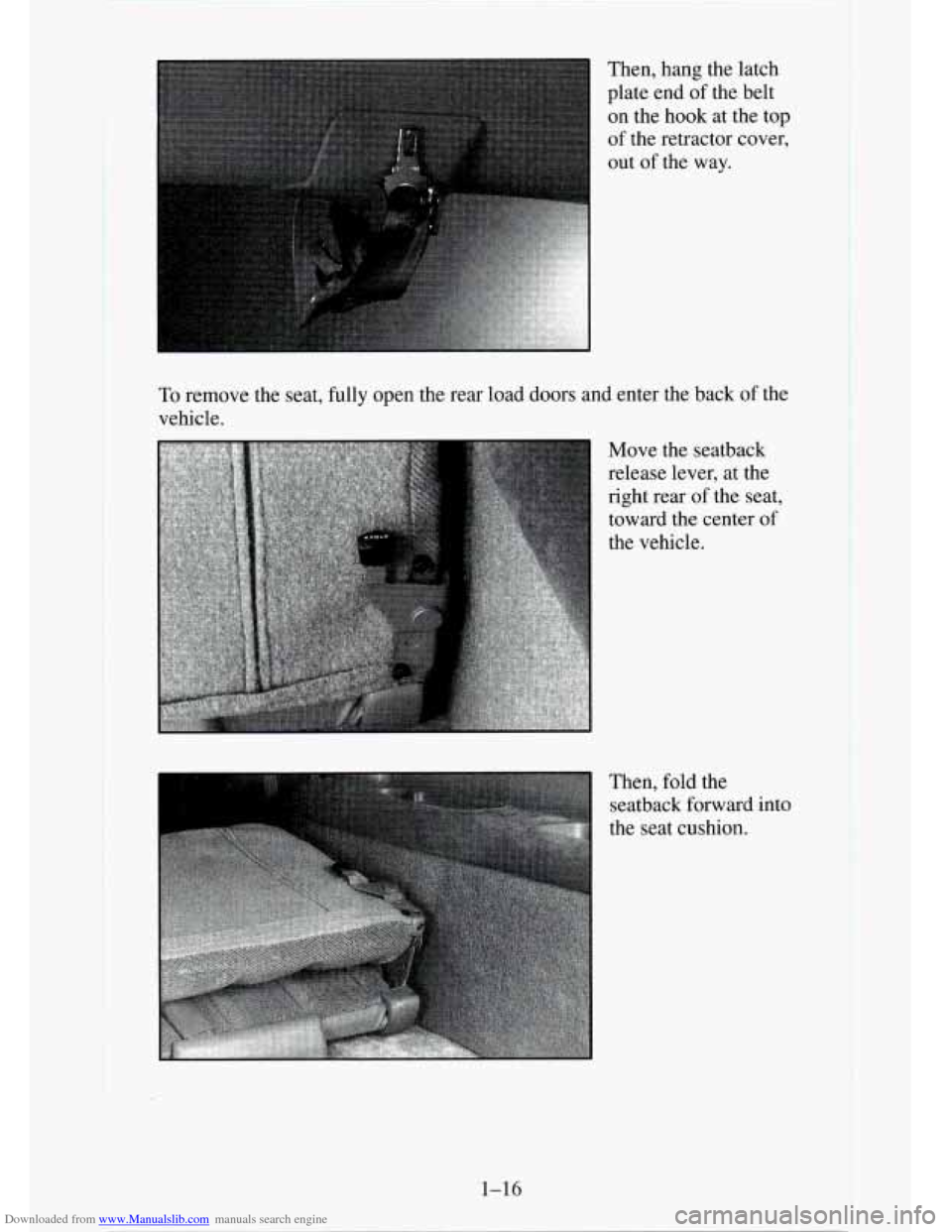
Downloaded from www.Manualslib.com manuals search engine Then, hang the latch
plate end of the belt
on the hook at the top
of the retractor cover,
out of the way.
To remove the seat, fully open th
vehicle.
.e rear load doors and enter the back of the
Move the seatback
release lever, at the
right rear of the seat,
toward the center
of
the vehicle.
Then, fold the
seatback forward into
the seat cushion.
1-16
Page 32 of 486
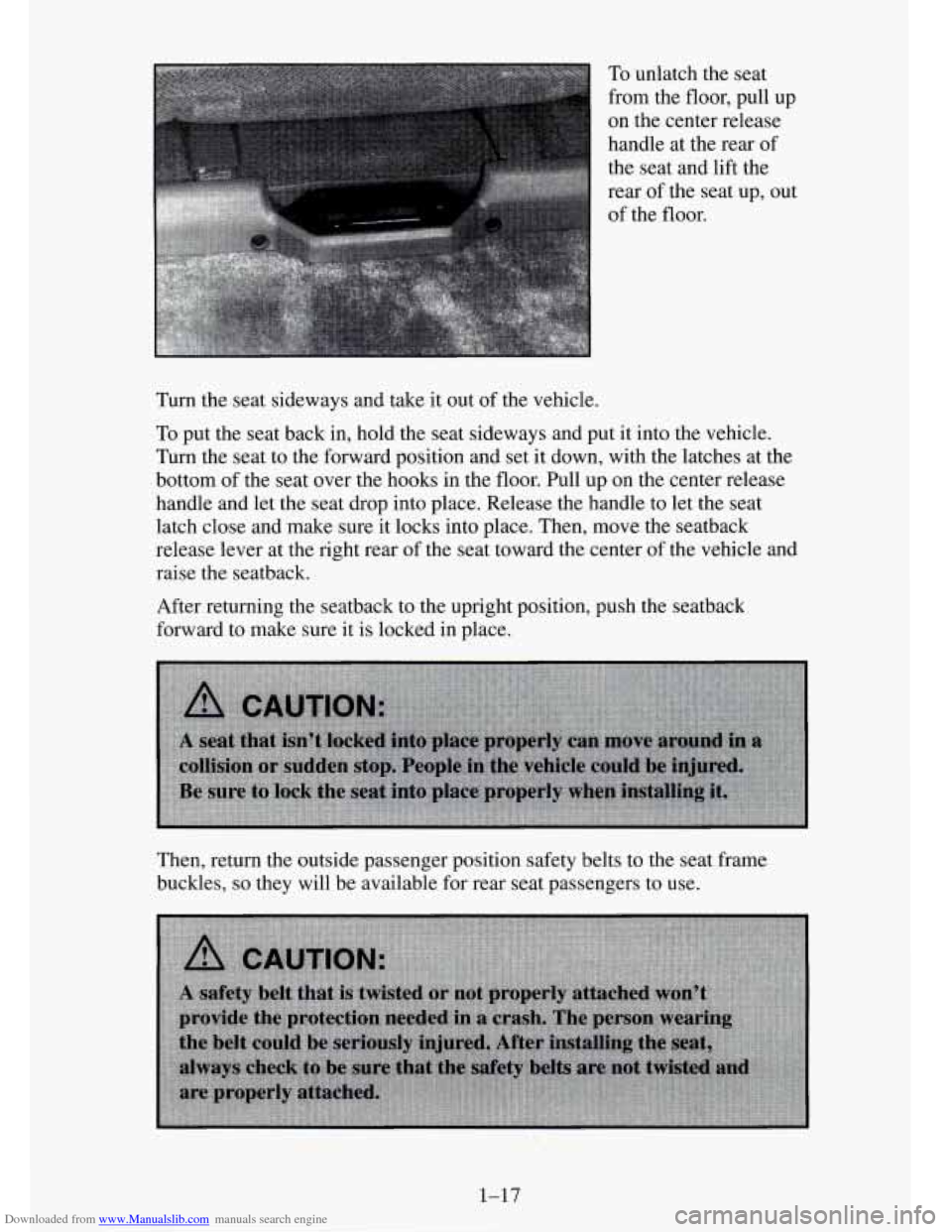
Downloaded from www.Manualslib.com manuals search engine To unlatch the seat
from the floor, pull up
on the center release
handle at the rear of
the seat and lift the
rear of the seat up, out
of the floor.
Turn the seat sideways and take it out of the vehicle.
To put the seat back in, hold the seat sideways and put it into the vehicle.
Turn the seat to the forward position and set it down, with the latches at the
bottom
of the seat over the hooks in the floor. Pull up on the center release
handle and let the seat drop into place. Release the handle to let the seat
latch close and make sure it locks into place. Then, move the seatback
release lever at the right rear of the seat toward the center of the vehicle and
raise the seatback.
After returning the seatback to the upright position, push the seatback
forward to make sure it is locked in place.
Then, return the outside passenger position safety belts to the seat frame
buckles,
so they will be available for rear seat passengers to use.
1-17
Page 46 of 486
Downloaded from www.Manualslib.com manuals search engine When should an air bag inflate?
The air bag is designed to inflate in moderate to severe frontal or near-frontal
crashes. The air bag
will inflate only if the impact speed is above the system’s
designed “threshold level.” If your vehicle goes straight into a wall that doesn’t
move or deform, the threshold level is about 12 to 16 mph (19 to 26
km/h).
The threshold level can vary, however, with specific vehicle design, so that it
can be somewhat above or below
this range. If your vehicle strikes something
that will move or deform, such as a parked car, the threshold level will be
higher. The air bag is not designed to inflate
in rollovers, side impacts, or rear
impacts, because inflation would not help the occupant.
In any particular crash, no one can say whether an air bag should have
inflated simply because of the damage to a vehicle or because of what the
repair costs were. Inflation is determined
by the angle of the impact and the
vehicle’s deceleration. Vehicle damage is only one indication of this.
The air bag system is designed to work properly under a wide range
of
conditions, including off-road usage. Observe safe driving speeds,
especially on rough terrain.
As always, wear your safety belt. See
“Off-Road Driving”
in the Index for more tips on off-road driving.
What makes an air bag inflate?
In a frontal or near-frontal impact of sufficient severity, the air bag sensing
system detects that the vehicle is suddenly stopping as a result
of a crash.
The sensing system triggers a chemical reaction of the sodium azide sealed
in the inflator. The reaction produces nitrogen gas, which inflates the air
bag. The inflator, air bag, and related hardware are all part of the air bag
module packed inside the steering wheel.
How does an air bag restrain?
In moderate to severe frontal or near-frontal collisions, even belted
occupants can contact the steering wheel. The air bag supplements the
protection provided by safety belts. Air bags distribute the force of the
impact more evenly over the occupant’s upper body, stopping the occupant
more gradually. But air bags would not help you in many types
of collisions,
including rollovers and rear and side impacts, primarily because an
occupant’s motion is not toward the air bag. Air bags should never be
regarded as anything more than a supplement to safety belts, and then only
in moderate to severe frontal or near-frontal collisions.
What will you see after an air bag inflates?
After the air bag inflates, it quickly deflates. This occurs so quickly that some
people may not even realize
the air bag inflated. Some components of the air
bag module in the steering wheel hub will be hot for a short time, but the part
of the bag that comes into contact with you will not be hot
to the touch. There
will be some smoke and dust coming from vents in the deflated air bag. Air
bag inflation
will not prevent the driver from seeing or from being able to
steer the vehicle, nor
will it stop people from leaving the vehicle.
1-31
Page 63 of 486
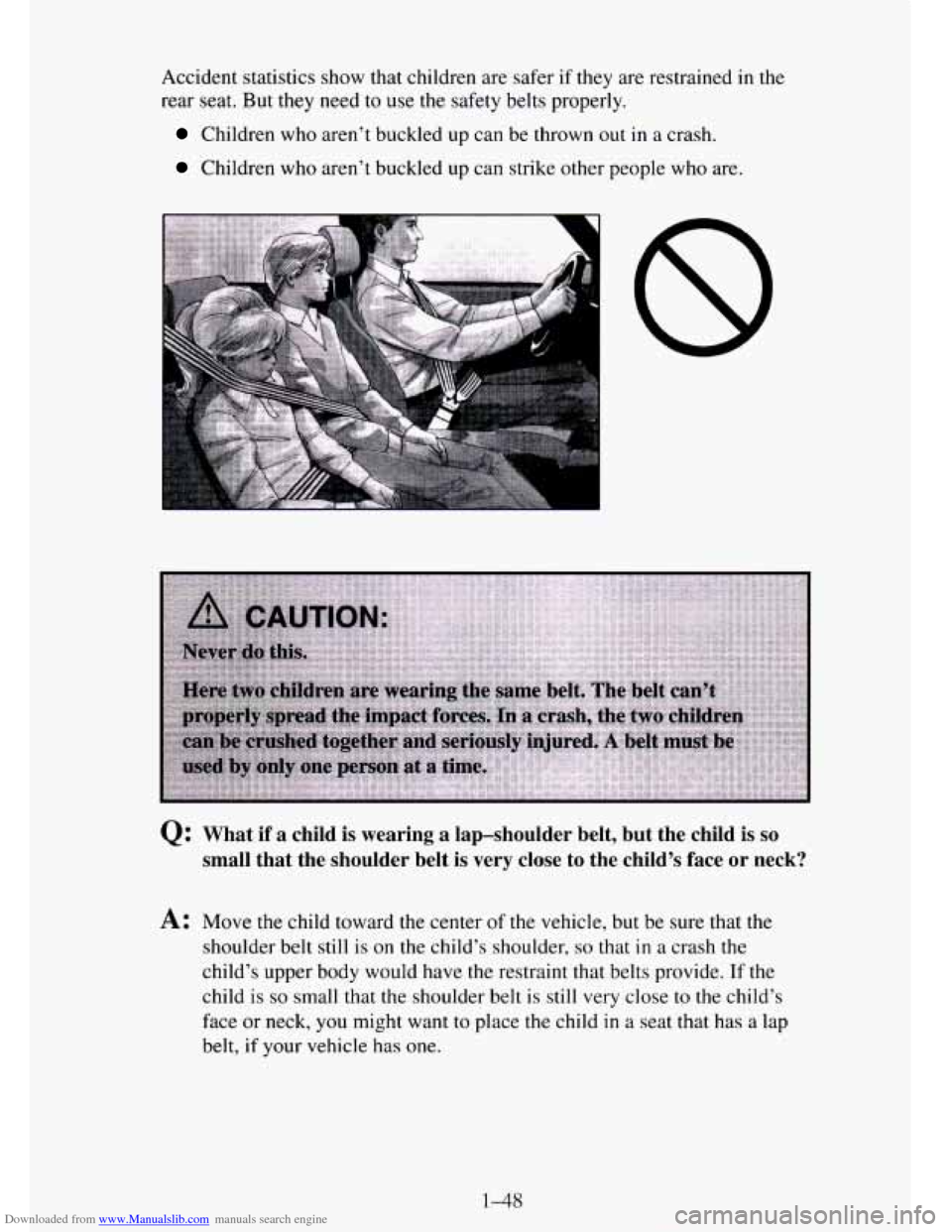
Downloaded from www.Manualslib.com manuals search engine Accident statistics show that children are safer if they are restrained in the
rear seat. But they need to use
the safety belts properly.
Children who aren’t buckled up can be thrown out in a crash.
Children who aren’t buckled up can strike other people who are.
Q: What if a child is wearing a lap-shoulder belt, but the child is so
small that the shoulder belt is very close to the child’s face or neck?
A: Move the child toward the center of the vehicle, but be sure that the
shoulder belt still is on the child’s shoulder,
so that in a crash the
child’s upper body would have the restraint that belts provide.
If the
child
is so small that the shoulder belt is still very close to the child’s
face or neck,
you might want to place the child in a seat that has a lap
belt, if your vehicle has
one.
1-48
Page 70 of 486
Downloaded from www.Manualslib.com manuals search engine Your Doors and How They Work
Side Doors
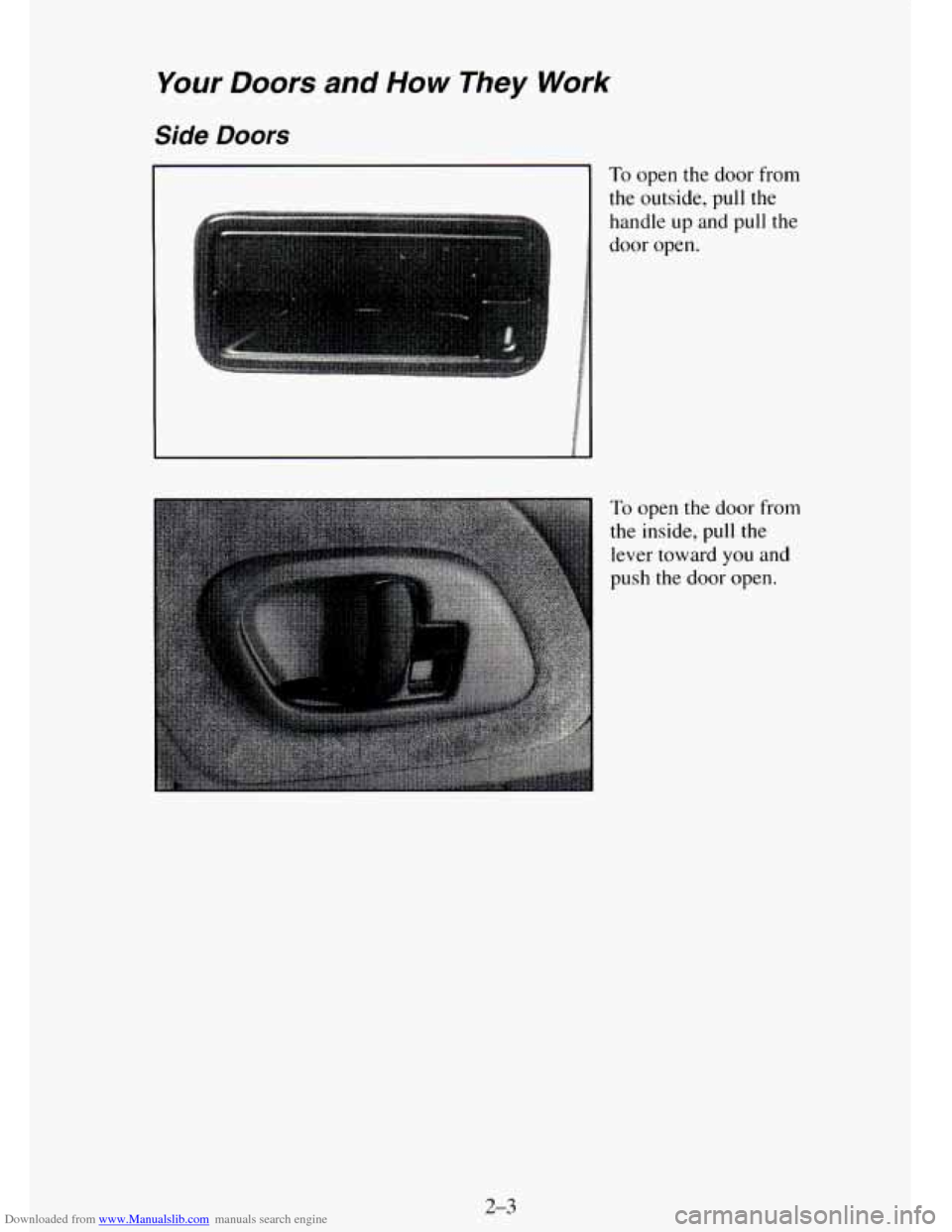
To open the door from
the outside, pull the
handle up and pull the
door open.
To open the door from
the inside, pull the
lever toward
you and
push the
door open.
Page 72 of 486
Downloaded from www.Manualslib.com manuals search engine Open the tailgate by lifting up on the handle while pulling the tailgate
toward you.
Close the tailgate before closing the rear
glass. After closing, make sure the
tailgate is securely latched by pulling it toward you. After closing the rear
glass, pull up on it’s handle
to make sure it is locked.
Panel Doors
To open the rear panel doors, you must open the passenger’s side door first.
If the door is locked, insert your door key in the lock and turn it
counterclockwise to unlock it.
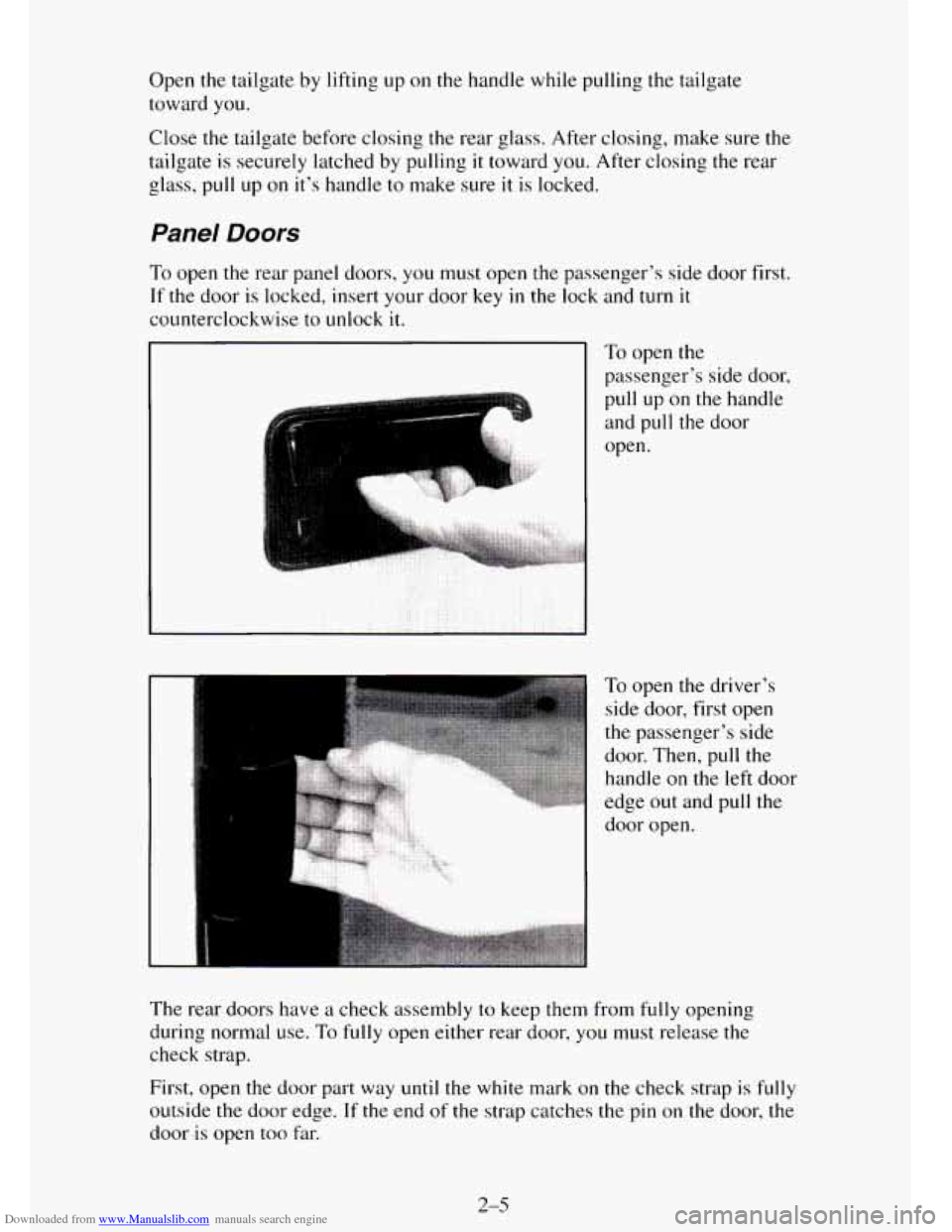
To open the
passenger’s side door,
pull up on the handle
and pull the door
open.
To open the driver’s
side door, first open
the passenger’s side
door. Then, pull the
handle on
the left door
edge out and pull the
door open.
The rear doors have a check assembly to keep them from
fully opening
during normal use. To fully open either rear door,
you must release the
check strap.
First, open
the door part way until the white mark on the check strap is fully
outside the door edge. If the end of the strap catches the pin on the door, the
door-is open too far.
Page 73 of 486
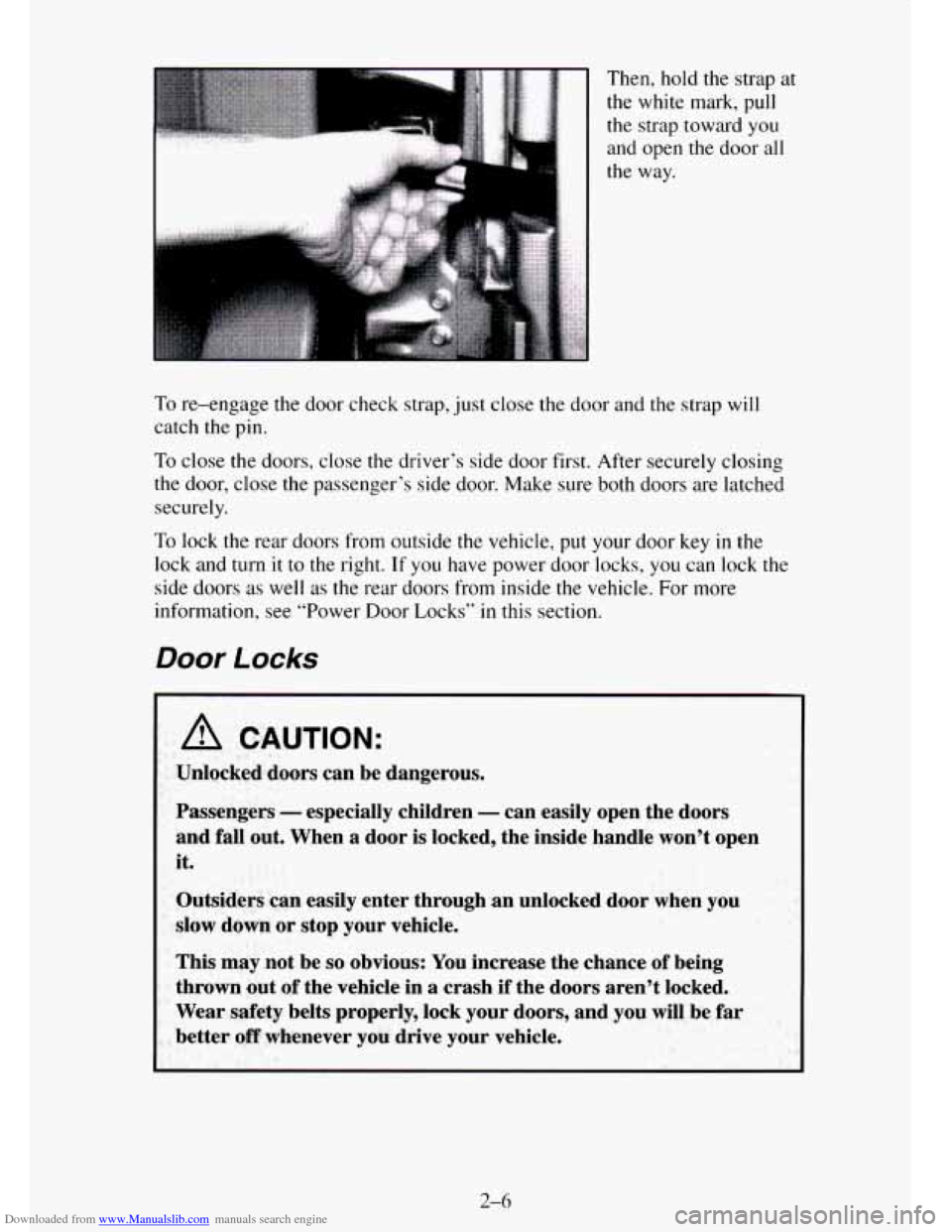
Downloaded from www.Manualslib.com manuals search engine Then, hold the strap at
the white mark, pull
the strap toward you
and open the door all
the way.
To re-engage the door check strap, just close the door and the strap will
catch
the pin.
To close the doors, close the driver’s side door first. After securely closing
the door, close the passenger’s side door. Make sure both doors are latched
securely.
To lock the rear doors from outside the vehicle, put your door key in the
lock and turn
it to the right. If you have power door locks, you can lock the
side doors
as well as the rear doors from inside the vehicle. For more
information, see “Power Door Locks”
in this section.
Door Locks
A CAUTION:
Unlocked doors can be dangerous.
Passengers
- especially children - can easily open the doors
and fall out. When
a door is locked, the inside handle won’t open
it.
Outsiders can easily enter through an unlocked door when you
slow down
or stop your vehicle.
This may not be
so obvious: You increase the chance of being
thrown out
of the vehicle in a crash if the doors aren’t locked.
Wear safety belts properly, lock your doors, and you will be
far
better off whenever you drive your vehicle.
2-6