1995 CHEVROLET SUBURBAN Temp
[x] Cancel search: TempPage 301 of 486
This doughnut-shaped logo (symbol) is used on most oil containers to help
you select the correct oil.
You should
look for this on the oil container, and use only those oils that
display the logo.
GM Goodwrench@
oil (in Canada, GM Engine Oil) meets all the
requirements for your vehicle.
Engine Oil Additives
Don’t add anything to your oil. Your GM dealer is ready to advise if you
think something should be added.
When to Change Engine Oil
See if any one of these is true for you:
Most trips are less than 5 to I0 miles (8 to 16 km). This is particularly
important when outside temperatures are below freezing.
0 Most trips include extensive idling (such as frequent driving in stop and
go traffic).
You operate your vehicle in dusty areas or off-road frequently.
0 You frequently tow a trailer or use a carrier on top of your vehicle.
If any of
these is true for your vehicle, then you need to change your oil and
filter every
2,500 miles (4 000 km) or 3 months - whichever comes first.
If
none of them is true, change the oil and filter every 5,000 miles (8 000
km) or I2 months - whichever comes first.
What to Do with Used Oil
Did you know that used engine oil contains certain elements that may be
unhealthy for your skin and could even cause cancer? Don’t let used oil stay
on your skin for very long. Clean your skin and nails with soap and water,
or a good hand cleaner. Wdsh or properly throw away clothing or rags
containing used engine
oil. (See the manufacturer’s warnings about the use
and disposal
of oil products.)
Used oil can be
a real threat to the environment. If you change your own oil,
be sure to drain all free-flowing oil from the filter before disposal. Don’t
ever dispose
of oil by putting it in the trash, pouring it on the ground, into
sewers, or
into streams or bodies of water. Instead, recycle it by taking it to
a place that collects used
oil. If you have a problem properly disposing of
your used oil, ask your dealer, a service station or a local recycling center
for help.
ProCarManuals.com
Page 304 of 486
Wait at least 30 minutes before checking the transmission fluid level if you
have been driving:
0 When outside temperatures are above 90°F (32°C j,
At high speed for quite a while.
In heavy traffic - especially in hot weather.
0 While pulling a trailer.
To get the right reading, the fluid should be at normal operating
temperature, which
is 180°F to 200°F (82°C to 93°C).
To check transmission fluid hot: Get the vehicle warmed up by driving
about
15 miles (24 km) when outside temperatures are above 50°F (1 0°C).
If it's colder than 50°F (10"C), drive
the vehicle in DRIVE (D) until the
engine temperature gage moves and then remains steady for ten minutes.
Then follow the
hot check procedures.
To check transmission fluid cold: A cold check is made after the vehicle
has been sitting for eight hours
or more with the engine off and is used only
as
a reference. Let the engine run at idle for five minutes if outside
temperatures are 50°F (10°C) or more. If it's colder than 50°F (IO'C), you
may have to idle
the engine longer. Should the fluid level be low during a
cold check,
you must perform a hot check before adding fluid. This will
give you
a more accurate reading of the fluid level.
lo check the fluid hot or cold
0 Park your vehicle on a level place. Keep the engine running.
With the parking brake applied, place the shift lever in PARK (P).
With your foot on the brake pedal, move the shift lever through each
gear range, pausing
for about three seconds in each range. Then,
position
the shift lever in PARK (P).
Let the engine run at idle for three minutes or more.
6-27
ProCarManuals.com
Page 310 of 486
How to Check Lubricant
P
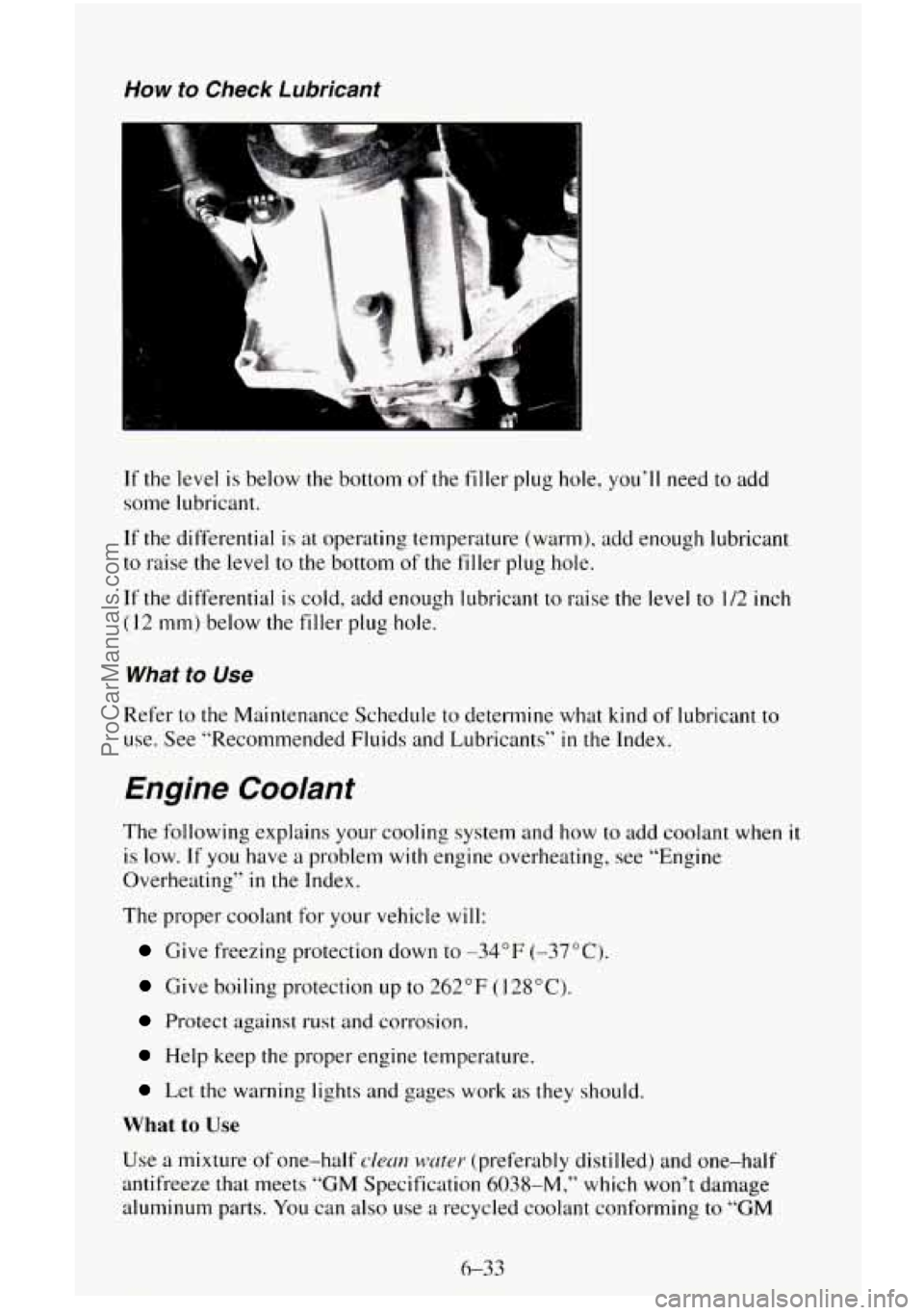
If the level is below the bottom of the filler plug hole, you’ll need to add
some lubricant.
If the differential is at operating temperature (warm), add enough lubricant
to raise the level to the bottom of the filler plug hole.
If the differential is cold, add enough lubricant to raise the level to 1/2 inch
(I 2 mm) below the filler plug hole.
What to Use
Refer to the Maintenance Schedule to determine what kind of lubricant to
use. See “Recommended Fluids and Lubricants” in the Index.
Engine Coolant
The following explains your cooling system and how to add coolant when it
is low. If you have a problem with engine overheating, see “Engine
Overheating”
in the Index.
The proper coolant for your vehicle will:
Give freezing protection down to -34°F (-37°C).
Give boiling protection up to 262°F (128°C).
Protect against rust and corrosion.
Help keep the proper engine temperature.
Let the warning lights and gages work as they should.
What to Use
Use a mixture of one-half chi? wcmr (preferably distilled) and one-half
antifreeze that meets
“GM Specification 6038-M,” which won’t damage
aluminum parts.
You can also use a recycled coolant conforming to “GM
6-33
ProCarManuals.com
Page 315 of 486
Surge Tank Pressure Cap - Diesel Engine
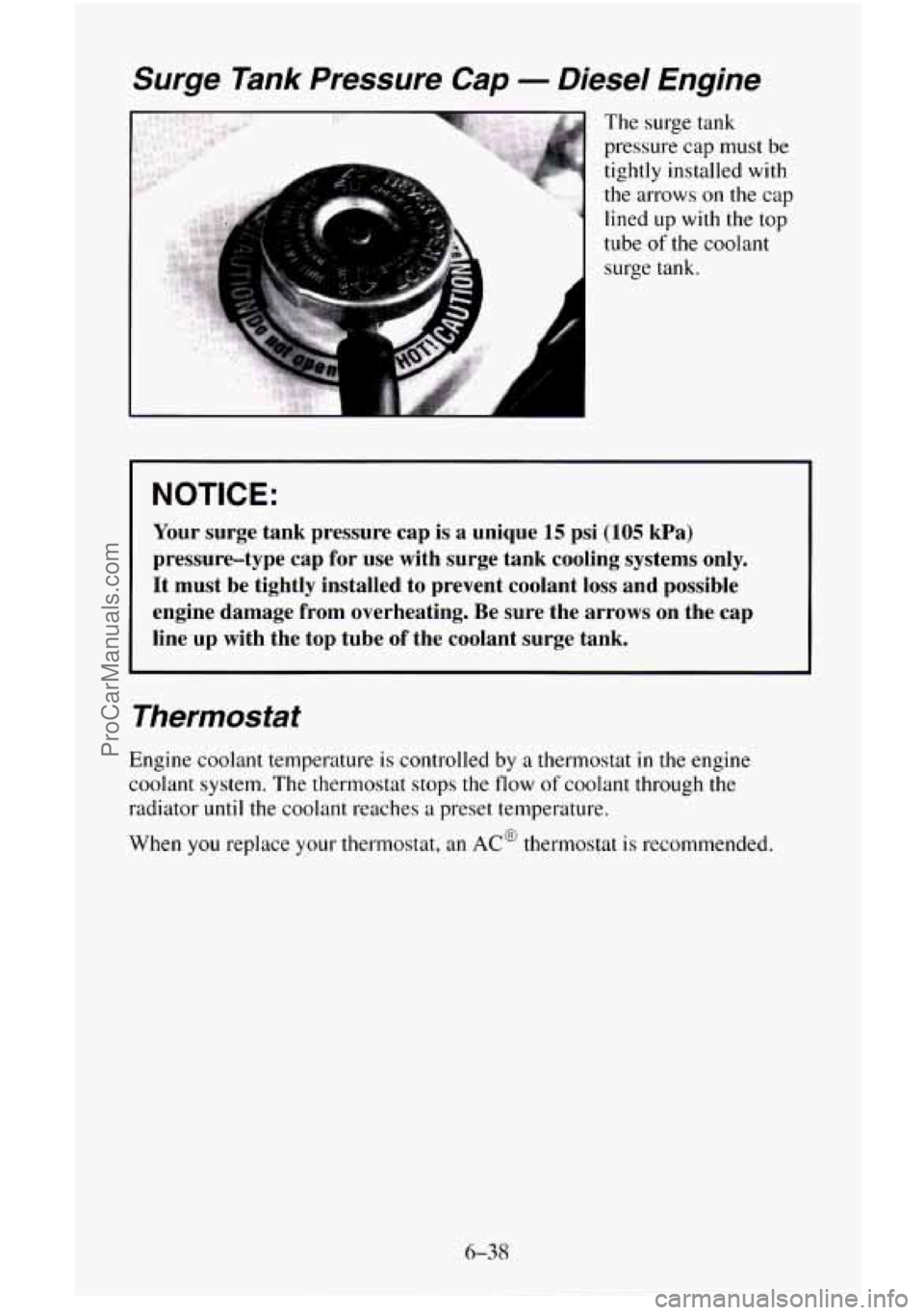
The surge tank
pressure cap must
be
tightly installed with
the arrows on the cap
lined up with the top
tube
of the coolant
surge tank.
NOTICE:
Your surge tank pressure cap is a unique 15 psi (105 kPa)
pressure-type cap for use with surge tank cooling systems only.
It must be tightly installed to prevent coolant
loss and possible
engine damage from overheating. Be sure the arrows on the cap
line up with the top tube of the coolant surge tank.
Thermostat
Engine coolant temperature is controlled by a thermostat in the engine
coolant system. The thermostat stops the flow
of coolant through the
radiator
until the coolant reaches a preset temperature.
When you replace your thermostat, an
AC@ thermostat is recommended.
6-38
ProCarManuals.com
Page 317 of 486
Windshield Washer Fluid
What to Use
When you need windshield washer fluid, be sure to read the manufacturer’s
instructions before use.
If you will be operating your vehicle in an area
where the temperature may fall below freezing, use
a fluid that has
sufficient protection against freezing.
To Add
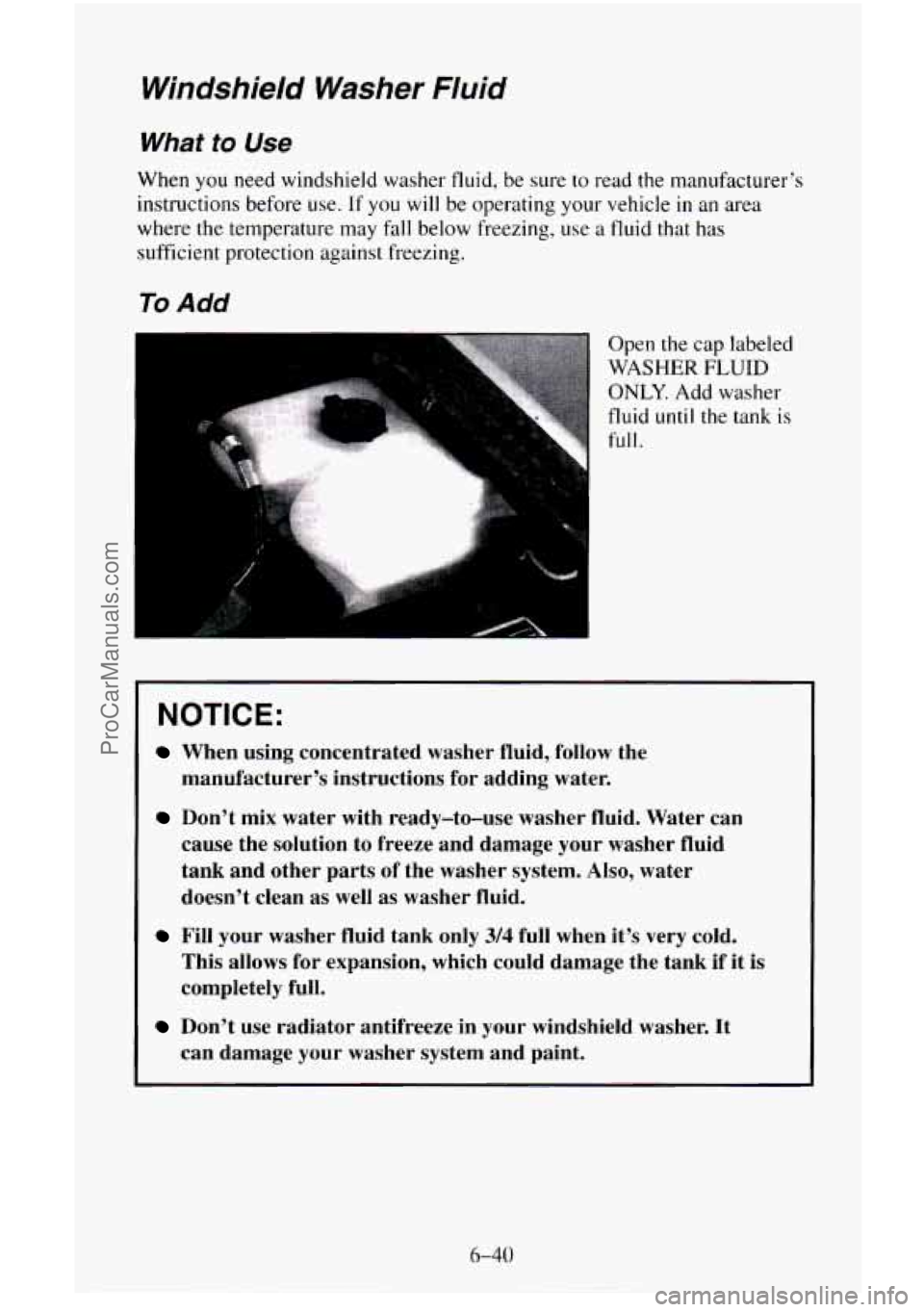
Open the cap labeled
WASHER
FLUID
ONLY. Add washer
fluid
until the tank is
full.
NOTICE:
When using concentrated washer fluid, follow the
manufacturer’s instructions
for adding water.
Don’t mix water with ready-to-use washer fluid. Water can
cause the solution to freeze and damage your washer fluid
tank and other parts of the washer system.
Also, water
doesn’t clean as well as washer fluid.
Fill your washer fluid tank only 3/4 full when it’s very cold.
This allows for expansion, which could damage the tank if it is
completely full.
Don’t use radiator antifreeze in your windshield washer. It
can damage
your washer system and paint.
6-40
ProCarManuals.com
Page 322 of 486
Air Conditioning
Every now and then have your dealership check your air conditioning
system to be sure
it has not lost any cooling ability. If you think the system
is not working properly, have your dealership check it out as soon as
possible.
The air conditioning will not work when the temperature is below
40°F
(4°C).
Fluid Leak Check
After the vehicle has been parked for a while, inspect the surface under the
vehicle for water, oil, fuel or other fluids. Water dripping from the air
conditioning system after
it has been used is normal. If you notice fuel leaks
or fumes, the causes should be found and corrected at once.
Lock Cylinders
To be sure your locks operate properly, they must be lubricated. Your
vehicle’s maintenance schedule will tell
you how often to lubricate them.
See “Recommended Fluids and Lubricants”
in the Index for the proper
lubricant to use.
You should not use penetrating oils because they could wash out the factory
installed lubricant and cause the lock
to bind. De-icers which contain
alcohol could also wash away
the lubricant, so be sure to lubricate the lock
after using
a de-icer of this type.
Battery
Every new GM vehicle has a Delco Freedom’ battery. You never have to
add water
to one of these. When it’s time for a new battery, we recommend
a Delco Freedom@ battery. Get one that has the replacement number shown
on the original battery’s label.
Vehicle Storage
If you’re not going to drive your vehicle for 25 days or more, take off the
black, negative
(-) cable from the battery. This will help keep your battery
from running down.
6-45
ProCarManuals.com
Page 336 of 486
Uniform lire Qualify Grading
The following information relates to the system developed by the United
States National Highway Traffic Safety Administration which grades tires
by treadwear, traction and temperature performance. (This applies
only to
vehicles sold in the United States.)
Treadwear
The treadwear grade is a comparative rating based on the wear rate of the
tire when tested under controlled conditions on a specified government test
course. For example, a tire graded 150 would wear one and a half
(I 1/2)
times as well on the government course as a tire graded 100. The relative
performance of tires depends upon the actual conditions
of their use,
however, and may depart significantly from the norm due to variations
in
driving habits, service practices and differences in road characteristics and
climate.
Traction - A, B, C
The traction grades. from highest to lowest are: A, B, and C. They represent
the tire’s ability to stop on wet pavement as measured under controlled
conditions on specified government test surfaces
of asphalt and concrete. A
tire marked
C may have poor traction performance.
Warning:
The traction grade assigned to this tire is based on braking
(straight-ahead) traction tests and does not include cornering (turning)
traction.
Temperature - A, 6, C
The temperature grades are A (the highest), B, and C, representing the tire’s
resistance to the generation
of heat and its ability to dissipate heat when
tested under controlled conditions on
a specified indoor laboratory test
wheel. Sustained high temperature can cause
the material of the tire to
degenerate and reduce
tire life, and excessive temperature can lead to
sudden tire fdilure. The grade
C corresponds to a level of performance
which all passenger car tires must meet under the Federal Motor Vehicle
Safety Standard
No. 109. Grades B and A represent higher levels of
performance on the laboratory test wheel than the minimum required
by
law.
6-59
-- ProCarManuals.com
Page 337 of 486
Warning: The temperature grade for this tire is established for a tire that is
properly inflated and
not overloaded. Excessive speed, underinflation, or
excessive loading, either separately or
in combination, can cause heat
buildup and possible tire failure.
These grades are molded on the sidewalls of passenger car tires.
While
the tires available as standard or optional equipment on General
Motors vehicles may vary with respect to these grades, all such tires meet
General Motors performance standards and have been approved for
use on
General Motors vehicles.
All passenger type (P Metric) tires must conform
to Federal safety requirements in addition to these grades.
Wheel Alignment and Tire Balance
The wheels on your vehicle were aligned and balanced carefully at the
factory
to give you the longest tire life and best overall performance.
In most cases, you will not need
to have your wheels aligned again.
However,
if you notice unusual tire wear or your vehicle pulling one way or
the other, the alignment may need
to be reset. If you notice your vehicle
vibrating when driving
on a smooth road, your wheels may need to be
rebalanced.
Wheel Replacement
Replace any wheel that is bent, cracked, or badly rusted or corroded. If
wheel nuts keep coming loose, the wheel, wheel bolts, and wheel nuts
should be replaced. If the wheel leaks air, replace it (except some aluminum
wheels, which can sometimes be repaired). See your GM dealer if any of
these conditions exist.
Your dealer will know the kind
of wheel you need.
Each new wheel should have the same load carrying capacity, diameter,
width, offset, and be mounted the same way as
the one it replaces.
If you need to replace any of your wheels, wheel bolts, or wheel nuts,
replace them only with new GM original equipment parts. This way, you
will be
sure to have the right wheel, wheel bolts, and wheel nuts for your
vehicle.
ProCarManuals.com