1995 CHEVROLET SUBURBAN Temp
[x] Cancel search: TempPage 159 of 486
fuel economy. This setting also cools the air the fastest and can be used to
keep “unwanted odors” and/or dust from entering the vehicle. When using
the air conditioner, turn off recirculation after the vehicle reaches
a
comfortable interior temperature.
When the right knob
on the control panel is between HEAT and DEFROST,
the recirculation feature will not function.
NC - This button, between the middle and right knobs, allows the air
coming into your vehicle
to be cooled and directed through the instrument
panel vents. This setting
is useful for normal cooling on hot days. When you
first
use A/C with the recirculation button pushed in, turn off recirculation
as soon as the vehicle reaches a comfortable interior temperature.
Engine Coolant Heater
If your vehicle has a diesel engine, it is equipped with an engine coolant
heater. An engine coolant heater is optional
on gas engine vehicles. If you
use the engine coolant heater before starting your engine (in cold weather
(20” F, (-8” C), or lower) your heating system will produce warmer air
faster, to heat
the passenger compartment in cold weather.
The use of an engine coolant heater also reduces
the time it takes for the
engine to reach normal operating temperature, and shortens the time it takes
the heater
to reach full output. For more information, See “Engine Coolant
Heater” in the Index.
Diesel Engine Heater Output
If you idle your diesel engine for a long time when it’s cold outside, your
heater may blow out cool air. This is normal. When you increase the engine
speed, your heater should blow
out warmer air. If it doesn’t, your coolant
level may be too low. See “Engine Coolant” in the Index to see how to
check your coolant level.
Rear Air Conditioning and Heating Systems (Suburban)
If your vehicle has either or both of these systems, you can increase and
decrease the air flow at the rear vents. Depending
on the system you have
and the setting selected, you can send cooled or heated air to the rear of the
vehicle.
Rear Air Conditioning (Without Rear Heater)
If your vehicle has rear air conditioning (without rear heater), the controls
are located above the front and second seats. The front and rear overhead
controls let
you increase and decrease the air flow at the rear vents.
3-4
ProCarManuals.com
Page 161 of 486
To increase and decrease the flow of heated air to the rear floor vents, move
the switch marked REAR HEAT to the blower speed you want.
The knob has three speed positions.
To increase the flow of heated air, move
the switch toward HIGH.
To decrease the flow of heated air, move it toward
LOW. To turn the fan off, move the switch to OFF.
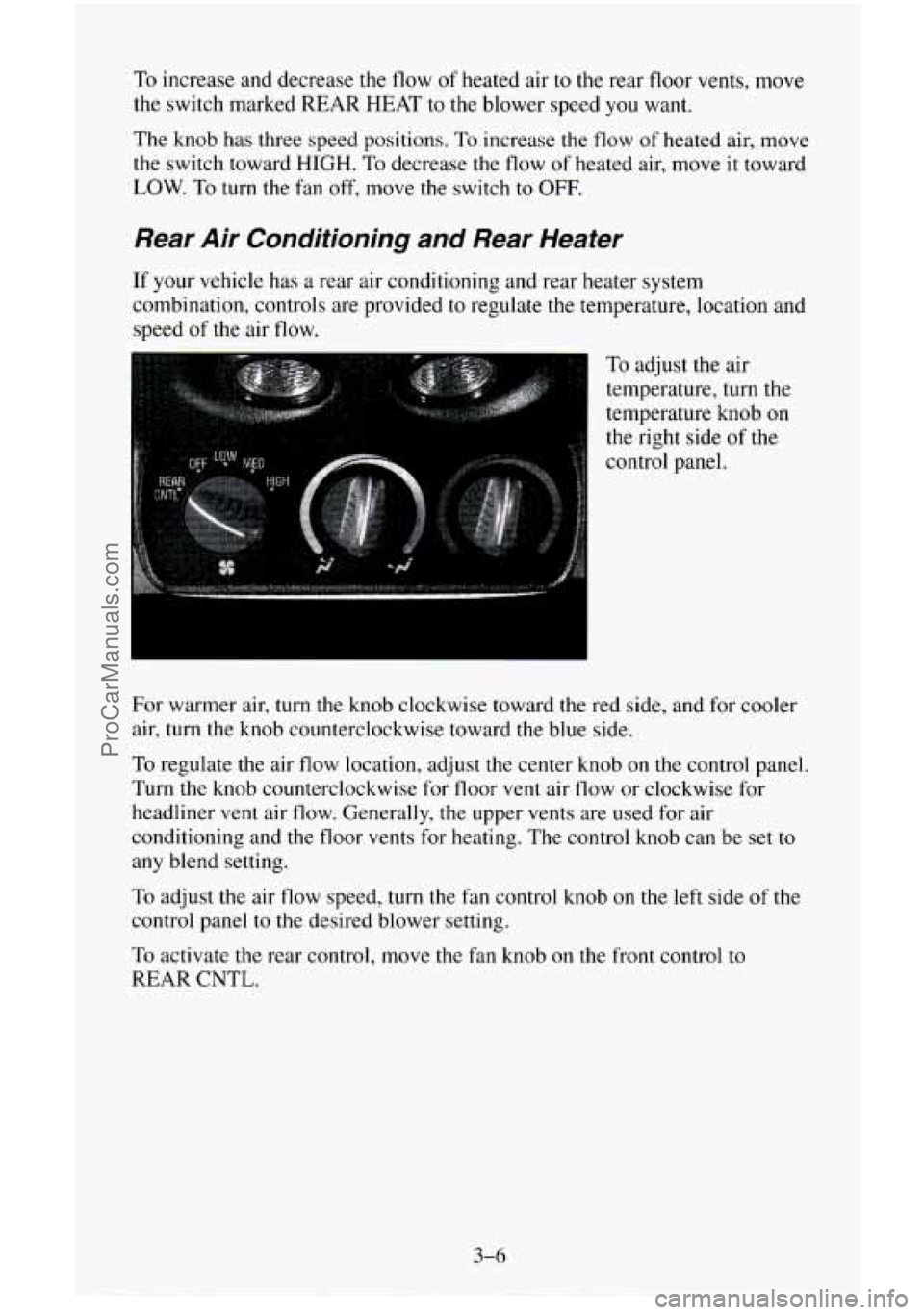
Rear Air Conditioning and Rear Heater
If your vehicle has a rear air conditioning and rear heater system
combination, controls are provided
to regulate the temperature, location and
speed of the air flow.
To adjust the air
temperature, turn the
temperature knob
on
the right side of the
control panel.
For warmer air, turn the knob clockwise toward the red side, and for cooler
air, turn the knob counterclockwise toward the blue side.
To regulate the air flow location, adjust the center knob on the control panel
Turn the knob counterclockwise for floor vent air flow or clockwise for
headliner vent air flow. Generally, the upper vents are used for air
conditioning and the floor vents for heating. The control knob can be set
to
any blend setting.
To adjust the air flow speed, turn the fan control knob on the left side of the
control panel
to the desired blower setting.
To activate
the rear control, move the fan knob on the front control to
REAR
CNTL.
3-6
ProCarManuals.com
Page 200 of 486
Q: What should I do if my vehicle stalls, or is about to stall, and I
can’t make it up the hill?
A: If this happens, there are some things you should do, and there are
some things you must not do. First, here’s what you should do:
0 Push the brake pedal to stop the vehicle and keep it from rolling
0 If your engine is still running, shift the transmission into reverse,
backwards.
Also, apply the parking brake.
release the parking brake, and
slowly back down the hill in reverse.
If your engine has stopped running, you’ll need to restart it. With the
brake pedal depressed and the parking brake still applied, shift the
transmission to
PARK (P) (or, shift to NEUTRAL (N) if your vehicle
has a manual transmission) and restart the engine. Then, shift to
reverse, release the parking brake, and slowly back down
the hill as
straight
as possible in reverse.
0 As you are backing down the hill, put your left hand on the steering
wheel at
the 12 o’clock position. This way, you’ll be able to tell if your
wheels are straight and maneuver as you back down. It’s best that you
back down the
hill with your wheels straight rather than in the left or
right direction. Turning
the wheel too far to the left or right will
increase the possibility of a rollover.
Here are
some things you must not do if you stall, or are about to stall,
when going up
a hill.
0 Never attempt to prevent a stall by shifting into NEUTRAL (N) (or
depressing the clutch, if you have a manual transmission) to “rev-up”
the engine and regain forward momentum. This won’t work. Your
vehicle
will roll backwards very quickly and you could go out of
control.
4-17
ProCarManuals.com
Page 201 of 486
Instead, apply the regular brake to stop the vehicle. Then apply the parking
brake. Shift into reverse, release the parking brake, and slowly back straight
down.
Never attempt to turn around if you are about to stall when going up a
hill. If the hill is steep enough
to stall your vehicle, it’s steep enough to
cause
you to roll over if you turn around. If you can’t make it up the
hill, you must back straight down the hill.
Q: Suppose, after stalling, I try to back down the hill and decide I just
can’t
do it. What should I do?
A: Set the parking brake, put your transmission in PARK (P) (or the
manual transmission
in first gear) , and turn off the engine. Leave the
vehicle and go get some help. Exit on the uphill side and stay clear
of
the path the vehicle would take if it rolled downhill. Do not shift the
transfer case to NEUTRAL
(N) when you leave the vehicle. Leave it in
some gear.
Driving Downhill
When off-roading takes you downhill, you’ll want to consider a number of
things:
How steep is the downhill? Will I be able to maintain vehicle control?
What’s the surface like? Smooth? Rough? Slippery? Hard-packed dirt?
Gravel?
Are there hidden surface obstacles? Ruts? Logs? Boulders?
What’s at the bottom of the hill? Is there a hidden creek bank or even a
river bottom with large rocks?
If
you decide you can go down a hill safely, then try to keep your vehicle
headed straight down, and use a low gear. This way, engine drag can help
4-18
ProCarManuals.com
Page 207 of 486
Night Vision
No one can see as well at night as in the daytime. But as we get older these
differences increase. A 50-year-old driver may require at least twice as
much light
to see the same thing at night as a 20-year-old.
What you do
in the daytime can also affect your night vision. For example,
if you spend the day
in bright sunshine you are wise to wear sunglasses.
Your eyes will have less trouble adjusting
to night. But if you’re driving,
don’t wear sunglasses at night. They may cut down
on glare from
headlamps, but
they also make a lot of things invisible.
You can be temporarily blinded by approaching lights. It can take a second
or two, or even several seconds, for your eyes to readjust to the dark. When
you are faced with severe glare (as from a driver who doesn’t lower the high
beams,
or a vehicle with misaimed headlamps), slow down a little. Avoid
staring directly into the approaching lights.
Keep your windshield and all the glass on your vehicle clean
- inside and
out. Glare at night is made much worse by dirt on the glass. Even the inside
of the glass can build up a film caused by dust. Dirty glass makes lights
dazzle and flash more than
clean glass would, making the pupils of your
eyes contract repeatedly.
Remember that your headlamps light
up far less of a roadway when you are
in
a turn or curve. Keep your eyes moving; that way, it’s easier to pick out
dimly lighted objects. Just as your headlamps should be checked regularly
for proper aim,
so should your eyes be examined regularly. Some drivers
suffer from night blindness
- the inability to see in dim light - and aren’t
even aware
of it.
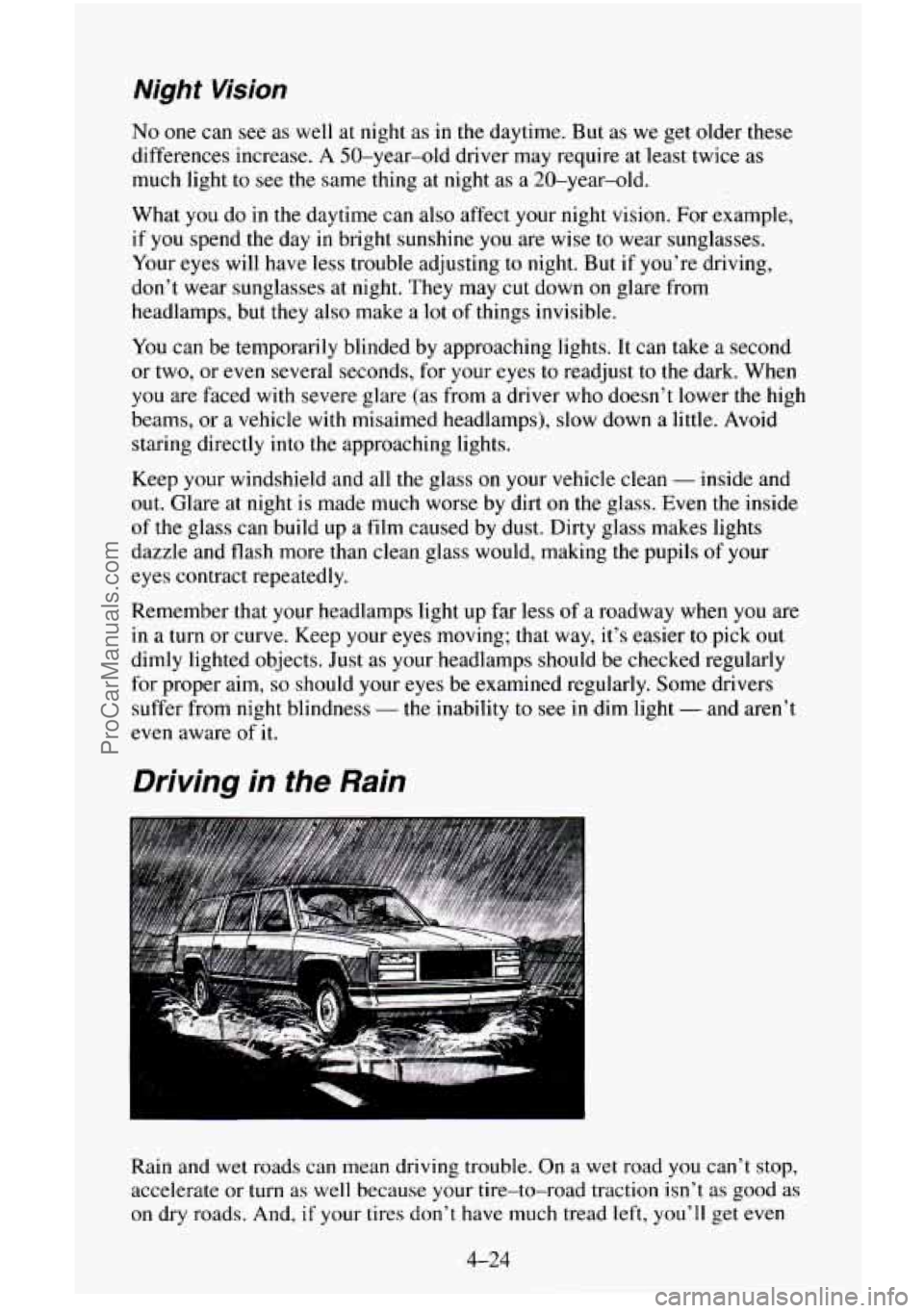
Driving in the Rain
Rain and wet roads can mean driving trouble. On a wet road you can’t stop,
accelerate or turn as well because your tire-to-road traction isn’t as good as
on dry roads. And,
if your tires don’t have much tread left, you’ll get even
4-24
ProCarManuals.com
Page 218 of 486
Power Take-Off (PTO)
NOTICE:
If you have a PTO that will exceed 35 horsepower installed on
your vehicle, it could damage the transfer case or transmission.
When having a PTO installed on your vehicle, make sure that it
will not exceed
35 horsepower.
Before using a power take-off, refer to the manufacturer’s or installer’s
instructions.
NOTICE:
Using a PTO while operating in one place before the vehicle has
reached normal operating temperature can damage the transfer
case or transmission.
If you will be using the PTO while
operating in one place, drive and warm up the vehicle before
using the PTO.
To engage a power take-off
1. Set the parking brake.
2. Shift the transmission into NEUTRAL (N).
3. Hold the clutch pedal down and engage the power take-off.
NOTICE:
Using a PTO for more than four hours without driving your
vehicle can damage the transfer case or transmission.
If using a
PTO for more than four hours without driving your vehicle,
drive your vehicle for
a while to allow the transfer case and
transmission to cool.
If you are going to drive the vehicle, shift the transmission into the gear
you want. Then shift the transfer case into the range you want
(if you
have four-wheel drive), apply the regular brakes and release the
parking brake.
4. Release the clutch (and the regular brakes) as you normally would.
When
you release the clutch, the power take-off will start.
4-35
ProCarManuals.com
Page 224 of 486
Three important considerations have to do with weight:
Weight of the Trailer
How heavy can a trailer safely be?
It depends on how you plan
to use your rig. For example, speed, altitude,
road grades, outside temperature and how much your vehicle is used to pull
a trailer are all important. And, it can also depend on any special equipment
that you have on your vehicle.
You can ask your dealer for our trailering information or advice, or you can
write
us at the address listed in your Warranty and Owner Assistance
Information Booklet.
In Canada, write to:
General Motors
of Canada Limited
Customer Assistance Center
1908 Colonel Sam Drive
Oshawa, Ontario
L 1 H 8P7
Weight of the Trailer Tongue
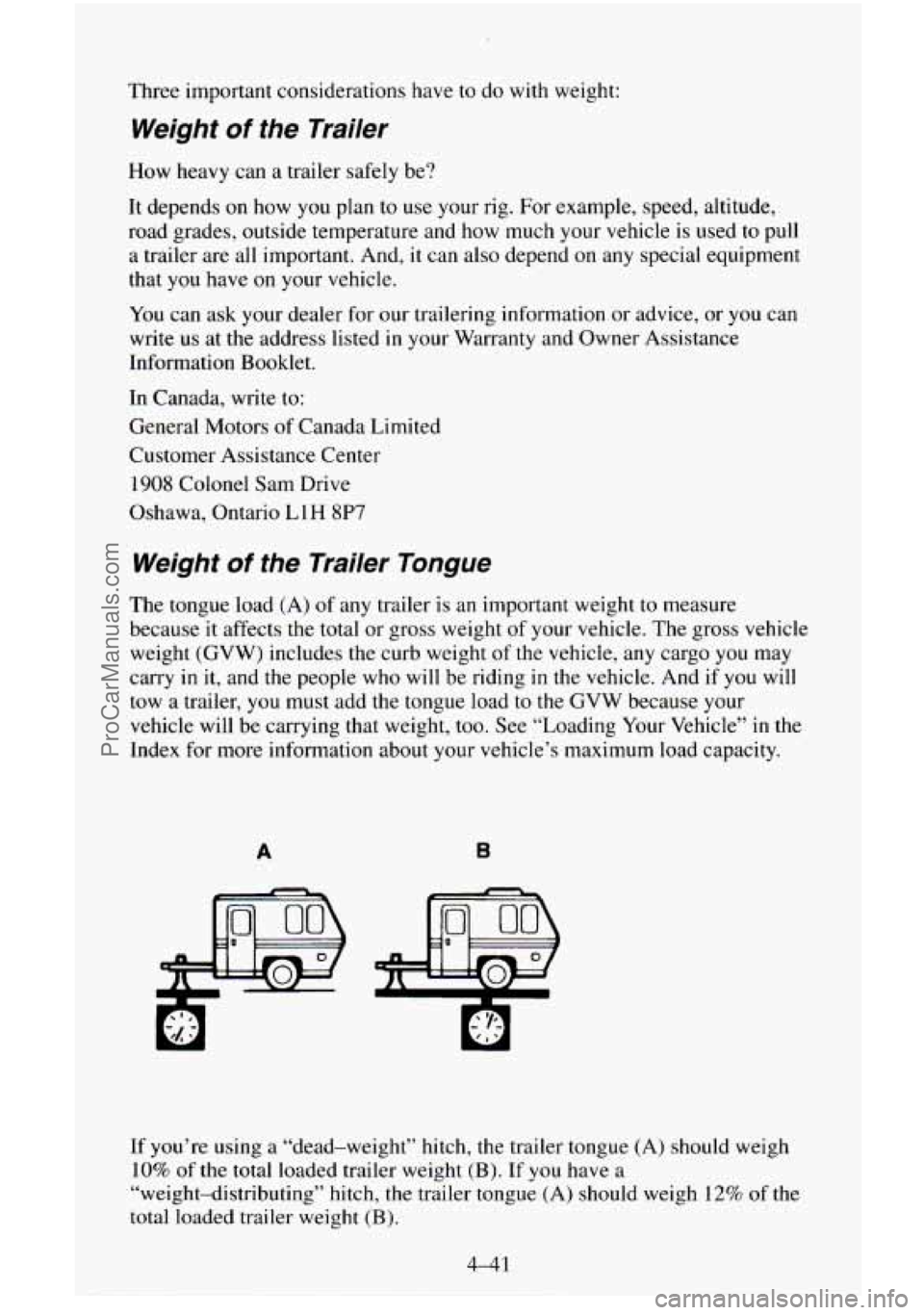
The tongue load (A) of any trailer is an important weight to measure
because
it affects the total or gross weight of your vehicle. The gross vehicle
weight (GVW) includes the curb weight
of the vehicle, any cargo you may
carry in it, and
the people who will be riding in the vehicle. And if you will
tow a trailer,
you must add the tongue load to the GVW because your
vehicle will be carrying that weight, too. See “Loading Your Vehicle” in the
Index for more information about your vehicle’s maximum load capacity.
A B
If you’re using a “dead-weight” hitch, the trailer tongue (A) should weigh
10% of the total loaded trailer weight (B). If you have a
“weight-distributing” hitch, the trailer tongue (A) should weigh
12% of the
total loaded trailer weight
(B).
ProCarManuals.com
Page 228 of 486
Turn Signals When Towing a Trailer
When you tow a trailer, your vehicle has to have extra wiring (included in
the optional trailering package). The green arrows
on your instrument panel
will flash whenever
you signal a turn or lane change. Properly hooked up,
the trailer lamps will
also flash, telling other drivers you’re about to turn,
change lanes or stop.
When towing a trailer, the green arrows on your instrument panel will flash
for turns even if the bulbs
on the trailer are burned out. Thus, you may think
drivers behind you are seeing your signal when they are not. It’s important
to check occasionally to be sure the trailer bulbs are still working.
Driving On Grades
Reduce speed and shift to a lower gear before you start down a long or steep
downgrade. If
you don’t shift down, you might have to use your brakes so
much that they would get hot and no longer work well.
On
a long uphill grade, shift down and reduce your speed to around 45 mph
(70 kdh) to reduce the possibility of engine and transmission overheating.
If
you have an automatic transmission you should use DRIVE (3) (or, as
you need to, a lower gear) when towing a trailer. Operating your vehicle in
DRIVE (3) when towing a trailer will minimize heat build-up and extend
the life
of your transmission.
If
you have a manual transmission and you are towing a trailer, it’s better
not to use FIFTH (5) gear. Just drive in FOURTH (4) gear (or, as you need
to,
a lower gear).
When towing at high altitude
on steep uphill grades, consider the following:
Engine coolant will boil at a lower temperature than at normal altitudes. If
you turn your engine off immediately after towing at high altitude on steep
uphill grades, your vehicle may show signs similar
to engine overheating.
To avoid this, let the engine run while parked (preferably on level ground)
with the automatic transmission
in PARK (P) (or the manual transmission
out of gear and the parking brake applied) for a few minutes before turning
the engine off.
If you do get the overheat warning, see “Engine
Overheating” in the Index.
Parking on Hills
You really should not park your vehicle, with a trailer attached, on a hill. If
something goes wrong, your rig could start to move. People can be injured,
and both your vehicle and
the trailer can be damaged.
But
if you ever have to park your rig on a hill, here’s how to do it:
1. Apply your regular brakes, but don’t shift into PARK (P) yet, or in gear
for a manual transmission.
ProCarManuals.com