1995 CHEVROLET S10 warning
[x] Cancel search: warningPage 229 of 354
Downloaded from www.Manualslib.com manuals search engine Four-wheel Drive Remote Oil Filter
If your vehicle has four-wheel drive, you will have a remote oil filter. There
is a special access door in the steering linkage shield assembly located under
the radiator support. Twist the screw to lock or unlock the door.
Engine Coolant Heater
An engine coolant heater can be a big help if you have to park outside in
very cold weather,
0°F (-1 8 O C) or colder. If your vehicle has this option,
see “Engine Coolant Heater” in the Index.
What to Do with Used Oil
Did you know that used engine oil contains certain elements that may be
unhealthy for your skin and could
even cause cancer? Don’t let used oil stay
on your skin for very long. Clean your skin and nails with soap and water,
or a good hand cleaner. Wash or properly throw away clothing or rags
containing used engine oil. (See the manufacturer’s warnings about the use
and disposal of oil products.)
Used oil can be a real threat to the environment. If you change your own oil,
be sure to drain all free-flowing oil from the filter before disposal. Don’t
ever dispose of oil by putting
it in the trash, pouring it on the ground, into
sewers, or into streams or bodies of water. Instead, recycle it by taking it
to
a place that collects used oil. If you have a problem properly disposing of
your used oil, ask your dealer, a service station or a local recycling center
for help.
Air Cleaner
To remove the round air cleaner filter for the 4.3L (VIN 2) engine, turn the
wing nuts counterclockwise. Remove the cover and change the filter. Care
should be taken during reassembly to ensure that the cover is on straight and
the wingnuts
are properly tightened.
= To avoid ingesting
dust in the engine, the
arrow on the air
cleaner lid should
point
to the front of
the engine.
6- 12
Page 238 of 354
Downloaded from www.Manualslib.com manuals search engine What to Use
Refer to the Maintenance Schedule to determine what kind of lubricant to
use. See “Recommended Fluids and Lubricants” in the Index.
Engine Coolant
The following explains your cooling system and how to add coolant when it
is low. If you have a problem with engine overheating, see “Engine
Overheating” in the Index.
The proper coolant for your vehicle will:
Give freezing protection down to -34°F (-37 “C).
Give boiling protection up to 262°F (128 “C).
Protect against rust and corrosion.
Help keep the proper engine temperature.
Let the warning lights and gages work as they should.
What to Use
Use a mixture of one-half clean water (preferably distilled) and one-half
antifreeze that meets “GM Specification 6038-M,” or “GM Specification
6043-M’ with the 2.2L (LN2) Code 4 engine, which won’t damage
aluminum parts.
You can also use a recycled coolant conforming to “GM
Specification 603%”’ or “GM Specification 6043-M” with the 2.2L
(LN2) Code 4 engine. Use GM Coolant Supplement (Sealer) with a
complete coolant flush and refill. If you use this mixture, you don’t need to
add anything else.
6-21
Page 245 of 354
Downloaded from www.Manualslib.com manuals search engine NOTICE:
Don’t let someone put in the wrong kind of fluid. For
example, just a few drops
of mineral-based oil, such as engine
oil, in your brake system can damage brake system parts
so
badly that they’ll have to be replaced.
Brake fluid can damage paint, so be careful not to spill brake
fluid on your vehicle.
If you do, wash it off immediately. See
“Appearance Care” in the Index.
Brake Wear
Your vehicle has front disc brakes and rear drum brakes.
Disc brake pads have built-in wear indicators that make a high-pitched
warning sound when the brake pads are
worn and new pads are needed. The
sound may come and go or be heard all the time your vehicle
is moving
(except when you are pushing
on the brake pedal firmly).
I NOTICE:
Continuing to drive with worn-out brake pads could result in
costly brake repair.
Some driving conditions or climates may Cause a brake squeal when the
brakes are
first applied or lightly applied. This does not mean something is
wrong with your brakes.
Your rear drum brakes don’t have wear indicators, but if you ever hear a
rear brake rubbing noise, have the rear brake linings inspected. Also, the
rear brake drums should be removed and inspected each time the tires are
removed for rotation or changing. When you have the front brakes replaced,
have
the rear brakes inspected, too.
Brake linings should always be replaced as complete axle sets.
6-28
Page 261 of 354
Downloaded from www.Manualslib.com manuals search engine Uniform Tire Quality Grading
The following information relates to the system developed by the United
States National Highway Traffic Safety Administration which grades tires
by treadwear, traction and temperature performance. (This applies only to
vehicles sold in the United States.)
Treadwear
The treadwear grade is a comparative rating based on the wear rate of the
tire when tested under controlled conditions on a specified government test
course. For example, a tire graded
150 would wear one and a half (1 112)
times as well on the government course as a tire graded 100. The relative
performance
of tires depends upon the actual conditions of their use,
however, and may depart significantly from the norm due to variations in
driving habits, service practices and differences in road characteristics and
climate.
Traction -A, By C
The traction grades, from highest to lowest are: A, B, and C. They represent
the tire’s ability to stop on wet pavement as measured under controlled
conditions on specified government test surfaces of asphalt and concrete.
A
tire marked C may have poor traction performance.
Warning: The traction grade assigned to this tire is based on braking
(straight-ahead) traction tests and does not include cornering (turning)
traction.
Temperature - A, 9, C
The temperature grades are A (the highest), B, and C, representing the tire’s
resistance to the generation of heat and its ability to dissipate heat when
tested under controlled conditions on a specified indoor laboratory test
wheel. Sustained high temperature can cause the material
of the tire to
degenerate and reduce tire life, and excessive temperature can lead to
sudden tire failure. The grade
C corresponds to a level of performance
which all passenger car tires must meet under the Federal Motor Vehicle
Safety Standard
No. 109. Grades B and A represent higher levels of
performance on the laboratory test wheel than the minimum required by
law.
6-44
Page 262 of 354
Downloaded from www.Manualslib.com manuals search engine Warning: The temperature grade for this tire is established for a tire that is
properly inflated and not overloaded. Excessive speed, underinflation, or
excessive loading, either separately or in combination, can cause heat
buildup and possible tire failure.
These grades are molded on the sidewalls of passenger
car tires.
While the tires available as standard or optional equipment on General
Motors vehicles may vary with respect to these grades, all such tires meet
General Motors performance standards and have been approved for use on
General Motors vehicles. All passenger type
(P Metric) tires must conform
to Federal safety requirements in addition to these grades.
Wheel Alignment and Tire Balance
The wheels on your vehicle were aligned and balanced carefully at the
factory to give you the longest tire life and best overall performance.
In most cases, you will not need to have your wheels aligned again.
However, if you notice unusual tire wear or your vehicle pulling one way or
the other, the alignment may need to be reset. If you notice your vehicle
vibrating when driving on a smooth road, your wheels may need to be
rebalanced.
Wheel Replacement
Replace any wheel that is bent, cracked, or badly rusted or corroded. If
wheel nuts keep coming loose, the wheel, wheel bolts, and wheel nuts
should be replaced. If the wheel leaks air, replace it (except some aluminum
wheels, which can sometimes be repaired). See your GM dealer if any of
these conditions exist.
Your dealer will know the kind of wheel you need.
Each new wheel should have the same load carrying capacity, diameter,
width, offset, and be mounted the same way as the one it replaces.
If you need to replace any of your wheels, wheel bolts, or wheel nuts,
replace them only with new GM original equipment parts. This way, you
will be sure to have the right wheel, wheel bolts, and wheel nuts for your
vehicle.
6-45
Page 264 of 354
Downloaded from www.Manualslib.com manuals search engine Tire Chains
NOTICE:
If your vehicle has P235/75R15, P235/70R15 or
3lxl0.50R15LT/C size tires, don’t use tire chains; they can
damage your vehicle.
If you have other size tires, use tire chains only where legal and
only when you must. Use only
SAE Class “S” type chains that
are the proper size for your tires. Install them on the drive axle
tires (four-wheel-drive vehicles can use chains on both axles)
and tighten them
as tightly as possible with the ends securely
fastened. Drive slowly and follow the chain manufacturer’s
instructions.
If you can hear the chains contacting your vehicle,
stop and retighten them.
If the contact continues, slow down
until
it stops. Driving too fast or spinning the wheels with chains
on will damage your vehicle.
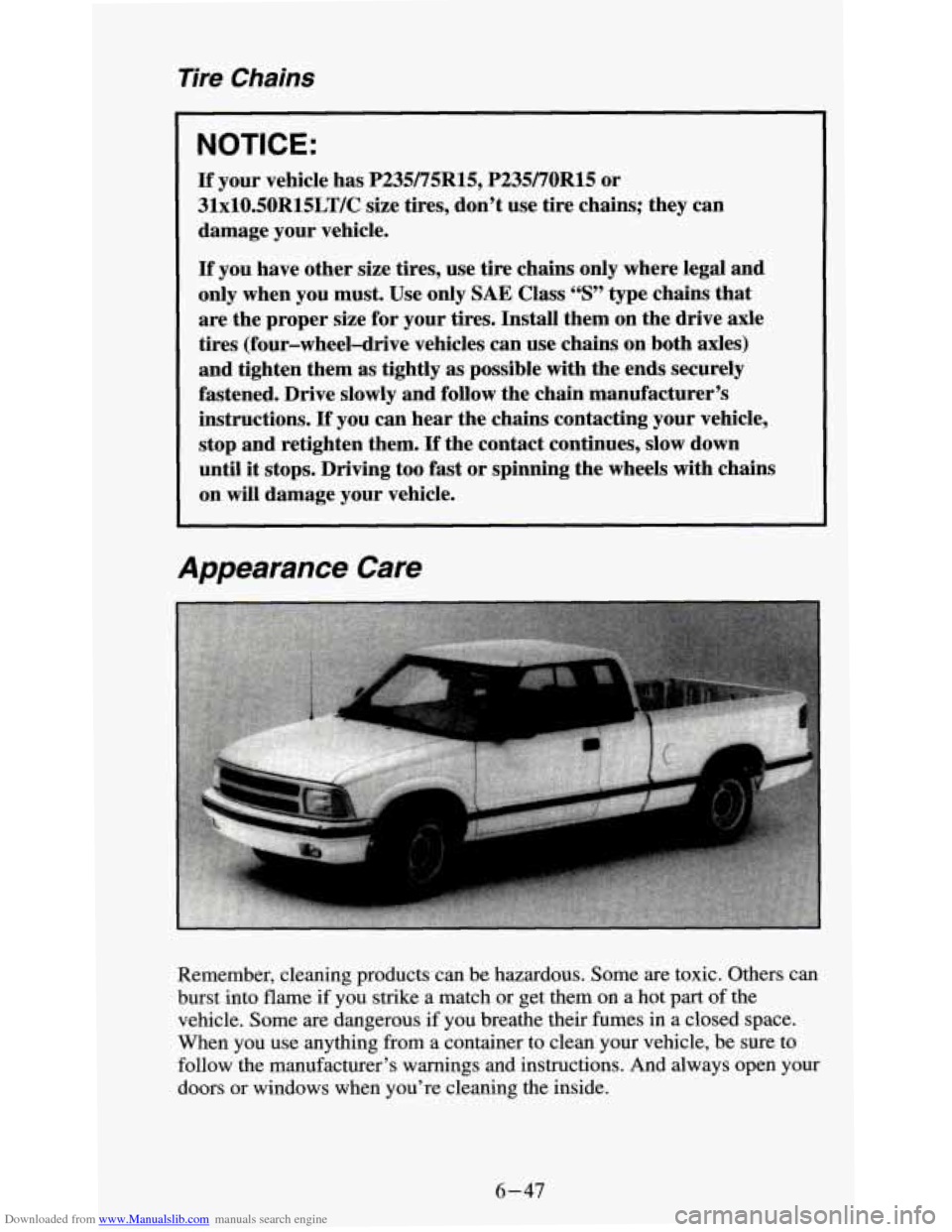
Appearance Care
Remember, cleaning products can be hazardous. Some are toxic. Others can
burst into flame if you strike
a match or get them on a hot part of the
vehicle. Some are dangerous if you breathe their fumes in a closed space.
When
you use anything from a container to clean your vehicle, be sure to
follow the manufacturer’s warnings and instructions. And always open your
doors
or windows when you’re cleaning the inside.
6-47
Page 281 of 354
Downloaded from www.Manualslib.com manuals search engine INSTRUMENT CLUSTER LAMPS
NOTE:
A PC part number indicates that the bulb and base are one
assembly and must be replaced as such.
LAMPS
Anti-lock Brake
Warning Indicator
Brake System Warning
Indicator
Check Gages Indicator
Daytime Running
Lamps Indicator
Charging System
Indicator
High Beam Indicator
Instrument Cluster Illumination
Malfunction Indicator
Lamp (Service Engine
Soon)
Seat Belt Indicator
Turn Signal Indicator
Upshift Indicator
AIR BAG Indicator
QUANTITY
1
1
1
1
6
1
TRADE NO.
PC74
PC74
PC74
PC74
PC74
PC74
PC168
PC74
PC194 PC74
PC74
See GM Dealer
6-64
Page 344 of 354
Downloaded from www.Manualslib.com manuals search engine Index
A
Air Bag (See “Supplemental Inflatable Restraint System (SIR)”)
Accessory Power Outlets
.......................................... 249
Adding Equipment to Your Air Bag-Equipped Vehicle (See “Supplemental
Inflatable Restraint System (SIR)”)
Air Cleaner (See “Engine-Air Cleaner”
Air Conditioning
(See “Heater/Air Conditioning Controls”)
Antennacare
................................................... 3-19
Anti-Lock Brakes (See “Brakes”)
Appearance Care
................................................ 6-47
Materials Chart
............................................... 6-56
Arbitration Program (See “Better Business Bureau Mediation”)
Audiosystems
................................................... 3-5
AM-FM Stereo Audio Compact Disc (CD) System
................... 3-13
AM-FM Stereo Audio System
.................................... 3-6
AM-FM Stereo Audio Cassette System
............................. 3-7
AM-FM Stereo Audio Cassette System
with Equalizer ................ 3-10
Care
of Your Cassette Player and Tape ............................. 3-18
Care of Compact Discs
......................................... 3-19
Delco LOC II@ Anti-Theft Feature
............................... 3-15
Understanding Radio Reception
.................................. 3-17
Readiness Light (See “Lights”)
Automatic Transmission
( See “Transmission”)
Axle Front
....................................................... 6-20
LockingRear
................................................. 2-22
Rear
........................................................ 6-19
B
Battery ........................................................ 6-29
Belts (See “Safety Belts”)
Better Business Bureau Mediation
.................................... 8-3
Blizzard (See “Driving-If You’re Caught in a Blizzard”)
Brakes
Adjustment
.................................................. 6-29
Anti-Lock
.................................................... 4-5
Anti-Lock Warning Light (See “Lights”)
To Check Brake Fluid .......................................... 6-27
Master Cylinder
.............................................. 6-26
Parking
..................................................... 2-22
PedalTravel
................................................. 6-29
Replacingparts
............................................... 6-29
System Warning Light (See “Lights”)
Trailer (See “Trailer Brakes”)
Wear
....................................................... 6-28
Braking
......................................................... 4-5
In Emergencies
................................................ 4-7
1