1995 CHEVROLET MONTE CARLO fuse
[x] Cancel search: fusePage 10 of 324
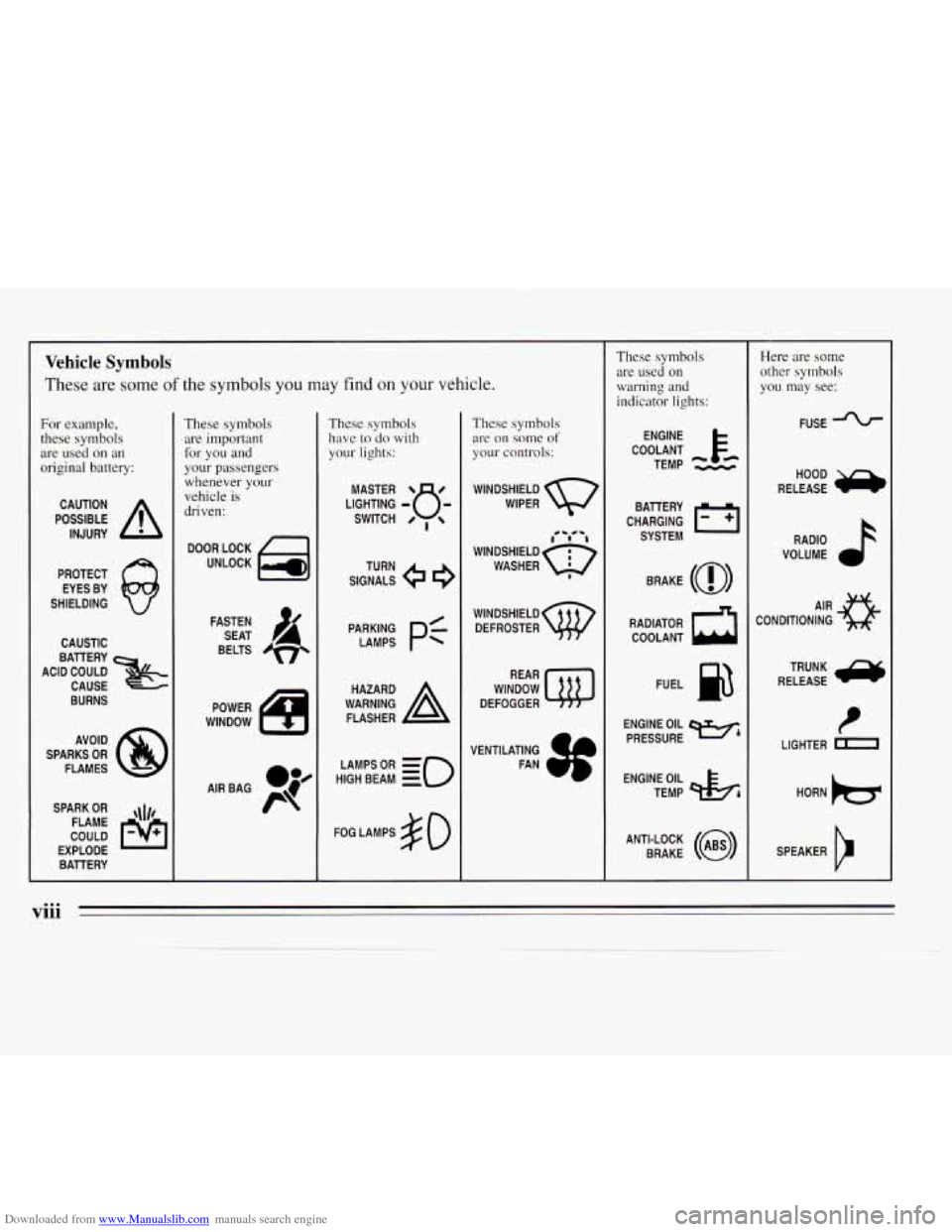
Downloaded from www.Manualslib.com manuals search engine Vehicle Symbols
These are some of the symbols you may find on your vehicle.
For example, these symbols
are used on an
original battery:
POSSIBLE A
CAUTION
INJURY
PROTECT EYES BY
SHIELDING
CAUSTIC
ACID COULD
x
BATTERY
CAUSE
BURNS
AVOID
SPARKS
OR
FLAMES
SPARK
OR ,\I/,
COULD FLAME
EXPLODE BAllERY
These symbols are important
for you and
your passengers whenever your
vehicle
is
driven:
DOOR LOCK
UNLOCK
FASTEN SEAT
4
BELTS
POWER
WINDOW
These symbols have
to do with
your lights:
SIGNALS e
TURN
HIGH
LAMPSoR BEAM = =o
FOG LAMPS $0
These symbols are
on solne of
your controls:
WIPER Q
f0 -** -1
WINDSHIELDQ
WASHER I
WINDSHIELD
DEFROSTER
WINDOW
DEFOGGER
VENTILATING FAN
These symbols are used
on
warning and
indicator lights:
COOLANT F-
TEMP --
ENGINE
CHARGING
I-1
BATTERY SYSTEM
BRAKE
(@)
RADIATOR COOLANT
a
FUEL e3
ENGINE OIL
PRESSURE
Wb
TEMP OIL 9b
ANTI-LOCK (@)
BRAKE
Here are some other symbols
you may see:
FUSE J
RADIO k
VOLUME a
CONDITIONING AIR a
t
LIGHTER m
viii
Page 65 of 324

Downloaded from www.Manualslib.com manuals search engine PASS-Key@II
Your vehicle is equipped with the PASS-Key@II
(Personalized Automotive Security System) theft
deterrent system. PASS-Key’II is a passive theft
deterrent system. This means you don’t have to do
anything different to arm or disarm the system. It works
when you insert or remove the key from the ignition.
PASS-Key@II uses a resistor pellet
in the ignition key
that matches a decoder in your vehicle.
When the PASS-Key@II system senses that someone
is
using the wrong key, it shuts down the vehicle’s starter
and fuel systems. For about three minutes, the starter
won’t work and fuel won’t go to the engine. If someone
tries to start your vehicle again or uses another key
during this time, the vehicle will not start. This
discourages someone from randomly trying different
keys with different resistor pellets in an attempt
to make
a match.
The ignition key must be clean and dry before it’s
inserted in the ignition or the engine may not start.
If the
engine does not start and the SECURITY light is on, the
key may be dirty or wet. Turn the ignition off.
Clean and dry the key. Wait about three minutes and try
again. The SECURITY light may remain on during this
time. If the starter still won’t work, and the key appears
to be clean and dry, wait about three minutes and try
another ignition key. At this time,
you may also want to
check the fuses (see “Fuses and Circuit Breakers” in
the
Index). If the starter won’t work with the other key, your
vehicle needs service. If your vehicle does start, the first
ignition key may be faulty. See your Chevrolet dealer or
a locksmith who can service the PASS-Key@II.
If you accidentally use a key that has a damaged or
missing resistor pellet, the starter won’t work, and the
SECURITY light will come on. But
you don’t have to
wait three minutes before trying another ignition key.
See your Chevrolet dealer or a locksmith who can
service the PASS-Key@II to have a new key made.
If you’re ever driving and the SECURITY light comes
on and stays on, you will be able to restart your engine if
you turn it off. Your PASS-Key@II system, however,
is
not working properly and must be serviced by your
Chevrolet dealer. Your vehicle
is not protected by the
PASS-Key@II system.
If you lose or damage a PASS-Key% ignition key,
see your Chevrolet dealer or a locksmith who can
service PASS-Key@II to have a new key made.
In an
emergency, call the Chevrolet Roadside Assistance
Program at
1 -800-CHEV USA (1 -800-243-8872).
2-9
Page 82 of 324
Downloaded from www.Manualslib.com manuals search engine As you signal a turn or a lane change, if the arrow
flashes faster than normal, a signal bulb may be burned
out and other drivers won’t
see your turn signal.
If a bulb is burned out, replace it to help avoid an
accident. If the green arrows don’t
go on at all when you
signal a turn, check the fuse (see “Fuses and Circuit
Breakers’’ in the Index) and for burned-out bulbs.
A chime will sound if you leave your turn signal on for
more than
1/2 mile (0.8 km).
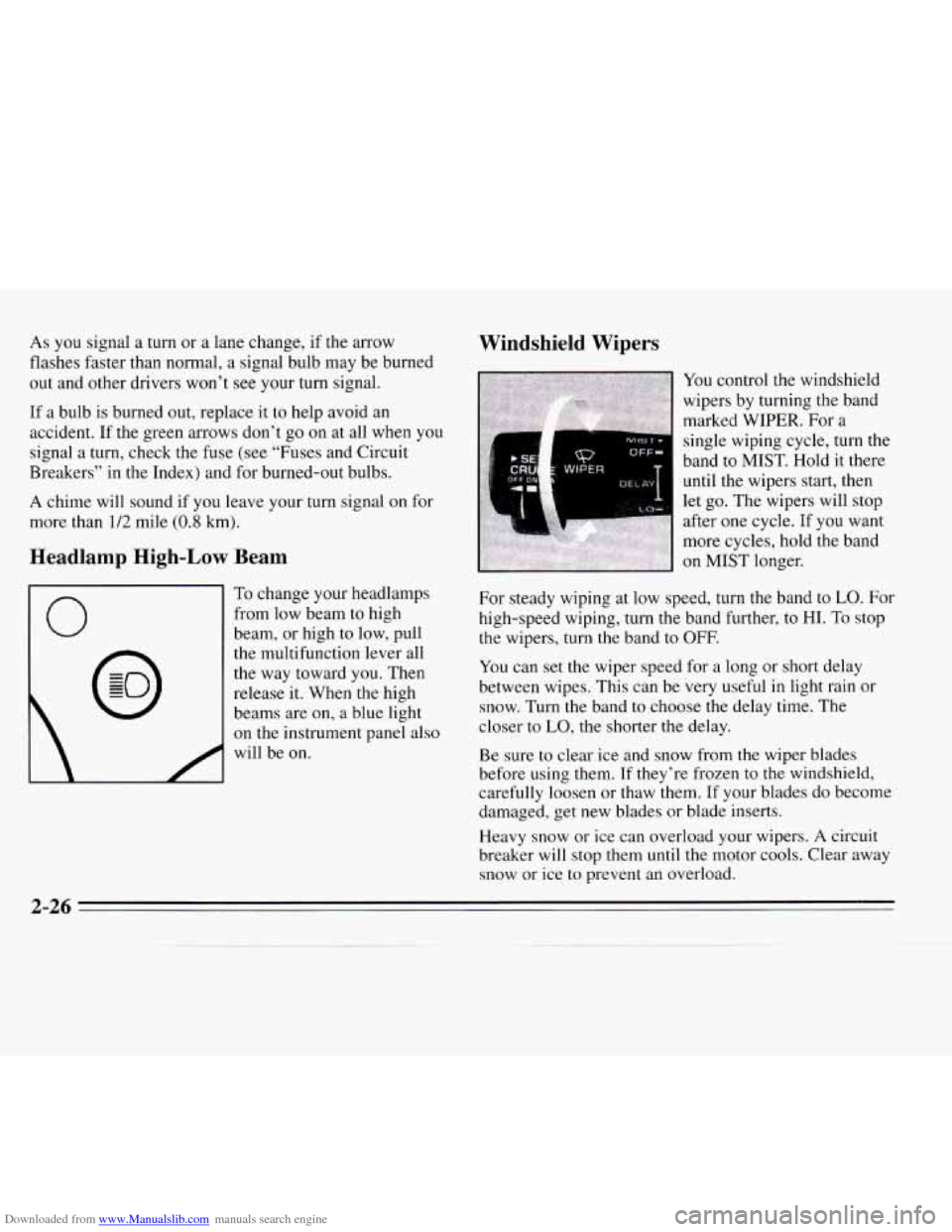
Headlamp High-Low Beam Windshield Wipers
You control the windshield
wipers by turning the band
marked WIPER. For a
6s WIPER
single wiping cycle, turn the
band to
MIST. Hold it there
until the wipers start, then
let
EO. The wipers will stop
0
To change your headlamps
from low beam
to high
beam, or high to low, pull
the multifunction lever all
the way toward you. Then
release it. When
the high
beams are on, a blue light
on the instrument panel also
will be on.
For steady wiping at low speed, turn the band to LO. For
high-speed wiping, turn the band further, to
HI. To stop
the wipers, turn the band
to OFF.
You can set the wiper speed for a long or short delay
between wipes. This can be very useful in light rain or
snow.
Turn the band to choose the delay time. The
closer to
LO, the shorter the delay.
Be sure to clear ice and
snow from the wiper blades
before using them.
If they’re frozen to the windshield,
carefully loosen or thaw them, If your blades
do become
damaged, get new blades or blade inserts.
Heavy snow or ice can overload your wipers.
A circuit
breaker will stop them until the motor cools. Clear away
snow or ice to prevent an overload.
2-26
Page 106 of 324
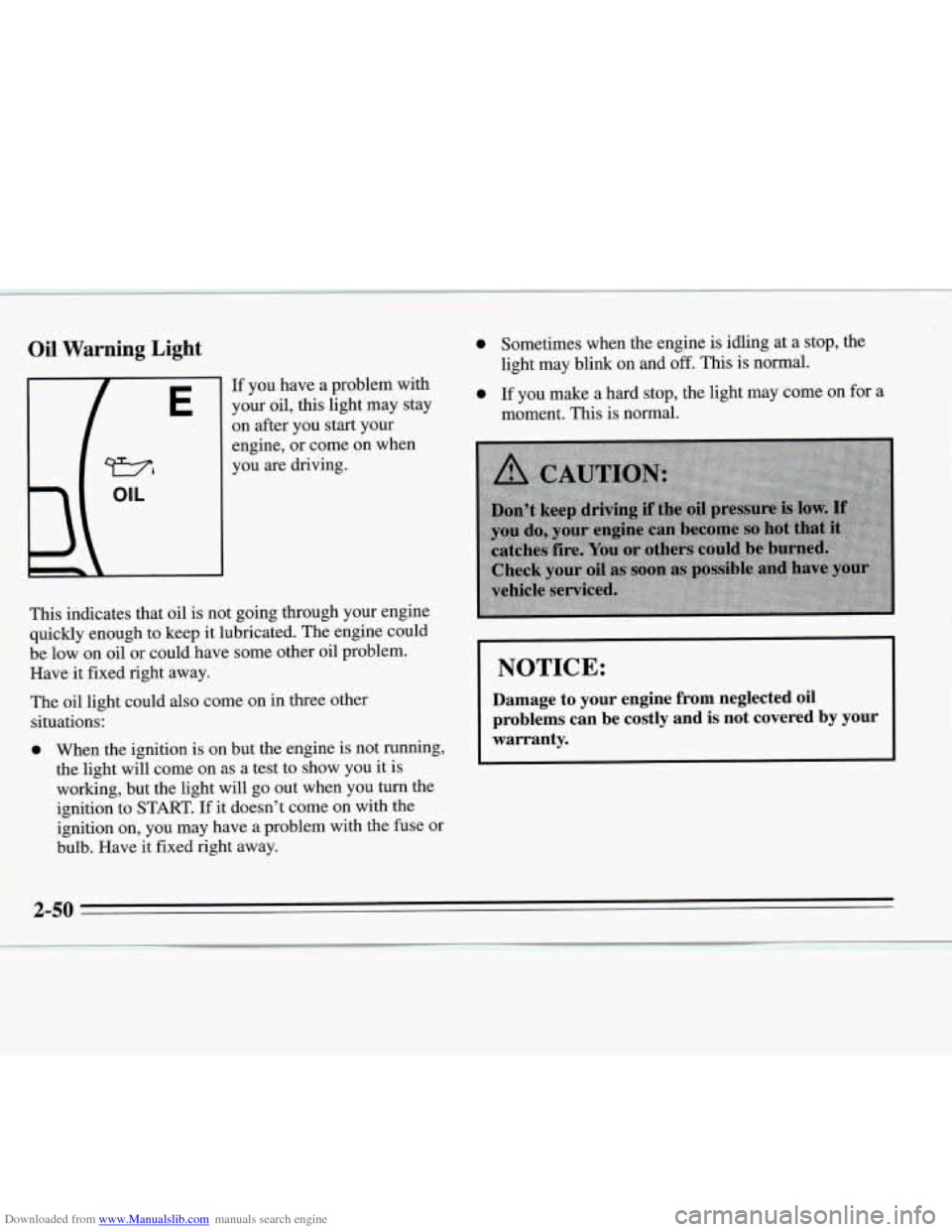
Downloaded from www.Manualslib.com manuals search engine Oil Warning Light
E
If you have a problem with
your oil,
this light may stay
on after you start your
engine, or come on when
you
are driving.
This indicates that oil is not going through your engine
quickly enough to keep
it lubricated. The engine could
be low on oil
or could have some other oil problem.
Have it fixed right away.
The oil light could also come on in three other
situations:
0 When the ignition is on but the engine is not running,
the light will come on as
a test to show you it is
working, but the light will go out when you
turn the
ignition to
START. If it doesn’t come on with the
ignition on, you may have a problem with the fuse or
bulb. Have it fixed right away.
0 Sometimes when the engine is idling at a stop, the
light may blink on and
off. This is normal.
0 If you make a hard stop, the light may come on for a
moment. This is normal.
I NOTICE:
Damage to your engine from neglected oil
problems can be costly and is not covered by your
warranty.
2-50
Page 248 of 324
Downloaded from www.Manualslib.com manuals search engine Fuses and Circuit Breakers
The wiring circuits in your vehicle are protected from
short circuits by a combination of fuses, circuit breakers,
and fusible thermal links
in the wiring itself. This
greatly reduces the chance of fires caused by electrical
problems.
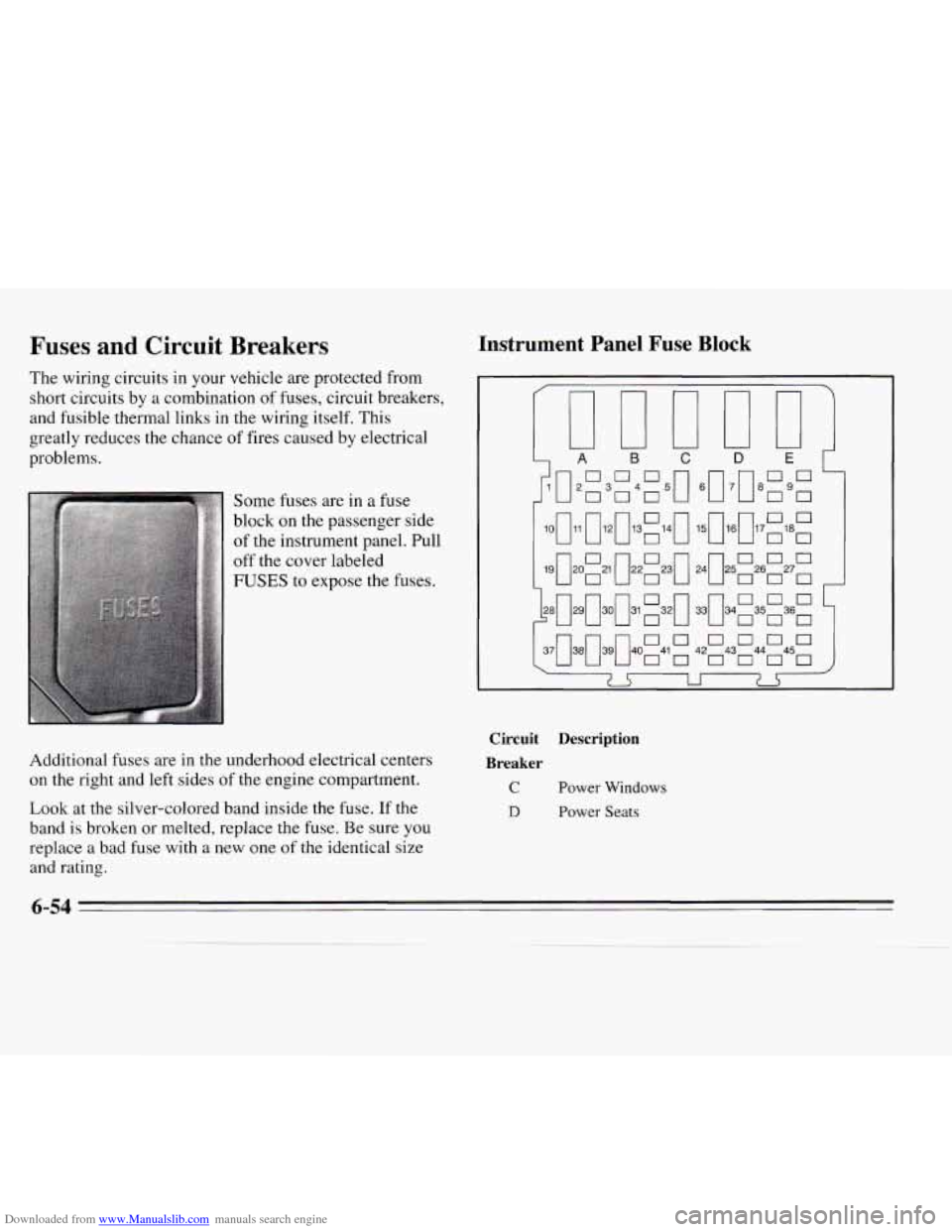
- Some fuses are in a fuse
block on the passenger side
of the instrument panel. Pull
I FUSES to expose the fuses.
Instrument Panel Fuse Block
B C D E
O320 33034 no0 35 36 0 no0
37~38~39~40 on 0000 43 44 45 0411[420 0 0 0
5
i
Additional fuses are in the underhood electrical centers
on the right and left sides of the engine compartment.
Look at the silver-colored band inside the fuse. If the
band
is broken or melted, replace the fuse. Be sure you
replace a bad fuse with a
new one of the identical size
and rating,
Circuit Description
Breaker
C
D
Power Windows
Power Seats
6-54
Page 249 of 324
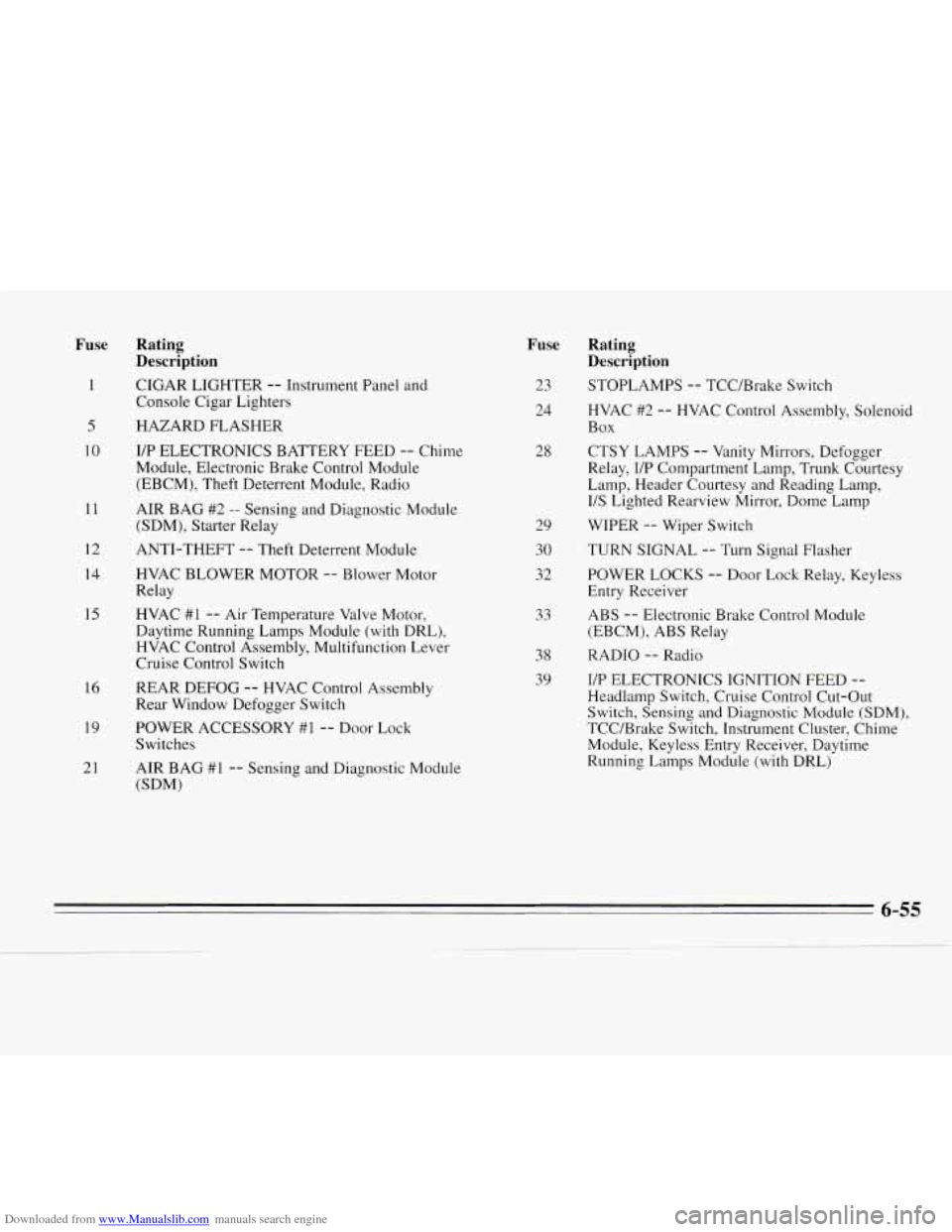
Downloaded from www.Manualslib.com manuals search engine Fuse
1
5
10
11
12
14
15
16
19
21
Rating
Description
CIGAR LIGHTER -- Instrument Panel and
Console Cigar Lighters
HAZARD FLASHER
I/P ELECTRONICS BATTERY FEED
-- Chime
Module, Electronic Brake Control Module
(EBCM), Theft Deterrent Module, Radio
AIR BAG #2
-- Sensing and Diagnostic Module
(SDM), Starter Relay
ANTI-THEFT
-- Theft Deterrent Module
HVAC BLOWER MOTOR
-- Blower Motor
Relay
HVAC
#1 -- Air Temperature Valve Motor,
Daytime Running Lamps Module (with DRL),
HVAC Control Assembly, Multifunction Lever
Cruise Control Switch
REAR DEFOG
-- WAC Control Assembly
Rear Window Defogger Switch
POWER ACCESSORY
#I -- Door Lock
Switches
AIR BAG
#1 -- Sensing and Diagnostic Module
(SDM)
Fuse Rating
Description
23
24
28
29
30
32
33
38
39 STOPLAMPS
-- TCC/Brake Switch
HVAC #2
-- HVAC Control Assembly, Solenoid
Box
CTSY LAMPS
-- Vanity Mirrors, Defogger
Relay,
UP Compartment Lamp, Trunk Courtesy
Lamp, Header Courtesy and Reading Lamp,
I/S Lighted Rearview Mirror, Dome Lamp
WIPER
-- Wiper Switch
TURN SIGNAL
-- Turn Signal Flasher
POWER LOCKS
-- Door Lock Relay, Keyless
Entry Receiver
ABS
-- Electronic Brake Control Module
(EBCM), ABS Relay
RADIO
-- Radio
I/€' ELECTRONICS IGNITION FEED
--
Headlamp Switch, Cruise Control Cut-Out
Switch, Sensing and Diagnostic Module
(SDM),
TCC/Brake Switch, Instrument Cluster, Chime
Module, Keyless Entry Receiver, Daytime
Running Lamps Module (with DRL)
6-55
Page 250 of 324

Downloaded from www.Manualslib.com manuals search engine Underhood Electrical Center -- Passenger
Side
I, I 1
on0
000
R/CMPT REL ECM BAT
TCC ENG EMIS CRUISE
on0 F/INJN ECM IGN ELEK IGN
TCC
ENG EMIS
CRUISE
F/INJN
Fuse Description
WCMPT REL Remote Trunk Release
ECM BAT Powertrain Control Module
(PCM), Fuel Pump/Oil Pressure
Switch, Fuel Pump Relay, Fan
Cont
#1 Relay
Automatic Transaxle, Transaxle
Range Switch (VIN
M only)
Generator, Digital Exhaust
Recirculation (DEGR) Valve,
Evaporative Emissions (EVAP)
Canister Purge Valve Solenoid,
Heated Oxygen Sensor,
Fan Cont
#2 Relay, A/C CMPR Relay
(VIN
M only)
Cruise Control Module, A/C
CMPR Relay (VIN
X only)
Fuel Injectors, High Resolution
24X Crankshaft Position Sensor,
Camshaft Position Sensor
6-56
Page 251 of 324

Downloaded from www.Manualslib.com manuals search engine Fuse
ECM IGN
ELEK IGN
10
11
12
13
Description
Powertrain Control Module
(PCM), Mass Air Flow (MAF) Sensor (VIN
X only)
Electronic Ignition (EI) Control
Module
UP Fuse Block
FAN CONT #1 Relay
Passenger Side Underhood
Electrical Center and I/P Fuse
Blocks: Fuses
5, 14,23 and 32
FAN CONT #2 Relay and
I/P Fuse
Block: Fuse 16, Power Seat
Circuit Breaker
“D”
Relay
14
15
16
17
18
Description
FUEL PUMP
A/C CMPR
FAN CONT #2
-- Secondary
Cooling Fan (Passenger Side)
FAN CONT
# 1 -- Primary
Cooling Fan (Driver Side)
Not Used
6-57