Page 202 of 324
Downloaded from www.Manualslib.com manuals search engine 1 LA
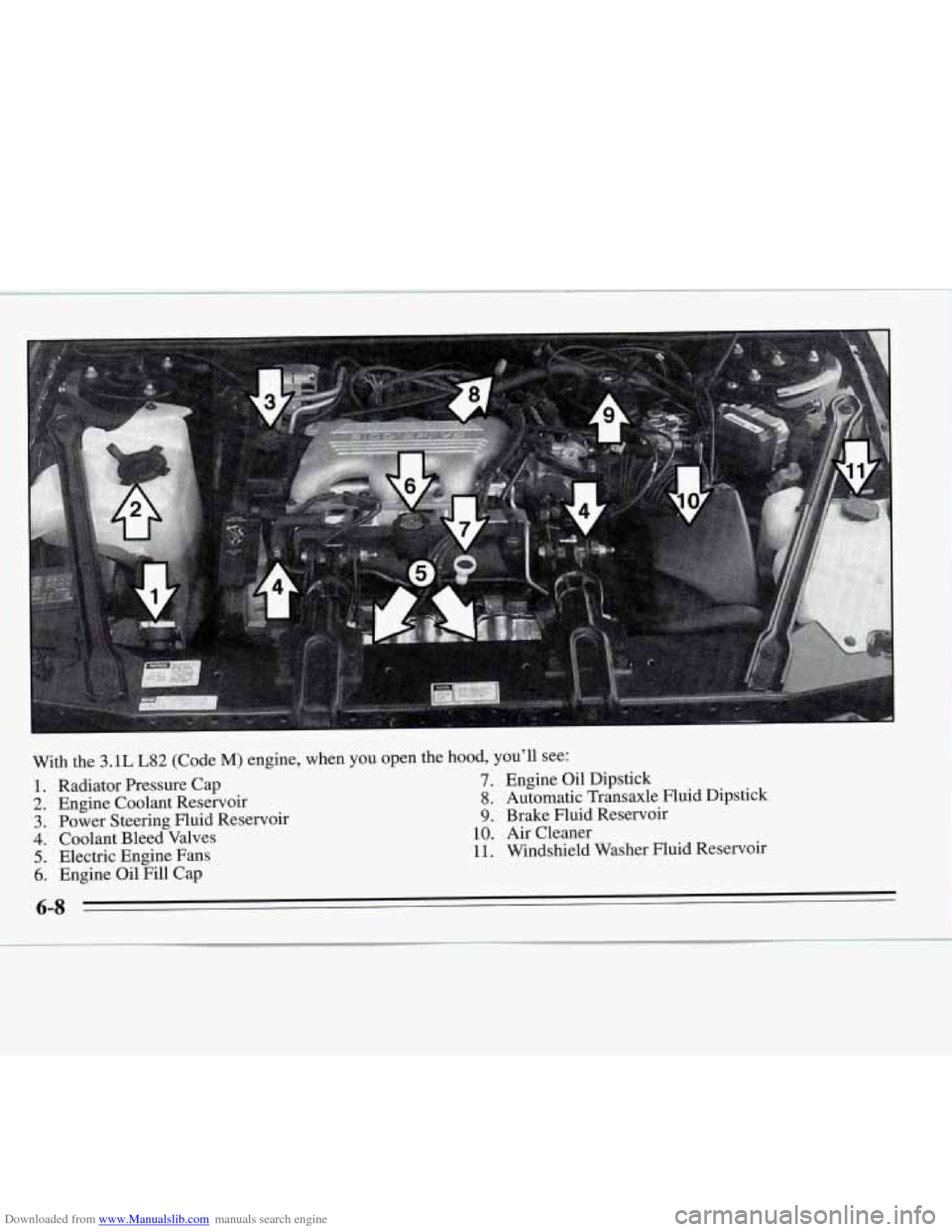
1. Radiator Pressure Cap
2. Engine Coolant Reservoir
3. Power Steering Fluid Reservoir
4. Coolant Bleed Valves
5. Electric Engine Fans
7. Engine Oil Dipstick
8. Automatic Transaxle Fluid Dipstick
9. Brake Fluid Reservoir
10. Air Cleaner
11. Windshield Washer Fluid Reservoir
6. Engine OilFill Cap
6-8
Page 203 of 324
Downloaded from www.Manualslib.com manuals search engine 1.
2.
3.
4.
5.
6.
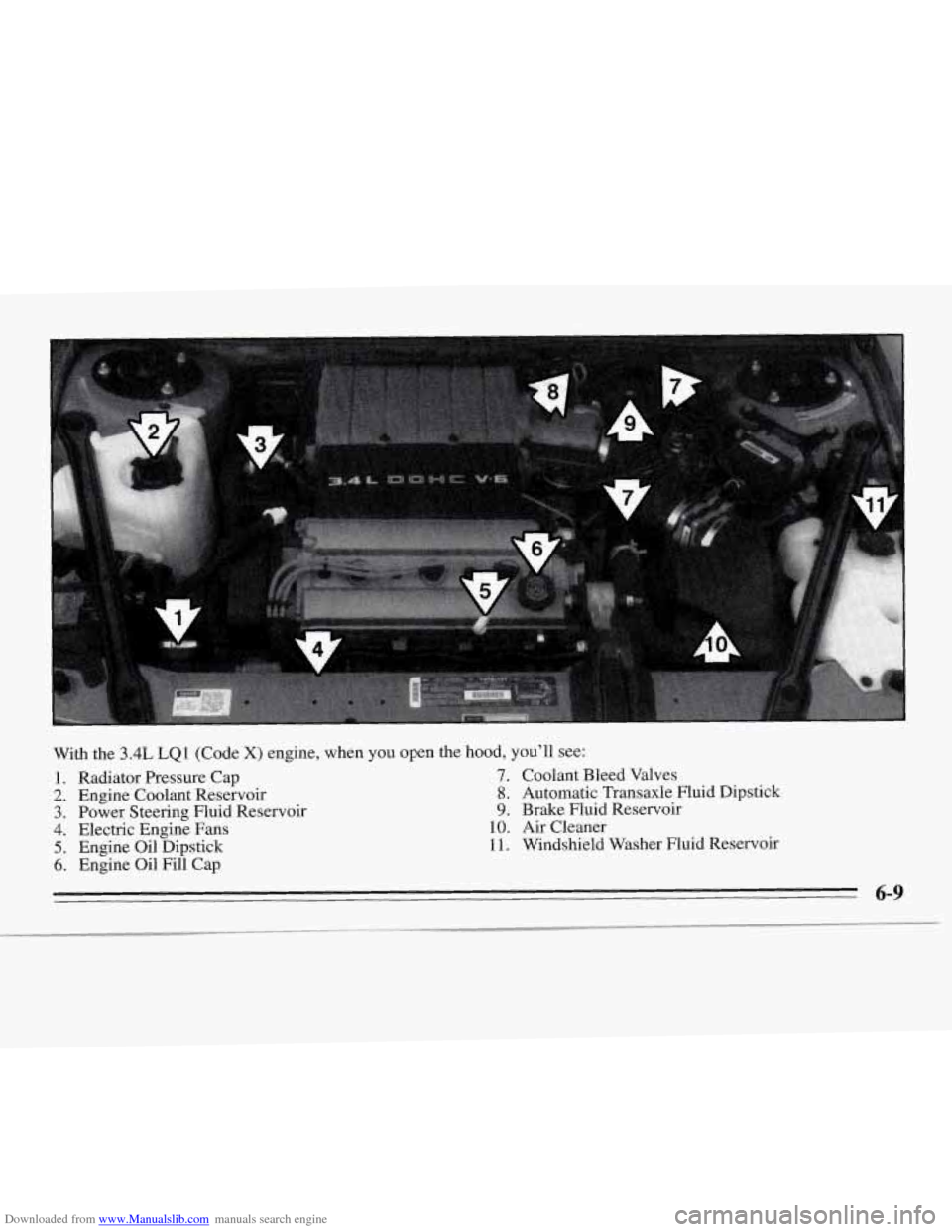
With the 3.4L LQ1 (Code X) engine, when you open the hood, you’ll see:
Radiator Pressure Cap Engine Coolant Reservoir
Power Steering Fluid Reservoir
Electric Engine Fans
Engine Oil Dipstick
Engine Oil
Fill Cap
7. Coolant Bleed Valves
8. Automatic Transaxle Fluid Dipstick
9. Brake Fluid Reservoir
10. Air Cleaner
11. Windshield Washer Fluid Reservoir
6-9
Page 208 of 324
Downloaded from www.Manualslib.com manuals search engine When to Change Engine Oil
See if any one of these is true for you:
0
0
0
0
Most trips are less than 5 to 10 miles (8 to 16 km).
This is particularly important when outside
temperatures are below freezing.
Most trips include extensive idling (such as frequent
driving in stop-and-go traffic).
Most trips are through dusty areas.
You frequently tow a trailer or use
a carrier on top of
your vehicle.
If any one of these is true for your vehicle, then you
need
to change your oil and filter every 3,000 miles
(5 000 km) or 3 months -- whichever comes first.
If none of them
is true, change the oil and filter every
7,500 miles (1 2 500 km) or 12 months -- whichever
comes first.
Engine Coolant Heater
An engine coolant heater can be a big help if you have
to park outside in very cold weather,
0°F (- 18OC) or
colder. If your vehicle has this option, see “Engine
Coolant Heater”
in the Index.
What to Do with Used Oil
Did you know that used engine oil contains certain
elements that may be unhealthy for your skin and could
even cause cancer? Don’t let used oil stay on your skin
for very long. Clean your skin and nails with soap and
water, or a good hand cleaner. Wash or properly throw
away clothing or rags containing used engine oil. (See
the manufacturer’s warnings about the use and disposal
of oil products.)
Used oil can be a real threat to the environment. If you
change your own oil, be sure to drain all free-flowing oil
from the filter before disposal. Don’t ever dispose
of oil
by putting it
in the trash, pouring it on the ground, into
sewers, or into streams or bodies
of water. Instead,
recycle
it by taking it to a place that collects used oil. If
you have a problem properly disposing of your used oil,
ask your dealer, a service station or a local recycling
center for help.
Page 213 of 324
Downloaded from www.Manualslib.com manuals search engine How to Add Fluid
Refer to the Maintenance Schedule to determine what
kind of transaxle fluid to use. See “Recommended
Fluids and Lubricants” in the Index.
If the fluid level is low, add only enough of the proper
fluid
to bring the level into the cross-hatched area on the
dipstick.
1. Pull out the dipstick.
2. Using a long-neck funnel, add enough fluid at the
dipstick hole to bring it
to the proper level.
It doesn’t take much fluid, generally less than a pint
(OSL). Don’t overfill. We recommend you use only fluid
labeled DEXRON@-111, because fluid with that label is
made especially for your automatic transaxle. Damage
caused by fluid other than DEXRON@-III
is not covered
by your new vehicle warranty.
After adding fluid, recheck the fluid level as
described under “How
to Check.”
When the correct fluid level is obtained, push the
dipstick back in all the way.
Engine Coolant
The following explains your cooling system and how to
add coolant when
it is low. If you have a problem with
engine overheating or if you need to add coolant to your
radiator, see “Engine Overheating” in the Index.
The proper coolant for your Chevrolet will:
0 Give freezing protection down to -34°F (-37°C).
Give boiling protection up to 262 OF ( 128 O C).
Protect against rust and corrosion.
Help keep the proper engine temperature.
Let the warning lights work as they should.
What to Use
Use a mixture of one-half clean water (preferably
distilled) and one-half antifreeze that meets
“GM
Specification 1825-M,” which won’t damage aluminum
parts. You can also use
a recycled coolant conforming to
GM Specification 1825-M with a complete coolant flush
and refill. Use GM Engine Coolant Supplement (sealer)
with any complete coolant flush and refill. If you use
this mixture, you don’t need to add anything else.
6-19
Page 214 of 324
Downloaded from www.Manualslib.com manuals search engine Adding Coolant
I NOTICE:
If you use an improper coolant mix, your engine
could overheat and be badly damaged. The
repair cost wouldn’t be covered by your
warranty.
Too much water in the mix can fie&
and crack the engine, radiator, heater core and
other parts.
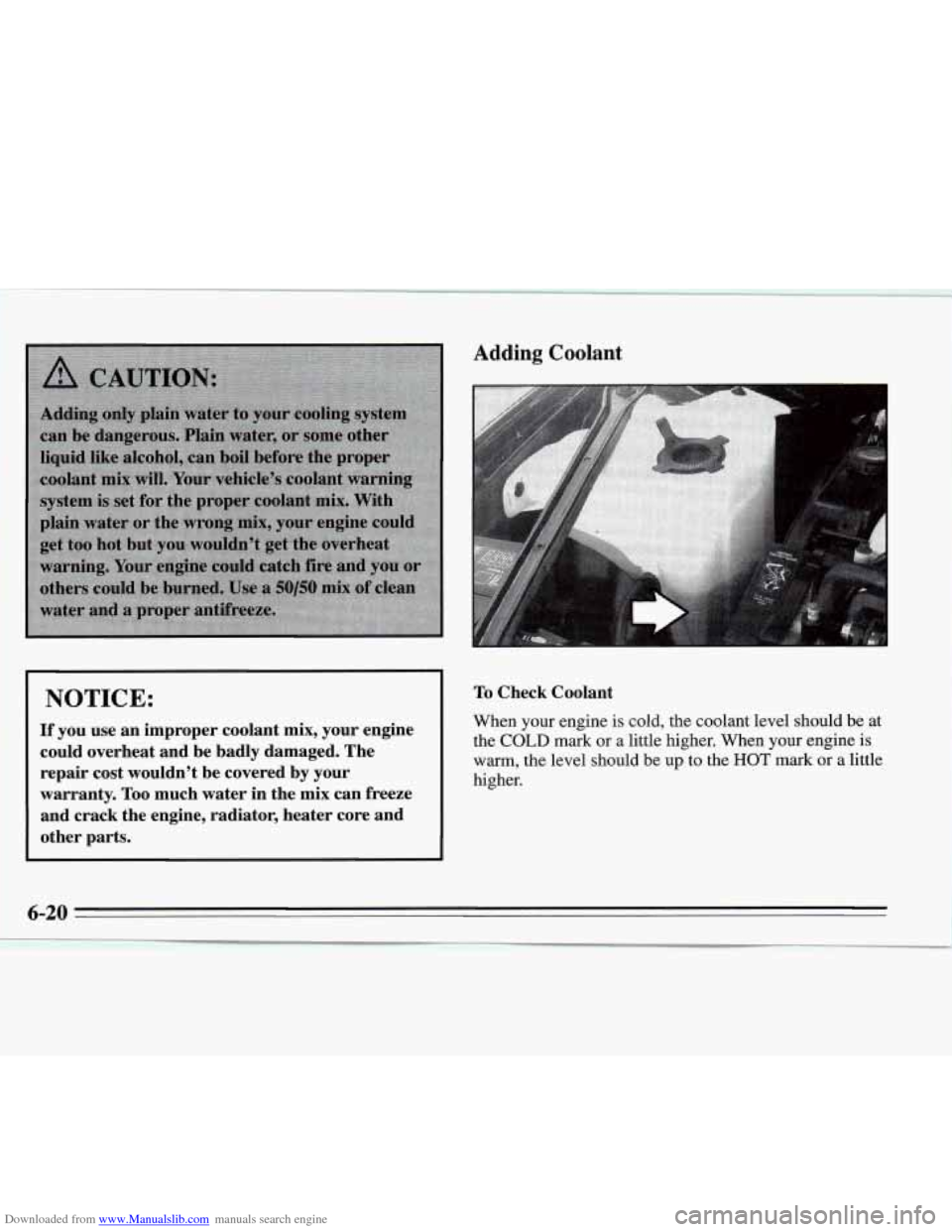
To Check Coolant
When your engine is cold, the coolant level should be at
the
COLD mark or a little higher. When your engine is
warm, the level should be up to the HOT mark or a little
higher.
6-20 I
Page 215 of 324
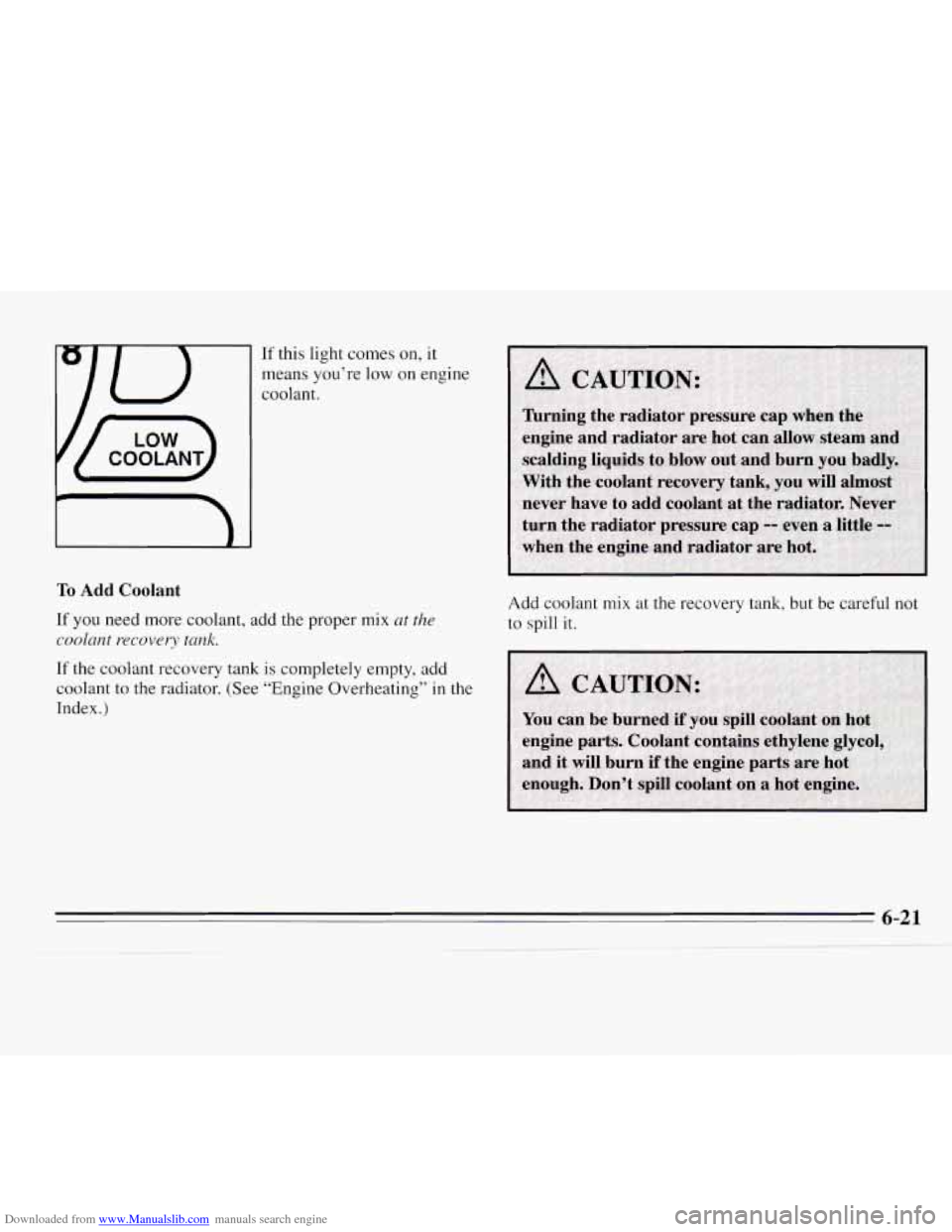
Downloaded from www.Manualslib.com manuals search engine If this light comes on, it
means you’re low on engine
coolant.
To Add Coolant
If you need more coolant, add the proper mix at the
coolant recovery tank.
If the coolant recovery tank is completely empty, add
coolant
to the radiator. (See “Engine Overheating” in the
Index.) Add
coolant mix at the recovery tank, but be careful not
to spill it.
6-21
Page 216 of 324
Downloaded from www.Manualslib.com manuals search engine Radiator Pressure Cap
NOTICE:
Your radiator cap is a 15 psi (105 kPa)
pressure-type cap and must be tightly installed
to prevent coolant loss and possible engine
damage from overheating. Be sure the arrows on
the cap line up with the overflow tube on the
radiator filler neck.
When you replace your radiator pressure cap, an AC@
cap is recommended.
Thermostat
Engine coolant temperature is controlled by a thermostat
in the engine coolant system.
The thermostat stops the
flow of coolant through the radiator until the coolant
reaches a preset temperature.
When you replace your thermostat, an
AC@ thermostat
is recommended.
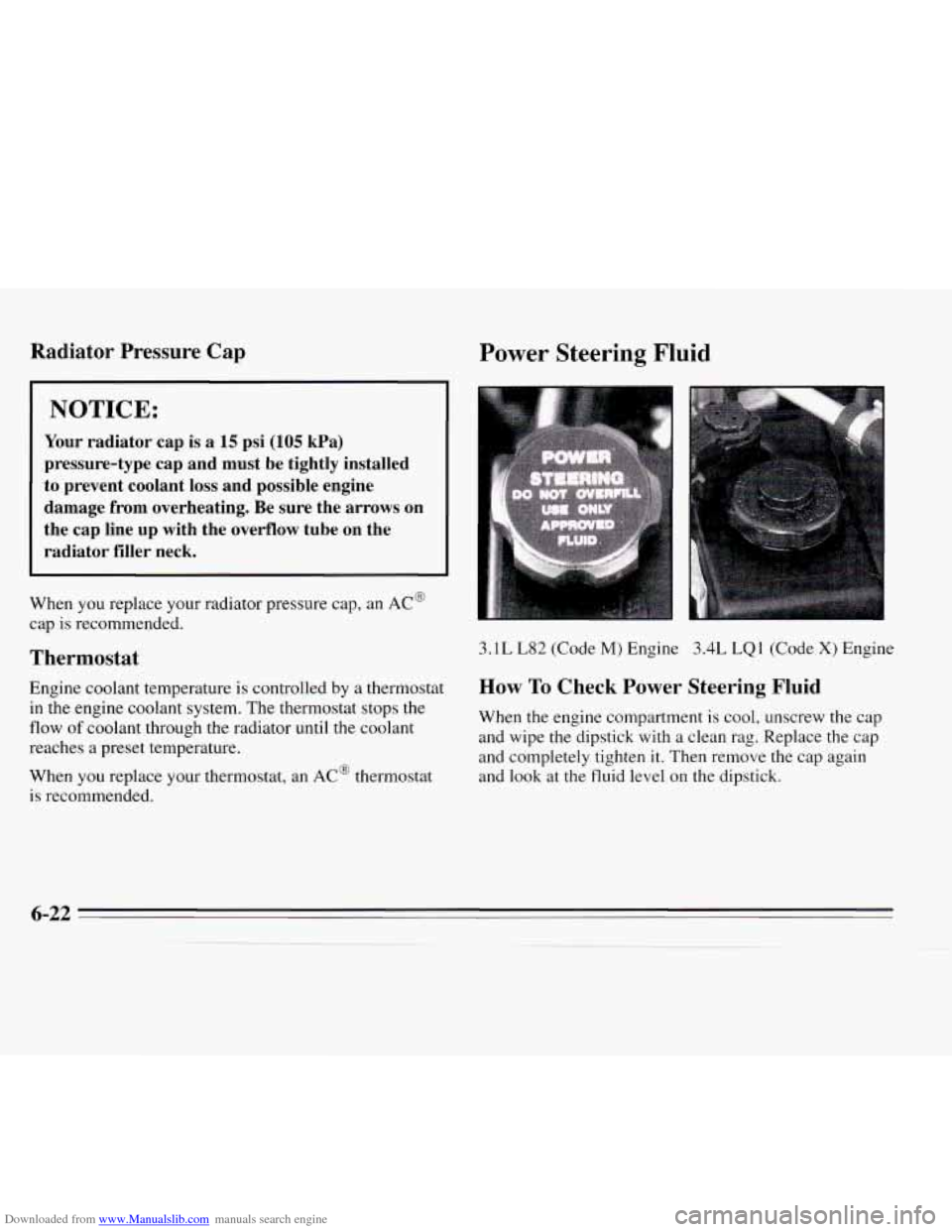
Power Steering Fluid
3.1 L L82 (Code M) Engine 3.4L LQ 1 (Code X) Engine
How To Check Power Steering Fluid
When the engine compartment is cool, unscrew the cap
and wipe the dipstick with a clean rag. Replace the cap
and completely tighten
it. Then remove the cap again
and look at the fluid level on the dipstick.
6-22
Page 269 of 324

Downloaded from www.Manualslib.com manuals search engine Maintenance Schedule I
30,000 Miles (50 000 km)
0 Change engine oil and filter (or every
3 months, whichever occurs first).
An Emission Control Service.
0 Lubricate the shift linkage, parking brake cable
guides, underbody contact
points and linkage
(or every
6 months, whichever occurs first).
every 24 months, whichever occurs first).
0 Drain, flush and refill cooling system (or
every 24 months, whichever occurs first).
See “Engine Coolant’’ in the Index for what
to use. Inspect hoses. Clean radiator,
condenser, pressure cap and neck. Pressure
test the cooling system and pressure cap.
0 Inspect engine accessory drive belt (or
An Emission Control Service.
An Emission Control Service.
0 Replace spark plugs. An Emission Control
Service.
17 Replace air cleaner filter. Replace filter
more often under dusty conditions.
An Emission Control Service.
0 Inspect fuel tank, cap and lines for damage
or leaks. Inspect fuel cap gasket for any
damage. Replace parts as needed.
An Emission Control Service. i-
0 Rotate tires. See “Tire Inspection and
Rotation’’ in the Index for proper rotation
pattern and additional information.
7-11