1995 CHEVROLET MONTE CARLO stop start
[x] Cancel search: stop startPage 103 of 324
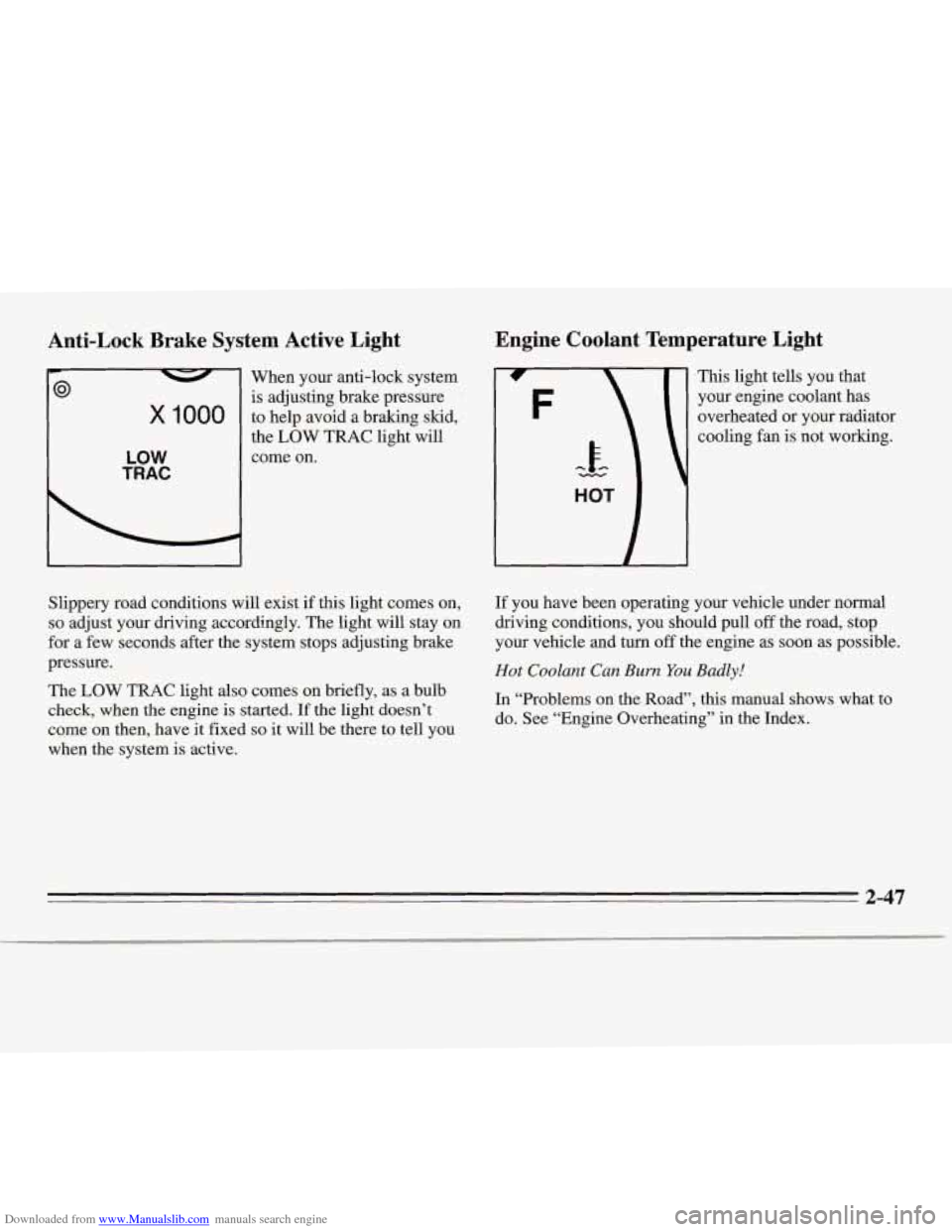
Downloaded from www.Manualslib.com manuals search engine Anti-Lock Brake System Active Light
x 1000
LOW
TRAC
When your anti-lock system
is adjusting brake pressure
to help avoid a braking skid,
the
LOW TRAC light will
come on.
Engine Coolant Temperature Light
This light tells you that
your engine coolant has
overheated
or your radiator
cooling
fan is not working.
Slippery road conditions will exist if this light comes on,
so adjust your driving accordingly. The light will stay on
for a few seconds after the system stops adjusting brake
pressure.
The
LOW TRAC light also comes on briefly, as a bulb
check, when the engine is started.
If the light doesn’t
come on then, have
it fixed so it will be there to tell you
when the system is active. If you
have been operating your vehicle under normal
driving conditions, you should pull
off the road, stop
your vehicle and
turn off the engine as soon as possible.
Hot Coolant Can Burn You Badly!
In “Problems on the Road”, this manual shows what to
do. See “Engine Overheating” in the Index.
2-47
Page 106 of 324
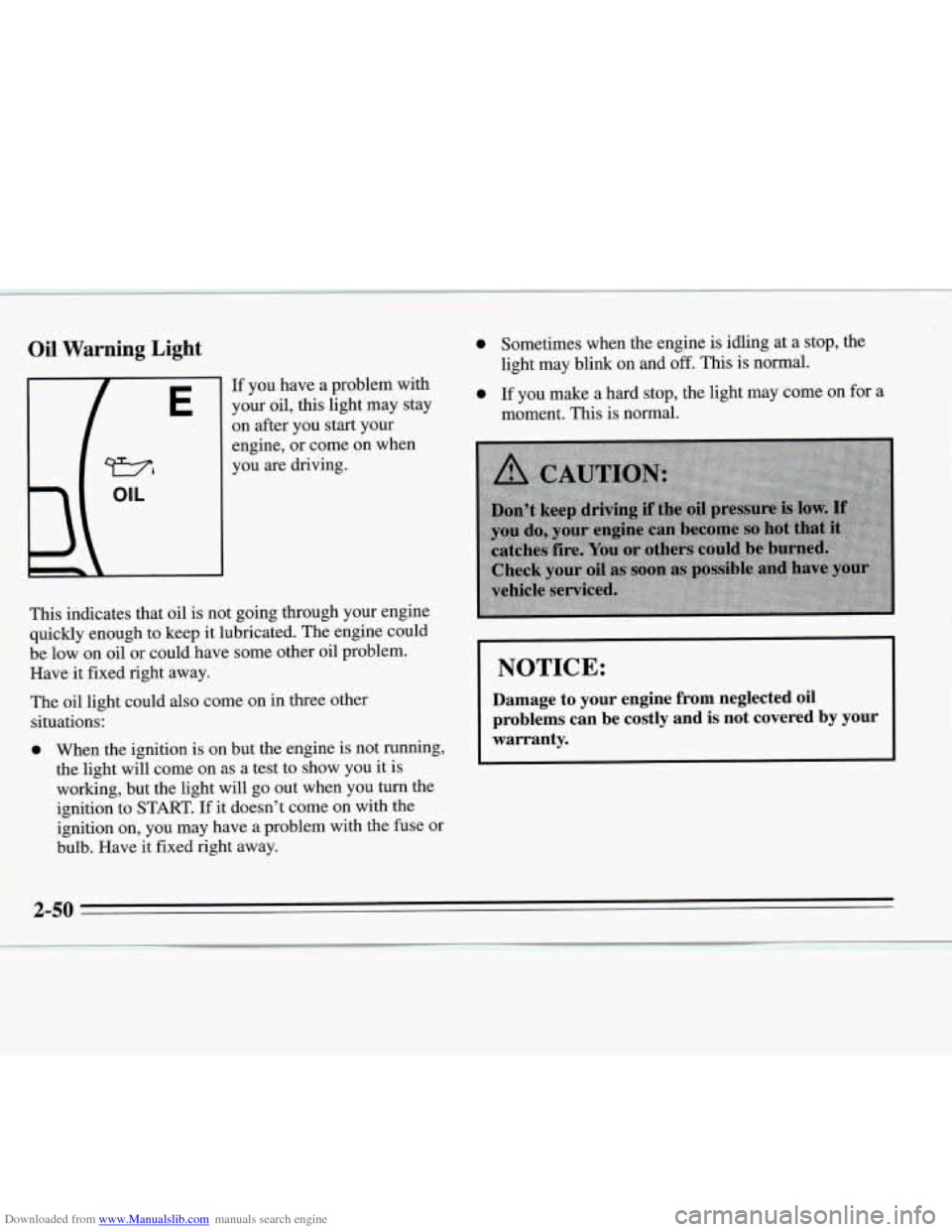
Downloaded from www.Manualslib.com manuals search engine Oil Warning Light
E
If you have a problem with
your oil,
this light may stay
on after you start your
engine, or come on when
you
are driving.
This indicates that oil is not going through your engine
quickly enough to keep
it lubricated. The engine could
be low on oil
or could have some other oil problem.
Have it fixed right away.
The oil light could also come on in three other
situations:
0 When the ignition is on but the engine is not running,
the light will come on as
a test to show you it is
working, but the light will go out when you
turn the
ignition to
START. If it doesn’t come on with the
ignition on, you may have a problem with the fuse or
bulb. Have it fixed right away.
0 Sometimes when the engine is idling at a stop, the
light may blink on and
off. This is normal.
0 If you make a hard stop, the light may come on for a
moment. This is normal.
I NOTICE:
Damage to your engine from neglected oil
problems can be costly and is not covered by your
warranty.
2-50
Page 107 of 324

Downloaded from www.Manualslib.com manuals search engine Security Light
Low Oil Level Light
Your engine is equipped
with an oil level monitoring
system. When the ignition
key is turned on, the LOW
OIL light will briefly flash.
If the light does not flash,
have
it fixed so it will be
ready to warn you if there’s
a problem.
If the light stays on, stop the vehicle on a level surface and
turm the engine off. Check the oil level using the engine oil
dipstick. (See “Engine Oil” in the Index.) If the light does
not flash, have the low oil level sensor system repaired
so
it will be ready to warn you if there’s a problem.
The oil level monitoring system only checks oil
level
during the brief period between key on and engine
crank. It does not monitor engine oil level when the
engine is running. Additionally, an oil level check is
only performed if the engine has been turned off for a
considerable period of time, allowing the oil normally
in
circulation to drain back into the oil pan. This light
will come on
when you turn the key to
START and stay on until the
vehicle starts. It will also
come on and stay on if your
key is too dirty or wet for
the PASS-Key@II system to
read the resistor pellet.
If the resistor pellet is damaged or missing, the light will
flash.
If you’re driving and the light comes on and remains on,
your PASS-Key% system is
not working properly.
Your vehicle is not protected by PASS-Key@II, and you
should see your dealer.
2-51
Page 117 of 324
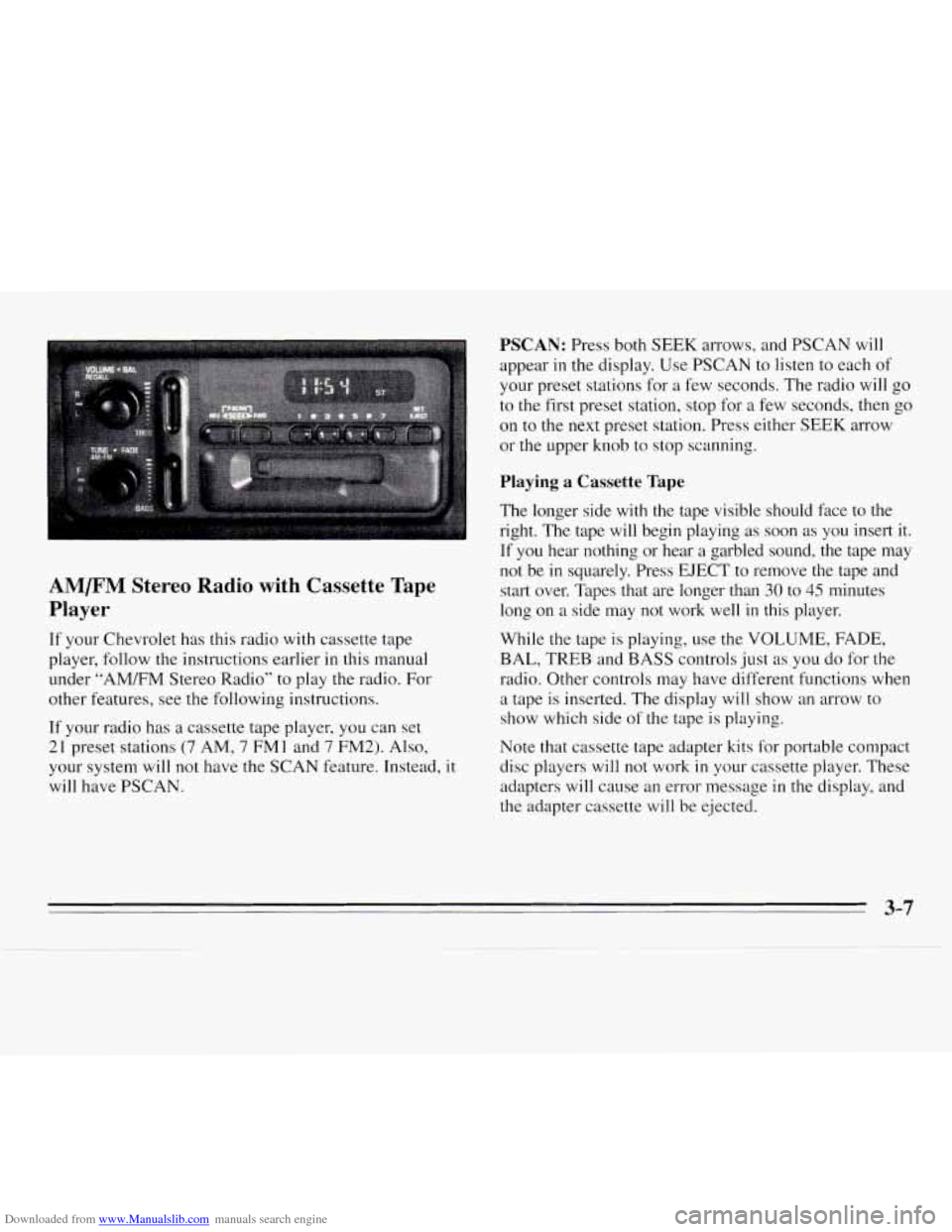
Downloaded from www.Manualslib.com manuals search engine AM/FM Stereo Radio with Cassette Tape
Player
If your Chevrolet has this radio with cassette tape
player, follow the instructions earlier
in this manual
under “AMEM Stereo Radio’’
to play the radio. For
other features, see the following instructions.
If your radio has
a cassette tape player, you can set
21 preset stations (7 AM, 7 FMl and 7 FM2). Also,
your system will not have the SCAN feature. Instead, it
will have PSCAN.
PSCAN: Press both SEEK arrows, and PSCAN will
appear
in the display. Use PSCAN to listen to each of
your preset stations for
a few seconds. The radio will go
to
the first preset station, stop for a few seconds, then go
on to the next preset station. Press either SEEK arrow
or the upper knob to stop scanning.
Playing a Cassette Tape
The longer side with the tape visible should face to the
right.
The tape will begin playing as soon as you insert it.
If you hear nothing or hear
a garbled sound, the tape may
not be
in squarely. Press EJECT to remove the tape and
start over. Tapes that are longer than
30 to 45 minutes
long on a side may not work well in this player.
While the tape is playing, use the VOLUME, FADE,
BAL, TREB and BASS controls just
as you do for the
radio. Other controls may have different functions when
a tape is inserted. The display will show an arrow to
show which side
of the tape is playing.
Note that cassette tape adapter kits
for portable compact
disc players will not work
in your cassette player. These
adapters
will cause an error message in the display, and
the adapter cassette will be ejected.
3-7
Page 123 of 324
Downloaded from www.Manualslib.com manuals search engine AM FM: Press this button to play the radio when a disc
is in the player. The letters
CD will go off the display.
CD AUX: Press this button to change to the disc
function when the radio is on.
CD will appear on the
display when the disc is active.
EJECT Press this button to remove the disc. The radio
will play.
If you turn off the ignition or radio with
a disc in the
player,
it will stay in the player. When you turn on the
ignition or system, the disc will start playing where
it
was stopped. If you press EJECT but don’t remove the
disc within
25 seconds, the player will pull the disc back
in
to protect it.
THEFTLOCK TM
Your system has this feature if it shows THEFTLOCK
on its face. THEFTLOCK is a theft-deterrent feature
that can
be used or ignored. If you ignore it, your system
will play normally. If you use it, your system can’t be
turned on if it is stolen because
it locks anytime battery
power is removed. To unlock it,
a code must be entered.
These instructions
will tell you how to enter a code into
your system. They
also tell you how to unlock the
system with your code and how to shut off the
THEFTLOCK system.
Entering a Code
1. Write down any number from 000 to 1999. This is
your code.
2. Turn the ignition to ACC or RUN.
3. Turn the radio off.
4. Press the 1 and 4 preset buttons at the same time and
hold until
“- - -7’ shows on the display.
You now have only 15 seconds between each of the
following steps.
5. Press MN and “OOO” will appear on the display.
6. Press MN again and hold until the last two digits of
your code appear.
7. Press and hold HR until the first digit or digits of
your code appear.
8. Press AM FM after you make sure the code matches
the one you wrote down. “rEP” will appear on the
display, meaning you should repeat Steps
5 through 7.
should appear on the display, meaning your system is
secured. If your ignition is off, THEFTLOCK will
flash in the display.
Store the paper with your code written on it
in a safe
place (not
in your vehicle).
9. After you repeat the steps, press AM FM. SEC
3-13
Page 134 of 324
Downloaded from www.Manualslib.com manuals search engine Avoid needless heavy braking. Some people drive
in spurts
-- heavy acceleration followed by heavy
braking
-- rather than keeping pace with traffic. This
is a mistake. Your brakes may
not have time to cool
between hard stops. Your brakes will wear out much
faster if you do a
lot of heavy braking. If you keep pace
with
the traffic and allow realistic following distances,
you will eliminate a lot of unnecessary braking. That
means better braking and longer brake life.
If your engine ever stops while you’re driving, brake
normally but don’t pump your brakes. If you do, the
pedal may get harder to push down. If your engine
stops, you will still have some power brake assist. But
you will use it when you brake. Once the power assist is
used up,
it may take longer to stop and the brake pedal
will be harder to push.
Anti-Lock Brakes (ABS)
Your Chevrolet has an advanced electronic braking
system that will help prevent a braking skid.
ANTI -
LOCI
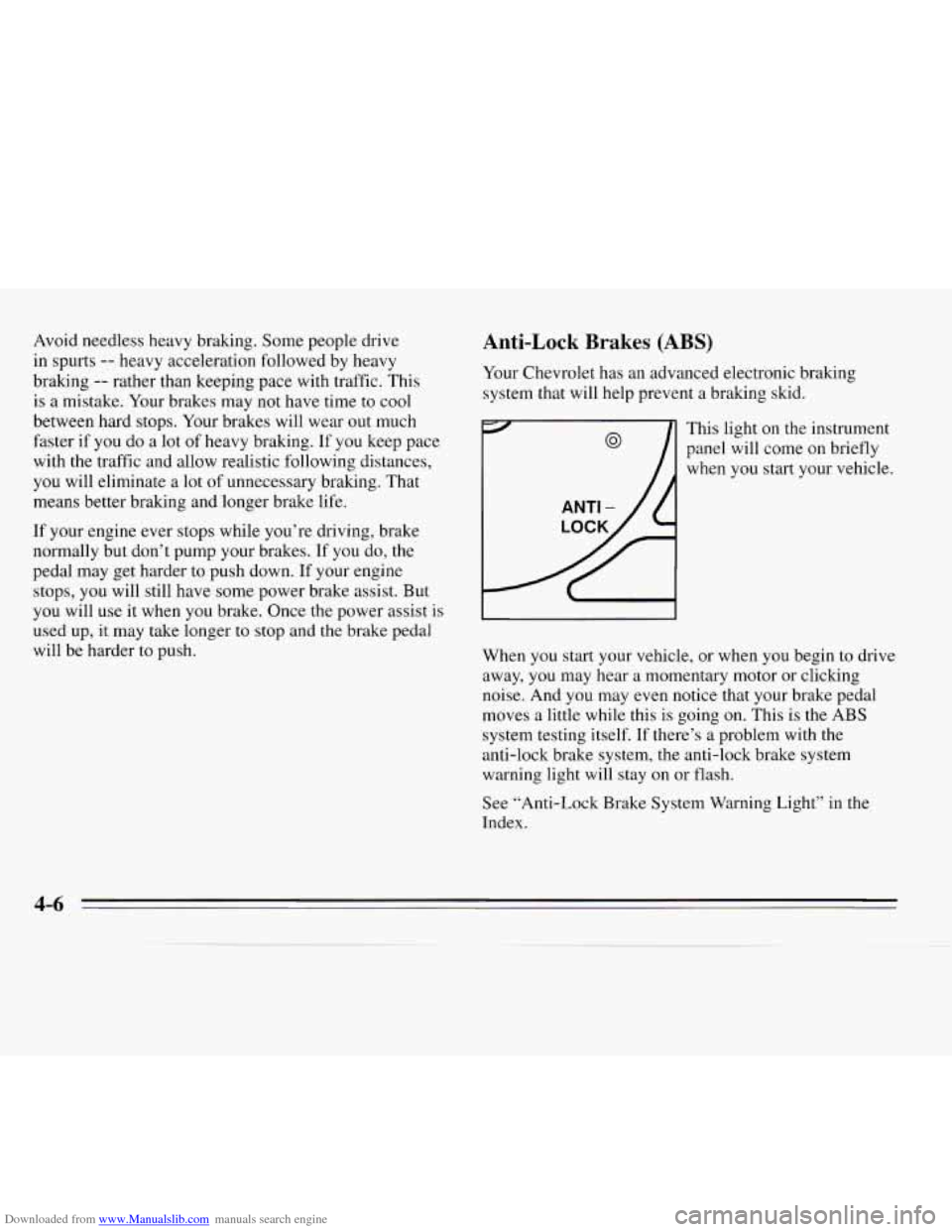
This light
panel will
when you on the
instrument
come on briefly
start your vehicle.
When you start your vehicle,
or when you begin to drive
away, you may hear a momentary motor or clicking
noise. And you may even notice that your brake pedal
moves a little while this
is going on. This is the ABS
system testing itself.
If there’s a problem with the
anti-lock brake system, the anti-lock brake system
warning light will stay on or flash.
See “Anti-Lock Brake System Warning Light’’ in the
Index.
4-6
Page 139 of 324
Downloaded from www.Manualslib.com manuals search engine Passing
The driver of a vehicle about to pass another on a
two-lane highway waits for just the right moment,
accelerates, moves around the vehicle ahead,
then goes
back into the right lane again. A simple maneuver?
Not necessarily! Passing another vehicle on a two-lane
highway is a potentially dangerous move, since the
passing vehicle occupies the same lane
as oncoming
traffic for several seconds. A miscalculation, an error in
judgment, or a brief surrender to frustration or anger can
suddenly put the passing driver face to face with the
worst of all traffic accidents
-- the head-on collision.
So here are some tips for passing:
0 “Drive ahead.” Look down the road, to the sides, and
to crossroads for situations that might affect your
passing patterns.
If you have any doubt whatsoever
about making a successful pass, wait for a better time.
0 Watch for traffic signs, pavement markings, and lines.
If
you can see a sign up ahead that might indicate a
turn or an intersection, delay your pass. A broken
center
line usually indicates it’s all right to pass
(providing the road ahead is clear). Never cross a solid
line on your side of the lane or a double solid line,
even if the road seems empty
of approaching traffic.
0 Do not get too close to the vehicle you want to pass
while you’re awaiting an opportunity. For one thing,
following too closely reduces your area
of vision,
especially if you’re following a larger vehicle. Also,
you won’t have adequate space if the vehicle ahead
suddenly slows or stops. Keep back a reasonable
distance.
0 When it looks like a chance to pass is coming up,
start to accelerate but stay
in the right lane and
don’t get too close. Time your move
so you will be
increasing speed
as the time comes to move into the
other lane. If the way
is clear to pass, you will have a
“running start” that more than makes up for the
distance you would lose by dropping back. And if
something happens to cause you to cancel your pass,
you need only slow down and drop back again and
wait for another opportunity.
If other cars are lined up to pass a slow vehicle, wait
your turn.
But take care that someone isn’t trying to
pass
you as you pull out to pass the slow vehicle.
Remember to glance over your shoulder and check
the blind spot.
4-11
Page 141 of 324
Downloaded from www.Manualslib.com manuals search engine A cornering skid and an acceleration skid are best
handled by easing your foot off the accelerator pedal.
If your vehicle starts to slide, ease your foot off
the
accelerator pedal and quickly steer the way you want the
vehicle to go. If you start steering quickly enough, your
vehicle may straighten out. Always be ready for a
second skid if it occurs.
Of course, traction is reduced when water, snow, ice,
gravel, or other material is on the road. For safety,
you’ll
want to slow down and adjust your driving to these
conditions. It is important to slow down on slippery
surfaces because stopping distance will be longer and
vehicle control more limited.
While driving on
a surface with reduced traction, try your
best to avoid sudden steering, acceleration, or braking
(including engine braking by shifting to a lower gear).
Any sudden changes could cause the tires to slide.
You
may not realize the surface is slippery until your vehicle
is skidding. Learn to recognize warning clues
-- such
as enough water, ice or packed snow on the road to make
a “mirrored surface”
-- and slow down when you
have any doubt.
Remember: Any anti-lock brake system
(ABS) helps
avoid only
the braking skid.
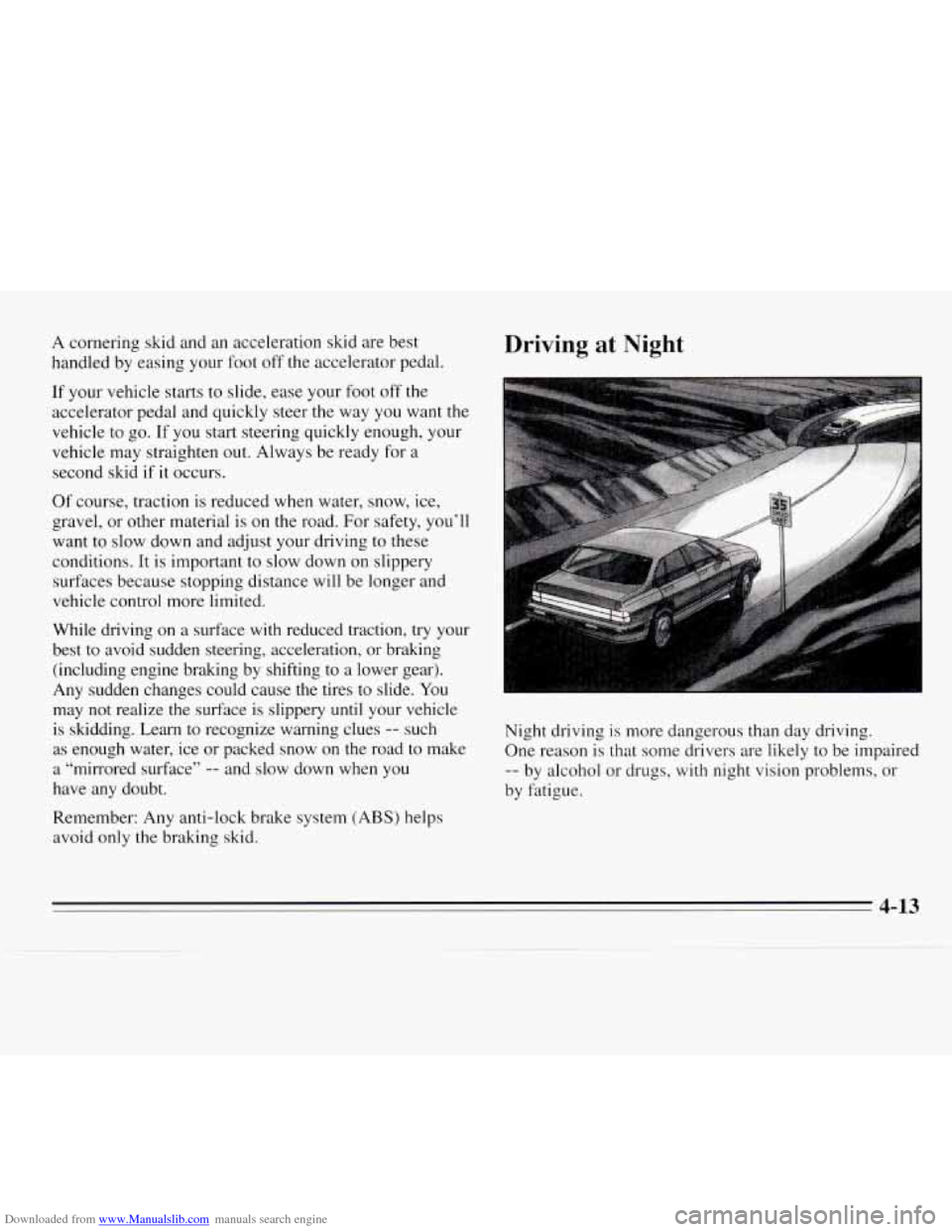
Driving at Night
F _+--
Night driving is more dangerous than day driving.
One reason is that some drivers are likely to be impaired
-- by alcohol or drugs, with night vision problems, or
by fatigue.
4-13