Downloaded from www.Manualslib.com manuals search engine Maintenance Schedule I1 I
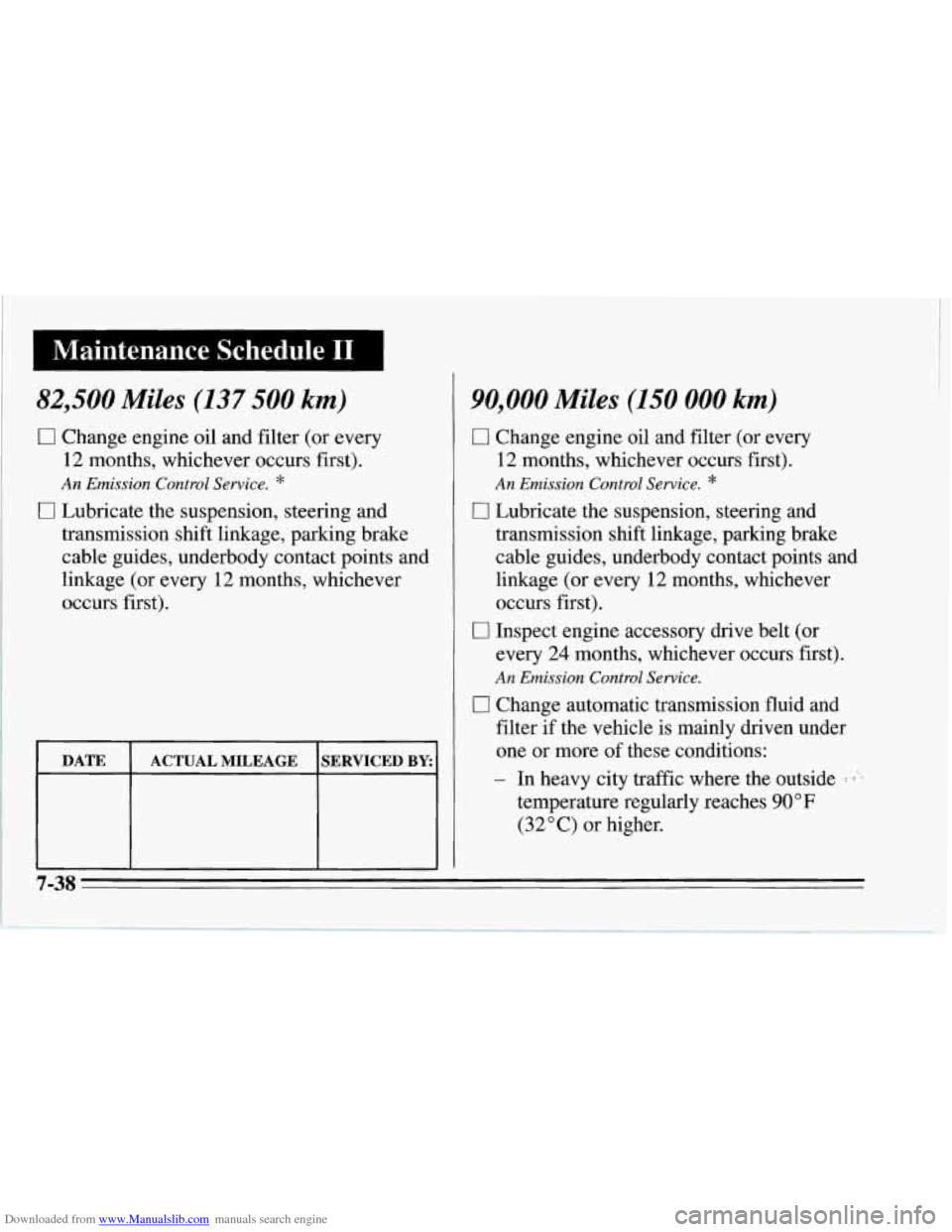
82,500 Miles (137 500 km)
0 Change engine oil and filter (or every
12 months, whichever occurs first).
17 Lubricate the suspension, steering and
An Emission Control Service. *
transmission shift linkage, parking brake
cable guides, underbody contact points and
linkage (or every
12 months, whichever
occurs first).
~~ ~
DATE SERVICED BY: ACTUAL MILEAGE
I
90,000 Miles (150 000 km)
0 Change engine oil and filter (or every
12 months, whichever occurs first).
An Emission Control Service.
0 Lubricate the suspension, steering and
*
transmission shift linkage, parking brake
cable guides, underbody contact points and
linkage (or every 12 months, whichever
occurs first).
every 24 months, whichever occurs first).
An Emission Control Service.
0 Change automatic transmission fluid and
filter
if the vehicle is mainly driven under
one or more
of these conditions:
- In heavy city traffic where the outside 2 q'.,
0 Inspect engine accessory drive belt (or
temperature regularly reaches
90 OF
(32 O C) or higher.
7-38
Downloaded from www.Manualslib.com manuals search engine I Maintenance Schedule I1
97,500 Miles (1 62 500 km)
0 Change engine oil and filter (or every
12 months, whichever occurs first).
0 Lubricate the suspension, steering and
An Emission Control Service. *
transmission shift linkage, parking brake
cable guides, underbody contact points and
linkage
(or every 12 months, whichever
occurs first).
100,000 Miles (166 000 km)
0 Replace spark plugs. An Emission Control
Service.
0 If you haven’t used your vehicle under
severe service conditions listed previously
and, therefore, haven’t changed your
automatic transmission fluid, change both
the fluid and filter.
DATE SERVICED BY ACTUAL MILEAGE
7-40
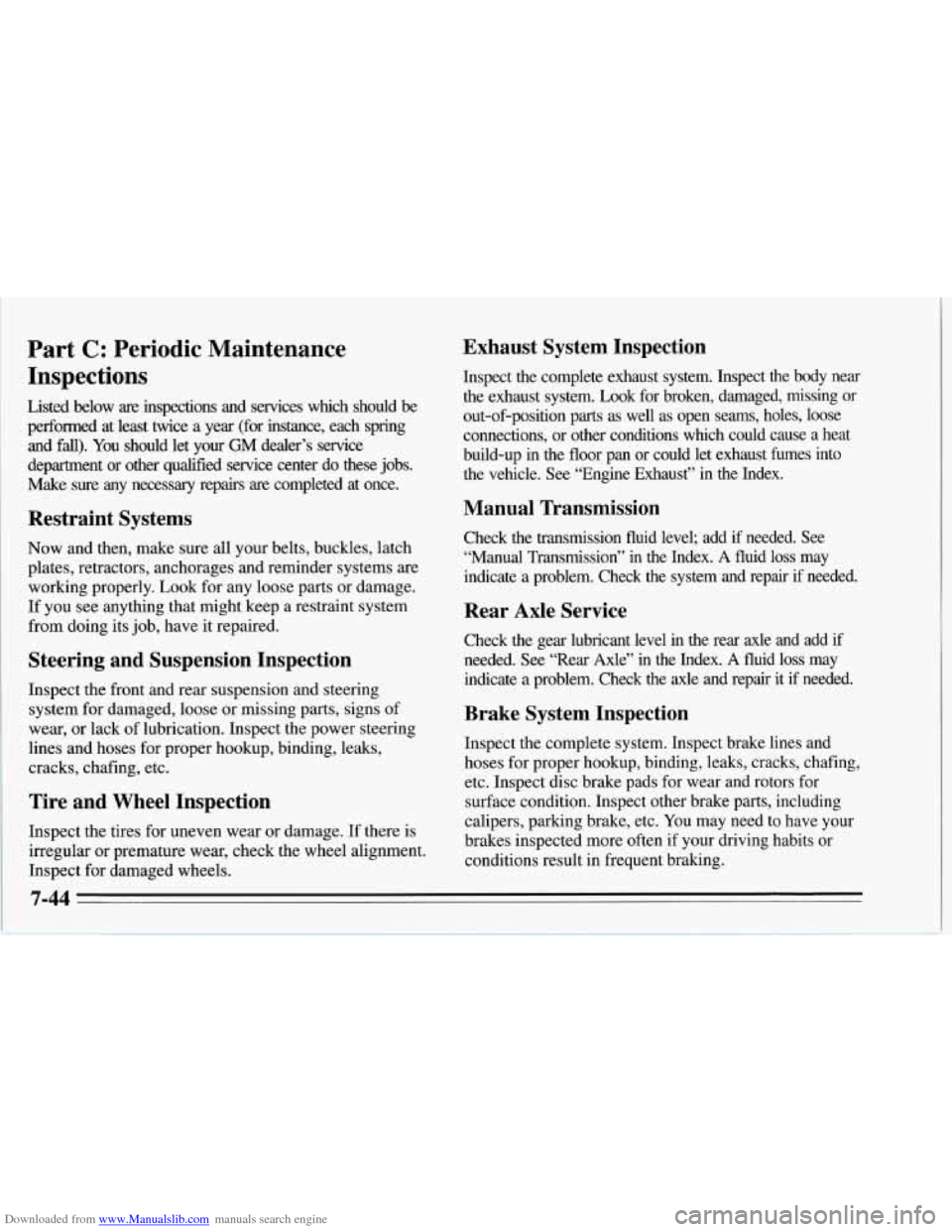
Downloaded from www.Manualslib.com manuals search engine Part C: Periodic Maintenance
Inspections
Listed below are inspections and services which should be
performed at least twice a year (for instance, each spring
and fall). You should let your GM dealer’s service
department or other qualified service center do these jobs.
Make sure any necessary repairs
are completed at once.
Restraint Systems
Now and then, make sure all your belts, buckles, latch
plates, retractors, anchorages and reminder systems are
working properly. Look for any loose parts or damage.
If you see anything that might keep a restraint system
from doing its job, have it repaired.
Steering and Suspension Inspection
Inspect the front and rear suspension and steering
system for damaged, loose or missing parts, signs of
wear,
or lack of lubrication. Inspect the power steering
lines and hoses for proper hookup, binding, leaks,
cracks, chafing, etc.
Tire and Wheel Inspection
Inspect the tires for uneven wear or damage. If there is
irregular or premature wear, check the wheel alignment.
Inspect for damaged wheels.
Exhaust System Inspection
Inspect the complete exhaust system. Inspect the body near
the exhaust system. Look for broken, damaged, missing or
out-of-position parts as well as open seams, holes, loose
connections, or other conditions which could cause a heat
build-up in the floor pan or could let exhaust fumes into
the vehicle. See “Engine Exhaust” in the Index.
Manual Transmission
Check the transmission fluid level; add if needed. See
“Manual Transmission” in the Index.
A fluid loss may
indicate a problem. Check the system and repair
if needed.
Rear Axle Service
Check the gear lubricant level in the rear axle and add if
needed. See “Rear Axle” in the Index. A fluid loss may
indicate a problem. Check the axle and repair it if needed.
Brake System Inspection
Inspect the complete system. Inspect brake lines and
hoses for proper hookup, binding, leaks, cracks, chafing,
etc. Inspect disc brake pads for wear and rotors for
surface condition. Inspect other brake parts, including
calipers, parking brake, etc.
You may need to have your
brakes inspected more often if your driving habits or
conditions result in frequent braking.
7-44