1995 CHEVROLET CAVALIER brake
[x] Cancel search: brakePage 244 of 340
Downloaded from www.Manualslib.com manuals search engine Wheel Replacement
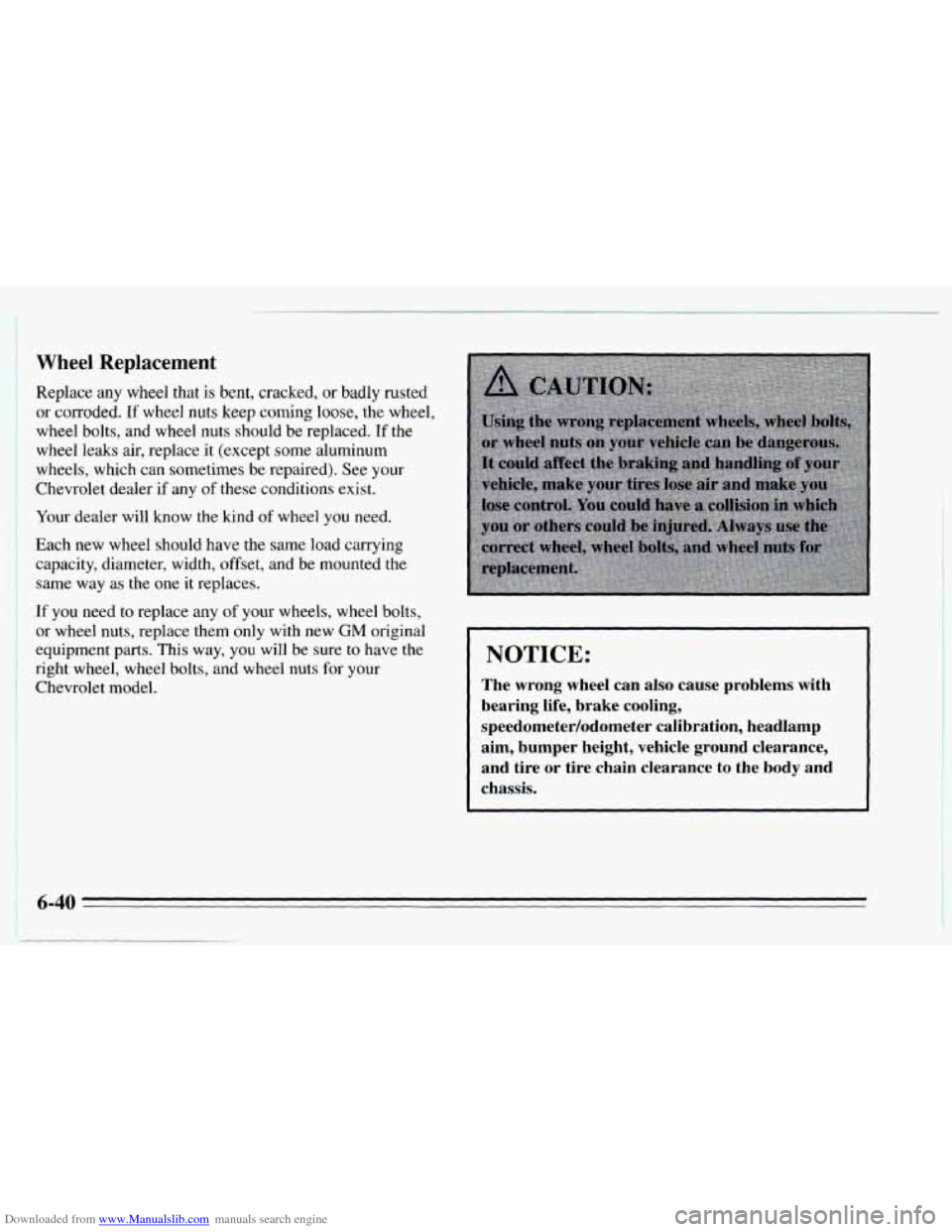
Replace any wheel that is bent, cracked, or badly rusted
i or corroded. If wheel nuts keep coming loose, the wheel,
' wheel bolts, and wheel nuts should be replaced. If the
wheel leaks air, replace
it (except some aluminum
I wheels, which can sometimes be repaired). See your
Chevrolet dealer if any
of these conditions exist.
Your dealer will know the kind
of wheel you need.
Each new wheel should have the same load carrying
~ capacity, diameter, width, offset, and be mounted the
same way as the
one it replaces.
~ If you need to replace any of your wheels, wheel bolts,
' or wheel nuts, replace them only with new GM original
i equipment parts. This way, you will be sure to have the
~ right wheel, wheel bolts, and wheel nuts for your
Chevrolet model. NOTICE:
The wrong wheel can also cause problems with
bearing life, brake cooling,
speedometer/odometer calibration, headlamp
aim, bumper height, vehicle ground clearance,
and tire or tire chain clearance to the body and
chassis.
Page 257 of 340
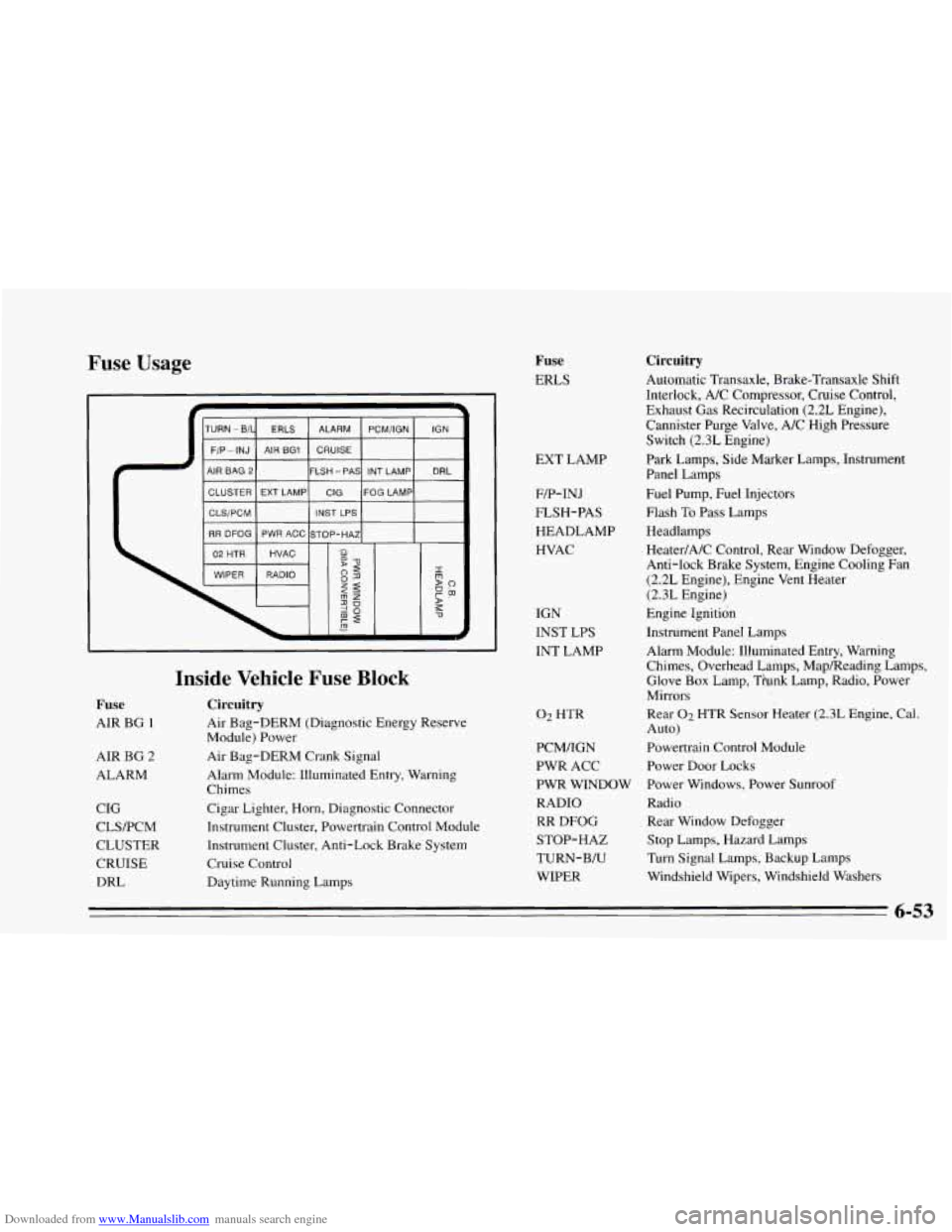
Downloaded from www.Manualslib.com manuals search engine Fuse Usage
S ALARM PCM/IGN IGN
Fuse
AIR BG 1
AIR BG 2
ALARM
CIG
CLSPCM
CLUSTER
CRUISE DRL
Inside Vehicle Fuse Block
Circuitry
Air Bag-DERM (Diagnostic Energy Reserve
Module) Power
Air Bag-DERM Crank Signal
Alarm Module: Illuminated Entry, Warning
Chimes
Cigar Lighter, Horn, Diagnostic Connector
Instrument Cluster, Powertrain Control Module
Instrument Cluster, Anti-Lock Brake System Cruise Control
Daytime Running Lamps IGN
INST
LPS
INT LAMP
Fuse
ERLS
EXT LAMP
F/P-INJ
FLSH-PAS
HEADLAMP
HVAC
Circuitry
Automatic Transaxle, Brake-Transaxle Shift
Interlock, A/C Compressor, Cruise Control,
Exhaust Gas Recirculation (2.2L Engine),
Cannister Purge Valve, A/C High Pressure
Switch (2.3L Engine)
Park Lamps, Side Marker Lamps, Instrument
Panel Lamps
Fuel Pump, Fuel Injectors
Flash To Pass Lamps
Headlamps
Heater/A/C Control, Rear Window Defogger,
Anti-lock Brake System, Engine Cooling Fan
(2.2L Engine), Engine Vent Heater
(2.3L Engine)
Engine Ignition
Instrument PaneiLamps
Alarm Module: 11,luminated Entry, Warning
Chimes, Overhead Lamps, MapReading Lamps,
Glove Box Lamp, Thnk Lamp, Radio, Power
Mirrors
Auto)
02 HTR Rear 02 HTR Sensor keater (2.3L Engine, Cal.
PCM/IGN Powertrain Control Module
PWR ACC Power
Door Locks
PWR WINDOW Power Windows, Power Sunroof
RADIO Radio
RR DFOG Rear Window Defogger
STOP-HAZ Stop Lamps, Hazard Lamps
TURN-B/U Turn
Signal Lamps, Backup Lamps
WIPER Windshield
Wipers, Windshield Washers
6-53
Page 258 of 340
Downloaded from www.Manualslib.com manuals search engine I 1
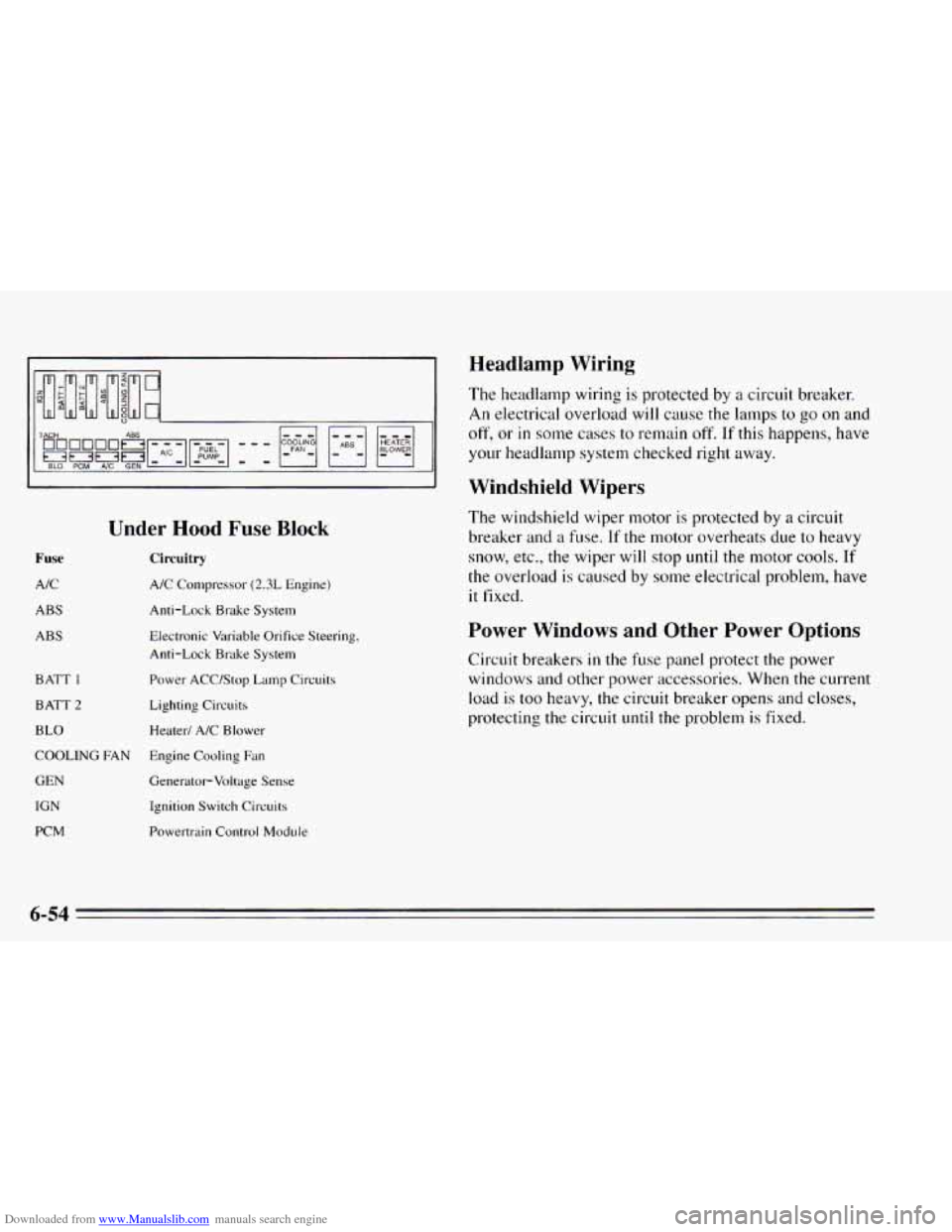
Under Hood Fuse Block
Fuse
AIC
ABS
ABS
BATT 1
BATT 2
BLO
COOLING FAN
GEN
IGN
PCM
Circuitry
A/C Compressor (2.3L Engine)
Anti-Lock Brake System
Electronic Variable Orifice Steering,
Anti-Lock Brake System
Power ACC/Stop
Lamp Circuits
Lighting Circuits
Heater/ A/C Blower
Engine Cooling Fan
Generator-Voltage Sense
Ignition Switch Circuits
Powertrain Control Module
Headlamp Wiring
The headlamp wiring is protected by a circuit breaker.
An electrical overload will cause the lamps to go on and
off, or
in some cases to remain off. If this happens, have
your headlamp system checked right away.
Windshield Wipers
The windshield wiper motor is protected by a circuit
breaker and a fuse.
If the motor overheats due to heavy
snow, etc., the wiper will stop until the motor cools. If
the overload is caused by some electrical problem, have
it fixed.
Power Windows and Other Power Options
Circuit breakers in the fuse panel protect the power
windows and other power accessories. When the current
load is too heavy, the circuit breaker
opens and closes,
protecting the circuit
until the problem is fixed.
Page 301 of 340
Downloaded from www.Manualslib.com manuals search engine At Least Once a Year
Key Lock Cylinders
Lubricate the key lock cylinders with the lubricant
specified
in Part D.
Body Lubrication
Lubricate all body door and rear compartment hinges.
Also lubricate all hinges and latches, including those for
the hood, glove box door, console door and any folding
seat hardware. Part
D tells you what to use. More
frequent lubrication may be required when exposed
to a
corrosive envlronment.
Starter Switch
1. Before you start, be sure you have enough room
around the vehicle.
2. Firmly apply both the parking brake (see “Parking
Brake”
in the Index if necessary) and the regular
brake.
NOTE:
Do not use the accelerator pedal, and be
ready
to turn off the engine immediately if it starts.
3. On automatic transaxle vehicles, try to start the
engine
in each gear. The starter should work only in
PARK (P) or NEUTRAL (N). If the starter works in
any other position, your vehicle needs service.
On manual transaxle vehicles, put the shift lever in
NEUTRAL
(N), push the clutch down halfway and
try to start the engine.
The starter should work only
when the clutch is pushed down all the way
to the
floor. If the starter works when the clutch isn’t
pushed
all the way down, your vehicle needs service.
7-39
Page 302 of 340
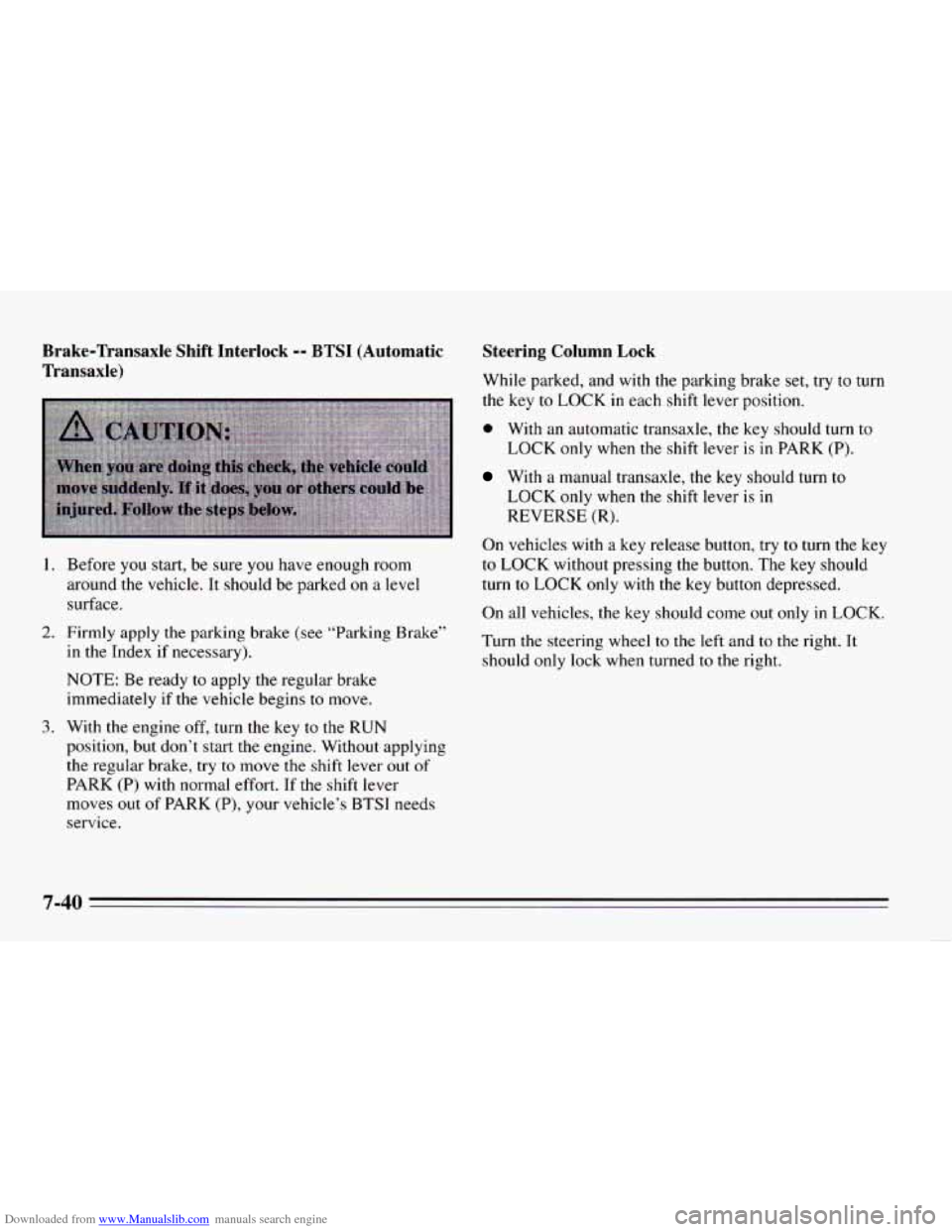
Downloaded from www.Manualslib.com manuals search engine Brake-Transaxle Shift Interlock -- BTSI (Automatic
Transaxle)
1.
2.
3.
Before you start, be sure you have enough room
around the vehicle. It should be parked
on a level
surface.
Firmly apply the parking brake (see “Parking Brake”
in the Index
if necessary).
NOTE: Be ready to apply the regular brake
immediately
if the vehicle begins to move.
With the engine off, turn the key to the RUN
position, but don’t start the engine. Without applying
the regular brake, try
to move the shift lever out of
PARK (P) with normal effort, If the shift lever
moves
out of PARK (P), your vehicle’s BTSI needs
service.
Steering Column Lock
While parked, and with the parking brake set, try to turn
the key to
LOCK in each shift lever position.
0 With an automatic transaxle, the key should turn to
LOCK only when the shift lever
is in PARK (P).
With a manual transaxle, the key should turn to
LOCK only when the shift lever is in
REVERSE
(R).
On vehicles with a key release button, try to turn the key
to LOCK without pressing the button. The key should
turn to
LOCK only with the key button depressed.
On all vehicles, the
key should come out only in LOCK.
Turn the steering wheel to
the left and to the right. It
should only lock when turned
to the right.
7-40
Page 303 of 340
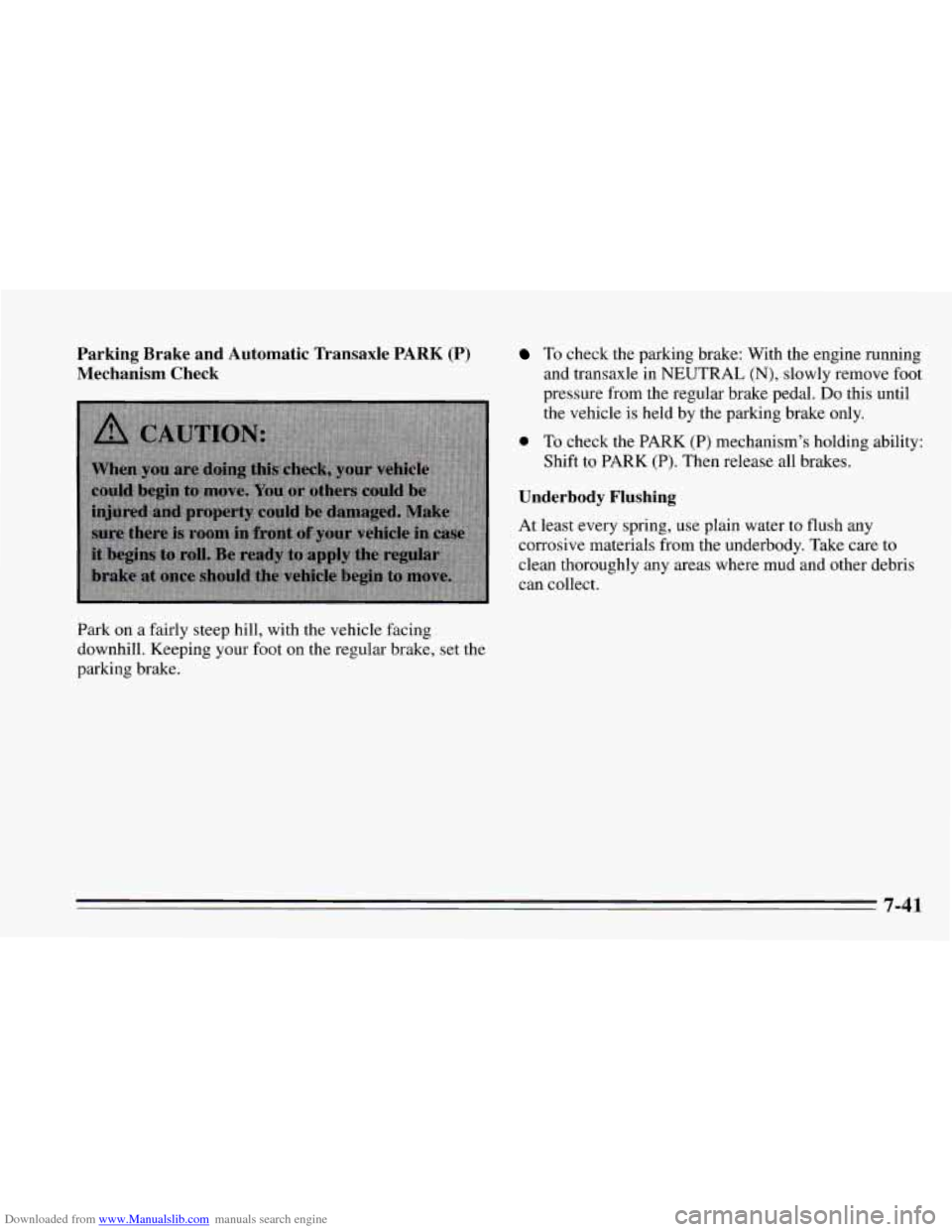
Downloaded from www.Manualslib.com manuals search engine Parking Brake and Automatic "ransaxle PARK (P)
Mechanism Check
Park on a fairly steep hill, with the vehicle facing
downhill. Keeping your foot on the regular brake, set the
parking brake.
To check the parking brake: With the engine running
and transaxle in NEUTRAL
(N), slowly remove foot
pressure from the regular brake pedal.
Do this until
the vehicle is held by the parking brake only.
0 To check the PARK (P) mechanism's holding ability:
Shift to
PARK (P). Then release all brakes.
Underbody Flushing
At least every spring, use plain water to flush any
corrosive materials from the underbody. Take care to
clean thoroughly any areas where mud and other debris
can collect.
7-41
Page 304 of 340
Downloaded from www.Manualslib.com manuals search engine Part C: Periodic Maintenance
Inspections
Listed below are inspections and services which should
be performed at least twice a year (for instance, each
spring and fall). You should let your
GM dealer’s
service department or other qualified service center do
these
jobs. Make sure any necessary repairs are
completed at once.
Restraint Systems
Now and then, make sure all your belts, buckles, latch
plates, retractors, anchorages and reminder systems are
working properly. Look for any loose parts or damage.
If you see anything that might keep a restraint system
from doing its job, have it repaired.
Steering, Suspension and Front-Wheel-Drive
Axle Boot and Seal Inspection
Inspect the front and rear suspension and steering
system for damaged, loose or missing parts, signs
of
wear, or lack of lubrication. Inspect the power steering
lines and hoses for proper hookup, binding, leaks,
cracks, chafing, etc. Clean and then inspect the drive
axle boot seals for damage, tears or leakage. Replace
seals if necessary.
Exhaust System Inspection
Inspect the complete exhaust system. Inspect the body near
the exhaust system.
Look for broken, damaged, missing or
out-of-position
parts as well as open seams, holes, loose
connections, or other conditions which could cause a heat
build-up in the floor pan or could let exhaust fumes into
the vehicle. See “Engine Exhaust”
in the Index.
Throttle Linkage Inspection
Inspect the throttle linkage for interference or binding, and f\
or
damaged or missing parts. Replace parts
as needed.
Accelerator and cruise control cables should not
be lubricated.
Manual Transaxle
Check the transaxle fluid level; add if needed. See
“Manual Transaxle” in the Index.
A fluid loss may
indicate a problem. Check the system and repair
if needed.
Brake System Inspection
Inspect the complete system. Inspect brake lines and
hoses for proper hookup, binding, leaks, cracks, chafing,
etc. Inspect disc brake pads for wear and rotors for
surface condition.
Also inspect drum brake linings for
wear and cracks. Inspect other brake parts, including
drums, wheel cylinders, calipers, parking brake, etc.
Check parking brake adjustment.
You may need to have
your brakes inspected more often if your driving habits
or conditions result in frequent braking.
7-42
~
Page 305 of 340
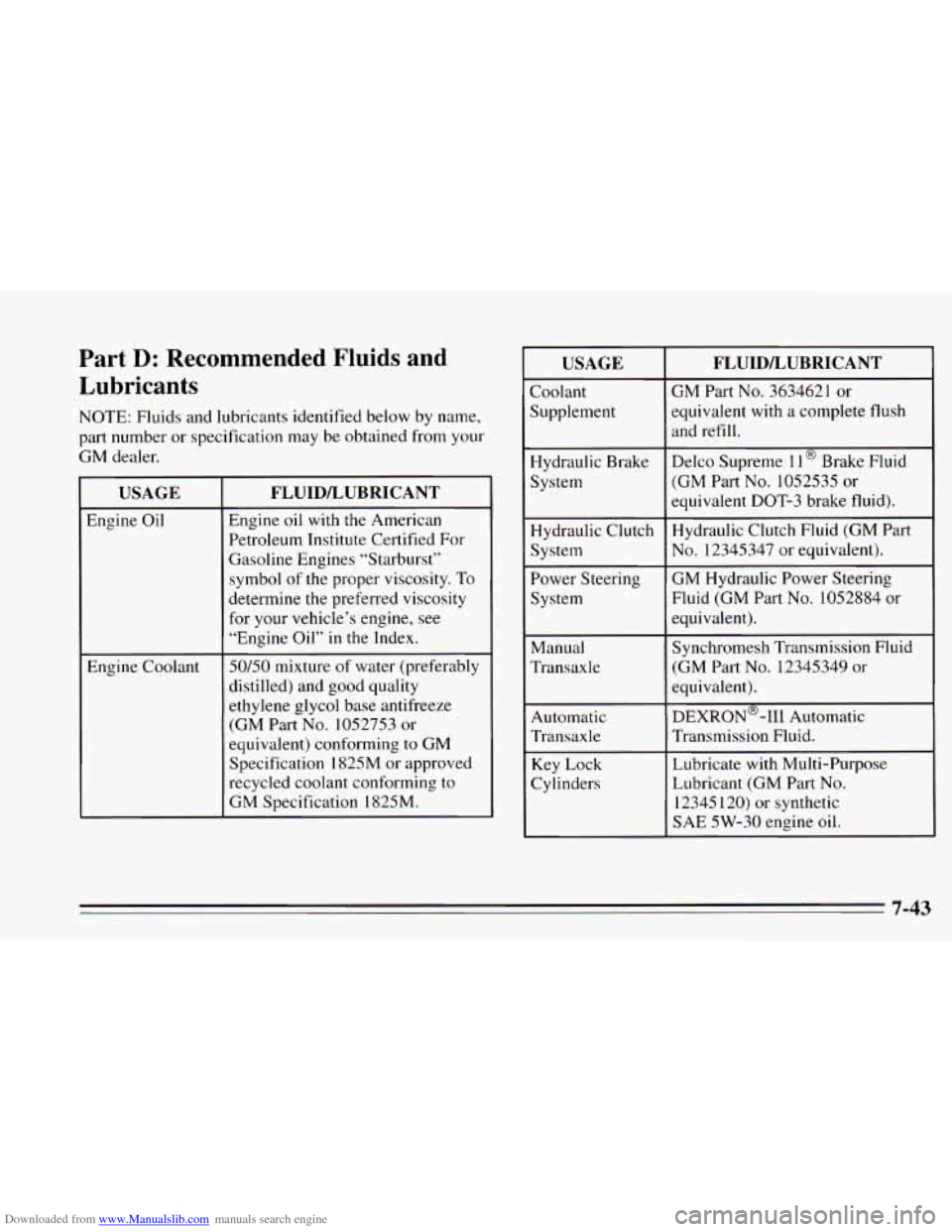
Downloaded from www.Manualslib.com manuals search engine Part D: Recommended Fluids and
Lubricants
NOTE: Fluids and lubricants identified below by name,
part number or specification may be obtained from your
GM dealer.
USAGE
Engine Oil
Engine Coolant
FLUIDLUBRICANT
Engine oil with the American
Petroleum Institute Certified For
Gasoline Engines “Starburst”
symbol
of the proper viscosity. To
determine
the preferred viscosity
for your vehicle’s engine, see
“Engine Oil”
in the Index.
50/50 mixture of water (preferably
distilled) and good quality
ethylene glycol base antifreeze
(GM Part No. 1052753 or
equivalent) conforming
to GM
Specification 1825M or approved
recycled coolant conforming to
GM Specification
1825M.
USAGE FLUIDLUBRICANT
Coolant
Supplement GM Part No. 3634621 or
(GM Part No. 1052535 or
System Delco Supreme
11 @ Brake
Fluid
Hydraulic Brake equivalent
with
a complete flush
Hydraulic Clutch Hydraulic Clutch Fluid (GM
Part
System No. 12345347 or equivalent).
Power Steering
GM Hydraulic Power Steering
System Fluid
(GM Part No. 1052884 or
equivalent). and refill.
~~
equivalent DOT-3 brake fluid).
Manual (GM Part
No. 12345349 or
Transaxle Synchromesh
Transmission Fluid
DEXRON@-111 Automatic
Automatic
Transaxle Transmission Fluid.
Key Lock Lubricate with Multi-Purpose
Cylinders Lubricant
(GM Part
No.
12345 120) or synthetic
SAE
5W-30 engine oil.
equivalent).
7-43